Dear Shareholders,
Over the past few months, we at Intelsat have reflected on the vision and excitement of the satellite communications pioneers of 1964 who launched our first geostationary communications satellite, Early Bird…had they any idea of the amazing communications solutions that their network would enable? With more than 50 satellites, teleports, 36,000 miles of fiber and services in nearly 200 countries and territories, I think they would be quite impressed with our network.
Yet, the more things change, the more they stay the same. Today Intelsat is home to a team of innovative engineers and business people who are every bit as excited about the future of satellite communications as those early visionaries. Our team comes to the table with a uniquely global perspective… envisioning communications infrastructures that connect governments, enterprises and individuals. Our enthusiasm is rooted in the knowledge that our services transform the quality of life, creating new business opportunities and fostering economic development in virtually every region and customer set we serve.
 Envision.
Given the significant changes in the global communications landscape, we are evolving our network architecture now to dramatically increase the amount of throughput available to our customers, and at the same time, significantly changing the cost per bit delivered. In a world where consuming more bits tomorrow has become inevitable, given our world of connected people and devices, our ability to deliver highly efficient broadband solutions will open new avenues of growth in media, fixed and wireless telecommunications, and mobility applications.
The new applications being powered by our satellite fleet truly capture the imagination…from Ultra High Definition (UHD) video and real-time geological data from an off-shore oil rig, to enabling the first wireless internet access to villages whose communications with the outside world have been limited to antiquated radio technology. Not to mention live television and broadband connectivity to your laptop or tablet during your next commercial flight.
Intelsat is currently in the design and build phase of a new series of high throughput satellites. Our next-generation Intelsat EpicNG satellite platform is designed to be fully integrated with our existing, flexible global network. EpicNG is backwards compatible. This means our customers—who have billions of dollars invested in their networking gear—will be able to use their existing network hardware to access our satellites, supporting a lower total cost of ownership for our solutions.
Open architecture also sets EpicNG apart from other high throughput projects. This feature will give our customers full control over the management of their network, allowing them to differentiate their services in their respective markets.
What do investors need to know about EpicNG? Beyond increasing our addressable market, EpicNG provides more throughput of capacity per dollar of capital invested. We will be able to gain efficiencies as we replace our existing satellites, allowing meaningful improvements in lifecycle capital expenditures.
The EpicNG satellites, as well as our other satellite programs, are on track. We currently have nine satellites being built under our capital investment plans, including six EpicNG satellites that will replace existing satellites nearing end of life. In addition, we continue to invest in our IntelsatOneSM terrestrial network, which complements our space network and allows our customers to access the global fleet from a single point on our fiber network.
Intelsat 30 is our next planned satellite launch, in the second half of 2014. In 2015, we plan to launch three satellites: Intelsat 29e, the first EpicNG satellite; Intelsat 31 and Intelsat 34. All of the satellites launching over the next two years have either Latin America or the North Atlantic as a focus, two of the globe’s most vibrant regions for satellite-enabled services.
 Connect.
In 2013, Intelsat entered a new phase in our corporate development. On April 18, 2013, we completed an initial public offering of our equity on the New York Stock Exchange, under the symbol “I”, as well as a preferred share offering listed as “IPRA”. As we have discussed over the course of 2013, we are focused on a two-phase plan to create equity value for our shareholders. In our first phase, we will use near-term cash flows to de-lever our balance sheet. In our second phase, we will leverage the inventory from our new satellites to generate organic growth.
With respect to this first phase, we are already delivering. In 2013 we reduced our total indebtedness by $617 million, applying our IPO proceeds, some insurance proceeds and free cash flow from operations to reduce debt, while also taking advantage of the favorable capital markets to refinance debt at reduced interest rates and extend our maturity profile.
Other highlights of our 2013 results included over $2.6 billion in revenue, $2.0 billion in Adjusted EBITDA*—an attractive 78% of revenue—and $116 million in free cash flow from operations*. Our results reflect some shifting dynamics in our Network Services business, particularly in Africa, and the effects of reduced U.S. government spending on our government business. Our top line also reflects a lack of growth capacity within our fleet, following the unfortunate launch failure of our Intelsat 27 satellite in February of 2013.
We remain optimistic about the long-term opportunities to serve the government sector and the Africa region, as both have increasing needs for cost-effective infrastructure that align to our capabilities. Even with the short-term challenges, we made significant progress in each of our customer sets in 2013, providing our customers with critical connectivity that completes their infrastructures and supports business growth.
Network Services
In 2013, our network services business revenue of $1.2 billion represented 46 percent of our revenue, growing 1 percent as compared to 2012.
In 2013, we advanced our strategy to provide broadband infrastructure for fixed and wireless telecommunications, private data enterprise networks and broadband mobility applications.
In 2014, our Network Services business is focused on bringing to market our next-generation Intelsat EpicNG satellite infrastructure. This includes working with existing customers to transition large fixed, wireless and mobile networks onto the more efficient, high-performance EpicNG platform. We believe that the higher performance will allow our customers to introduce new solutions and expand service territories—both of which result in broader addressable markets for our network.
The next significant growth catalyst for our Network Services business is the launch of the first EpicNG satellite, Intelsat 29e, in the latter half of 2015.
Media
In 2013, our media business revenue of $884 million represented 34 percent of our revenue, growing 3 percent as compared to 2012.
In 2013, our video neighborhood satellites maintained and grew share, where satellite capacity launched in 2011 and 2012 allowed us to grow with existing and new customers. Some of our most significant new and renewing contracts included capacity for media distribution in Africa, traditional broadcast in the United States, direct-to-home (DTH) platforms in Mexico, the Caribbean, Eastern Europe and Russia, and regional distribution for global media concerns expanding operations in Asia and Latin America.
In 2014, our media business is focused on growing our share of business with existing customers, while also supporting new DTH operators and content owners as they grow their businesses. For instance, in the latter half of 2014 we will launch the first of two satellites for which the Ku-band payload is fully dedicated to providing services for DIRECTV DTH television services in Latin America. Following in 2015, two additional satellites will build our video neighborhoods in the media-hungry Latin America region.
Government
Government comprised 19 percent of Intelsat’s total revenue for the year ended December 31, 2013, and at $486.1 million decreased 7 percent compared to the year ended December 31, 2012.
This disappointing result reflected reduced U.S. government spending due to budget pressures and reduction of force in Afghanistan, trends that will continue to affect our results in 2014.
In 2013, recognizing the coming shifts in U.S. Department of Defense spending levels, we sought to reposition our business, focusing on the provision of more complex, end-to-end solutions that include use of our ground network as well as our satellite capacity.
In 2014, with a new, lower expectation with respect to U.S. defense spending, we will continue to build on our end-to-end capabilities. We have been active in lobbying for U.S. government procurement reforms, and this will continue. Our government customers should be able to evaluate and procure commercial satellite capacity on a long-term basis. When our government customer in Australia did so, it generated an estimated AUS$150 million in projected savings over a 15 year period.
We remain optimistic about the opportunity to serve the U.S. government, because we know we can provide in-flight capabilities on time and on budget.
 |
Artist Rendering of an Intelsat EpicNG Satellite |
Tranform.
Over the longer term, our growth prospects are primarily driven by four elements, each of which is relevant to our three customer sets:
- The ever-increasing need for fixed and mobile broadband connectivity in a world consuming increasing amounts of content;
- The continued progression of formats that drive increasing need for bandwidth;
- The need for countries to provide basic and broadband connectivity to their respective citizens; and
- The evolution of our global network to include our next-generation platform, Intelsat EpicNG.
Intelsat has remained at the forefront of our industry for half of a century. In reflecting on this milestone, I ascribe our longevity to a number of attributes.
Our engineering and operational excellence represents the best the industry has to offer. Our performance in this regard is directed to the benefit of our customers. Our goal is for our infrastructure—the connectivities, throughput and regions served—to be a critical element in our customers’ ability to offer differentiated services to their end markets.
Our technical skills are complemented by our global/local perspective—designing and operating globally, while delivering locally. We are uniquely positioned to support the most global of customers. Just as importantly, we enable some of the most entrepreneurial communications services being delivered in some of the world’s most remote spots.
Ever important, though, is our willingness to challenge the status quo. We believe that the EpicNG platform will allow each of our customer sets to provide new services with better overall economics, and that this will create a new generation of satellite-enabled solutions.
We cannot be complacent in any aspect of our business: while Intelsat EpicNG has been received to great acclaim, we are already thinking about EpicNG 2.0 and the prospects of incorporating further innovations into our global platform.
When we push the bounds of our technology, working with our customers and our partners, we further advance the important—although sometimes invisible—role that satellite communications fills in the overall communications landscape.
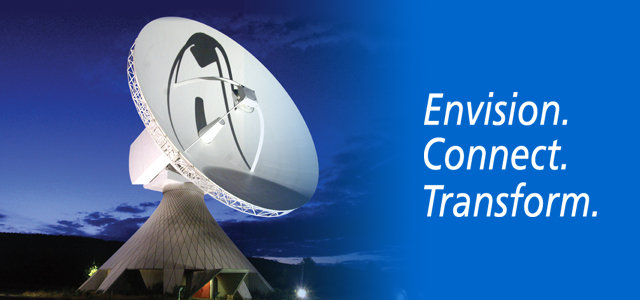 |
An Earth Station at Intelsat's Fuchsstadt, Germany Teleport |
Over the past 50 years, we have become adept at identifying the applications that will become mainstream—and in providing infrastructure that will allow the roll out on a global basis. Our role in supporting a wider deployment of wireless communications, the distribution of UHD and the support of in-flight broadband services are three recent examples.
Every day, we demonstrate our ability to partner closely with our customers, to understand where their opportunities lie and share best practices from the other regions we serve. We build the network that supports customer growth five or ten years out, a network that transforms businesses and the lives of users.
Over time, the expanded opportunities will transform our business as well, and accelerate our ability to deliver on our two-part investment thesis—paying down debt in the near-term, growing revenue in the long-term and thus creating increased value for Intelsat shareholders.
We sincerely thank you for your interest in our company.
David McGlade
Intelsat Chairman and Chief Executive Officer

*Adjusted EBITDA, free cash flow from operations, adjusted net income per diluted common share and related margins included in this release are non-GAAP financial measures. Please see the consolidated financial information in our filings with the SEC to reconcile these measures to comparable GAAP financial measures.