|
We had an extremely challenging fiscal 2002. We want you to understand the difficulties we’ve faced, and we want to discuss why we believe Two of our Company’s critical performance criteria are profitability and market share. In fiscal 2001, both of these measures deteriorated in the face of difficult market forces in both of our industries. Throughout the past two years we have concentrated on creating initiatives to manage through the industry problems and reposition ourselves for new opportunities. By the end of fiscal 2002, we were able to see that those initiatives were working. While we were unable to attain profitability, the operating loss was cut substantially during the year and market share improved in some of our most important market segments. We expect that fiscal 2003 will show further improvements in our financial results and will be another important step forward. We base this expectation on the benefits we have already realized through the belt-tightening and other corporate initiatives—including new product development—we have undertaken during the past two years.
In both RVs and Housing, Fleetwood made some mistakes that exacerbated the cyclical problems that occurred in the two industries. Our success in the 1990s gave rise to some complacency in our RV Group, and our Housing Group ended up with excess capacity—in both manufacturing and retail—due to temporarily inflated sales caused by the lack of restraint in manufactured housing finance. While industry RV revenues were hitting an all-time high in 1999, we were also achieving record sales, but losing market share. The share loss was a symptom of deeper problems. We simply had become too conservative in our development of products. The result was a lack of innovation and a failure to keep pace with new designs and trends. One example is our delay in offering slide-out models. Our issues were compounded when industry sales dropped off precipitously—in the spring of 2000 for motor homes and in the fall of 2000 for travel trailers. Our dealer inventories and finished goods were at an all-time high with products that much of the market considered to be outdated. Obviously, working through that inventory was expensive and this, in combination with other factors, caused us to experience a series of quarterly losses. Meanwhile, the late ’90s also foreshadowed problems in the housing industry, even in the midst of a boom. Driven by relaxed underwriting standards, industry unit shipments hit a 25-year high in calendar 1998. Our competitors sought vertical integration and began acquiring retailers. Because of the high quality of our independent retail network, a significant portion of the network was purchased or had received offers. In response, we decided to enter the retail side of the business and we established Fleetwood Retail Corp. (FRC). Acquisition prices for established retailers skyrocketed and, in hindsight, we grew FRC too quickly and too expensively, both through acquisition and the development of new stores. In 2000, the manufactured housing industry was just beginning to suffer from the excesses on the part of every participant—the lenders that had fueled the expansion with loose underwriting standards; the manufacturers and retailers who overbuilt and oversold; and even the retail customers who took out loans for homes beyond their financial means. As a result, the industry is still enduring the consequences—repossessed housing competing with new products, and lenders exiting the market under the burden of loans made in the frenzy of the late ’90s. Perhaps the hardest to quantify is the lingering impact on the industry’s reputation, which makes it more difficult to attract new lenders into the business and has impeded some of the strides that were being made toward greater acceptance of our products alongside site-built homes. Fiscal 2001 was a belt-tightening period for us. We continued some of the cost-cutting moves we had begun in the prior year in Housing, and started applying the same disciplines in RVs. We reduced capacity and inventory; we cut our workforce by a third; we looked for ways to restructure our organization to make it more efficient; and we made changes to our purchasing process to take greater advantage of our Company’s size. At the same time, we were making investments that have already paid off or will payoff over the long haul, such as our product development process, new customer relationship management tools, improved information technology and centralized service centers.
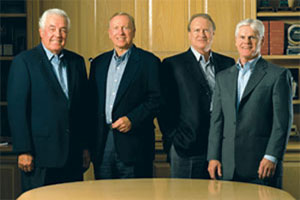
Fiscal 2002 brought rebuilding. As we look at the results of that effort today, we note the successful introduction of new products into the RV marketplace, for which we were rewarded in the first quarter of calendar 2002 by once again taking the market leadership position in Class A motor homes. The housing industry has not rebounded yet, but the manufacturing side of our Housing Group managed to stay profitable throughout the downturn until the final quarter of fiscal 2002. By then, however, it had become apparent that the recovery in the manufactured housing industry had been further delayed by yet another round of contractions in lending capacity. Appropriately, this development led us to book further non-cash adjustments for asset impairments and reserves, which had a punishing impact on our reported earnings for the quarter and for the year. Analyst and manufacturer predictions for manufactured housing industry shipments in calendar 2002 have been revised consistently downward as the year has progressed. Still, we believe that we are sized just about right for the market going forward and, more importantly, that our Housing Group is the best in the business. Unfortunately, as much as market uncertainty has affected our profitability on the manufacturing side, it has had an even more profound effect on FRC. We believed that we would be appropriately sized at 150 stores. We are now down to 137 stores and are narrowing the loss, but can’t predict with certainty when the retail operation will become profitable. In addition to the disappointing operating results, the difficult manufactured housing market has also precipitated some large non-cash accounting charges. We adopted the new Statement of Financial Accounting Standards No. 142 during the year, which requires that we estimate the fair value of any business segment that has goodwill and record any impairment, instead of amortizing goodwill. As a result, we recorded a goodwill write-off at FRC of $80.6 million, which reflects the size to which we rapidly grew FRC, the costs we incurred at that time and the subsequent deterioration of industry conditions. We also recorded inventory write-downs and restructuring and impairment costs in the retail division totaling $18.4 million for the year. So, where does this leave us in terms of our financial health? Well, despite all these industry-wide problems, and despite our own mistakes in past years, we achieved positive cash flows from operations of $34.5 million during fiscal 2002. We also completed a number of key financial initiatives during the year that greatly strengthened our balance sheet and provided the wherewithal to continue investments in our future. We arranged a loan facility (recently restructured) with a group of lenders, led by Bank of America, which now provides us with a $190 million credit line. We completed a $20 million private placement of Common stock in October 2001 and we sold $150 million worth of new convertible trust preferred securities (CTPS) in December 2001. Then in January 2002, we successfully exchanged $38 million in face value of new CTPS for $86 million in face value of our old CTPS. We chose to conserve cash by deferring the distributions on the remaining old CTPS and by discontinuing payment of dividends on our Common stock. Meanwhile, we have also chosen to pay the distributions on the two new issues of CTPS in Common stock rather than in cash. The sum of all of these actions leaves us in a strong financial position. We are not by any means complacent about our financial health. We are, however, confident that our balance sheet now provides a solid foundation for Fleetwood’s future. There were major changes in top management during fiscal 2002, as Nelson Potter resigned as president and chief executive officer and Glenn Kummer retired as chairman of the board. David Engelman and Tom Pitcher stepped in from the Company’s Board to take these respective positions on an interim basis and have worked closely with Fleetwood’s senior management to implement the Company’s initiatives. The Board has appointed a Search Committee that is actively engaged in the process to select a new CEO and president to lead Fleetwood into the future. Chuck Wilkinson, who had served as senior vice president–Housing Group, was asked to assume the additional responsibility for operations of the RV Group in September 2001. He was named executive vice president–operations at that time and enjoys the full confidence of the Board. He is working with the managers of both the RV and Housing groups to push toward product innovation, recaptured market share and profitability. His new role has had the added benefit of allowing for greater synergies between the two groups—most notably in purchasing activities. Boyd Plowman, chief financial officer, was promoted to executive vice president in December 2001. Boyd was the architect of the transactions that resulted in substantial improvements to our balance sheet. Forrest Theobald, a longtime associate who, in early 2001, accepted the challenge of a promotion to general counsel and corporate secretary, was concurrently appointed senior vice president. Chuck, Boyd and Forrest are examples of longtime associates steeped in industry knowledge and Company history, who are nonetheless driving change to bring about a world-class Fleetwood. John Moore moved into the position of vice president–human resources and is leading a bench-building initiative to ensure that we have outstanding professionals prepared to be promoted into management as positions become available. In fact, we are excited by the growing number of younger executives and managers who are starting to make their mark on the Company.
We’re looking toward the future, and we’re pursuing new initiatives with vigor. It has been a difficult couple of years for all of us, but the actions that have been taken and the moves that we’re planning are positive and promising. We fully expect our new CEO to continue the implementation of these programs. One of our most important financial initiatives going forward is the prudent development of our own manufactured housing retail financing capability through our wholly owned subsidiary, HomeOne Credit Corp. On the RV side, we have been very pleased with the response to our new diesel models and our refreshed gasoline products. Our new travel trailers have been well received, and we have more enhancements coming out this fall and beyond. As was stated in last year’s annual report, this is a fun business—and it’s most exciting and rewarding when we’re filling market demand with innovative products and features. That is the ultimate key to our growth in this group, and we won’t take our eye off that ball again. And, of course, we will continue to build quality and offer terrific customer service any time it’s needed. It all adds up to providing value. That’s what we’ve prided ourselves on doing for more than 50 years, and it’s what brought our Company to the top of both of our industries. Wherever we might have lost sight of that goal, we have refocused. Most importantly, we believe that providing value to our customers will result in providing value to our shareholders. One last word about a topic that is on everyone’s mind in corporate America these days, and that is “good corporate governance.” You have our personal commitment that we, along with our Board of Directors, take our governance responsibilities very seriously—so much so that we view this commitment to be a cornerstone in all of our improvement initiatives. The Board has been extremely involved and supportive during this time of transition, and we want to express our appreciation to them. We especially thank Walter Beran, who is retiring from the Board after nine years of invaluable service. We also want to take this opportunity to thank our associates, dealers and suppliers, who have been with us on the road back to preeminence. We appreciate their support, and that of our shareholders, in fulfilling our commitment to building Fleetwood into a world-class company. And we are looking forward—straight forward—to better days ahead.
| |||