|
|||||||||
Deep water — depths greater than 1,500 feet — is the arena with the greatest number of large untapped reservoirs and greatest revenue growth potential for Halliburton. As oil and gas companies move into ever-deeper water to meet the demand for energy, they are predicted to spend about $84 billion in deepwater development over the next five years. Most of this spending will be on multibillion-dollar projects, where the preferred contractors will be large integrated service companies who are able to supply the necessary combination of key technologies and project management skills. Halliburton aims to be the uniquely qualified contractor for such developments. Deepwater development has special challenges. Reservoirs in a field tend to be widely dispersed, and for cost reasons must be developed with relatively few wells requiring minimal intervention. This is why Halliburton’s deepwater flagship includes many of the advanced technologies already mentioned. Real-time reservoir description, Enventure expandable tubing, Anaconda, multilaterals, advanced stimulation and SmartWells are all key enablers for the deepwater environment. In fact, it is the combined excellence of the other four flagships that make Halliburton a leader in pursuing deepwater work. 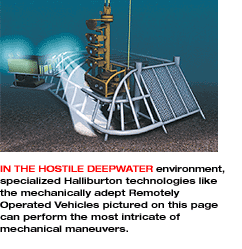
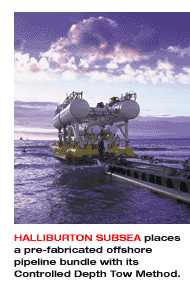
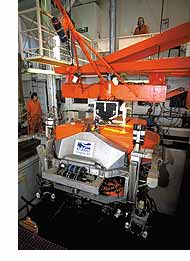
In addition, the company has introduced specialized technologies for deepwater work in recent years, such as faster Remotely Operated Vehicles (ROVs) with greater mechanical abilities; flexible riser systems made from carbon fiber composites that lift the hydrocarbons to the surface and reduce the need for surface equipment; and smart tie-backs and smart control buoys that can make remote-controlled adjustments in producing fields spread over a wide area. All of these areas will see further development in coming years. Together they are making possible deepwater work that was out of reach just a few years ago. The year’s most promising deepwater breakthrough comes from the field of flow assurance — technologies that allow improved uninterrupted flow of hydrocarbons over time. Specifically, sending crude oil through long tie-backs in cold, deep water creates the danger of wax and gas hydrates forming deposits. This in turn requires expensive intervention to restore the flow. Wax Eater,™ Halliburton’s new system currently being field tested, is installed at the wellhead and breaks up the wax, removing it from the mixture. Wax Eater will eliminate the need for far more expensive alternative treatments, and enable the extended tie-backs that are critical to developing fields of smaller, widely dispersed reservoirs. In addition to specific technologies, success in this arena also depends on the ability to treat deepwater projects with a total systems approach, matching all the surface and subsurface components, while reducing cycle times, capital expenditures and operating expenditures. These capabilities are based on Halliburton’s innovative products and services, as well as its roster of skilled project managers, who have proven their worth in managing huge development and fabrication jobs all over the world. |
|||||||||
|
|||||||||
|
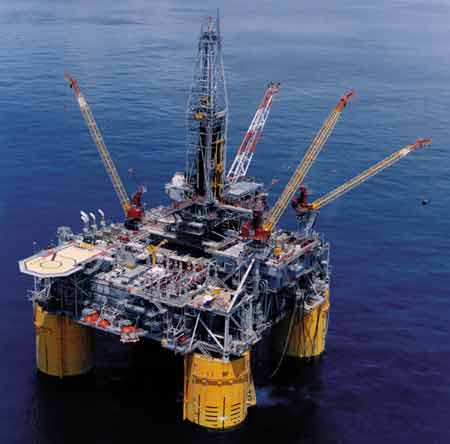
Recent projects include Exxon Diana in the Gulf of Mexico, which involved fabricating a record-sized production platform and executing horizontal well completions; and the $2 billion Terra Nova field offshore Newfoundland, which included building one of the largest floating, production, storage and offloading (FPSO) vessels built to date, plus drilling and completing six complex subsea wells. This year saw the start of engineering, procurement, installation and construction (EPIC) work for a $300 million offshore oil and gas facility in Nigeria for Shell, including fabrication of a mooring facility and the largest FPSO built in the last five years. All of these projects require the global resources and innovative project management that few organizations besides Halliburton can offer. By far the biggest and most important deepwater development in the world today is the $2.5 billion Petrobras Barracuda/Caratinga project offshore Brazil. This EPIC contract is believed to be the largest ever awarded to a single contractor.
This project began with a breakthrough in project finance, as foreign banks and trading companies came together to form a special purpose company, Barracuda & Caratinga Leasing Company B.V. Halliburton is lending its project management and project finance expertise as the EPIC contractor to facilitate the financing arrangements for Petrobras. The size and scope of the project are also precedent-setting. The development of these two fields, which together have reserves estimated at 1.2 billion barrels, will take from late 2000 to the spring of 2004. Halliburton’s work includes subsurface well construction and completion, subsea manufacturing and installation, and floating production. The subsurface work will be on 51 wells. Virtually every Halliburton product and service line will take part, with Sperry-Sun drilling services and the completions group performing the lion’s share of the work. The first two wells were completed in January, 2001. The subsea work will involve the manufacture of 28,000 tons of flowlines by Halliburton’s Wellstream unit. Halliburton Subsea will install the risers, flowlines, umbilicals and seabed fixtures in water depths from 2,500 feet to 4,000 feet. Halliburton will supply two FPSOs, which together will produce 300,000 barrels per day. One will be converted in Brazil’s Rio State Shipyards. Detail design for the topsides, along with the fabrication and installation of 100,000 tons of process and utility modules, will also be done by Brazilian contractors. This high degree of local content, under Halliburton’s project management, will fulfill one of Rio State’s important objectives — the growth and revitalization of key sectors of its economy. Halliburton will also hook up the wells to the FPSOs, commission both vessels and subsea systems, and operate the field for the first three months. Barracuda/Caratinga is the first deepwater mega-project to be managed by one company under one EPIC contract. It solves a crucial development and energy supply problem for the customer, Brazil’s national oil company, and serves as a demonstration of Halliburton’s end-to-end project management and execution capability in deep water. 
|
|||||||||
Halliburton | Energy Services | Technology Flagships | Engineering & Construction | Financial Information | Corporate Information | Board of Directors | Printable Report © 2001 Halliburton Company |
|||||||||