|
|||
|
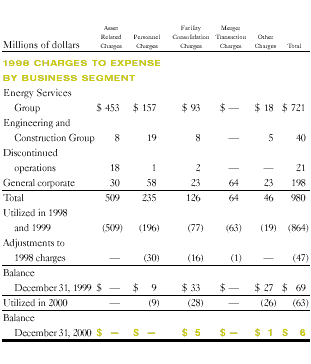
NOTE 12. SPECIAL CHARGES AND CREDITS The table below summarizes the 1998 pretax expenses
for special charges and the accrued amounts utilized and adjusted
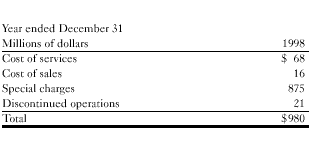
through December 31, 2000. Our 1998 results of operations reflect special charges totaling $980 million to provide for costs associated with the Dresser Industries, Inc. merger and industry downturn due to declining oil and gas prices. These charges were reflected in the following captions of the consolidated statements of income:
Most restructuring activities accrued for in the 1998 special charges were completed and expended by the end of 1999. We utilized $63 million in 2000 for sales of facilities and other actions that were initiated in 1999 but were concluded in 2000. From inception through December 31, 2000, we used $368 million in cash for items associated with the 1998 special charges. The unutilized special charge reserve balance at December 31, 2000 is expected to result in future cash outlays of $6 million. At December 31, 2000, no adjustments or reversals to the remaining accrued special charges are planned. During the second quarter of 1999, we reversed $47 million of the 1998 special charge based on our reassessment of total costs to be incurred to complete the actions covered in our special charges. The components of the reversal are as follows:
Asset
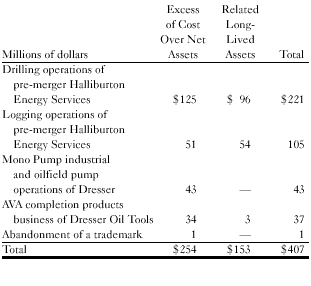
Related Charges As a result of the merger, Halliburton Company’s and Dresser Industries, Inc.’s completion products operations and formation evaluation businesses have been combined. Excluded is Halliburton’s logging-while-drilling business and a portion of our measurement-while-drilling business which were required to be disposed of in connection with the United States Department of Justice consent decree. See Note 2. We recorded impairments based upon anticipated future cash flows in accordance with Statement of Financial Accounting Standards No. 121. This was based on the change in strategic direction, the outlook for the industry, the decision to standardize equipment product offerings and the expected loss on the disposition of the logging-while-drilling business. The following table summarizes the resulting write-downs of excess of cost over net assets acquired and long-lived assets associated with:
As discussed below, the merger caused management to reevaluate the realizability of excess cost over net assets acquired and related long-lived assets of these product service lines. Each business was considered to be impaired under SFAS No. 121 guidance. The overall market assumptions on which the impairment computations were made assumed that 1999 calendar year drilling activity as measured by worldwide rig count would be 1,900 rigs which was up from the 1,700 level in the third quarter of 1998. Rig count for calendar year 2000 and beyond was assumed to increase about 3% per year based upon estimated long-term growth in worldwide demand for oil and gas. These assumptions were based on market data available at the time of the merger. In addition to these assumptions, management utilized a 10-year timeframe for future projected cash flows, a discount rate that approximates its average cost of capital, and specific assumptions for the future performance of each product service line. The most significant assumptions are discussed below. In each case, these analyses represented management’s best estimate of future results for these product service lines. Drilling operations of pre-merger Halliburton Energy Services. Our pre-merger drilling business consisted of logging-while-drilling, measurement-while-drilling and directional drilling services. The majority of the pre-merger logging-while-drilling business and a portion of the pre-merger measurement-while-drilling business were required to be sold under the United States Department of Justice consent decree. We have integrated the remaining drilling business with the Sperry-Sun operations of Dresser. Our strategy focuses generally on operating under the Sperry-Sun name and using Sperry-Sun’s superior technology, tools and industry reputation. Our remaining pre-merger drilling assets and technology are being de-emphasized as they wear out or become obsolete. These tools will not be replaced resulting in significant decreases in future cash flows and an impairment of the excess of cost over net assets and related long-lived assets. Significant forecast assumptions included a revenue decline in the remaining pre-merger drilling business due to the measurement-while-drilling sale in the first year. Related revenue and operating income over the following 10 years were projected to decline due to reduced business opportunities resulting from our shift in focus toward Sperry-Sun’s tools and technologies. We determined that there was a $125 million impairment of excess of cost over net assets acquired. In addition, related long-lived asset impairments consisted of $61 million of property and equipment and $14 million of related spare parts, the value of which was estimated using the “held for use” model during the forecast period. An impairment of $3 million was recorded related to property and equipment and $18 million of spare parts using the “held for sale” model sold in accordance with the consent decree with the United States Department of Justice. See Note 2. Logging operations of pre-merger Halliburton Energy Services. The merger of Halliburton Company and Dresser Industries, Inc. enabled the acceleration of a formation evaluation strategy. This strategy takes advantage of Sperry-Sun’s logging-while-drilling competitive position and reputation for reliability combined with our Magnetic Resonance Imaging Logging (MRIL®) technology acquired with the NUMAR acquisition in 1997. Prior to the merger, we were focused on growing the traditional logging business while working toward development of new systems to maximize the MRIL® technology. The merger allowed us to implement the new strategy and place the traditional logging business in a sustaining mode. This change in focus and strategy resulted in a shift of operating cash flows away from our traditional logging business. This created an impairment of the excess of cost over net assets and related long-lived assets related to our logging business. Significant forecast assumptions included revenues decreasing slowly over the 10-year period, reflecting the decline in the traditional logging markets. Operating income initially was forecasted to increase due to cost cutting activity, and then decline as revenue decreased due to the significant fixed costs in this product service line. We calculated $51 million impairment of the excess of cost over net assets acquired. In addition, related long-lived asset impairments consisted of $22 million of property and equipment and $32 million of spare parts which management estimated using the "held for use" model during the forecast period. Mono Pump operations of pre-merger Dresser. The amount of the impairment is $43 million, all of which represents excess of cost over net assets acquired associated with the business. Our strategy for Mono Pump is to focus primarily on the oilfield business including manufacturing power sections for drilling motors. The prior strategy included emphasis on non-oilfield related applications of their pumping technology and the majority of Mono Pump revenues were related to non-oilfield sales. The change in strategy will result in reduced future cash flows resulting in an impairment of the excess of costs over net assets acquired. Significant forecast assumptions included stable revenue for several years and then slowly declining due to decreasing emphasis of industrial market applications. Operating income was forecasted to initially be even with current levels but then decline over the period as revenues declined and fixed costs per unit increased. AVA operations of Dresser Oil Tools. The amount of the impairment is $37 million of which $34 million relates to excess of costs over net assets acquired. The plan for Dresser’s AVA business line (which supplies subsurface safety valves and other completion equipment) was to rationalize product lines which overlap with our pre-existing completion equipment business line. The vast majority of the AVA product lines were de-emphasized except for supporting the installed base of AVA equipment and specific special order requests from customers. AVA products were generally aimed at the high-end custom completion products market. Our strategy was to focus on standardized high-end products based upon pre-merger Halliburton designs thus reducing future AVA cash flows and impairing its assets and related excess of costs over net assets acquired. Additional asset related charges. Additional asset related charges include:
Asset related charges have been reflected as direct reductions of the associated asset balances. Personnel
Charges Facility
Consolidation Charges
As of December 31, 2000, we have substantially completed the work to vacate, sell or close the service, manufacturing and administrative facilities related to the 1998 special charge. The majority of the sold, returned or vacated properties are located in North America and have been eliminated from the Energy Services Group. The remaining expenditures will be made as the remaining properties are vacated and sold. Merger
Transaction Charges Other
Charges
|