 |
  |
 | |
|
Migraine Frovatriptan 2002 has witnessed a number of important milestones in the Company's evolution as a product company, with the approval of frovatriptan in 15 European Union countries, followed by its launch as an acute treatment for migraine both in the United States and in its first European country, Germany. In the United States, frovatriptan had achieved a market share greater than 2% for the triptan class of drugs nine months following launch, according to prescription data generated by the market research organisation IMS Health. In Germany, after 20 weeks on the market, frovatriptan's market share of units sold had increased to 5.2% of the triptan class, also based on IMS Health data. In the United States the product is being co-promoted by Elan and UCB under the trademark Frova™, with sales forces detailing to neurologists and primary care physicians. In Germany, frovatriptan is being marketed by Berlin Chemie, the German affiliate of our European licensee Menarini. Menarini has also recently launched the drug in the United Kingdom and Ireland, and is preparing for further European launches later in 2003. In the third quarter of 2002, we announced positive headline results from a multi-centre US clinical trial exploring frovatriptan's potential use in the prophylaxis (prevention) of menstrually associated migraine. This is a common form of migraine suffered by women, which occurs at or around the time of menstruation. It is estimated that over 50% of female migraineurs report menstruation as one of the triggers for their migraine attacks. Reports indicate that menstrually associated migraines tend to last longer than other migraines and are more debilitating, generally more resistant to treatment, and more likely to recur after an initial response to treatment. Our study, a double-blind, placebo-controlled, crossover design, was conducted at 36 clinics in the United States and involved over 500 menstrually associated migraine (MAM) sufferers. Patients were evaluated over three menstrual cycles over the course of which each patient received all three dose regimens - placebo, 2.5mg frovatriptan once daily and 2.5mg frovatriptan twice daily. During each cycle they took the treatment for a total of six days commencing two days before the predicted onset of their headache. 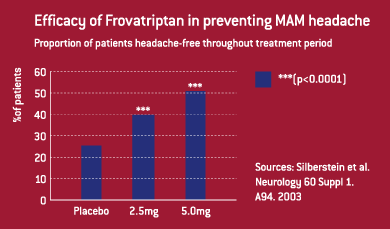 The headline results showed that both dose levels of frovatriptan were highly effective in reducing the incidence, severity and duration of menstrually associated migraines compared to placebo. By the intention to treat analysis half the patients were completely headache-free during the six-day period when they took 2.5mg frovatriptan twice daily and around 40% when they took 2.5mg frovatriptan once daily, compared to only 26% when they took a placebo. The improvement in headache-free rates was highly statistically significant for both dose regimens compared to placebo (p<0.0001). The full results of the study were presented at a meeting of the American Academy of Neurology in the United States in April 2003, and will subsequently be published in key scientific and clinical journals. Additional studies will be required to enable Elan and Menarini to apply for US and European regulatory approval for the use of frovatriptan in the prophylaxis of menstrually associated migraine. We believe that the requirements to submit applications to extend European product licences will be broadly similar to those in the United States. No drugs of the triptan class are currently approved for prophylactic use in menstrually associated migraine. If the positive outcome of the initial study is reproduced in further studies and an extension to the product licence successfully obtained, we believe that it would give frovatriptan a competitive advantage that could enable our marketing partners to significantly increase frovatriptan's market share. Sexual dysfunction VML 670 - sexual dysfunction There is increasing interest in new treatments for sexual dysfunction. In our programme with VML 670 we are currently targeting a specific male and female patient population whose sexual dysfunction has arisen as a direct result of drugs that they take to treat depression. The most widely prescribed class of anti-depressant drugs are known as SSRIs (selective serotonin re-uptake inhibitors). They work by increasing circulating levels of serotonin (5-HT), a chemical produced in the brain that affects mood. According to published studies, a significant proportion of patients taking SSRIs, between 30% and 40%, experience some form of sexual dysfunction as a side effect of the treatment. This may manifest itself in a number of ways, including loss of sexual desire, erectile dysfunction, or an inability to achieve orgasm. Studies have shown that SSRIs reduce the activity of one particular type of receptor for serotonin, the so-called 5-HT1A receptor, which is known to be involved in the mediation of sexual behaviour. The hypothesis we are exploring is that VML 670, which has potent and selective activity at 5-HT1A receptors, can re-activate these receptors and so restore normal sexual function. Our programme has made good progress throughout the year. In the first half we successfully completed a Phase I programme that included single and multiple-dose studies in healthy volunteers as well as a study to confirm that there are no adverse consequences from the co-administration of VML 670 and a commonly prescribed SSRI anti-depressant. We subsequently started a multi-centre, double-blind, placebo-controlled Phase IIa trial with VML 670 in approximately 240 male and female patients taking either of the two most commonly prescribed SSRIs. Recruitment for the study, which we are running at 40 centres in the UK, is now complete. We remain on track to review the preliminary results with our partner, Lilly Corporation, in the second half of 2003. Parkinson's disease Adenosine A2A antagonist programme In our adenosine programme we are targeting two different clinical indications, Parkinson's disease and depression. Parkinson's disease Parkinson's disease is a debilitating and progressive movement disorder that affects approximately 1% of the population over the age of 65 years. Common symptoms include stiffening of the muscles and difficulty in initiating movement. Sufferers may also develop a tremor or shaking. The primary cause of the problems of co-ordination and movement in Parkinsonian patients is nerve degeneration and cell death in the brain, leading to the loss of dopamine, a chemical produced in the brain that is involved in the control of voluntary movement. Most conventional therapies for Parkinson's disease are based on dopamine replacement. Although generally effective in the short term, these treatments can have severe, or even disabling, side effects and their effectiveness tends to decrease over time. In addition, current therapies that target dopamine do not slow down or stop progression of Parkinson's disease. Adenosine is another brain chemical that also plays an important role in motor co-ordination and movement control. A subtype of adenosine receptor, the adenosine A2A receptor, is found in high density in the part of the brain responsible for motor function, where it appears to direct the activity of other neurotransmitter mechanisms, including dopamine mechanisms, that are dysfunctional in Parkinson's disease. We believe that by using selective adenosine A2A receptor antagonists to restore the imbalance of the other neurotransmitters caused by the loss of dopamine, we may be able to provide a novel approach to treat the symptoms of Parkinson's disease and to slow or stop its progression. During 2002 we selected our first lead development candidate for Parkinson's disease, VR 2006. We are currently completing a series of pre-clinical studies that are required by the regulatory authorities to establish the safety profile of the drug before it can be given to humans. Our intention is to take the compound into clinical trials subject to additional funding becoming available through a strategic collaboration or the implementation of another strategic option. Depression and anxiety Depression and anxiety Depression is the leading cause of disability worldwide. In the United States, the world's largest market for pharmaceutical products, it is estimated that depressive disorders affect approximately 17 million people, and nearly twice as many women (12%) as men (7%) are affected by a depressive disorder each year. In May 2002 we were very pleased to announce a new strategic collaboration with Roche to research and develop A2A antagonists as anti-depressants. This followed pre-clinical research by Vernalis, Roche and a number of other companies suggesting that adenosine receptors, and specifically the adenosine A2A receptor subtype, may be a novel target for a completely new class of anti-depressant drugs. In our own programme we have already synthesised selective adenosine A2A receptor antagonists that show activity in pre-clinical models of depression. Under the terms of the agreement, Roche has an option to license worldwide rights to develop, manufacture and market product candidates coming out of our research programme for the treatment of depression and anxiety, which is exercisable up to the end of Phase I studies. On each anniversary of the option grant, Roche has to pay the Company an option renewal fee in order to extend its option for a further year, and we also have the potential to receive milestone payments for compounds that move into development. If Roche exercises its option, the two companies would pool their respective intellectual property and would establish a joint research programme under which Roche would fund our research costs. Roche would also then undertake and fund all development work. We would potentially receive a series of development and post-approval milestone payments totalling up to $80 million on product candidates from the joint programme, whether arising from Vernalis or Roche intellectual property, as well as substantial royalties on future product sales. In the prospectus for the Placing and Open Offer of 1 May 2003, we stated that work on this programme would continue whilst we pursue strategic options for the Company, but that the future of the programme would depend on additional funding becoming available either through a strategic collaboration or the implementation of another strategic option. Obesity 5-HT2C agonist programme - obesity Over the last ten years there has been a dramatic rise in the prevalence of obesity, particularly in first-world countries. Obesity in the United States has reached epidemic proportions, with over one-third of the total population now considered by the National Institutes of Health to be clinically obese. This figure is projected to exceed 50% within the next 25 years. In European countries the corresponding figure is lower, approximately 20%, but the rate of increase in prevalence is showing a similar trend to that of the United States. The important role of the 5-HT2C receptor in controlling eating and satiety was a ground-breaking discovery by our own scientists in 1997. In obesity, this control mechanism may not work effectively and may lead to excess food consumption, which the body stores as fat. Compounds that activate this receptor can help to promote the feeling of satiety and control the urge to eat to excess. Our programme is focused on developing novel and highly selective 5-HT2C receptor agonists as drugs to improve weight loss. Our 5-HT2C programme has been the subject of a joint research and development collaboration with Roche since December 1999. Roche's continued commitment to the programme was clearly evidenced by a new agreement that we signed with Roche in February 2002. The new agreement extends the original collaboration and includes significantly improved commercial terms for Vernalis, with further research funding, potential milestone payments from Roche now doubled to around $60 million, and royalties rising to as high as 15% on successfully marketed compounds. Roche will continue to undertake and fund all development work. The first clinical development candidate from this programme entered Phase I clinical trials in May 2002, triggering a milestone payment to Vernalis. We and Roche subsequently took the decision, in July, to withdraw this compound from the Phase I trials, when the early pharmacokinetic data in man revealed unexpectedly high levels of a metabolite of the drug in the bloodstream. Although there were no resultant side effects, the data did not meet our stringent criteria for progression into Phase II. While this was undoubtedly a setback, it is not unusual for drugs to be discontinued in Phase I. The intention is to take at least one compound from the programme into Phase I trials as soon as possible. We currently anticipate a new development candidate being selected in the second half of 2003. |
 |