
|
|

| MARTIN STEWART CHIEF FINANCIAL OFFICER  |
Turnover Operating revenues grew by 8% to £1,545 million.
Subscriber revenues, which account for 80% of total turnover, grew 3% year-on-year. Direct-to-home revenue, which accounts for 63% of total turnover, increased by £11 million to £979 million, primarily reflecting increased yield per subscriber. Wholesale revenues, including, for the first time, digital terrestrial television ("DTT") revenues from ONdigital, rose 11% to £253 million, mainly due to a 15% increase in cable subscriber numbers. The yield per cable subscriber has continued to decline, as cable operators drive penetration using low cost entry packages comprising a few basic channels with a telephony service. Advertising revenue increased by 11% to £217 million, outperforming the estimated revenue growth in the UK television market of 8%. Programming costs have risen by £100 million (14%) to £787 million. Sports costs, which represent 40% of total programming costs, have grown by 11% to £318 million. This has been driven by an increase of £27 million in football costs, mainly due to contractual increases in Premier League and Football League costs, together with the first season of the new Scottish Premier League contract. The increase was also attributable to the Cricket World Cup and to Sky Sports News, which was launched in August 1998. Movie costs increased by 22% to £238 million, mainly due to an increase in output movies, the number of megahits, and new movie deals. These cost increases were partly offset by a slight decrease in the number of cable movie subscribers. |
An increase in entertainment programming costs by 28% to £58 million reflects increased investment in commissioned programming, which accounted for 32% of Sky One costs. The cost of acquisition rights for popular US series also rose.
Carriage costs paid to third party channels rose by 7% to £139 million, following contractual increases in the rates paid per subscriber for the analogue service and the impact of new channel launches for the digital service. Other operating costs Marketing costs increased by £48 million to £216 million, driven by a £40 million increase in above-the-line expenditure to £69 million. This was due to the advertising campaign supporting the digital launch and the successful relaunch of the channels. The acquisition costs of new digital subscribers and the costs of transitioning analogue subscribers to the digital service up until the launch of the new offer, were offset by a decrease in analogue acquisition spend. Subscriber related costs increased £62 million to £154 million, driven by the £38 million cost of digital set-top boxes before the new offer. The remaining £24 million was due to increased subscriber handling costs, together with increased infrastructure costs. The Group continues to invest in its subscriber management operations in order to provide the best service levels for its customers. Transmission and related functions rose by £21 million to £91 million, due to the enlarged infrastructure required to support both analogue and digital services. The expected step change in overheads occurred due to the additional infrastructure required for digital with overheads increasing by £36 million to £112 million. |
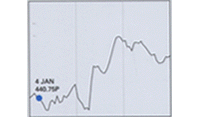 SHARE PRICE HIGH/LOWS 03 JANUARY - MARCH 1999 |
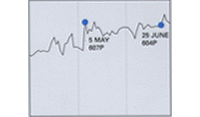 SHARE PRICE HIGH/LOWS 04 APRIL - JUNE 1999 |
|
|
Operating margin (before exceptionals) decreased from 24% to 12%, with the growth in revenues being outstripped by the considerable investment in both programming and distribution associated with the roll out of Sky digital. Exceptional items Pre-tax exceptional items comprise the digital transition provision of £450 million (£315 million post tax), £5 million of consequent financing costs and the costs relating to the aborted Manchester United PLC bid of £6 million. Joint ventures The Group’s share of net operating losses from joint ventures increased to £58 million. This was largely due to BiB as it started subsidising the cost of set-top boxes. The Group continues to invest in its programming joint ventures managed by its wholly owned subsidiary Sky Ventures. Whilst the performance of many of these channels is improving, this has been offset by losses from new ventures such as MUTV and Music Choice. Interest Net interest costs (before exceptionals) of £55 million increased by £2 million compared to the prior year, due to the increase in average borrowings offset by a decrease in average interest rates payable. Taxation The effective tax rate on ordinary activities excluding joint venture losses is 30%, before taking into account ACT and prior year adjustments. Full tax relief on exceptional items resulted in an overall tax credit of £104 million. Dividends The Board is convinced that the policy to drive subscriber growth will create significant value for our s h a reholders. The Group operates in a fast-developing and high-technology market and currently has opportunities to achieve strong returns for its shareholders by the investment of funds in its businesses. These opportunities to invest in organic growth, together with the objectives of maintaining gearing at efficient levels, led to the Board ’s announcement in May, suspending dividend payments to shareholders. Accordingly, no final dividend is proposed. The Board intends to return excess capital to share holders through dividends and/or share re-purchases at the appropriate time. Cash flow Following the significant investment in the digital roll out, operating cash flow decreased by £166 million to £238 million. This, combined with the purchase of an 11.1% stake in Manchester United (£67 million), net interest paid (£51 million), dividends and tax paid (£131 million), capital expenditure (£76 million) and joint venture funding (£68 million), resulted in a £147 million increase in net debt during the year, to £665 million at year end. Capital expenditure Totalled £76 million in fiscal 1999 (1998: £82 million). The main areas of expenditure were continued investment in digital technology, the Sky Networks building, a studio for Sky Sports News and a new building in Scotland for telemarketing services. Financing The Group has refinanced its debt during the year and subsequent to the year end, to provide the flexibility to deal with the increased requirements for financing during the digital roll out period. In February 1999 the Group issued a US$600 million ten-year global bond. The proceeds, which were used to pay down bank debt, have been swapped into sterling at an average floating rate of six-month sterling LIBOR plus 127 basis points. At the start of the new financial year, the Group’s £1 billion revolving credit facility was cancelled and replaced by a new £750 million facility. The new facility will mature in five years, and interest will accrue at rates between 0.50% and 1.40% per annum above LIBOR, depending on the Group’s credit rating. |
In July 1999, the Group issued US$650 million and £100 million of ten-year global Regulation S/144A bonds with SEC registration rights. The proceeds of the dollar bonds have been swapped into sterling at a fixed semi-annual rate of 7.653% per annum. The sterling notes are at a fixed rate of 7.75% per annum. The aggregate net proceeds of the bond issues of £512 million were used to repay the drawn down balance on the revolving credit facility, with the remaining cash balance to provide funding for the roll out of digital. At the year end the Group also had in issue US$300 million 7.30% Guaranteed Notes repayable in October 2006. Swap transactions were entered into which converted the proceeds to sterling, of which half carries a fixed rate of interest of 8.384% until maturity. The remainder is fixed at 7.94% until April 2002, thereafter floating at 62 basis points over six-month LIBOR. Treasury Policy and Risk Management The main purpose of the Group’s financial instruments is to raise finance for its operations. In addition, the Group enters into derivative transactions to manage both interest rate and currency risks arising from the Group’s operations and its sources of finance. It is the Group’s policy that foreign exchange transactions are restricted to fixed price instruments, that all hedging is to cover known risks and that no trading in financial instruments is undertaken. The amount of cash that can be placed with any one institution is restricted according to credit rating and regular and frequent reporting to management is required for all transactions and exposures. The Group finances its operations through bank borrowings, the issue of long-term bonds and share capital. The Group borrows at both fixed and floating rates of interest and then uses interest rate swaps to manage exposure to interest rate fluctuations. It is the Group’s policy to have an appropriate mixture of fixed and floating rates. At 30 June 1999, 42% of the Group’s borrowings were at fixed rates after taking account of interest rate swaps (30 June 1998: 51%), moving to 75% after the re-financing of the Group’s borrowings subsequent to the year end. To ensure continuity of funding, the Group’s policy is to ensure that its borrowings mature over a period of years. At 30 June 1999, 79% of the Group’s borrowings were due to mature in more than five years (1998: 34%), moving to 100% after the re-financing of the Group’s borrowings subsequent to the year end. The Group’s revenues are substantially denominated in pounds sterling, although a significant proportion of operating costs is denominated in US dollars. In the year to 30 June 1999, 20% of operating costs (£270 million) were denominated in US dollars (1998: 24.5%). This relates mainly to the Group’s long-term programming contracts with US suppliers. The Group currently manages its US dollar/pound sterling exchange risk exposure primarily by the purchase of forward rate agreements for approximately one year. Future foreign exchange liabilities are substantially hedged up to one year ahead, using forward foreign exchange contracts. Occasionally, other financial instruments are employed to manage the exposure where these are more appropriate. All US dollar-denominated forward rate agreements and similar financial instruments entered into by the Group are in respect of firm commitments which exceed the value of such agreements and instruments. At 30 June 1999 the Group had outstanding commitments to purchase in aggregate US$501 million at an average rate of US$1.6406 to £1.00. The Group also incurs costs in Euros and Luxembourg francs relating to certain transponder rental costs; these payments are also covered by forward rate agreements. Although these financial instruments can mitigate the effect of short-term fluctuations in exchange rates, there can be no effective or complete hedge against long-term currency fluctuations. The Group’s debt exposure is currently denominated in sterling after taking foreign exchange swaps into account. Going concern The Directors consider, on the basis of current financial projections and facilities available, that the Group has adequate resources to continue in operational existence for the foreseeable future and for this reason the going concern basis has been adopted in preparing the accounts. |


