|



|
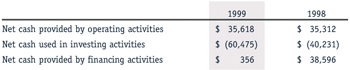
The following table presents EMCOR's net cash provided by operating activities, net cash used in investing activities and net cash provided by financing activities for the years ended December 31, 1999 and 1998 (in thousands):
The Company's consolidated cash balance decreased by $24.5 million from $83.1 million at December 31, 1998 to $58.6 million at December 31, 1999. Net cash provided by operating activities for 1999 was $35.6 million, an increase of $0.3 million from $35.3 million for 1998. The cash provided by operating activities was primarily due to increased net income, non-cash net income items, increased contracts in progress accounts payable and accrued expenses, offset partially by increased accounts receivable. Net cash used in investing activities for 1999 of $60.5 million consisted primarily of $55.8 million for acquisitions and $10.7 million for the net purchase of property, plant and equipment, versus $28.5 million and $10.9 million used for the same activities for 1998, respectively. Net cash provided by financing activities for 1999 of $0.4 million was primarily due to net proceeds from the exercise of common stock warrants of $10.0 million, offset by the purchase of common stock of $2.9 million and repayments of long-term debt and capital lease obligations of $7.0 million. In 1998, net cash provided by financing activities of $38.6 million was primarily due to the issuance of convertible subordinated notes of $115.0 million, net proceeds from issuance of common stock of $22.5 million, offset partially by the retirement of Series C notes for $61.9 million, purchases of common stock for $14.0 million, payment of working capital credit lines of $9.5 million, and retirement of the Supplemental Sellco Note for $5.5 million. On December 22, 1998, EMCOR and certain of its subsidiaries amended and restated the June 19, 1996 credit facility; the amended credit facility provides EMCOR with a credit facility for borrowings of up to $150.0 million. The amended working capital credit facility, which has an expiration date of June 30, 2002, is guaranteed by certain direct and indirect subsidiaries of EMCOR. It is secured by substantially all of the assets of EMCOR and those subsidiaries, and it provides for borrowing capacity available in the form of revolving loans and/or letters of credit. The revolving loans bear interest at (1) a rate which is the prime commercial lending rate announced by Harris Trust and Savings Bank from time to time (8.5% at December 31, 1999) plus 0% to 0.5%, based on certain financial tests or (2) at a LIBOR rate (6.0% at December 31, 1999) plus 1.25% to 2.0% based on certain financial tests. The interest rates in effect at December 31, 1999 were 8.5% and 7.25%, respectively. Letters of credit fees issued under the credit facility ranging from 0.5% to 2.0% are charged based on type of letters of credit issued and certain financial tests. As of December 31, 1999 and 1998, EMCOR had approximately $17.4 million and $30.2 million of letters of credit outstanding, respectively. In October 1997, the Company's Canadian subsidiary, Comstock Canada Ltd., renewed a credit agreement with a bank providing for an overdraft facility of up to Cdn. $0.5 million. The facility is secured by a standby letter of credit and provides for interest at the bank's prime rate (6.5% at December 31, 1999). There were no borrowings outstanding under this credit agreement at December 31, 1999 and 1998. The Canadian subsidiary may utilize EMCOR's 1998 credit facility for any future working capital requirements. In 1998, EMCOR issued notes in connection with the acquisition of two companies. A principal payment of $1.0 million was made in August 1999 in respect of one note issued in August 1998, and a principal payment of the balance of $1.15 million is to be made in respect of that note in August 2000. Interest on the note is payable together with payments of principal. The other note, issued in the principal amount of $6.2 million in December 1998, was paid in full in January 1999. The Company believes that current cash balances and borrowing capacity available under lines of credit, combined with cash expected to be generated from operations, will be sufficient to provide short-term and foreseeable long-term liquidity and meet expected capital expenditure requirements. |