
|



|
The principal allegations of the complaint are that the defendants breached their fiduciary duties by causing the plans to purchase and hold stock of EMCOR when it was then known as JWP, Inc. and when the defendants knew or should have known it was imprudent to do so. The plaintiff has not made claim for a specific dollar amount of damages but generally seeks to recover for the benefit plans the loss in the value of JWP stock held by the plans. EMCOR and the other defendants intend to vigorously defend the case. Insurance coverage may be applicable under an EMCOR pension trust liability insurance policy for EMCOR and those present and former employees of EMCOR who are defendants in the action. Substantial settlements or damage judgements against EMCOR arising out of these matters could have a material adverse effect on EMCOR’s business, operating results and financial condition. In addition to the above, EMCOR is involved in other legal proceedings and claims, asserted by and against EMCOR, which have arisen in the ordinary course of business. EMCOR believes it has a number of valid defenses to these actions and EMCOR intends to vigorously defend or assert these claims and does not believe that a significant liability will result. However, EMCOR cannot predict the outcome thereof or the impact that an adverse result of the matters discussed above will have upon EMCOR’s financial position or results of operations.
To the Board of Directors and Stockholders of EMCOR Group, Inc.: We have audited the accompanying consolidated balance sheets of EMCOR Group, Inc. (a Delaware corporation) and subsidiaries (the “Company”) as of December 31, 1999 and 1998, and the related consolidated statements of operations, stockholders’ equity and comprehensive income and cash flows for each of the three years in the period ended December 31, 1999. These consolidated financial statements and the schedule referred to below are the responsibility of the Company’s management. Our responsibility is to express an opinion on these consolidated financial statements and schedule based on our audits. We conducted our audits in accordance with generally accepted auditing standards. Those standards require that we plan and perform the audit to obtain reasonable assurance about whether the financial statements are free of material misstatement. An audit includes examining, on a test basis, evidence supporting the amounts and disclosures in the financial statements. An audit also includes assessing the accounting principles used and significant estimates made by management, as well as evaluating the overall financial statement presentation. We believe that our audits provide a reasonable basis for our opinion. In our opinion, the financial statements referred to above present fairly, in all material respects, the financial position of the Company as of December 31, 1999 and 1998, and the results of their operations and their cash flows for each of the three years in the period ended December 31, 1999, in conformity with generally accepted accounting principles. Our audits were made for the purpose of forming an opinion on the basic financial statements taken as a whole. The schedule of Valuation and Qualifying Accounts is presented for purposes of complying with the Securities and Exchange Commission rules and is not part of the basic financial statements. This schedule has been subjected to the auditing procedures applied in the audits of the basic financial statements and, in our opinion, fairly states in all material respects the financial data required to be set forth therein in relation to the basic financial statements taken as a whole. 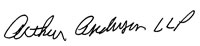
Stamford,
Connecticut |

