|
|||||||
|
 |
|
|||||


FirstMerit Corporation and Subsidiaries
Selected Financial Data (continued)
 |
|
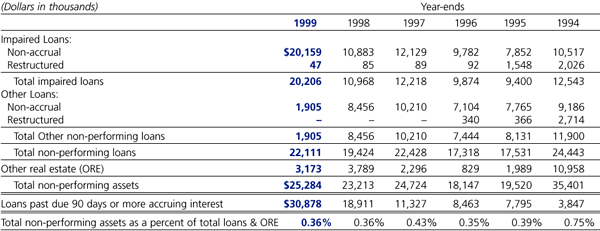
Asset Quality Making a loan to earn an interest spread inherently includes taking the risk of not being repaid. Successful management of credit risk requires making good underwriting decisions, carefully administering the loan portfolio and diligently collecting delinquent accounts. The Corporation’s Credit Policy Division manages credit risk by establishing common credit policies for its subsidiary banks, participating in approval of their largest loans, conducting reviews of their loan portfolios, providing them with centralized consumer underwriting, collections and loan operations services, and overseeing their loan workouts. The Corporation’s objective is to minimize losses from its commercial lending activities and to maintain consumer losses at acceptable levels that are stable and consistent with growth and profitability objectives. The Corporation adopted Statement of Financial Accounting Standard No. 114,”Accounting by Creditors for Impairment of a Loan,” and Statement No. 118, an amendment of Statement No. 114, “Accounting by Creditors for Impairment of a Loan - Income Recognition and Disclosures.” These statements provide guidance for determining the allowance for loan losses related to impaired loans and illustrate the required financial statement disclosures for impaired loans. Impaired loans are loans for which current information or events, it is probable that a creditor will be unable to collect all amounts due according to the contractual terms of the loan agreement. Impaired loans must be valued based on the present value of the loans’ expected future cash flows at the loans’ effective interest rates, at the loans’ observable market price, or the fair value of the loans’ collateral. Non-Performing Assets Non-performing assets consist of:
Under the Corporation’s credit policies and practices, all non-accrual and restructured commercial, agricultural, construction, and commercial real estate loans meet the definition of impaired loans under Statements 114 and 118. Impaired loans as defined by Statements 114 and 118 exclude certain consumer loans, residential real estate loans, and leases classified as non-accrual. Consumer installment loans are charged off when they reach 120 days past due. Credit card loans are charged off when they reach 180 days past due. When any other loan becomes 90 days past due, it is placed on non-accrual status unless it is well secured and in the process of collection. Any losses are charged against the allowance for possible loan losses as soon as they are identified. Non-performing assets at year-end 1999 were $25.3 million, $23.2 million at year-end 1998 and $24.7 million at year-end 1997. As a percentage of total loans outstanding plus ORE, non-performing assets were 0.36% at year-end 1999 and 1998 compared to 0 .43% in 1997 and 0.35% in 1996. The average balances of impaired loans for the years ended 1999 and 1998 were $15.6 million and $11.6 million, respectively. For the year ended 1999, impaired assets earned $572,000 in interest income. Had they not been impaired, they would have earned $1.9 million. For the same period, total non-performing loans earned $787,000 in interest income. Had they been paid in accordance with the payment terms in force prior to being considered impaired, on non-accrual status, or restructured, they would have earned $3.5 million. In addition to non-performing loans and loans 90 days past due and still accruing interest, Management identified potential problem loans totaling $75.8 million at year-end 1999. These loans are closely monitored for any further deterioration in the borrowers’ financial conditions and for the borrowers’ abilities to comply with terms of the loans. |