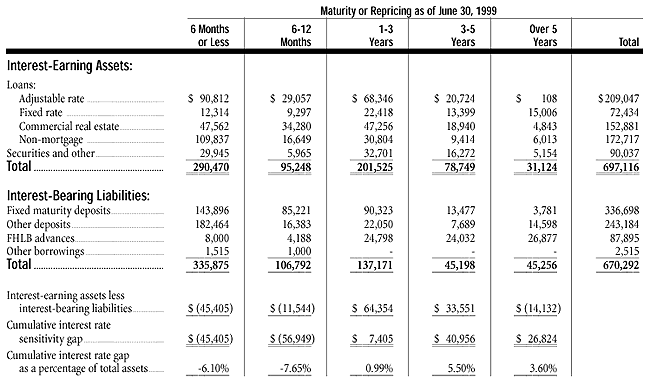
Management's Discussion and Analysis of Financial Condition and Results of OperationsThe following financial review presents an analysis of the asset and liability structure of Home Federal Bancorp and a discussion of the results of operations for each of the periods presented in the annual report as well as a discussion of Home Federal Bancorp's sources of liquidity and capital resources.Holding Company Business Home Federal Bancorp (the "Company") is organized as a unitary savings and loan holding company and owns all the outstanding capital stock of Home Federal Savings Bank (the "Bank"). The business of the Bank and therefore, the Company, is providing consumer and business banking services to certain markets in the south-central portions of the State of Indiana. The Bank does business through 16 full service banking branches. General The Bank's earnings in recent years reflect the fundamental changes that have occurred in the regulatory, economic, and competitive environment in which savings institutions operate. The Bank's earnings are primarily dependent upon its net interest income. Interest income is a function of the average balances of loans and investments outstanding during a given period and the average yields earned on such loans and investments. Interest expense is a function of the average amount of deposits and borrowings outstanding during the same period and the average rates paid on such deposits and borrowings. Net interest income is the difference between interest income and interest expense. The Bank is subject to interest rate risk to the degree that its interest-bearing liabilities, primarily deposits and borrowings with short- and medium-term maturities, mature or reprice more rapidly, or on a different basis, than its interest-earning assets. While having liabilities that mature or reprice more frequently on average than assets will be beneficial in times of declining interest rates, such an asset/liability structure will result in lower net income or net losses during periods of rising interest rates, unless offset by other factors such as non-interest income. The Bank's net income is also affected by such factors as fee income and gains or losses on sale of loans. The Bank's net interest income after provision for loan losses has improved from $19.0 million in fiscal 1995 to $23.0 million in fiscal 1999. The increase in net interest income is primarily the result of an increase in interest-earning assets over interest-bearing liabilities. Asset/Liability Management The Bank follows a program designed to decrease its vulnerability to material and prolonged increases in interest rates. This strategy includes: 1) selling certain longer term, fixed rate loans from its portfolio; 2) increasing the origination of adjustable rate mortgage loans; 3) improving its interest rate gap by increasing the interest rate sensitivity and shortening the maturities of its interest-earning assets and extending the maturities of its interest-bearing liabilities; and 4) increasing its non-interest income. A significant part of the Bank's program of asset and liability management has been the increased emphasis on the origination of adjustable rate and/or short-term loans, which include adjustable rate residential mortgages and construction loans, commercial loans and consumer-related loans. The Bank continues to offer fixed rate residential mortgage loans. The Bank retains the servicing function on most of the 15-year and 30-year loans sold, thereby increasing non-interest income. The proceeds of these loan sales are used to reinvest in other interest-earning assets or to repay short-term debt. Liability Related Activities The Bank has taken several steps to stabilize interest costs and match the maturities of liabilities to assets. Retail deposit specials are competitively priced to attract deposits in the Bank's market area. When retail deposit funds become unavailable due to competition, the Bank employs Federal Home Loan Bank of Indianapolis ("FHLB") advances to maintain the necessary liquidity to fund lending operations. In addition, the Bank utilizes FHLB advances to match maturities with select commercial loans. The Bank has endeavored to spread its maturities of FHLB advances over a seven year period so that only a limited amount of advances come due each year. This avoids a concentration of maturities in any one year and thus reduces the risk of having to renew all advances when rates may not be favorable. The Bank applies early withdrawal penalties to protect the maturity and cost structure of its deposits and utilizes longer term fixed rate borrowings when the cost and availability permit the proceeds of such borrowings to be invested profitably. As a result of its asset restructuring efforts, the Bank has foregone, and will likely forego in the future, certain opportunities for improving income on a short-term basis in exchange for a reduction in long-term interest rate risk. For instance, the Bank's increased emphasis on the origination of adjustable rate mortgages may cause it to sacrifice the initially higher rates of interest available to lenders on fixed rate loans. Similarly, market conditions usually have dictated that financial institutions pay substantially higher interest rates on long-term deposits than on short-term deposits. Also, the Bank has elected to keep its liquidity in excess of regulatory requirements in order to maintain a short-term portfolio better able to react to interest rate volatility. The interest sensitivity "gap" is defined as the amount by which assets repricing within the respective period exceed liabilities repricing within such period. The annual prepayment assumptions used in this table range from 12% to 30% for fixed rate mortgage loans and mortgage-backed securities; 0% to 20% for adjustable rate mortgage loans; and 10% to 85% for commercial and consumer loans, depending on their maturity and yield. For deposit accounts, it has been assumed that fixed maturity deposits are not withdrawn prior to maturity and that other deposits will suffer attrition at the rates shown in the following table:
The prepayment and attrition rates are selected after considering the current interest rate environment, industry asset and liability price tables developed by the Office of Thrift Supervision ("OTS") and the Company's historical experience. All other interest-earning assets and interest-bearing liabilities are shown based on their contractual maturity or repricing date. The following table sets forth the repricing dates of the Company's interest-earning assets and interest-bearing liabilities at June 30, 1999. (dollars in thousands)
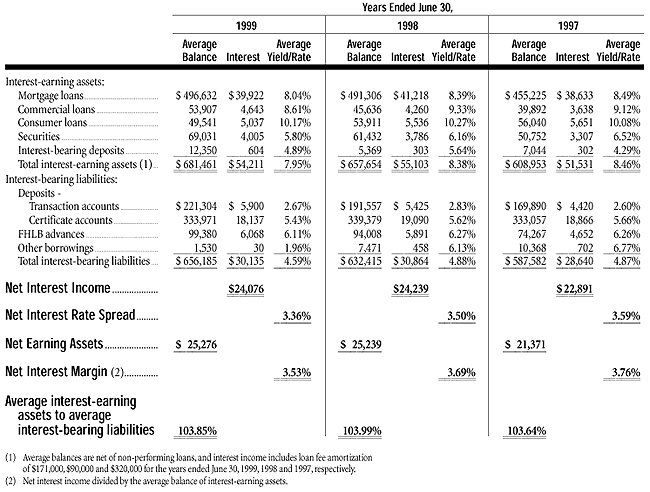
Interest Rate Spread The following table sets forth information concerning the Bank's interest-earning assets, interest-bearing liabilities, net interest income, interest rate spreads and net yield on average interest-earning assets during the periods indicated (including fees which are considered adjustments of yields). Average balance calculations were based on daily and monthly balances. (dollars in thousands)
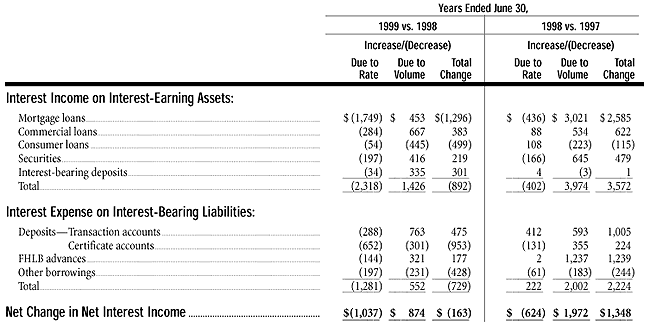
Rate/Volume Analysis The following table sets forth the changes in the Bank's interest income and interest expense resulting from changes in interest rates and changes in the volume of interest-earning assets and interest-bearing liabilities. Changes not solely attributable to volume or rate changes have been allocated in proportion to the changes due to volume or rate. (in thousands)
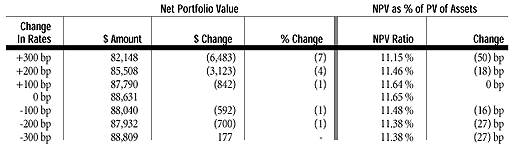
RESULTS OF OPERATIONS Comparison of Year Ended June 30, 1999 and Year Ended June 30, 1998: General The Company reported net income of $10.5 million for the year ended June 30, 1999. Net income for the year ended June 30, 1998 was $10.4 million, an increase of $87,000 or 0.8%. Net Interest Income Net interest income before provision for loan losses decreased $163,000, or 0.7% for the year ended June 30, 1999, compared to the prior year. This decrease was primarily the result of the lower interest rate environment experienced in fiscal 1999 as compared to fiscal 1998. Rates on interest-earning assets declined more rapidly than the interest rates on interest-bearing liabilities, which was reflected in a 14 basis point drop in the Company's net interest rate spread. Net interest income after provision for loan losses remained relatively stable, decreasing by $94,000, or 0.4% over that of the prior year, to $23.0 million. In each period, the provision and allowance for loan losses were based on an analysis of individual credits, prior and current loss experience, overall growth in the portfolio, the change in the portfolio mix and current economic conditions. The balance of the allowance for loan losses was $4.3 million at June 30, 1999. Interest Income The Company's total interest income for the year ended June 30, 1999, decreased $892,000, or 1.6%, as compared to the year ended June 30, 1998. Interest income decreased primarily due to the decrease in the average yield earned on interest-bearing assets, which fell to 8.0% in fiscal 1999 from 8.4% in fiscal 1998. The decrease in interest income due to the decline in average yield was partially mitigated by a $23.8 million increase in the average balance of interest-earning assets. This growth in average balance was attributed to a relatively strong local economy and continued emphasis on the part of the Company to expand its market share of non-residential mortgage loan products. Interest Expense Total interest expense for the year ended June 30, 1999, decreased $729,000, or 2.4%, as compared to the year ended June 30, 1998. The decrease in interest expense mirrored the decrease in interest income. Although declining rates paid on deposits decreased interest expense, increasing average balances of interest-bearing liabilities partially offset the decrease in interest expense. Other Income Other income increased $289,000 from $9.7 million in fiscal year 1998 to $10.0 million in fiscal year 1999. This increase was due to an increase of $262,000 in loan servicing income, an increase of $259,000 in miscellaneous income and a $119,000 increase in income from joint ventures. The increase in loan servicing income was due to an increase in the servicing portfolio of $76.3 million in fiscal 1999. The growth in the servicing portfolio resulted from the heavy refinancing activity started in fiscal 1998 which continued into the first nine months of fiscal 1999 due to the low interest rate environment experienced during that period. The Bank sells most of its fixed rate loan originations, thus causing the large increase in the servicing portfolio. The increase in miscellaneous income resulted from the lease buy out of a building held for investment of $159,000, $59,000 of tax refunds from prior years' returns and a $34,000 credit for insurance expense paid in prior years. The increase in joint venture income reflects the income received from a joint venture begun in fiscal 1998, which has moved out of the development phase and is producing income. These increases were offset by decreases in insurance, annuity income, and other fees of $340,000. The decrease in insurance, annuity income and other fees was due primarily to decreased income of $374,000 from annuity and brokerage sales. The reduction in annuity and brokerage sales was the result of several factors, including: 1) a market change resulting in reduced volume of client transactions completed in the annuity area; 2) a change in personnel of the brokerage staff; and 3) a change in the way the Bank is compensated for brokerage sales which reduces initial fees received, but will generate future income from the management of clients' accounts. Other Expenses Other expense remained fairly stable, increasing $125,000, or 0.8% over the prior fiscal year, to $15.9 million from $15.7 million. While total other expenses were fairly constant, certain categories within other expenses experienced fluctuations. Compensation and employee benefits decreased $373,000, or 4.2%, reflecting the reduction of bonus expense in fiscal 1999 compared to fiscal 1998 of $678,000. The reduction to compensation and employee benefits from reduced bonus expenses was partially diminished by increases in the cost of health care and salary increases. Miscellaneous expenses increased $579,000, or 20.9%, due to a variety of factors including: 1) a write off of bad checks of $298,000; 2) a write down of $118,000 on the value of a building held by the Company for investment reflecting the lease buy out; 3) the expensing of deferred costs associated with the same building of $39,000 and; 4) increased loan costs of $94,000 due primarily to the use of new underwriting software. RESULTS OF OPERATIONS Comparison of Year Ended June 30, 1998 and Year Ended June 30, 1997: General The Company reported net income of $10.4 million for the year ended June 30, 1998. Net income for the year ended June 30, 1997, was $6.8 million which included a charge for the legislated special after-tax assessment of $1.8 million to help recapitalize the FDIC Savings Association Insurance Fund (SAIF). Without the SAIF assessment, net income for the period ended June 30, 1997, would have been $8.6 million. Comparing fiscal year 1998 net income to the SAIF adjusted net income of fiscal year 1997, Home Federal showed an increase of $1.8 million, or 21.2%. Net Interest Income Net interest income before provision for loan losses increased $1.3 million, or 5.9% for the year ended June 30, 1998, compared to the prior year. This increase was the result of assets growing $36.8 million, or 5.4%. Net interest income after provision for loan losses also increased by $1.3 million, or 5.9% over that of the prior year, to $23.0 million even though the loan loss provision in fiscal 1998 was $64,000 higher than the provision in fiscal 1997. In each period, the provision and allowance for loan losses were based on an analysis of individual credits, prior and current loss experience, overall growth in the portfolio and current economic conditions. The balance of the allowance for loan losses was $4.2 million at June 30, 1998. Interest Income The Company's total interest income for the year ended June 30, 1998, increased $3.6 million, or 6.9%, as compared to the year ended June 30, 1997. Interest income increased primarily due to growth in the loan portfolio. This growth was attributed to a relatively strong local economy and increased emphasis on the part of the Company to expand its market share of non-residential mortgage loan products. Interest Expense Total interest expense for the year ended June 30, 1998, increased $2.2 million, or 7.8%, as compared to the year ended June 30, 1997. Increased deposit and borrowing balances accounted for the increase in total interest expense. Other Income Other income increased $2.5 million from $7.2 million in fiscal year 1997 to $9.7 million in fiscal year 1998. This increase was due to an increase of $2.1 million in gain on sale of loans, as well as increases in service fees and miscellaneous income. The increase in gain on sale of loans was due to the low interest rate environment of the second half of fiscal year 1998 that helped cause loan originations to increase over 70% from the prior year. The Bank sells most of its fixed rate loan originations, which increased 166% over last year, thus causing the large increase in gain on sale of loans in the current year. Service fees on NOW accounts increased $303,000 to $2.0 million in fiscal 1998 compared to $1.7 million in fiscal 1997 due primarily to new checking account products that increased the number of accounts and related fees. The growth in miscellaneous fees was due to the sale of a previous branch site and increased appraisal fees due to increased volumes resulting from the lower rate environment. Other increases included $109,000 increase in insurance, annuity income and other fees for the year ended June 30, 1998, as compared to the year ended June 30, 1997. The increase was primarily due to the increase in fees generated by the Bank's brokerage department. These increases were offset by decreases in loan servicing income of $189,000 and decreases of $139,000 in income from joint ventures. Loan servicing income of $841,000 included a $244,000 charge relating to the impairment of the Bank's originated mortgage servicing rights. Accounting standards specify conditions under which mortgage servicing rights should be accounted for separately from the underlying mortgage loans. The impairment of these rights resulted from the lower rate environment experienced primarily in the second half of fiscal 1998 causing the devaluation of the prior year's originated mortgage servicing rights which were derived from the sale of higher rate loans in fiscal 1997. Joint venture income decreased as several joint ventures are reaching their conclusion and a new joint venture formed to start residential lots is still in the development stage. Other Expenses Other expense decreased over the prior fiscal year to $15.7 million from $17.8 million, a $2.1 million decrease. The FDIC assessment represented $3.0 million of the $2.1 million decrease. Without the one time assessment, non-interest expense would have increased $938,000 or 6.3%. Most of the adjusted increase in non-interest expense came from personnel cost increases due to normal salary increases and increased commissions due to the increased loan activity discussed previously, totaling $806,000, and increased bonus payouts of $172,000 due to increased after tax earnings. Additionally, occupancy and equipment expense increased $201,000 or 9.6%, due to two primary factors: 1) depreciation charges for the relocated Salem branch office and 2) increased equipment expense related primarily to the upgrade and maintenance of data processing equipment. Miscellaneous expenses increased $279,000, or 11.2%, due to a variety of factors including: 1) increased loan expenses of $20,000 related to increased loan volume, as well as a one time charge of $30,000 to write off miscellaneous loan charges, 2) increased checking account related charges of $82,000 due to the growth in checking accounts, 3) increased real estate owned expenses of $39,000 and 4) increases in office supplies of $53,000. FINANCIAL CONDITION The Company's total assets increased $25.0 million to $744.5 million at June 30, 1999, from $719.5 million at June 30, 1998. Cash and interest-bearing deposits increased $8.5 million. In addition, loans receivable, net increased $4.9 million. Securities available for sale increased $16.2 million, while securities held to maturity decreased $4.6 million. The Company's total liabilities increased $22.3 million with deposits increasing $35.9 million and Federal Home Loan Bank advances decreasing $10.2 million. The Company borrowed $1.0 million of senior debt during fiscal year 1999 to finance the repurchase of the Company's stock. Shareholders' equity increased $2.7 million, primarily due to an increase in retained earnings of $8.2 million. Retained earnings increased $10.5 million from net income and decreased $2.3 million as a result of dividends paid to shareholders. Common stock had a net decrease of $4.9 million: $5.8 million from the repurchase of Company stock and increases of $812,000 from options exercised and $84,000 from the related tax benefit of non-qualified dispositions of such options. In accordance with Statement of Accounting Standards 115,"Accounting for Certain Investments in Debt and Equity Securities," the Company had an accumulated other comprehensive loss from unrealized losses in its available for sale portfolio of $576,000, or a $654,000 decrease in shareholders' equity from the June 30, 1998, gain position of $78,000. INTEREST RATE SENSITIVITY The OTS requires each thrift institution to calculate the estimated change in the institution's net portfolio value ("NPV") assuming an instantaneous, parallel shift in the Treasury yield curve of 100 to 300 basis points either up or down in 100 basis point increments. NPV represents the sum of future cash flows of liabilities discounted to present value. The OTS permits institutions to utilize the OTS' model, which is based upon data submitted in the institution's quarterly thrift financial reports. In estimating the NPV of mortgage loans and mortgage-backed securities, the OTS model utilizes various price indications and prepayment rates. At June 30, 1999, these price indications varied from 75.60 to 115.25 for fixed rate mortgages and mortgage-backed securities and varied from 91.47 to 106.52 for adjustable rate mortgages and mortgage-backed securities. Prepayment rates for June 30, 1999, ranged from a constant prepayment rate ("CPR") of 6% to a CPR of 43%. The value of deposit accounts appears on both the asset and liability side of the NPV calculation in the OTS model. In estimating the value of certificate of deposit accounts, ("CDs"), retail price estimates represent the value of the liability implied by the CD and reflect the difference between the CD coupon and secondary-market CD rates. As of June 30, 1999, the retail CD price assumptions varied from 77.35 to 118.2. The retail CD intangible prices represent the value of the "customer relationship" due to the rollover of CD deposits and are an intangible asset for the Bank. As of June 30, 1999, the retail CD intangible price assumptions varied from .07 to 1.14. Other deposit accounts such as transaction accounts, money market deposit accounts, passbook accounts and non-interest-bearing accounts are valued at 100% of their respective outstanding balances in all nine interest rate scenarios on the liability side of the OTS model. On the asset side of the model, intangible prices are used to reflect the value of the "customer relationship" of the various types of deposit accounts. As of June 30, 1999, the intangible prices for transaction accounts, money market deposit accounts and passbook accounts varied from -1.67 to 18.02 , -.43 to 11.45 and -.65 to 13.32, respectively. The following table sets forth the Bank's interest rate sensitivity of NPV as of June 30, 1999. (dollars in thousands)
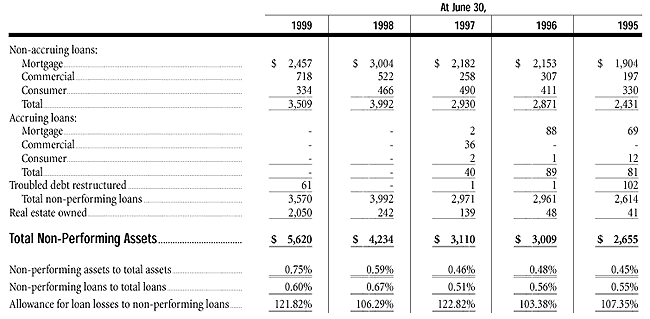
 ASSET QUALITY In accordance with the Company's classification of assets policy, management evaluates the loan and investment portfolio each month to identify substandard assets that may contain the potential for loss. In addition, management evaluates the adequacy of its allowance for possible loan losses. Non-performing Assets The following table sets forth information concerning non-performing assets of the Bank. Real estate owned includes property acquired in settlement of foreclosed loans that is carried at net realizable value. (dollars in thousands)
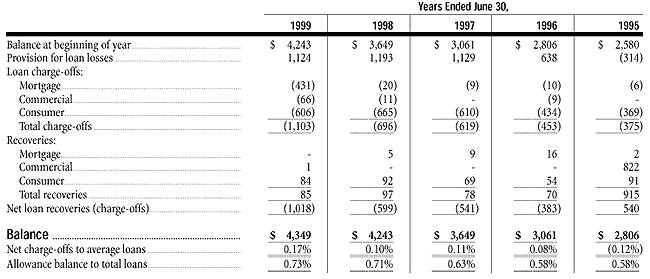
In addition, at June 30, 1999, there were $2.4 million in current performing loans that were classified as special mention or substandard for which potential weaknesses exist which may result in the future inclusion of such items in the non-performing category. Total non-performing assets increased $1.4 million to $5.6 million in fiscal 1999. The majority of the increase in non-performing assets was in the real estate owned area. Real estate owned increased $1.8 million due primarily to the repossession of a single commercial property of $1.2 million, represented by an apartment complex. Allowance for Loan Losses The following table sets forth an analysis of the allowance for possible loan losses. See Note 1 to the Consolidated Financial Statements for a discussion of the Company's policy for establishing the allowance for loan losses. (dollars in thousands)
Liquidity and Capital Resources The standard measure of liquidity for the thrift industry is the ratio of cash and eligible investments to a certain percentage of net withdrawable savings and borrowings due within one year. The minimum required level is currently set by OTS regulation at 4%. At June 30, 1999, the Bank's liquidity ratio was 20.4%. Historically, the Bank has maintained its liquid assets which qualify for purposes of the OTS liquidity regulations above the minimum requirements imposed by such regulations and at a level believed adequate to meet requirements of normal daily activities, repayment of maturing debt and potential deposit outflows. Cash flow projections are regularly reviewed and updated to assure that adequate liquidity is maintained. Cash for these purposes is generated through the sale or maturity of securities and loan prepayments and repayments, and may be generated through increases in deposits or borrowings. Loan payments are a relatively stable source of funds, while deposit flows are influenced significantly by the level of interest rates and general money market conditions. Borrowings may be used to compensate for reductions in other sources of funds such as deposits. As a member of the FHLB System, the Bank may borrow from the FHLB of Indianapolis. At June 30, 1999, the Bank had $87.9 million in borrowings from the FHLB of Indianapolis. As of that date, the Bank had commitments to fund loan originations and purchases of approximately $31.6 million and commitments to sell loans of $13.1 million. In the opinion of management, the Bank has sufficient cash flow and borrowing capacity to meet current and anticipated funding commitments. The Bank's liquidity, represented by cash and cash equivalents, is a result of its operating, investing and financing activities. During the year ended June 30, 1999, there was a net increase of $8.5 million in cash and cash equivalents. The major uses of cash during the year were loan originations, net of repayments, of $213.2 million; purchases of investment and mortgage-backed securities of $45.2 million; and repayment of FHLB advances of $63.7 million. Partially offsetting these uses of cash, the major sources of cash provided during the year included $223.5 million from selling fixed rate mortgage loans to the Federal National Mortgage Association ("FNMA") and the Federal Home Loan Mortgage Corporation ("FHLMC"); maturities and sales of investment securities of $32.2 million; and proceeds from FHLB advances of $53.5 million. Impact of Inflation The consolidated financial statements and related data presented herein have been prepared in accordance with generally accepted accounting principles. These principles require the measurement of financial position and operating results in terms of historical dollars, without considering changes in the relative purchasing power of money over time due to inflation. The primary assets and liabilities of thrifts such as the Bank are monetary in nature. As a result, interest rates have a more significant impact on the Bank's performance than the effects of general levels of inflation. Interest rates do not necessarily move in the same direction or with the same magnitude as the price of goods and services. In the current interest rate environment, the liquidity, maturity structure and quality of the Bank's assets and liabilities are critical to the maintenance of acceptable performance levels. YEAR 2000 READINESS DISCLOSURE The Problem The Year 2000 issue is the result of potential problems with computer systems or any equipment with computer chips that use dates where the year portion of the date has been stored as just two digits (e.g. 99 for 1999). Systems using this two-digit approach will not be able to determine whether "00" represents the year 2000 or 1900. The problem, if not corrected, will make those systems fail altogether or, even worse, allow them to generate incorrect calculations causing a disruption of normal operations. Readiness Efforts In 1997, a comprehensive project plan to address the Year 2000 issue as it relates to Home Federal's operations was developed, approved by the Board of Directors and implemented. The scope of the plan includes five phases of Awareness, Assessment, Renovation, Validation and Implementation as defined by federal banking regulatory agencies. A project team consisting of key members of the technology staff, representatives of functional business units and senior management was developed. Additionally, the duties of the Vice President of Data Processing Compliance were realigned to serve primarily as the Year 2000 project manager. An assessment of the impact of the Year 2000 issue on Home Federal's computer systems was completed. The scope of the project includes other operational and environmental systems since they may be impacted if embedded computer chips control the functionality of those systems. From the assessment, we identified those systems deemed to be mission critical or those that have a significant impact on normal operations. Home Federal relies heavily on third party vendors and service providers for its data processing capabilities and to maintain its computer systems. Formal communications with these providers and other external counterparties were initiated in 1997 to assess the Year 2000 readiness of their products and services. At that time, a process for the on-going monitoring of their progress in meeting their targeted schedule was implemented. All systems, critical and non-critical, have been deemed Year 2000 compliant by the vendors and service providers. To validate the readiness of each major system, Home Federal requested detailed documentation of the testing procedures used and of test results from each vendor and service provider. The project team has evaluated the effectiveness of testing performed by the vendors to determine the level of further testing required by Home Federal. To the extent possible, Home Federal has completed Year 2000 testing in its own environment for all critical systems. Testing will continue throughout 1999 as needed for non-critical systems and as required for changes made to compliant systems. Current Status With the exception of the brokerage system for which Home Federal is awaiting final test documentation, all mission-critical systems have met the required criteria to be given a status of "Y2K Ready" by the project team.While all systems have been certified as Year 2000 compliant by the vendors, some of the less critical ones are in the final stages of our internal validation process and are close to receiving our full "Y2K Ready" status. With testing and implementation of its critical systems essentially 100% complete, the Home Federal Year 2000 project team will focus on monitoring system readiness and testing of any required system changes as needed. Preparations for the transition weekend and refining business contingency plans will continue through the months remaining in 1999. Customer Risk In 1998, Home Federal also implemented a plan to manage the potential risk posed by the impact of the Year 2000 issue on its major customers. Procedures were amended to include an evaluation of the Year 2000 risk posed by major borrowers in all new requests for credit, and appropriate action is being taken to minimize the risk to Home Federal. Additionally, we have completed an assessment of the risk posed by existing customers and have determined that, while an increase in delinquency may occur for a short period of time, the risk for actual loss is low. This determination is based, in part, upon information provided by the customers concerning their Year 2000 readiness progress and our best estimates of their overall sensitivity to Year 2000 risk. Contingency Plan Realizing that some disruption may occur despite our best efforts, we have developed contingency plans for each critical system in the event that one or more of those systems fail. Critical business functions have been identified and the development of temporary procedures for the continued operations of those functions has been completed. Updating and testing these business resumption procedures is an ongoing process, which will continue throughout 1999. Key employees, from both the business and systems operational areas, will be on hand over the Year 2000 weekend to test the functionality of critical systems and to implement contingency procedures if needed. Risk Assessment Based upon current information related to the progress of our major vendors and service providers and our internal testing progress, we have determined that the Year 2000 issue will not pose significant operational problems for Home Federal's computer systems. This determination is based on the continued Year 2000 readiness of the products and services of third party vendors and service providers on which our systems rely, the availability of certain resources and other external factors. The goal of our Year 2000 project is to ensure that all products and services offered by Home Federal Savings Bank are ready for the Year 2000 with no disruption in service and minimal inconvenience to our customers. As with any effort of this scale and involving resources of so many third party providers, it is impossible to guarantee that no system or customer will be impacted in some way by the Year 2000 transition. Recent Accounting Pronouncements The Financial Accounting Standards Board has issued Statement No. 137, which amends FAS No. 133,"Accounting for Derivative Instruments and Hedging Activities," that the Company will be required to adopt in future periods. See Note 1 to the consolidated financial statements for further discussion of this pronouncement.
|