 |
 also view as pdf |
 requires Acrobat |
 |
| Focused on financial initiatives | |||||||||||||
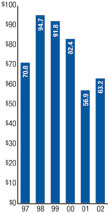
Focused on Financial InitiativesCaraustar continued to generate and manage cash flow through a variety of strategic initiatives including: improving purchasing processes, new product development, rationalizing unprofitable capacity and controlling capital expenditures. Compared to 2001, Caraustar freed up over $24.3 million in cash by managing working capital, even with the acquisition of Smurfit-Stone Container Corporation's Industrial Packaging Division (SIPD). As Caraustar's markets remain highly competitive and the domestic economy continues a slow recovery, the company's emphasis will be on effective and conservative cash management. |
|||||||||||||
Generating Significant Cash Flow |
|||||||||||||
|
|||||||||||||
|
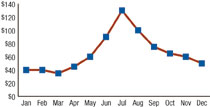
Caraustar's mill relationships allow it to purchase fiber in a more competitive manner, which is critical in a market affected by volatile fiber costs. Caraustar also effectively manages its chemical additives purchases through its Paradigm Chemical and Consulting Division. Paradigm is charged with supplying all of the company's process additives at the lowest possible costs, as well as consulting with operating managers to resolve process problems. This stand-alone business also offers its purchasing and consulting expertise to outside customers as well as to Caraustar. Established in 2001, Paradigm's key leadership team has, collectively, over 75 years of paper chemistry sales and application experience. In 2002, Paradigm is estimated to have reduced chemical costs by more than $6 million through leveraging Caraustar's purchases and training operating managers in the proper application and monitoring of additives. Energy also constitutes one of Caraustar's most significant variable costs, averaging $50 per ton in 2002. As prices remain volatile due to geopolitical concerns, Caraustar has sought other means by which to mitigate this volatility. In most cases, our mills have the ability to utilize more than one source of energy (i.e., natural gas, fuel oil or coal) to provide steam to power the paperboard machines. This provides the company with some flexibility to switch to the most economical energy source in a given situation. |
|||||||||||||
Focused on New Products with Opportunities to Enhance Margins |
|||||||||||||
|
|||||||||||||
|
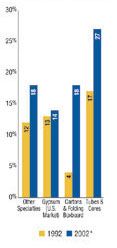
The Sprague Paperboard mill's new products, InverFreez and InverTop, represent competitively priced customer solutions for the food packaging industry. This has allowed Caraustar to enter into former virgin substrate markets where strong demand is already in place, thereby improving the company's volume. The Sprague product offers similar characteristics as virgin products but at 20 to 30 percent reduced cost to the converter. As a result, the production of InverFreez and InverTop has grown to represent over 20 percent of the 174 thousand tons manufactured at the Sprague mill in 2002. Other products, such as board for carded packaging produced at the company's Rittman facility, an increased volume demand for Caraustar's overnight mailer products, and continued market share growth in the pharmaceutical and healthcare industries, helped improve volume growth in 2002. One of the few bright spots in the U.S. industrial economy in 2002 was the continued gains in the home building and remodeling market. Demand for wallboard facings grew 1.8 percent in 2002, and more importantly, has increased 17 percent over the last five years. The rebuild of Caraustar's joint venture mill in Indiana, PBL, realized a 44 percent increase in its output of gypsum facing paper in 2002. The key to future success at PBL is the combination of a high-strength facing paper with a paper weight approximately 25 percent below historic nominal averages. The PBL product has other characteristics critical to support the new family of high speed wallboard manufacturing lines built over the last three years. Furthermore, the lightweight paper characteristic reduces freight costs for the mill and for the wallboard maker and decreases drying requirements, thereby reducing energy costs for the wallboard plant. Restructuring and ConsolidationThrough restructuring and consolidation Caraustar has reduced capacity by 225 thousand tons since 1999. The restructuring is part of an ongoing effort to rationalize Caraustar's capacity, balance industry demand and cost-effectively meet customer demands. Halifax Paper Board Company, Roanoke Rapids, NC, was permanently shut down in December 2002. The mill had been idle since mid-2001 due to reduced market demand for uncoated recycled boxboard for the specialty product businesses. As a result of the trend toward offshore sourcing of various specialty products, such as board games and puzzles, Carolina Converting, Inc., Fayetteville, NC, will be consolidated with another specialty converting location and relocated in 2003. Additionally, the carton converting operation at Ashland Carton Plant, Ashland, OH, was restructured to focus on product lines where Caraustar has competitive efficiencies. Through its consolidating and restructuring measures, Caraustar expects to achieve significant cost savings in 2003. Another example of improving capacity utilization was the consolidation of Caraustar's folding carton plants in Archdale and Randleman, NC. Combining these two plants that were only 13 miles apart will provide a more competitive platform to serve our customer base with improved manufacturing capabilities and efficiencies. In January 2003, the company completed the purchase of the remaining equity interest in Caraustar Northwest, LLC, located in Tacoma, WA. The interest was purchased for approximately $700 thousand from its venture partner, Paccess, a Portland, Oregon-based general partnership. The Tacoma facility, which manufactures tubes, cores, and edge protectors andperforms custom slitting for customers on the West Coast, became part of the Caraustar Industrial & Consumer Products Group. This operation converts approximately five thousand tons on an annualized Controlling ExpendituresCaraustar spent $22.5 million in capital expenditures to maintain and improve its asset base in 2002, compared with $28.1 million in 2001. Approximately $7 million of the capital expenditures were used for improved productivity, with the remaining $15 million spent on replacement of machinery and equipment at the company's mills and converting facilities. Capital expenditures for 2003 are expected to be in the range of $22 million to $25 million. For the first time since the Great Depression, demand for paper and paperboard products declined for three consecutive years. Over this period, however, Caraustar grew volume and market share. |
|||||||||||||
|
Caraustar continued to
focus on adding to its value in 2002 by generating cash flow through a variety of strategic programs. Caraustar Product Line
|
|
|