|
 
(14) Benefit Plans
Stewart Enterprises Employees' Retirement Trust
The Company has a defined contribution retirement plan, the "Stewart
Enterprises Employees' Retirement Trust (A Profit-Sharing Plan)
("SEERT")." This plan covers substantially all
employees with more than one year of service who have attained
the age of 21. Contributions are made to the plan at the discretion
of the Company's Board of Directors. Additionally, employees
who participate may contribute up to 15% of their earnings. Effective
January 1, 1997, the first 5% of such employee contributions
are eligible for Company matching contributions at the rate of
$.50 for each $1.00 contributed. Prior to January 1, 1997, Company
matching contributions were $.25 for each $1.00 contributed.
The Company's expense, including the Company's matching contributions,
for the fiscal years ended October 31, 1998, 1997 and 1996 was
approximately $3,550, $2,900 and $2,550, respectively.
Non-qualified Supplemental
Retirement and Deferred Compensation Plan
In January 1994, the Company developed
a non-qualified key employee defined contribution supplemental
retirement plan, which provides certain highly compensated employees
the opportunity to accumulate deferred compensation which cannot
be accumulated under SEERT due to certain limitations. Contributions
are made to the plan at the discretion of the Company's Board
of Directors. Additionally, employees who participate may contribute
up to 15% of their earnings. Effective January 1, 1997, the first
5% of such employee contributions are eligible for Company matching
contributions at the rate of $.50 for each $1.00 contributed.
Prior to January 1, 1997, Company matching contributions were
$.25 for each $1.00 contributed. The Company's expense, including
the Company's matching contributions, for the fiscal years ended
October 31, 1998, 1997 and 1996 was approximately $300, $164
and $116, respectively.
1991 Incentive Compensation Plan
In May 1991, the Company adopted the 1991 Incentive Compensation
Plan, pursuant to which officers and other employees of the Company
could be granted stock options, stock awards, restricted stock,
performance share awards or cash awards by the Compensation Committee
of the Board of Directors. From September 25, 1992 through October
31, 1995, the Company granted options that become exercisable
based upon the passage of time to officers and other employees
for the purchase of a total of 2,905,876 shares of Class A Common
Stock at exercise prices equal to the fair market value at the
grant date, which ranged from $4.45 to $8.00 per share. The options
generally were exercisable in 25% annual increments over the
four years following their grant, except that options granted
during fiscal year 1995 were exercisable 50% per year over the
next two years. On July 25, 1995, the Compensation Committee
accelerated by two months the exercisability of options scheduled
to become exercisable September 25, 1995. As of October 31, 1998,
there were no outstanding options under this Plan.
From November 1, 1992 through October 31,
1995, the Company granted performance-based options to certain
officers and other employees for the purchase of a total of 3,300,000
shares of Class A Common Stock at exercise prices equal to the
fair market value at the grant date, which ranged from $4.78
to $8.00 per share. The agreements under which the options were
granted provided that the options were to become exercisable
on December 1, 1996 only if, at any time prior to November 1,
1996, the average of the closing sale prices of a share of the
Company's Class A Common Stock over five consecutive trading
days equaled or exceeded $9.89, and the average annual compounded
increase in the Company's earnings per share for the four fiscal
years ending October 31, 1996 was at least 15%. Generally accepted
accounting principles require that a charge to earnings be recorded
for these performance-based options for the difference between
the exercise price and the then-current stock price when achievement
of the performance objectives becomes probable.
During May 1995, the stock price objective
was achieved, and in July 1995, management determined that the
achievement of the earnings objective was probable. Accordingly,
during the third quarter of fiscal year 1995, the Company recorded
a noncash charge of $17,252 ($10,869, or $.15 per share, after-tax)
for the difference between the option exercise prices and $10.79,
the then-market price of the Company's Class A Common Stock.
Additionally, in July 1995 the Compensation Committee accelerated
the exercisability of the performance-based options, thereby
establishing the total charge to earnings. As of October 31,
1998, all performance-based options granted under the 1991 Incentive
Compensation Plan had been exercised.
Pursuant to the Company's 1991 Incentive
Compensation Plan, each director and certain former directors
of the Company who are not employees of the Company were granted
options to purchase 11,250 shares of the Company's Class A Common
Stock on each of February 16, 1993, and November 1, 1993, 1994
and 1995. Persons who are not employees of the Company who joined
the Board between option grant dates and certain former directors
received a reduced number of options based on the number of months
of service on the Board prior to the next grant date. The options
became exercisable on October 31 following the date of grant,
but may be exercised earlier if the director dies, retires from
the Board on or after reaching age 65 or becomes disabled. The
options expired on October 31, 1997. The exercise price of the
options was 80% of the fair market value of the Class A Common
Stock on the date of grant. As of October 31, 1998, 243,750 options
had been granted pursuant to these provisions of the Plan, and
all had been exercised.
1995 Incentive Compensation Plan
In August 1995, the Board of Directors adopted, and in December
1995 and December 1996 amended, the 1995 Incentive Compensation
Plan, pursuant to which officers and other employees of the Company
may be granted stock options, stock awards, restricted stock,
stock appreciation rights, performance share awards or cash awards
by the Compensation Committee of the Board of Directors. From
September 7, 1995 through April 7, 1998, the Company granted
options to officers and other employees for the purchase of a
total of 7,424,536 shares of Class A Common Stock at exercise
prices equal to the fair market value at the grant dates, which
ranged from $10.50 to $21.50 per share. In general, two-thirds
of the options became exercisable in full on the first day between
the date of grant and August 31, 2000 that the average of the
closing sale prices of a share of the Company's Class A Common
Stock for the 20 preceding consecutive trading days equaled or
exceeded $26.44, which represented a 20% annual compounded growth
in the price of a share of the Company's Class A Common Stock
over five years. The remaining options generally become exercisable
in 20% annual increments beginning on September 7, 1996, except
for grants issued since the initial grant date, which options
vest over the remainder of the original five-year period. The
Compensation Committee may accelerate the exercisability of any
option at any time at its discretion and the options become immediately
exercisable in the event of a change of control of the Company,
as defined in the plan. All of these options expire on October
31, 2001. As of October 31, 1998, 4,968,506 options had been
exercised under this plan, and 130,190 options had been forfeited.
During April 1998, the stock price performance
target was achieved, and the Company's performance-based stock
options granted under the Company's 1995 Incentive Compensation
Plan and covering 4,855,886 shares vested. Accordingly, during
the second quarter of fiscal year 1998, the Company was required
by generally accepted accounting principles to record a nonrecurring,
noncash charge to earnings of $76,762 ($50,279, or $.51 per share,
after-tax).
Additionally, to encourage optionees to
exercise their options immediately in order to renew the performance-based
option program and to reduce potential dilution from additional
shares in the market, the Company offered to repurchase the options
for the difference between $27.31, the closing price on the date
on which the options vested, and the exercise price of the options.
The repurchase of certain of the options by the Company and the
exercise of the remaining options resulted in a cash outlay of
$69,431.
In July and August 1998, the Company granted
new options under the 1995 Incentive Compensation Plan to officers
and employees for the purchase of 3,592,250 shares of Class A
Common Stock at exercise prices equal to the fair market value
at the grant dates, which ranged from $21.38 to $27.25 per share.
One-third of the options become exercisable in 20% annual increments
beginning on July 17, 1999. The remaining two-thirds of the options
become exercisable in full on the first day between the grant
date and July 17, 2003 that the average of the closing sale prices
of a share of Class A Common Stock over the 20 preceding consecutive
trading days equals or exceeds $67.81, which represents a 20%
annual compounded growth in the price of a share of Class A Common
Stock over five years. Generally accepted accounting principles
require that a charge to earnings be recorded for the performance-based
options for the difference between the exercise price and the
then current stock price when achievement of the performance
objective becomes probable. All of the options expire on July
31, 2004.
Directors' Stock Option Plan
Effective January 2, 1996, the Board of Directors adopted, and
in December 1996 amended, the Directors' Stock Option Plan, pursuant
to which each director of the Company who is not an employee
of the Company was granted an option to purchase 72,000 shares
of the Company's Class A Common Stock. From January 2, 1996 through
October 31, 1997, the Company granted a total of 360,000 options
at exercise prices equal to the fair market value at the grant
dates, which ranged from $12.34 to $18.25 per share. The options
generally become exercisable in 25% annual increments beginning
January 2, 1997, except for grants issued since the initial grant
date, which options vest over the remainder of the original four-year
period. The Compensation Committee may accelerate the exercisability
of any option at any time at its discretion and the options become
immediately exercisable in the event of a change of control of
the Company, as defined in the plan. All of the options expire
on January 2, 2001. As of October 31, 1998, 91,052 options had
been exercised under this plan.
Employee Stock Purchase Plan
On July 1, 1992, the Company adopted an "Employee Stock
Purchase Plan" and reserved 2,250,000 shares of Class A
Common Stock for purchase by eligible employees, as defined.
The plan provides to eligible employees the opportunity to purchase
Company Class A Common Stock semiannually on June 30 and December
31. The purchase price is established at a 15% discount from
fair market value, as defined. As of October 31, 1998, 477,033
shares had been acquired under this plan.
Statement of Financial Accounting Standards No.
123
The Company has adopted the disclosure-only provisions of Statement
of Financial Accounting Standards No. 123, "Accounting for
Stock-Based Compensation," (SFAS 123) and continues to apply
Accounting Principles Board Opinion No. 25 and related interpretations
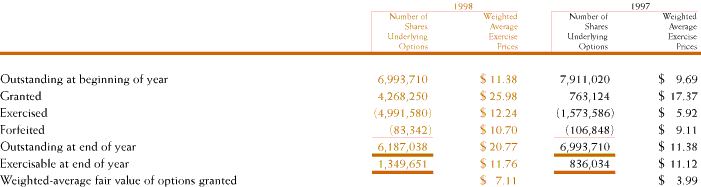
in accounting for its stock-based compensation plans. The following
table is a summary of the Company's stock options outstanding
as of October 31, 1998 and 1997, and the changes that occurred
during fiscal years 1998 and 1997.
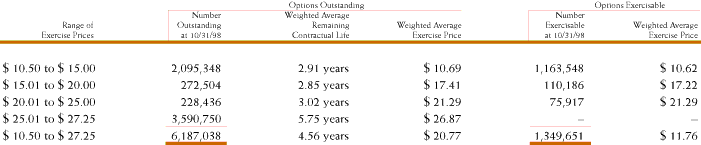
The following table further describes the
Company's stock options outstanding as of October 31, 1998:
SFAS 123 applies only to options granted,
and shares acquired under the Company's Employee Stock Purchase
Plan, since the beginning of the Company's 1996 fiscal year.
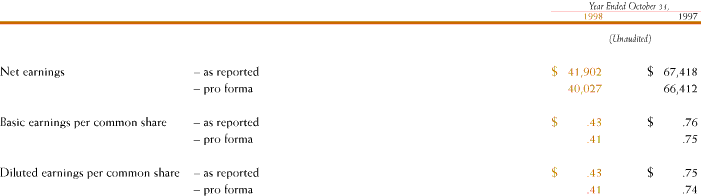
Consequently, the pro forma amounts disclosed below do not reflect
any compensation cost for the 7.8 million stock options outstanding
as of the beginning of fiscal year 1996. If the Company had elected
to recognize compensation cost for its stock option and employee
stock purchase plans based on the fair value at the grant dates
for awards under those plans, in accordance with SFAS 123, net
earnings and earnings per share would have been as follows:
The fair value of the Company's stock options
used to compute pro forma net earnings and earnings per share
disclosures is the estimated present value at grant date using
the Black-Scholes option pricing model with the following weighted
average assumptions for fiscal years 1998 and 1997, respectively:
expected dividend yield of .3% and .2%; expected volatility of
20.9% and 19.6%; risk-free interest rate of 5.5% and 6.1%; and
an expected term of 4.7 and 3.3 years, respectively.
Likewise, the fair value of shares acquired
through the Employee Stock Purchase Plan is estimated on each
semiannual grant date using the Black-Scholes option pricing
model with the following weighted average assumptions for fiscal
years 1998 and 1997, respectively: expected dividend yield of
.2% for both years; expected volatility of 20.5% and 19.6%; risk-free
interest rate of 5.3% and 5.2%; and an expected term of .5 years,
for both years.
|

