 |
 |
|
Earnings also included pretax charges of $7.6 million to conform First American’s accounting policies to AmSouth’s policies, an $8.0 million impairment loss on a First American portfolio investment and $71.0 million in loan impairment losses associated with certain healthcare-related loans transferred to AHAD. On an after-tax basis, these items totaled $264.3 million. Excluding the merger-related and other charges, 1999 diluted earnings per share were $1.53 on income of $604.7 million. Refer to Note 3 in the Notes to Consolidated Financial Statements for a more detailed discussion of merger and other related charges. Two key measures of profitability in the banking industry are return on average equity (ROE) and return on average assets (ROA). ROE measures the profitability of a company’s shareholders’ equity, while ROA measures how effectively a company utilizes its assets. Based on reported earnings, ROE was 11.57 percent in 2000 compared to 10.69 percent in 1999 and 15.33 percent in 1998. ROA was 0.79 percent in 2000, 0.81 percent in 1999 and 1.22 percent in 1998. Earnings Analysis |
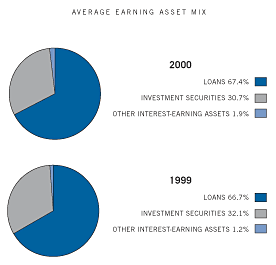
The amount of NII earned is determined primarily by variations in the volume and mix of interest-earning assets and interest-bearing liabilities and changes in their related yields and interest rates paid. Net interest income was $1.4 billion in 2000, a decrease of $91.6 million or 6.0 percent from 1999. The decline was primarily caused by a decrease in the net interest margin (NIM), the result of higher interest rates and lower volumes of interest-free funding sources. The NIM declined 27 basis points in 2000 to 3.75 percent versus 4.02 percent in 1999. It is expressed as a percentage and is computed by dividing fully taxable equivalent NII by average interest-earning assets. The NIM measures how effectively the bank utilizes its interest-earning assets in relationship to the interest cost of funding them. The decline in the NIM during 2000 was a result of higher funding costs caused by rapidly rising interest rates. Further compounding the impact of rising interest rates was AmSouth’s sensitivity to rising rates caused by the mix of earning assets and funding sources on the balance sheet. AmSouth had a substantial portion of fixed-rate earning assets, such as investment securities and automobile loans, while relying on floating rate funding sources, such as interest-bearing deposits and wholesale borrowings. As interest rates rose in 1999 and 2000, rates paid on funding liabilities increased more rapidly than yields on interest-earning assets. The result was margin compression and a narrowing net interest spread. The NIM compression and NII decline were partially offset by benefits resulting from restructuring a portion of the leasing portfolio during 2000 which permanently lowered the effective tax rate on income from the portfolio. These transactions resulted in an increase to the taxable equivalent adjustment of $35.4 million and an increase to NII on a fully taxable equivalent basis of $10.9 million compared to 1999. Interest-earning assets are primarily composed of loans and investment securities and were relatively flat compared to 1999. Average loans net of unearned income (net loans) were slightly higher in 2000 due to growth primarily in commercial real estate and equity lending. See further discussion of loans in the Balance Sheet Analysis. |
|
|
|
|
 |
|