Notes
to Financial Statements pg 1 2 3
4 5 6
7 8 9
10 11 12
13 14 15
16

Downloadable Version

PDF

1. Summary of Significant Accounting Policies
Description of Business
Best Buy Co., Inc. is North America’s No. 1 specialty retailer of name-brand consumer electronics, home office equipment, entertainment software and appliances. We operate three segments: Best Buy, Musicland and International. Best Buy is a specialty retailer of consumer electronics, home office equipment, entertainment software and appliances comprised of 481 stores in 44 states. Also included in the Best Buy segment is Seattle-based Magnolia Hi-Fi, a high-end retailer of audio and video products with 13 stores. Musicland, with more than 1,320 locations in the United States, Puerto Rico and the U.S. Virgin Islands, is primarily a mall-based retailer of prerecorded music, movies and other entertainment-related products. International is comprised of Future Shop, which currently operates 95 stores and is Canada’s largest consumer electronics retailer, offering products similar to Best Buy.
Basis of Presentation
The consolidated financial statements include the accounts of Best Buy Co., Inc. and its subsidiaries. Significant
intercompany accounts and transactions have been eliminated. All subsidiaries are wholly owned.
Use of Estimates in the Preparation of
Financial Statements
The preparation of financial statements in conformity with generally accepted accounting principles requires us to make estimates and assumptions. These estimates and assumptions affect the reported amounts in the consolidated balance sheets and statements of earnings, as well as the disclosure of contingent liabilities. Actual results could
differ from these estimates and assumptions.
Fiscal Year
Our fiscal year ends on the Saturday nearest the end of February. Fiscal 2002 and 2000 each included 52 weeks, while fiscal 2001 included 53 weeks.
Cash and Cash Equivalents
We consider highly liquid investments with a maturity of three months or less when purchased to be cash equivalents. These investments are carried at cost, which approximates market value.
Recoverable Costs From Developed Properties
The costs of acquisition and development of properties that we intend to sell and lease back or recover from
landlords within one year are included in current assets.
Merchandise Inventories
Merchandise inventories are recorded at the lower of cost or market. The primary methods used to determine cost are the average cost and retail inventory methods.
Property and Equipment
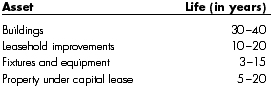
Property and equipment are recorded at cost. Depreciation is computed using the straight-line method over the estimated useful lives of the assets or, in the case of leasehold improvements, over the shorter of the estimated useful lives or lease terms. When indicators of impairment exist, we evaluate long-lived assets for impairment using an undiscounted cash flow analysis.
Estimated useful lives by major asset category are as follows:
 back
to top
back
to top