

Similar to many retailers, the Company’s business is seasonal. Revenues and earnings are typically greater during the second half of the fiscal year, which includes the holiday selling season. The timing of new store openings, costs associated with acquisitions and development of new businesses, and general economic conditions also may affect future quarterly results of the Company.
The following tables show selected unaudited quarterly operating results and high and low prices of the Company’s common stock for each quarter of fiscal 2001 and 2000.
($ in thousands,
except per share amounts)
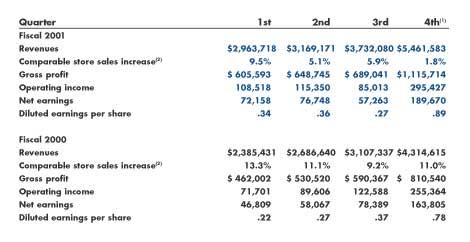
(1) The fourth quarter of fiscal 2001 included 14 weeks. All other quarters included 13 weeks. The comparable store sales increase for the fourth quarter of fiscal 2001 was based upon the comparable 14-week period for the prior year. Also, during the fourth quarter of fiscal 2001, the Company acquired the common stock of Musicland Stores Corporation and Magnolia Hi-Fi, Inc. The results of operations of those businesses are included from their dates of acquisition.(2) Best Buy stores only.
Common Stock Prices
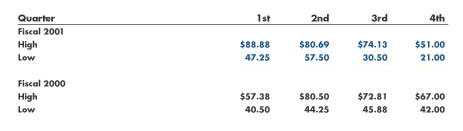
Best Buy’s common stock is traded on the New York Stock Exchange under the symbol BBY. As of March 30, 2001, there were 1,970 holders of record of Best Buy common stock. The Company has not historically paid, and has no current plans to pay, cash dividends on its common stock.
Forward-Looking Statements
Section 27A of the Securities Act of 1933, as amended, and section 21E of the Securities Exchange Act of 1934, as amended, provide a “safe harbor” for forward-looking statements to encourage companies to provide prospective information about their companies. With the exception of historical information, the matters discussed in this annual report are forward-looking statements and may be identified by the use of words such as “believe,” ”expect,” “anticipate,” “plan,” “estimate,” “intend” and “potential.” Such statements reflect the current view of the Company with respect to future events and are subject to certain risks, uncertainties and assumptions. A variety of factors could cause the Company’s actual results to differ materially from the anticipated results expressed in such forward-looking statements, including, among other things, general economic conditions, acquisitions and development of new businesses, product availability, sales volumes, profit margins, and the impact of labor markets and new product introductions on the Company’s overall profitability. Readers should review the Company’s Current Reports on Form 8-K that describe additional important factors that could cause actual results to differ materially from those contemplated by the statements made in this annual report.
 back
to top
back
to top