     
      


 |
|
|
|
The Company has defined benefit pension plans available
to substantially all employees that are either fully paid for
by the Company or provide for mandatory employee contributions
as a condition of participation. Under the cash balance plan
in the United States, a participating employee accumulates a
cash balance account which is credited monthly with an allocation
equal to 3.5 percent of compensation and interest. The Company’s
funding policy is to contribute annually the statutorily required
minimum amount as actuarially determined.
The Company also maintains a supplemental nonqualified executive
retirement program for certain of its executives. The benefit
obligation related to this program is included below and is
approximately $20 million and $18 million at December 31, 2002
and 2001, respectively.
Assets set aside in a rabbi trust established for this program,
that approximate the obligation, are included in other assets
on our balance sheet. At December 31, 2002, certain of our international
plans were underfunded by approximately $24 million and our
U.S.-based plan was fully funded.
The Company, generally at its own discretion, provides a postretirement
healthcare program that is administered by the Company to employees
who elect to and are eligible to participate. The Company funds
a portion of the costs of this program on a self-insured and
insured-premium basis and, for the years ended December 31,
2002, 2001 and 2000, made payments totaling $1.7 million, $1.8
million and $2.1 million, respectively.
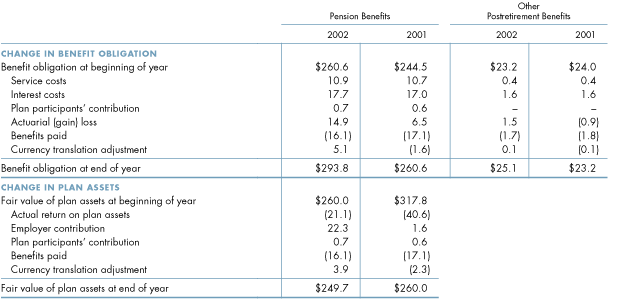
The changes in benefit obligations and plan assets were as follows
at December 31 (in millions):
|
|
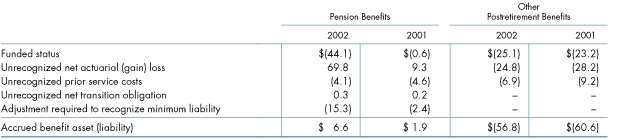
The funded status of the Company’s pension and postretirement
programs was as follows at December 31 (in millions):
|
|
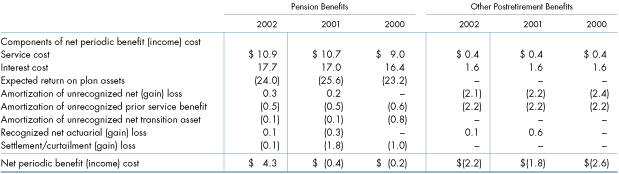
The net periodic pension benefit cost (income) and postretirement
healthcare benefit income includes the following components
for the years ended December 31 (in millions):
|
|
In 1993, the Company amended certain of its existing postretirement
healthcare programs creating an unrecognized prior service benefit.
The unrecognized prior service benefit is being amortized over
approximately 13 years.
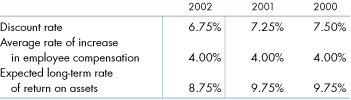
The development of the net periodic pension benefit cost (income)
and the projected benefit obligation were based upon the following
assumptions for the years ended December 31:
|
|
The date used to measure plan assets and liabilities was October
31 in each year. Plan assets are invested primarily in stocks,
bonds, short-term securities and cash equivalents.
The weighted average discount rate used in determining the accumulated
postretirement healthcare benefit obligation was 6.75 percent,
7.25 percent and 7.5 percent for the years ended December 31,
2002, 2001 and 2000, respectively. A 7.25 percent annual rate
of increase in per capita cost of covered healthcare benefits
was assumed for 2002 and beyond. Because of limitations on the
Company’s contributions under the amended healthcare program,
changes in the healthcare trend rate assumption do not have
a significant effect on the amounts reported. To illustrate,
a change in the assumed healthcare cost trend rate by 1 percentage
point effective January 2002 would change the accumulated postretirement
benefit obligation as of December 31, 2002 by approximately
$0.6 million and the aggregate of the service and interest cost
components of net periodic postretirement benefit cost (income)
for the year ended December 31, 2002 by approximately $0.1 million.
The Company also maintains a defined contribution savings and
profit sharing plan (the “Plan”). The Plan allows
eligible employees to participate after six months and 500 hours
of service. Participants may elect to contribute between 1 percent
and 15 percent of their annual compensation as defined in the
Plan. The Company is obligated to contribute an amount equal
to 25 percent of each employee’s basic contribution, as
defined, and may, at the discretion of the Company, contribute
additional amounts. For the years ended December 31, 2002, 2001
and 2000, the Company’s contributions to the Plan were
$4.4 million, $3.8 million and $4.1 million, respectively. |
|
|