GAS DISTRIBUTION
Nicor Gas typically accounts for about 90 percent of
Nicor Inc.'s consolidated operating income. The company
is widely regarded as one of the best companies in the
natural gas distribution industry, and it consistently ranks
at or near the top of its industry in terms of operating
efficiency and financial returns.
Nicor Gas delivers natural gas to 1.9 million customers
in a service territory that encompasses most of the northern
third of Illinois, excluding the city of Chicago. The
company's customer base consists of a well-balanced mix
of residential, commercial and industrial customers, and
the region's diverse economy helps to reduce the potential
impact of adverse conditions in any specific industry.
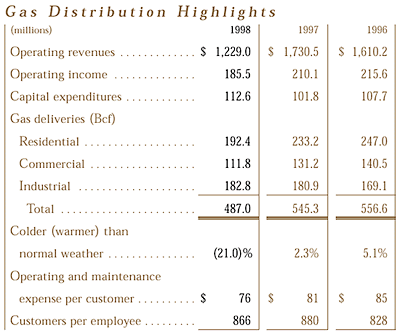
Financial Results. Gas distribution operating income
decreased to $185.5 million in 1998 from $210.1 million
in 1997 due to the impact of weather that was 23 percent
warmer than the prior year, partially offset by a 4 percent
reduction in operating and maintenance expenses.
Natural Gas Deliveries. This past year was the warmest
of this century in northern Illinois, and the unusually
warm weather had an adverse impact on demand for
natural gas in Nicor Gas' service territory. For the year,
natural gas deliveries were 487 Bcf compared with 545
Bcf in 1997. The negative impact of warmer weather
was partially offset by several positive factors, including
an increase in deliveries for electric power generation,
the addition of new customers, and efforts to promote
increased use of natural gas among existing customers.
The Choice Is Yours. The utility industry has changed
significantly in recent years, and consumers are finding
that regulatory changes and increased competition are
leading to new alternatives.
Nicor Gas supports customer choice and believes all
customers should be able to choose their natural gas
supplier. Almost all of the company's industrial natural
gas deliveries are to customers who already buy some
or all of their natural gas from third-party suppliers. To
make choice an option for even more customers, Nicor
Gas launched its Customer Select ® test program in 1998, and 20,000 commercial and industrial customers, the maximum allowed to enroll, chose to participate. In September 1998, the company received approval to
open the program to an additional 40,000 business
customers and 80,000 residential customers beginning
in 1999. In all instances, Nicor Gas will continue to
deliver natural gas to the customer, provide for the
safety and maintenance of its distribution system, and
read customer meters.
Building on Our Strengths. As the utility industry
has changed, Nicor Gas has focused on its strengths.
The company has an extensive storage and transmission
system that provides significant flexibility when it comes
to serving the needs of customers. The system interconnects
with six interstate pipelines-including the new
Northern Border pipeline-and additional interconnects
are likely in the future as new pipelines come into the
area. This gives Nicor Gas an enviable supply position
and helps keep customer prices low.
Historically, Nicor Gas' low prices have given the
company a competitive advantage versus electricity in
northern Illinois, and have also gone a long way toward
ensuring a high level of customer satisfaction. The people
of Nicor Gas are also one of the company's strengths,
providing the ability to anticipate and adapt to changes
in the industry.
Working to Achieve Growth. While some opportunities
in the energy industry are best pursued through unregulated
entities (see "Other Nicor Ventures" on pages 13 and 14),
there are still opportunities to achieve growth in the gas
distribution business. Nicor Gas has averaged about 30,000
customer additions per year in recent years, and has also
worked hard to achieve additional deliveries to existing
commercial and industrial customers through focused
sales and marketing efforts. However, deliveries can be
adversely affected when customers replace old equipment
with newer, more energy-efficient equipment.
To help achieve growth at Nicor Gas, the company
has pursued a variety of opportunities. Over the past few
years, for example, Nicor Gas has put itself in position to
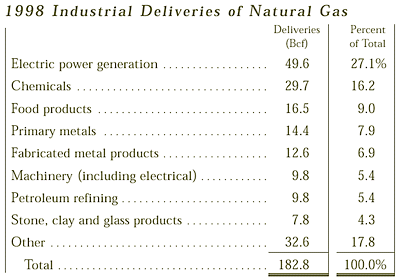
serve the market for electric power generation. In 1998,
deliveries of natural gas for electric power generation
increased to 50 Bcf, up from 40 Bcf the prior year and
22 Bcf just two years ago.
Nicor Gas has also had success in nontraditional
activities, finding innovative ways to utilize its physical
assets by providing natural gas storage and intrastate
transportation services. These and other nontraditional
activities contributed over $8 million to operating
income in 1998.
Is There Anything Else I Can Do for You? An essential
element of any effort to achieve growth is outstanding
customer service. Nicor Gas has devoted significant effort
in recent years to improving upon an already high level
of customer satisfaction by asking the customer, "Is there
anything else I can do for you?"
Nicor Gas strengthened its commitment to customers
in 1998 by implementing a toll-free telephone number
and by revising its bill format in response to customers'
desire for a more "understandable" bill. The company
also implemented measures to enhance the billing
process and the way customer inquiries are resolved.
To continue building on these efforts and successes,
Nicor Gas is taking advantage of every opportunity to
listen to customers and understand their needs, and to
develop and deliver solutions that create value. This
may mean developing products and services not currently
offered, or improving existing services to better serve
customers. The people of Nicor Gas will continue to make
other changes-large and small-to keep the Nicor
promise of "unconditional personal service for each
and every customer."
The Keys to Success. As the people of Nicor Gas
look to the future, they are focusing on a number of key
issues that must be addressed in order to achieve success.
Growth: With a diverse and growing customer base, an
extensive storage and transmission system, and a favorable
location on the nation's natural gas pipeline grid,
Nicor Gas has achieved favorable returns and cash flow
at a time when significant changes are taking place in
the gas distribution industry. The company plans to
continue to pursue a combination of both traditional
and nontraditional activities in order to achieve growth
and capitalize on new opportunities.
Customer Care: Nicor Gas is strengthening its
commitment to customer satisfaction by working to
better understand customer expectations, focusing on
employee training and education, and measuring and
monitoring its progress against improvement goals. One
of the objectives is to build loyalty to the Nicor brand,
and customer input during the past two years indicates
a high degree of customer satisfaction and loyalty.
Employee and Organizational Excellence: Nicor Gas strives
to be recognized by both employees and the communities
it serves as a great place to work. In order to achieve
those objectives, the company works to promote leadership
and teamwork internally, and focuses on shared
values and the employee behaviors that support those
values in order to create a high-performance work culture.
Technology: Many of Nicor Gas' initiatives require technological
solutions. Accordingly, a key issue for 1999 is to
establish a framework to optimize the uses of technology
to accomplish business strategies.
Cost Management: In the past, Nicor Gas has successfully
focused on tightly controlling costs while maintaining
system integrity, and will continue to do so in the future.
Over the years, cost management and ensuring reliability
have become part of the corporate culture at Nicor Gas.
SHIPPING
Tropical Shipping, one of the largest carriers of
containerized cargo in the Caribbean region, typically
accounts for about 10 percent of Nicor's operating
income. The company has a reputation for providing
quality and on-time service and has earned leading
market shares in many of the ports it serves.
Nicor has owned Tropical Shipping since 1982, and
over the years the company has contributed significantly
to earnings growth and cash flow at Nicor.
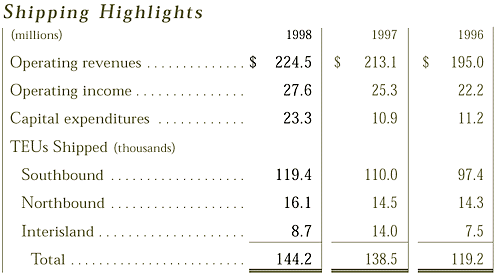
Financial Results. In 1998, Tropical Shipping again
achieved record volumes shipped, revenues and operating
income. Operating income was $27.6 million, up from
$25.3 million in 1997, due to an increase in volumes
shipped and higher average rates.
Year in Review. For the year, Tropical Shipping
transported 144,200 TEUs compared with 138,500 TEUs
in 1997 as the company increased volumes in nearly
every region it serves.
The company also continued its efforts to increase
efficiency and reduce costs. Tropical Shipping operates
a fleet of 13 owned and 5 charter vessels, and in 1998,
the company modified its vessel schedule in order to
reduce the number of weekly port calls, streamline the
handling of containers, and free up vessel capacity.
Tropical Shipping also increased its overall capacity by
upgrading its charter vessels. The fleet is carefully managed
to avoid overcapacity in any given market, and to
ensure the optimum combination of cargo mix and speed.
Tropical Shipping also made a significant investment
in new freight equipment in 1998. Taking advantage of
container prices that were very low compared to historical
levels, Tropical Shipping purchased over 1,100 containers
in 1998, increasing its overall capacity and replacing a
significant portion of older and leased containers.
Industry Developments. On October 1, 1998, the
U.S. Congress passed the Ocean Shipping Reform Act.
This Act has an effective date of May 1, 1999, subject
to implementation regulations to be issued by the
Federal Maritime Commission by March 1, 1999. The
Act allows confidential contracts between shipping
companies and their customers, and many believe this
change will put downward pressure on ocean shipping
rates. Additionally, global carriers are establishing a
presence in the Caribbean market.
Outlook. Tropical Shipping is meeting the challenge of
deregulation and increased competition through effective
cost management, superior customer service and its
premier fleet and shore assets. The company's primary
goals continue to be:
- building close ties with customers;
- being the "low-cost" competitor through on-time,
efficient cargo handling and vessel scheduling;
- developing diversified revenue sources;
- managing costs to maintain a competitive advantage; and
- developing a talented workforce.
Although the Caribbean marketplace has matured significantly,
growth opportunities remain. Most of the region is
economically and politically stable, and Tropical Shipping
is pursuing opportunities to increase volumes in markets it
already serves, expand geographically in the region to
new markets, serve additional U.S. ports, and continue
to expand in nontraditional niche businesses.
In addition, Tropical Shipping is considering updating
its fleet by adding new vessels with greater capacity
which are capable of higher speeds. The company has
not added to its fleet of owned vessels since 1993, and
since that time, the volume of shipments handled by
Tropical Shipping has grown by 50 percent. The company
has relied on charter capacity to handle the increase in
volumes, but expanding Tropical Shipping's owned fleet
may be a more economical way to meet the company's
long-term needs.
Overall, Tropical Shipping is well-positioned for
continued success in the Caribbean. The company is
financially strong, competitive and poised to build on
its status as the quality, dependable transportation
company in the Caribbean.
OTHER NICOR VENTURES
As the natural gas and electric utility industries are further
deregulated, Nicor is continually looking for opportunities
to provide products and services that will meet customers'
changing energy needs-and for innovative ways to generate
new revenue or contribute to earnings per share
growth. What follows is an update on Nicor's unregulated
energy-related businesses and financial initiatives.
Nicor Energy. Nicor Energy is a joint venture between
Nicor and Dynegy Inc. Nicor Energy's initial focus is on
providing natural gas products and services to small- and
medium-sized commercial and industrial customers-as
well as to eligible residential customers-in the greater-Chicago
area.
Looking ahead, Nicor Energy is focusing on increasing
its customer base and enhancing overall business processes
to better serve customers. The company's initiatives
include adding to its customer base in northern Illinois,
expanding geographically, developing electric capabilities
and initiating electric sales campaigns where allowed by
regulatory changes, and refining information technology
systems and other business processes.
Electric Power Generation. The market for electric
power generation can be divided into three segments:
small commercial generation, mid-sized commercial
generation, and large industrial or wholesale generation.
Already well established in the market for mid-sized
commercial generation projects, Nicor provides service
to customers as a developer and general contractor for
cogeneration projects. Nicor's success in this segment
of the market is one of the reasons the company decided
to explore other electric power generation opportunities.
Regarding the market for small generation needs, Nicor
signed a memorandum of understanding in 1998 with
General Electric (GE) Power Systems that gives Nicor
exclusive rights to market GE microturbines in Illinois
and Wisconsin. Nicor also announced an alliance with
Dynegy that gives Nicor the ability to pursue large
electric power generation projects in the Midwest. One
such project, a 250-megawatt, natural gas-fired electric
generation plant, is under construction in Illinois. Overall,
the market for electric power generation represents a
significant opportunity for Nicor.
Supply Ventures. Regulatory changes and the arrival
of Canadian gas supplies through the Northern Border
Pipeline are increasing the importance of Chicago as a
natural gas hub. This, in turn, opens up significant growth
opportunities for Nicor. Approximately 3,600 Bcf of gas is
consumed in the five-state Midwest region annually, and
the commodity changes hands many times en route to
market. Nicor continues to explore ways to facilitate
these transactions and to otherwise participate in this
evolving marketplace by entering the wholesale gas
trading business and capitalizing on the value of the
Nicor storage and transmission system, as well as its
interconnects with interstate pipelines.
Other Nonregulated Businesses. Nicor's developing
businesses build on the company's strengths and its
expertise in the utility industry. These small, but strategic,
businesses are providing a variety of unregulated products
and services, including appliance service contracts; turnkey
natural gas fueling services; and consulting, product testing
and commercialization for the natural gas industry.
Other Investments. Nicor has made a number of
financial investments in recent years. These investments
are in cargo container leasing and affordable housing tax
credit funds. The payback period on these investments is
typically very short, and they quickly generate incremental
cash flow for Nicor. Nicor's financial investments in 1998
totaled $23 million.

