|
|
 |


|
Our investment strategy is designed to help stabilize our portfolio through the inherent cycles of real estate markets while still providing the reward offered by quality assets in superior growth markets. We achieve this by balancing a number of key performance criteria. There is geographic balance: We strive to have no more than 20% of our assets in any one market. There is economic balance: An area heavily dependent upon one industry, such as tourism, is complemented by another market that is more dependent on a different industry, perhaps technology. There is seasonal balance: Strong summer rentals in one market are offset by equally strong rentals during the winter in another. Within this macro framework of portfolio allocation is the micro strategy of sub-market selection. We rely upon the expertise of our local and regional executives to select those choice in-fill or master-planned community locations which have limited competition and superior growth prospects. An occupancy rate of 95% or more for seven consecutive years demonstrates the success of this market strategy.
A. They are all high quality and relatively new, averaging nine years of age versus an industry-wide average of 34 years. We prefer newer assets for two reasons. First, they require a lower level of maintenance expenditures, thereby reducing capital spending needs. Second, there is a lower risk of design obsolescence. The design issue is particularly important in the luxury apartment category, where residents expect to live in communities with the highest quality standards and the latest in-home features and community amenities.
Q. Is there a certain age benchmark at which you automatically divest of a property?
A. No, our decision to sell a property involves many considerations. In terms of managing the portfolio, divestiture planning is as important as investment planning. Our plans are done on a rolling three-year basis in order to capture peak pricing.
Q. Gables’ portfolio seems concentrated in the Sun Belt. Does this really define your market selection process?
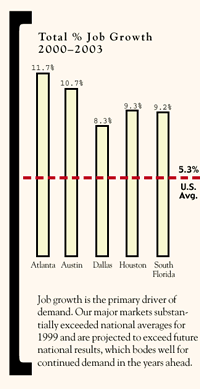
A. When we created the Company, yes; but today, no. We choose markets based on the growth characteristics of their economies and our ability to establish a critical mass in supply-constricted sub-markets. We devote a great deal of time to research and forecasting of economic trends. We want to be in high job growth markets, not only because jobs drive housing demand but also because these types of markets generally are more resilient and recover faster from economic slowdowns. It just so happens that the fastest growing job markets have been in the Sun Belt. If the overall conditions were right, we would consider other geographic areas.
Q. What other considerations drive your investment decisions?
A. Our market selection process is always an exercise in balance - striving not to be too overly dependent on one area, one type of economy, one season, etc. But even more important are our sub-market decisions - selecting the best places to invest within a given market. We tend to specialize in urban in-fill locations or master planned communities. In both cases, there is a high demand for multifamily housing and substantial barriers to entry due to development restrictions or limited land. |


 Q.
Do
the assets in Gables’ current portfolio share any one characteristic?
Q.
Do
the assets in Gables’ current portfolio share any one characteristic?