|
|
 |


|
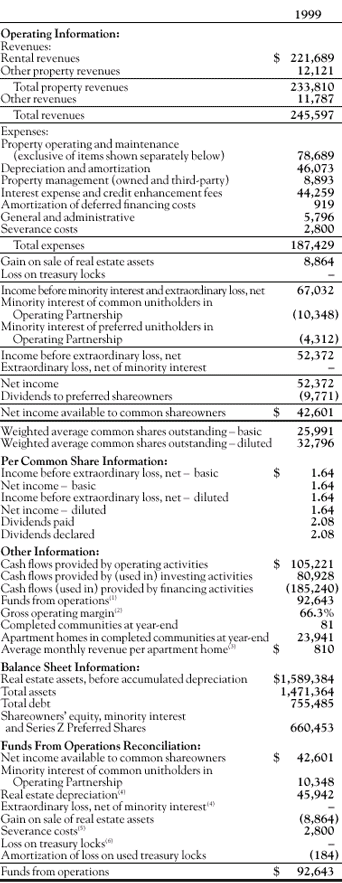
(1) Gables considers funds from operations (“FFO”) to be a useful performance measure of the operating performance of an equity REIT because, together with net income and cash flows, FFO provides investors with an additional basis to evaluate the ability of a REIT to incur and service debt and to fund dividends and capital expenditures. Gables believes that in order to facilitate a clear understanding of its operating results, FFO should be examined in conjunction with net income as presented in the financial statements and data included elsewhere in this report. Gables computes FFO in accordance with standards established by the National Association of Real Estate Investment Trusts (“NAREIT”). FFO, as defined by NAREIT, represents net income (loss) determined in accordance with generally accepted accounting principles (“GAAP”), excluding gains or losses from sales of assets or debt restructuring, plus certain non-cash items, primarily real estate depreciation, and after adjustments for unconsolidated partnerships and joint ventures. In addition, extraordinary or unusual items as well as significant non-recurring events that materially distort the comparative measurement of FFO are typically disregarded in its calculation. FFO presented herein is not necessarily comparable to FFO presented by other real estate companies due to the fact that not all real estate companies use the same definition. However, Gables’ FFO is comparable to the FFO of real estate companies that use the NAREIT definition. FFO should not be considered as an alternative to net income, an indicator of Gables’ operating performance or an alternative to cash flows as a measure of liquidity. FFO does not measure whether cash flow is sufficient to fund all of Gables’ cash needs, including principal amortization, capital expenditures, and distributions to shareowners and unitholders. Additionally, FFO does not represent cash flows from operating, investing or financing activities as defined by GAAP. Reference is made to “Management’s Discussion and Analysis of Financial Condition and Results of Operations - Liquidity and Capital Resources” for a discussion of Gables’ cash needs and cash flows. (2) Gross operating margin represents (a) total property revenues less property operating and maintenance expenses (exclusive of real estate depreciation expense) as a percentage of (b) total property revenues. (3) Average monthly revenue per apartment home is equal to the average monthly rental revenue collected during the period divided by the average monthly number of apartment homes occupied during the period. (4) Reflects real estate depreciation and extraordinary loss for both wholly-owned communities and joint ventures, as applicable. (5) Pursuant to the NAREIT definition of FFO, this item is disregarded in the calculation of FFO as it represents a significant non-recurring event that materially distorts the comparative measurement of Gables’ performance over time. Gables believes the organizational changes that resulted in the charge are unusual and non-recurring in nature. (6) Pursuant to the NAREIT definition of FFO, this item is disregarded in the calculation of FFO as it represents a significant non-recurring event that materially distorts the comparative measurement of Gables’ performance over time. While Gables may utilize derivative financial instruments such as rate locks to hedge interest rate exposure by modifying the interest rate characteristics of prospective financing transactions, it believes the events and circumstances that resulted in these losses are non-recurring in nature. |