|
|
 |



|
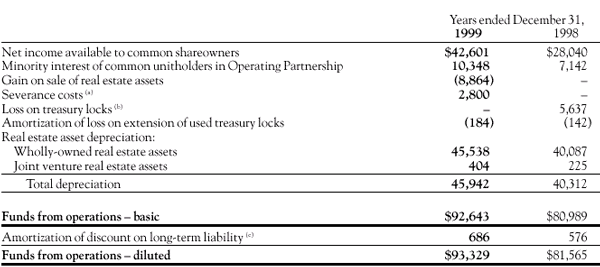
Year 2000 The Year 2000 issue occurs when business application software or embedded microcontrollers use two digits to specify the year, rather than four. As a result, computers with time-sensitive software programs may recognize a date using “00” as the year 1900 instead of the year 2000 which could result in system failures or miscalculations causing disruptions of normal business operations. Gables’ efforts to address the Year 2000 issue prior to January 1, 2000 were divided into the following phases: (1) identifying all equipment that could have been affected by the Year 2000 issue, (2) contacting the vendors and third-party providers that maintained and/or supported such equipment to obtain a Year 2000 compliance certification, (3) assembling a list of items that would not be compliant and prioritizing the items to be either replaced or retrofitted, and (4) replacing or retrofitting items that were not Year 2000 compliant, and identifying and implementing alternative solutions to items that could not be replaced or retrofitted. Gables has not experienced any significant disruptions to date in mission critical systems and it believes those systems successfully responded to the Year 2000 date change. In addition, Gables is not aware of any significant Year 2000 issues with its third-party service providers or vendors. Gables’ costs of addressing the Year 2000 issue have not been material to Gables’ financial condition or results of operations and were primarily related to equipment upgrades and allocation of personnel resources. In addition, Gables does not expect to incur any future material costs related to the Year 2000 issue. Although Gables believes its computer systems will continue to function properly going forward, there can be no assurance that such systems, or those systems of other companies on which Gables relies, will not experience some type of problem related to the Year 2000 issue, and that such problems will not result in material business interruptions, loss of revenues or other adverse effects. Accordingly, Gables will continue to monitor its mission critical systems and those of its third-party service providers and vendors throughout the year 2000. Supplemental Discussion - Funds From Operations and Adjusted Funds From Operations Gables considers funds from operations (“FFO”) to be a useful performance measure of the operating performance of an equity REIT because, together with net income and cash flows, FFO provides investors with an additional basis to evaluate the ability of a REIT to incur and service debt and to fund dividends and capital expenditures. Gables believes that in order to facilitate a clear understanding of its operating results, FFO should be examined in conjunction with net income as presented in the financial statements and data included elsewhere in this report. Gables computes FFO in accordance with standards established by the National Association of Real Estate Investment Trusts (“NAREIT”). FFO, as defined by NAREIT, represents net income (loss) determined in accordance with GAAP, excluding gains or losses from sales of assets or debt restructuring plus certain non-cash items, primarily real estate depreciation, and after adjustments for unconsolidated partner-ships and joint ventures. In addition, extraordinary or unusual items as well as significant non-recurring events that materially distort the comparative measurement of FFO are typically disregarded in its calculation. FFO presented herein is not necessarily comparable to FFO presented by other real estate companies due to the fact that not all real estate companies use the same definition. However, Gables’ FFO is comparable to the FFO of real estate companies that use the NAREIT definition. Adjusted funds from operations (“AFFO”) is defined as FFO less recurring, non-revenue enhancing capital expenditures. FFO and AFFO should not be considered alternatives to net income as indicators of Gables’ operating performance or as alternatives to cash flows as measures of liquidity. FFO does not measure whether cash flow is sufficient to fund all of Gables’ cash needs including principal amortization, capital expenditures, and distributions to shareowners and unitholders. Additionally, FFO does not represent cash flows from operating, investing or financing activities as defined by GAAP. Reference is made to “Management’s Discussion and Analysis of Financial Condition and Results of Operations - Liquidity and Capital Resources” for a discussion of Gables’ cash needs and cash flows. A reconciliation of FFO and AFFO follows:
a) Severance costs of $2,800 for the year ended December 31, 1999 represent charges associated with organizational changes resulting from management succession directives, including the resignation of the former chairman and chief executive officer and the former chief operating officer. The NAREIT definition of FFO disregards significant non-recurring events that materially distort the comparative measurement of FFO over time. Gables believes the organizational changes that resulted in the charge are unusual and non-recurring in nature. Gables also believes that other organizational changes could arise in the future that could result in similar charges. Gables believes these severance costs materially distort the comparative measurement of FFO and, therefore, have been disregarded in the calculation of FFO pursuant to the NAREIT definition of FFO. b) Loss on treasury locks of $5,637 for the year ended December 31, 1998 represents mark to market losses recorded upon the expiration of the terms of treasury lock agreements that were (1) entered into in anticipation of a projected debt offering, (2) subsequently extended in connection with modifications in the projected timing of the debt offering as a result of unanticipated capital transactions, including the South Florida acquisition, and (3) terminated due to economic conditions affecting the unsecured debt market. The NAREIT definition of FFO disregards significant non-recurring events that materially distort the comparative measurement of FFO over time. While Gables may utilize derivative financial instruments such as rate locks to hedge interest rate exposure by modifying the interest rate characteristics of prospective financing transactions, it believes the specific series of events and circumstances that resulted in the loss of hedge accounting for those treasury locks is unusual and non-recurring in nature. Gables also believes that different events and circumstances could arise in the future that could result in similar losses. Gables believes these losses materially distort the comparative measurement of FFO and, therefore, have been disregarded in the calculation of FFO pursuant to the NAREIT definition of FFO. c) This obligation was settled with Units. Such Units are excluded from basic shares and Units outstanding, but are included in the calculation of diluted shares and Units outstanding. |