* Acquisition of three distributors, two based in Miami and one in the Czech Republic, with combined 1996 revenue of $201 million. This boosts CHS' Latin American revenue above $1 billion per year and gives the Company a presence in Africa for the first time.
* Letter of intent to acquire Denmark-based Lars Krull A.S., with 1996 revenue of $70 million and operations in three countries where CHS had no presence previously Denmark, Ireland and Norway.
* Exercise of over-allotment option by underwriters adds 1.95 million shares (pre 3 for 2 split) or $62 million to the CHS public offering, making it the largest such offering in the history of the computer products distribution industry.
* Board approves three-for-two split of CHS common shares.
| 1997 | 1996 | % of change | |
| (in thousands, except for per share common amounts) | |||
| Net sales | $4,756,383 | $1,855,540 | 156.3% |
| Gross profit | 346,669 | 131,108 | 164.4% |
| Operating earnings | 89,161 | 28,873 | 208.8% |
| Earnings before income taxes and minority interest | 65,013 | 20,360 | 219.3% |
| Income tax expense | 13,988 | 6,086 | 129.8% |
| Net earnings | 48,391 | 12,166 | 297.8% |
| Net earnings per common share diluted | $ 1.32 | $ .78 | 69.2% |
| Balance Sheet Data | 1997 | 1996 | ||||
| Cash and cash equivalents | $ 68,806 | $ 35,137 | ||||
| Working capital | 278,771 | 31,506 | ||||
| Total assets | 1,968,822 | 861,949 | ||||
| Long-term debt | 61,556 | 45,327 | ||||
| Shareholders' equity | 667,764 | 104,533 | ||||

* Completed our sixth consecutive quarter of triple-digit increases in both net income and sales with the growth rate for profits exceeding the revenue growth rate over that 18-month period.
* Improved net, operating and gross margins over the comparable figures for 1996.
* Acquired 15 companies, national and regional leaders among them, thereby becoming the largest microcomputer distributor in both Latin America and Europe, the largest outside the U.S., and third in the world.
* Completed the largest public offering of stock in the history of our industry raising $474 million by selling 30% more shares than originally planned at a price more than 20% above what had first been proposed.
And those were only the most notable of the year's highlights. Like every year, since 1993 when the Company began operations, 1997 brought progress so substantial and so multi-faceted that it transformed CHS. By every measure financial performance, market penetration, resources, stature in the industry CHS was a vastly different company at the end of 1997 than it had been when the year began.
And the transformation continues. The opening months of 1998 have brought new achievements, new progress, new opportunities and the development of new, even loftier goals.
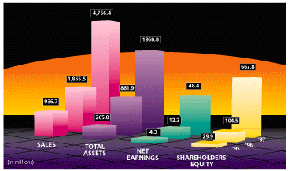
Ultimately, of course, any corporation's performance has to be measured in numbers. CHS' numbers were impressively good when 1997 began and markedly better by year-end. The year's net income, $48.4 million, was 298% higher than the 1996 total. Earnings per share rose to $1.32 from $0.78 in 1996, and net sales climbed 156% to a 1997 total of $4.8 billion. Operating income rose 209% to a 1997 total of $89.2 million, and gross profit rose 164% to $346.7 million.
Our ability to manage rapidly accelerating sales is reflected in the upward movement of our key margins. The Company's net and operating margins were 1.0% and 1.9% during 1997, respectively, compared with 0.7% and 1.6%, respectively, in the preceding year.
The extent to which we have opportunities to further improve our profitability by reducing selling, general and administrative expense as a percent of sales is apparent in the fact that we reduced this ratio to 5.1% in the fourth quarter of 1997 from 5.7% in the third quarter.
Important as our acquisitions program continues to be, it is by no means the Company's sole source of growth. Sales from continuing operations "same-store" sales were 28% higher in 1997 than a year earlier. The gain is 34% when constant currency rates are used.
Throughout 1997 we continued to pursue an aggressive acquisitions strategy aimed at strengthening the Company's leadership position by taking advantage of the fragmentation of the microcomputer distribution industry outside the U.S. and the competitive edge available to large, efficient companies able to qualify for the best discounts and rebates. Two of the acquisitions of 1997 were particularly significant.
The first involved Karma International, S.A. ("Karma"), a Switzerland-based company distributing microcomputer products through 28 offices to more than 10,000 resellers in 18 countries in Europe, the Middle East and Asia. Because Karma had revenues of approximately $700 million in 1996 and a compound annual growth rate of more than 100% over the preceding three years, this acquisition added significantly both to our size and to our growth.
Karma was one of the principal means by which the 1997 transformation of CHS was accomplished. It made CHS first in the world among distributors of mass-storage products, and it gave us for the first time a presence in the big, fragmented and immensely promising Middle Eastern and Asian markets.
In the same month that the Karma acquisitions was completed August 1997 we announced our plans for the purchase of Santech Micro Group (Santech), a leading distributor in the Scandinavian countries with 1996 sales of approximately $718 million and a compound annual growth rate of 51% over the preceding three years. This purchase, completed in October, vaulted CHS into the number-one position in the Scandinavian market with estimated 1998 sales of nearly $1 billion. Simultaneously, it made us the largest distributor in Europe and number three in the world.
In the midst of all this, to raise money for acquisitions and for use as working capital, we decided to attempt to issue 10 million new shares of common stock at price expected to be approximately $26.50 per share. Ultimately, after 13 million shares were sold at $31.75 per share (pre 3 for 2 stock split) and the underwriters exercised their option to purchase an additional 1.95 million shares, this became the largest offering in the history of our industry. It netted CHS approximately $430 million. We used $200 million of these proceeds to provide the cash portion of the Karma and Santech acquisitions. The increase in working capital made possible by the offering has increased our ability to take advantage of competitively significant early payment discounts.
The offering also contributed substantially
to making our balance sheet vastly stronger at the end of 1997 than it
had been a year earlier. Working capital rose ninefold, from $31.5 million
at the end of 1996 to $279 million on December 31, 1997. By contrast, long-term
debt rose comparatively
modestly over the same period, from $45.3
million to $61.6 million, while shareholders' equity increased from $104.5
million to $667.8 million. Shortly after completion of the offering, our
Board of Directors approved a three-for-two split of CHS common shares.
We ended 1997 with the opening of our new European distribution centers in Warsaw and Budapest. These new centers, with 50,000 square feet of warehouse and office space each, supplement our 100,000 square-foot facility in the Czech Republic. Together, these three operations illustrate the importance of our presence in the high-potential, still highly fragmented East European marketplace.
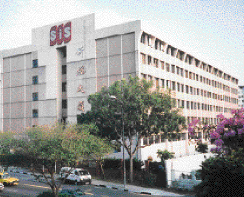
We enter 1998 committed to staying on course and continuing to generate more of the same: more earnings, more sales, more national and regional markets successfully entered. We continue to actively seek high-quality, profitable distributors with knowledge of the markets that interest us and strong entrepreneurial skills. Less than two months into the new year, we agreed to purchase 80% of the Hong Kong, Malaysia and Singapore subsidiaries of SiS Distribution Ltd ("SiS"). This latest acquisition is expected to have consolidated sales totaling some $420 million in 1998. SiS serves approximately 2,000 resellers throughout its region, and it is an unusually attractive opportunity because few Asian distributors are active in more than one national market. The acquisition brings with it eight offices in People's Republic of China, expanding our presence into that huge and undeveloped market.
Asia, the Middle East, Africa the world is rich in untapped opportunities for CHS to repeat in new places what it has already done and is continuing to accomplish in Latin America and Europe. We are committed to seizing these opportunities, and also to continuing to manage everything we do in such a way as to grow our profitability as well as our sales.
We are excited about our prospects. The Company's
Board and management are grateful to our shareholders, our employees and
our vendors for making those prospects possible, and for our success to
date.
Claudio Osorio
Chairman, Chief Executive Officer and President
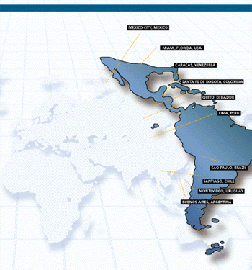
And of all the fast-growing major markets of the world, the most dynamic is expected to be Latin America. This is true partly because of the explosion of economic development that is sweeping the entire region from Mexico to Argentina, causing demand for computer products to rise sharply. It's also true because penetration of the Latin American market for computer products is still at an almost ridiculously low level: less than 3%, versus more than 36% in the U.S.
What all this adds up to is a tremendous opportunity for computer product
distributors with a strong market presence, good knowledge of Latin America's
numerous national markets, and the financial resources needed to compete
effectively. We believe that CHS Electronics is better positioned than
any other distributor to take advantage of this opportunity. The Company
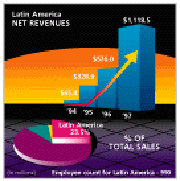
is now the largest distributor in Latin America, with sales of $1.1 billion
in 1997 (the region contributed 23% of the Company's sales for the year).
CHS' local management has the authority to make decisions necessary to
satisfy the particular demands of their respective markets. The Company
believes that its business model of focused distribution through locally
managed full service facilities provides competitive and operating advantages.
The Company is committed to using its advantages to be both an agent of
growth and a beneficiary of growth throughout Latin America in 1998 and
in the years to follow.


Several acquisitions contributed significantly to building CHS' market position in Latin America during 1997. In March, the Company acquired Dinexim, which was based in Miami, distributed to resellers throughout the region, and had 1996 sales of $152 million. June brought agreements for the purchase of three additional Latin American distribution companies. Among these three was CompExpress Informatica Ltda., which, with revenues of $51 million in 1996, was among the largest IBM distributors in Brazil.
These acquisitions, when added to CHS' other operations in Argentina
and Brazil, made the Company the leading distributor of computer products
in those two major countries. In November, CHS agreed to purchase Micro-Informatica,
which served more than 3,000 resellers from its Miami base and had 1997
revenues of $134 million.
With each of these steps, CHS has added to the strength of the regional
leadership position it began building in July 1994 with the acquisition
of Promark, a major Miami-based distributor with subsidiaries in Argentina,
Chile, Colombia and Venezuela. By the time of the public offering in June
1996, CHS had acquired additional major distribution capabilities in Latin
American through its BEK and Merisel acquisitions and through the purchase
of local distributors in Peru and Ecuador. Acquisitions since that public
offering have brought into CHS additional operations with strong entrepreneurial
management able to take full competitive advantage of the top-line products
and cost reductions made possible by affiliation with one of the world's
largest and most efficient distribution giants.


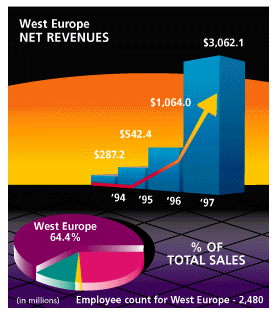
West Europe, one of the wealthiest and most technologically developed
regions on Earth, is of course one of the world's great markets for high-tech
equipment. In fact, the region accounts for nearly a fourth of the global
personal computer market. There is no better evidence of the speed with
which
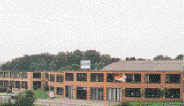
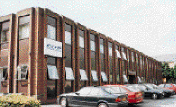
CHS Electronics has been moving into a position of world leadership than the fact that in 1997 it emerged as the number-one distributor of microcomputer products in Western Europe.
Despite the region's size and economic importance, Western Europe is neither as mature nor as intensely competitive as the U.S. as a computer products distribution market. Market penetration (the percentage of personal computers to population) in Western Europe is still only about half that of the U.S., and because the Western European market remains relatively fragmented, it offers profit margins in many markets that, although narrower than those in developing parts of the world, are significantly more attractive than those in the U.S.
The CHS story in Western Europe is one of astonishing growth from small beginnings. Though the Company first entered the computer products distribution industry by acquiring a relatively small German operation in 1993, its presence in the region remained extremely modest for more than a year and a half until the September 1994 acquisition of certain units of Omnilogic, an important distributor in England, France and Belgium. Almost exactly two years after that came the acquisition of Merisel's operations in Austria, England, France, Germany and Switzerland. At that point, CHS was not merely a presence in the West European market but a contender for leadership. A series of 1997 acquisitions transformed CHS from being merely one of the region's contenders to being the leader in its industry. Especially notable among these acquisitions were:
*Frank & Walter, the fourth largest distributor in Germany, which made CHS the largest distributor in that country.
*Karma International, a major distributor not only in Europe but also active in the Middle East and Asia.
*Santech Micro Group, one of the top distributors in Scandinavia.
It was the Santech acquisition, which when added to CHS' other operations,
produced Scandinavian revenues expected to total over $1 billion in 1998.
This addition put the Company in the top position in Western Europe.
The Karma acquisition added approximately 10,000 additional resellers to CHS, and it brought other significant aspects as well. It contributed a new logistic concept of centralized warehousing and just-in-time distribution throughout Europe of CHS' universal and unbranded products. The Karma distribution system is recognized throughout the industry as a model of efficient, centralized distribution of commodity products in fragmented markets. The economies of that system, and their impact on lower selling, general and administrative expenses, have been extended throughout CHS.
The achievement of leadership is only a beginning for CHS in Western
Europe. The Company's new number-one position will be extended and consolidated
in 1998 and beyond through internal growth and the continued pursuit of
acquisitions that offer new opportunities for profitable growth. CHS continues
to explore possible acquisitions throughout the region, looking for candidates
with entrepreneurial local management teams that are demonstrably knowledgeable
of their national markets and well positioned to make use of the economies
and support systems that CHS can make available to them.
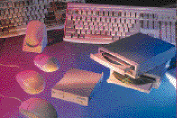

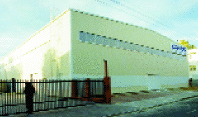
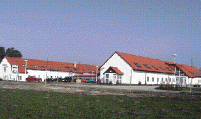
Though Eastern Europe is still unfamiliar territory for many international companies, CHS has been active in the region almost since it began distribution operations in 1993. Shortly after making its first acquisition in Germany that year, CHS began doing business in the Czech Republic. It found that demand was strong, and that the existing distribution system was fragmented and rudimentary. From this has flowed both very strong internal growth along with a growing list of acquisitions. CHS is now doing business in 13 of the region's countries, is the leading distributor in 9 of those countries, and is a dominant leader in the region with its nearest competitor only a third its size.
In 1997, the Company's East European sales were $514 million, more than double the 1996 total. While 16% of the increase over 1996 came from the acquisitions of companies distributing in Estonia, the Czech Republic, Slovakia and Slovenia, most of the increase was contributed by internal growth. All of the more than two dozen CHS Companies operating in Eastern Europe during 1997 were profitable. Overall they achieved a net profit margin of more than 3% a level that would be unachievable in more developed markets.
Even today, international distributors are rare in Eastern Europe. The dominant position that CHS now enjoys in the region makes it highly attractive to computer product manufacturers seeking to expand there: through CHS (and through no other single company) they can reach every country in the region.
The Company's East Europe sales goal for 1998 is an ambitious one: $1 billion. It is helped in the pursuit of this goal by its most recent round of acquisitions including:
* TH' Systems, which has its head office in the Czech Republic, had 1997 sales of $143 million, and distributes in the Czech Republic, Hungary, Poland and Slovakia.
* Merisel Russia, which had 1997 sales
of $57 million, makes CHS the largest distributor in Russia.

* Two Istanbul-based distributors, Arena and Armada, which had combined sales of $131 million in 1997 and make CHS the largest distributor in Turkey.
CHS ended 1997 with pro forma revenues of $200 million in the Czech Republic, $160 million in Russia, and $40 million each in Hungary and Slovakia. It had an increasingly significant presence in other Eastern European countries, especially in the three Baltic states and the former Balkan countries: Bulgaria, Croatia and Slovenia.
Two new distribution centers, each including 50,000 square feet of office
and warehouse space, were opened in Budapest and Warsaw in November. Together
with the Company's 100,000 square-foot facility in the Czech Republic,
they are tangible evidence of the prominence and steadily increasing importance
of CHS throughout the East European region.

In the nineteenth century, the merchants of
the West dreamed of selling "oil for the lamps of China" to become
a source of some basic necessity for the vast reaches of Asia, thereby
tapping into a market of almost unimaginable size.
Today, with so many parts of the Far East experiencing rapid modernization and economic development, that kind of dream is more enticing than ever. A version of it, suited to the late 1990s, would not involve oil for lamps but personal computers for homes, offices and stores of China, Malaysia, Singapore and Vietnam...
CHS Electronics is today in the earliest stages of turning that dream into a reality.
The Company entered the Asian market in 1997 its acquisition of Karma International, which included China among the 18 countries in which it distributed microcomputer products. The start was a modest one Asia and the Middle East together accounted for about 17% of Karma's $700 million in 1996 revenues but its importance was out of proportion to its size. By creating a connection between the fragmented, undeveloped Asian market and CHS' increasingly efficient, aggressively expanding global distribution system, the Karma acquisition put a unique opportunity and an organization capable of putting that opportunity to good and full use into direct contact for the first time.
The Company's second step into Asia came in
February, 1998 with the agreement to purchase 80% of the China, Malaysia,
Singapore and Vietnam subsidiaries of SiS Distribution Ltd., a Hong Kong-based
distributor of microcomputer products. Because the operation included eight
offices in the People's Republic of China, CHS found itself with additional
new distribution capabilities in that market. The SiS acquisition was an
unusually attractive opportunity in several ways. The acquired operations
were one of the longest-established computer distribution companies in
Asia, which brought with them an experienced Asian management team
the kind of local knowledgeable, entrepreneurial team that CHS has always
sought in executing its acquisition program. SiS was also attractive as
an unusual example of an Asian distribution company doing business in more
than one national market. It handles a product line similar to that of
CHS, one providing first-quality brands such as Hewlett Packard, IBM, Compaq
and Microsoft to approximately 2,000 resellers in its high-potential markets.
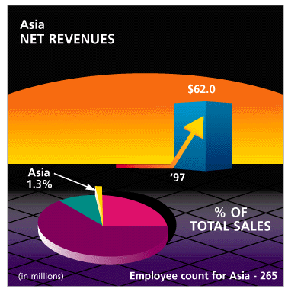
The terms of the SiS deal demonstrate that the recent uncertainty in Far Eastern financial markets has contributed to making acquisitions in the region far more attractive than they had been earlier. The purchase price of companies that had been seriously overvalued not long ago are coming closer into alignment with reality, giving rise to excellent opportunities for buyers.
This opportunity placed CHS with its financial resources and its consistent success in winning over the most attractive acquisition candidates around the world in the right place, at the right time.

In keeping with the long and rapid strides taken by CHS in 1997 and in every year since the start of our distribution operations, the Company has ambitious goals for 1998:
| Twelve Months Ended December 31, | |||||
|---|---|---|---|---|---|
| 1997 | 1996 | 1995 | 1994 | 1993 | |
| (In thousands, except per share and other data) | |||||
| Income Statement Data: | |||||
| Net sales | $4,756,383 | $1,855,540 | $936,703 | $359,169 | $146,408 |
| Cost of goods sold | 4,409,714 | 1,724,432 | 868,716 | 333,983 | 136,968 |
| Gross profit | 346,669 | 131,108 | 67,987 | 25,186 | 9,440 |
| Operating expenses | 257,508 | 102,235 | 57,188 | 21,798 | 9,075 |
| Operating income | 89,161 | 28,873 | 10,799 | 3,388 | 365 |
| Interest income | (11,470) | (3,199) | (1,757) | (250) | (229) |
| Interest expense | 35,618 | 11,712 | 6,454 | 2,070 | 1,076 |
| Earnings (loss) before income taxes and minority interest in subsidiaries | 65,013 | 20,360 | 6,102 | 1,568 | (482) |
| Provision for income taxes | 13,988 | 6,086 | 1,797 | 603 | 241 |
| Minority interest | 2,634 | 2,108 | -- | -- | -- |
| Net earnings (loss) | $48,391 | $12,166 | $4,305 | $965 | $(723) |
| Net earnings (loss) per share--basic | $1.44 | $.80 | $.41 | $.14 | $(.21) |
| Net earnings (loss) per share--diluted | 1.32 | .78 | .37 | .14 | (.21) |
| Weighted average shares
outstanding--basic |
33,527 | 15,244 | 10,618 | 7,039 | 3,403 |
| Other Data:
Number of countries |
39 | 28 | 15 | 10 | 2 |
| Inventory turns | 9 | 10 | 10 | 10 | 23 |
| Days receivable | 33 | 36 | 35 | 32 | 31 |
| At December 31, | |||||
| 1997 | 1996 | 1995 | 1994 | 1993 | |
| Balance Sheet Data: | |||||
| Cash and cash equivalents | $68,806 | $35,137 | $11,171 | $8,368 | $603 |
| Working capital (deficit) | 278,771 | 31,506 | 9,843 | 14,004 | (1,426) |
| Total assets | 1,968,822 | 861,949 | 265,804 | 164,468 | 29,058 |
| Total debt | 371,066 | 201,259 | 55,239 | 23,302 | 6,949 |
| Shareholders' equity | 667,764 | 104,533 | 29,892 | 19,870 | 1,930 |
The Company cautions that the factors described above could cause actual results or outcomes to differ materially from those expressed in any forward-looking statements of the Company made by or on behalf of the Company. Any forward-looking statement speaks only as of the date on which such statement is made, and the Company undertakes no obligation to update any forward-looking statement or statements to reflect events or circumstances after the date on which such statement is made or to reflect the occurrence of unanticipated events. New factors emerge from time to time, and it is not possible for management to predict all of such factors. Further, management cannot assess the impact of each such factor on the business or the extent to which any factor, or combination of factors, may cause actual results to differ materially from those contained in any forward-looking statements.
The Company derives all of its operating income and cash flow from its operating subsidiaries, most of which are organized and operated outside the United States. Generally, the Company purchases its inventory with a combination of United States dollars and local currency and sells in local currency. The Company seeks to limit its exposure to the risk of currency fluctuations through hedging. See "--Currency Risk Management."
The following table sets forth acquisitions made by the Company, the service areas of the operations acquired and the dates as of which the results of operations of the acquired company were included in the Company's financial statements during 1995 to 1997.
| Subsidiary(1) | Service Area | Date Included in
Financial Statements |
|---|---|---|
| CHS Nexsys(2) | Colombia | December 1997 |
| CHS Ledakon | Colombia | November 1997 |
| CHS Romak | Ireland | October 1997 |
| CompExpress | Brazil | October 1997 |
| Santech | Norway, Sweden,
Denmark |
October 1997 |
| Ameritech Argentina(3) | Argentina | August 1997 |
| Ameritech
Exports(3) |
Latin America | August 1997 |
| Atlantis
Skupina(4) |
Slovenia | August 1997 |
| Karma | Europe, Middle
East and Asia |
August 1997 |
| Lars Krull | Denmark, Norway,
Sweden |
August 1997 |
| CHS Dinexim | Latin America | May 1997 |
| CHS Access and Agora | Czech Republic | May 1997 |
| CHS International High Tech Marketing | Africa | April 1997 |
| Frank & Walter | Germany | January 1997 |
| CHS Estonia | Estonia | January 1997 |
| Infocentro de Chile(4) | Chile | January 1997 |
| CHS Merisel United Kingdom(5) | United Kingdom | October 1996 |
| CHS Merisel France(5) | France | October 1996 |
| CHS Merisel Switzerland(5) | Switzerland | October 1996 |
| CHS Merisel Germany(5) | Germany | October 1996 |
| CHS Merisel Austria(5) | Austria | October 1996 |
| CHS Merisel Latin America(5) | Latin America | October 1996 |
| CHS Merisel Mexico(5) | Mexico | October 1996 |
| CHS Ecuador(4) | Ecuador | June 1996 |
| CHS Russia | Russia | June 1996 |
| CHS Switzerland | Switzerland | April 1996 |
| CHS Peru | Peru | March 1996 |
| CHS Hungary(4) | Hungary | February 1996 |
| CHS Poland | Poland | November 1995 |
| CHS Czechia(6) | Czech Republic | October 1995 |
| CHS Sweden | Sweden | July 1995 |
| CHS Finland | Finland | July 1995 |
| CHS BEK | Latin America | July 1995 |
(1) The names are those by which the Company refers to
its subsidiaries and are not necessarily the legal names of the entities.
(2) The Company owns 65 of this company.
(3) Deemed by the Company to be part of one acquisition.
(4) The Company owns 51 of this company.
(5) Deemed by the Company to be part of one acquisition.
(6) The Company acquired a 16 interest in CHS Czechia
in January 1993 and acquired the remaining 84 in October 1995.
| Years Ended December 31, | |||
|---|---|---|---|
| 1997 | 1996 | 1995 | |
| Net sales | 100.0 | 100.0 | 100.0 |
| Cost of goods sold | 92.7 | 92.9 | 92.7 |
| Gross profit | 7.3 | 7.1 | 7.3 |
| Operating expenses | 5.4 | 5.5 | 6.1 |
| Operating earnings | 1.9 | 1.6 | 1.2 |
| Interest income | (.2) | (.1) | (.2) |
| Interest expense | .7 | .6 | .7 |
| Earnings before income taxes | 1.4 | 1.1 | .7 |
| Income taxes | .3 | .3 | .2 |
| Minority interest | .1 | .1 | -- |
| Net earnings | 1.0 | .7 | .5 |
Gross Profit. Gross profit increased $215.6 million, or 164.4, from $131.1 million in 1996 to $346.7 million in 1997 due principally to acquisitions and, to a lesser extent, internal growth. Gross profit on a comparable basis for subsidiaries consolidated for both 1996 and 1997 increased $42.4 million, or 48.3. Newly acquired subsidiaries (including existing CHS companies for the first nine months of 1997 which were integrated with companies acquired from Merisel) contributed $173.1 million of increased gross profit.
Gross margin increased from 7.1 in 1996 to 7.3 in 1997. The change in gross margin was due to increased early payment discounts and vendor rebates offset to some extent by lower gross margins of the recently acquired Karma operations. The Company utilized more early payment discount opportunities as a result of the cash generated by its public equity offering in July 1997. Additionally, the Company's growth has resulted in more favorable volume rebates with certain key vendors. The increase in gross margin attributable to early payment discounts (0.2) and volume rebates (1.4) was offset by the fact that the Karma operation has a lower gross margin due to the nature of the products sold. The Company expects that 1998 gross margins will be lower than in 1997 due to the impact of having the Karma operations included in the entire year and due to continued competitive pressures. Although the Company has been achieving higher gross margins (10.5 and 9.3 in 1996 and 1997, respectively) in its Eastern European operations than in other areas, the Company expects gross margins in Eastern Europe to continue to decline due to increased competition and a Company strategy to increase sales through more competitive pricing. The Company expects that the impact on gross profit due to decreased gross margins in this geographic area will be fully offset by increased sales.
Operating Expenses. Operating expenses as a percentage of net sales declined from 5.5 in 1996 to 5.4 in 1997. Included were the expenses of maintaining a minimally utilized warehouse in the Netherlands in 1997 and $1.4 million in Merisel restructuring expenses in 1996. In 1998 the warehouse is expected to be utilized for distribution of universal products (e.g., mass storage and components). The comparative operating expense ratios without these items would have been 5.4 for 1997 and 5.4 for 1996. The Company expects that the inclusion of Karma's results for a full year will result in operating expenses being a lower percentage of net sales based on the lower operating expenses of Karma. Operating expenses for both periods include the results of foreign currency transactions. Such results were a net gain of $1.2 million in 1997 and $1.6 million in 1996.
Net Interest Expense. Net interest expense increased $15.6 million, or 183.7, from $8.5 million in 1996 to $24.1 million in 1997. The increase is directly related to the increase in average loan amounts outstanding.
Income Taxes. Income taxes as a percentage of earnings before income taxes and minority interest in subsidiaries decreased from 29.9 in 1996 to 21.5 in 1997. The change is due to a higher proportion of income earned in jurisdictions with lower tax rates and the use of net operating loss carryforwards, offset, to a certain extent, by losses in subsidiaries with no tax benefit and non deductible goodwill amortization. The Company expects to have an effective tax rate lower than the statutory United States tax rate in 1998 principally due to its ability to use remaining net operating loss carryforwards from certain subsidiaries and the proportion of income expected in jurisdictions with lower tax rates.
Gross Profit. Gross profit increased $63.1 million, or 92.8, from $68.0 million in 1995 to $131.1 million in 1996 due principally to acquisitions and, to a lesser extent, internal growth. Gross profit on a comparable basis for subsidiaries consolidated for both 1995 and 1996 increased $13.6 million, or 20.0. Subsidiaries not included in both 1995 and 1996 contributed $49.5 million of gross profit.
Gross margin decreased from 7.3 in 1995 to 7.1 in 1996. The decrease was due to lower gross margins from subsidiaries located in Western Europe, particularly those operations acquired from Merisel, which, as a result of high volumes of sales by those entities, had a significant impact on the Company's gross margin as a whole. The Company attributes the decrease in gross margins to competitive pressures in this region, especially in Germany. The Company's subsidiaries in Germany had the lowest gross margins of all its European subsidiaries in 1996. The Company expects that overall gross margin may continue to decline in 1997 due to continued competitive pricing pressures and the fact that the gross margins of the acquired Merisel companies have been generally lower than that of the Company and will be included in the consolidation for the full year. In addition, the acquisition of Frank & Walter, which operates in Germany, where gross margins are generally lower, will also impact overall gross margin. The gross margin of the combined Merisel companies for the nine months ended September 30, 1996 was 7.0.
Operating Expenses. Operating expenses as a percentage of net sales declined from 6.1 in 1995 to 5.5 in 1996. The decline was due to efficiencies gained through increased sales volume and the Company's efforts to control costs. The reduction was achieved even though a provision of $1.4 million was made for restructuring costs incurred by CHS (consisting of severance costs for CHS employees, write-off of CHS leasehold improvements and lease termination costs of CHS closed facilities) to implement consolidation in markets in which a CHS company previously existed and a company was acquired from Merisel. The operating expense ratio without such charge would have been 5.4 for the year.
Net Interest Expense. Net interest expense increased $3.8 million, or 81.2, from $4.7 million in 1995 to $8.5 million in 1996. The increase is directly related to the increase in average loan amounts outstanding.
Income Taxes. Income taxes as a percentage of earnings before income taxes and minority interest in subsidiaries increased slightly from 29.4 in 1995 to 29.9 in 1996. Management does not believe this change is significant. The difference between this tax rate and the statutory United States tax rate is due to the utilization of net operating loss carryforwards and lower foreign tax rates, offset to some extent by losses in subsidiaries with no tax benefit and non-deductible goodwill amortization.
Certain of the Company's United States based subsidiaries are parties to a Loan and Security Agreement providing for revolving credit advances and the issuance of letters of credit against eligible accounts receivable and inventory up to a maximum of $60 million. Amounts outstanding bear interest, at the election of the borrowers, at either a variable market rate based on the prime rate of the lender or LIBOR. The agreement limits the ability of the borrowers to pay dividends to the Company. The agreement matures in October 1999 and is secured by a lien on essentially all of the borrowers' assets. The agreement contains certain restrictive covenants. During November and December 1997, the borrowers were in violation of requirements to deposit receipts in specified accounts. The lender has waived these violations. The Company has guaranteed this indebtedness.
The Company's subsidiaries typically enter into revolving credit agreements with financial institutions in their countries of operations. At December 31, 1997, the aggregate amount available under these agreements was $445.4 million and $348.3 million was then outstanding. Such agreements are usually for a term of one year and are secured by the receivables of the borrower. The weighted average interest rate at December 31, 1997 was 7.3. The Company typically guarantees these loans. The Company has also guaranteed the obligations of certain of its subsidiaries to manufacturers.
The Company derives all of its operating income and cash flow from its subsidiaries and relies on payments from, and intercompany borrowings with, its subsidiaries to generate the funds necessary to meet its obligations. In certain countries, exchange controls may limit the ability of the Company's subsidiaries to make payments to the Company. Restrictions in financing or credit arrangements may also limit access to such earnings. Certain of the Company's subsidiaries are parties to financing agreements that limit the ability of such subsidiaries to make payments to the Company. In the year ended December 31, 1997, the contribution of such subsidiaries to the Company's consolidated EBITDA was 16.6. Claims of creditors of the Company's subsidiaries will generally have priority as to the assets and cash flow of such subsidiaries over the claims of the Company or its creditors. See Note F to the Consolidated Financial Statements.
The Company has completed a risk assessment of the ability of its information systems to operate in light of the "year 2000 problem." Based on the assessment, the Company has developed an action plan, which principally consists of replacing existing non-compliant systems with new systems. The Company believes it is feasible to acquire such new systems before the year 2000 and that the cost of such systems are within its capital cost budget and financing capabilities.
The Company's principal need for additional cash in 1998 will be for the purchase of additional inventory to support growth and to take greater advantage of available cash discounts offered by certain of the Company's vendors for early payment and to pay amounts due to sellers of businesses. The Company anticipates funding this cash requirement partially through an offering of $200 million of Senior Notes due 2005 ("Note Offering"), its subsidiaries' existing bank credit lines and through additional credit facilities, but there can be no assurance that financing will be available on terms acceptable to the Company. The unavailability of such financing could adversely affect the growth of the Company. The Notes will be sold in a Rule 144A and Regulation S private offering.
To reduce the risk of loss to the Company due to vendor price reductions and slow moving or obsolete inventory, the Company's contracts with its vendors generally provide price protection and stock rotation privileges, subject to certain limitations. Price protection allows the Company to offset the accounts payable owed to a particular vendor if such vendor reduces the price of products the Company has purchased within a specified period of time and which remain in inventory. Stock rotation permits the Company to return to the vendor for full credit, with an offsetting purchase order for new products, predetermined amounts of inventory purchased within a specified period of time. Such credit is typically used to offset existing invoices due without incurring re-stocking fees.
Accounts Receivable. The Company manages its accounts receivable to balance the needs of its customers to purchase on credit with its desire to minimize its credit losses. Bad debt expense as a percentage of the Company's net sales for each of the years ended 1996 and 1997 was 0.2. The Company's credit losses have been minimized by its extensive credit approval process and the use of credit insurance and factoring by its Western European subsidiaries. In its sales to customers in Latin America, the Company often receives post-dated checks at the time of sale. Customers who qualify for credit are typically granted payment terms appropriate to the customs of each country.
Hedging and Currency Management Activities. The Company attempts to limit its risk of currency fluctuations through hedging where possible. In the year ended December 31, 1997, a significant amount of the purchases of products by the Company were made in United States dollars and approximately 88 of Company sales were made in currencies other than the United States dollar. The primary currencies in which sales were made were the German mark (29 of sales), the French franc (10) and the British pound (9). At December 31, 1997, approximately $271.6 million of accounts payable were attributable to foreign currency liabilities denominated in currencies other than the subsidiaries' functional currencies. Of these, $229.3 million were denominated in United States dollars and $26.2 million were denominated in German marks. Approximately 39 of these liabilities were unhedged. The most significant unhedged amounts were recorded in Czechian korunas ($24.7 million), Hong Kong dollars ($21.7 million), Polish zlotys ($14.2 million), Argentine pesos ($13.6 million), and Mexican pesos ($10.6 million).
CHS Finance, a wholly owned subsidiary of the Company, engages in central treasury functions including hedging activities related to foreign currency for the Company and short-term working capital loans to the Company's subsidiaries to enable them to take advantage of early payment discounts offered by certain vendors. These loans are denominated in the functional currency of the borrowing subsidiary or United States dollars. Generally, CHS Finance hedges its receivables denominated in currencies other than its functional currency, the Swiss franc. It attempts to limit the amount of unhedged receivables to an amount which approximates the total unhedged liabilities. The Company intends to review this policy periodically and may modify it in the future.
Through both hedging activities coordinated by CHS Finance and subsidiary hedging activities, the Company makes forward purchases of United States dollars in an attempt to hedge certain European currencies and reduce exposure to fluctuations in exchange rates. Additionally, in certain countries in Eastern Europe and in Latin America where it is not practical to make forward purchases, to minimize exposure to currency devaluations, the Company has adopted a policy of attempting to match accounts receivable with accounts payable and to limit holdings of local currencies. In these countries, the Company attempts to sell products at the United States dollar equivalent rate. Factors which affect exchange rates are varied and no reliable prediction methods are available for definitively determining future exchange rates. In general, countries make an effort to maintain stability in rates for trade purposes. There can be no assurance that these asset management programs will be effective in limiting the Company's exposure to these risks.
Market for the Registrant's Common Equity and Related Stockholder Matters
The following table sets forth for the periods indicated the high and low closing sales prices of the Company's Common Stock (symbol: CHSE) from January 1, 1996 through June 6, 1996 on the Nasdaq Small-Cap Market and thereafter on the Nasdaq National Market. The Company effected a one-for-two reverse stock split on March 14, 1996. On September 15, 1997, the Company effected a three-for-two forward split for all shareholders of record as of September 2, 1997. All prior amounts have been adjusted to reflect the effects of such splits. Such prices are based on inter-dealer bid and asked prices, without markup, markdown, commissions, or adjustments and may not represent actual transactions.
| Fiscal Year | Period | Historic Prices | |
|---|---|---|---|
| High | Low | ||
| 1997 | First Quarter | $16.08 | $10.33 |
| Second Quarter | 17.75 | 11.50 | |
| Third Quarter | 29.75 | 17.21 | |
| Fourth Quarter | 30.75 | 14.75 | |
| 1996 | First Quarter | $11.00 | $5.33 |
| Second Quarter | 12.33 | 6.58 | |
| Third Quarter | 9.67 | 6.67 | |
| Fourth Quarter | 13.00 | 6.83 | |
The last reported sale price of the Common Stock as reported on the Nasdaq National Market on March 23, 1998 was $18.25 per share. As of March 23, 1998, the outstanding Common Stock was held of record by 343 shareholders. The Company believes that it has in excess of 400 beneficial owners.
The Company has never paid cash dividends on its Common Stock and does not anticipate paying cash dividends in the foreseeable future, but intends instead to retain any future earnings for reinvestment in its business. Any future determination to pay cash dividends will be at the discretion of the Board of Directors and will be dependent upon the Company's financial condition, results of operations, capital requirements and such other factors as the Board of Directors deems relevant. See "Management's Discussion and Analysis of Financial Condition and Results of Operations--Liquidity and Capital Resources."
| December 31, | ||
|---|---|---|
| 1997 | 1996 | |
| ASSETS | ||
| CURRENT ASSETS: | ||
| Cash | $68,806 | $35,137 |
| Accounts receivable: | ||
| Trade, less allowance for doubtful accounts of $18,347 in 1997 and $14,830 in 1996 | 659,757 | 340,098 |
| Affiliates | 24,604 | 3,241 |
| 684,361 | 343,339 | |
| Inventories | 693,503 | 321,770 |
| Prepaid expenses and other current assets | 65,255 | 39,374 |
| Total current assets | 1,511,925 | 739,620 |
| PROPERTY AND EQUIPMENT, NET | 61,468 | 30,947 |
| COST IN EXCESS OF ASSETS ACQUIRED, NET | 381,830 | 78,780 |
| OTHER ASSETS | 13,599 | 12,602 |
| $1,968,822 | $861,949 | |
| LIABILITIES AND SHAREHOLDERS' EQUITY | ||
| CURRENT LIABILITIES: | ||
| Notes payable | $309,510 | $155,932 |
| Accounts payable, trade | 771,535 | 452,569 |
| Accrued liabilities | 83,309 | 44,873 |
| Amounts due to sellers under acquisition agreements | 54,866 | 49,200 |
| Income taxes payable | 12,711 | 5,120 |
| Deferred income taxes | 1,223 | 420 |
| Total current liabilities | 1,233,154 | 708,114 |
| LONG TERM DEBT | 61,556 | 45,327 |
| MINORITY INTEREST | 6,348 | 3,975 |
| SHAREHOLDERS' EQUITY: | ||
| Preferred stock, authorized 5,000,000 shares; 0 shares outstanding | -- | -- |
| Common stock, authorized 100,000,000 shares at $.001 par value;
oustanding
48,910,999 shares at December 31, 1997 and 18,600,576 shares at December 31, 1996 |
49 | 19 |
| Additional paid-in capital | 621,021 | 92,843 |
| Retained earnings | 65,115 | 16,724 |
| Cumulative foreign currency translation adjustment | (18,421) | (5,053) |
| TOTAL SHAREHOLDERS' EQUITY | 667,764 | 104,533 |
| $1,968,822 | $861,949 | |
| Year Ended December 31, | |||
|---|---|---|---|
| 1997 | 1996 | 1995 | |
| Net sales (including sales to affiliates of $21,063 in 1995) | $4,756,383 | $1,855,540 | $936,703 |
| Cost of goods sold | 4,409,714 | 1,724,432 | 868,716 |
| Gross profit | 346,669 | 131,108 | 67,987 |
| Operating expenses | 257,508 | 102,235 | 57,188 |
| Operating income | 89,161 | 28,873 | 10,799 |
| Other (income) expense: | |||
| Interest income | (11,470) | (3,199) | (1,757) |
| Interest expense | 35,618 | 11,712 | 6,454 |
| 24,148 | 8,513 | 4,697 | |
| Earnings before income taxes and minority interest in subsidiaries | 65,013 | 20,360 | 6,102 |
| Income taxes | 13,988 | 6,086 | 1,797 |
| Minority interest in subsidiaries | 2,634 | 2,108 | -- |
| Net earnings | $48,391 | $12,166 | $4,305 |
| Net earnings per common share--basic | $1.44 | $.80 | $.41 |
| Net earnings per common share--diluted | $1.32 | $.78 | $.37 |
| Three Years Ended December 31, 1997 | ||||||
|---|---|---|---|---|---|---|
| Common
Stock |
Additional
Paid-In Capital |
Retained
Earnings |
Deferred
Compensation |
Cumulative
Foreign Currency Translation Adjustment |
Total | |
| Balance at January 1, 1995 | $7 | $19,625 | $253 | $(138) | $123 | $19,870 |
| Adjustment 3 for 2 forward stock split | 3 | (3) | -- | -- | -- | -- |
| Deferred compensation recognized | -- | -- | -- | 138 | -- | 138 |
| Issuance of common stock in acquisitions | 1 | 5,351 | -- | -- | -- | 5,352 |
| Net earnings | -- | -- | 4,305 | -- | -- | 4,305 |
| Foreign currency translation adjustment | -- | -- | -- | -- | 227 | 227 |
| Balance at December 31, 1995 | 11 | 24,973 | 4,558 | -- | 350 | 29,892 |
| Common stock or other consideration issued in acquisitions (Note B) | -- | 16,982 | -- | -- | -- | 16,982 |
| Common stock issued in public offering | 7 | 50,607 | -- | -- | -- | 50,614 |
| Stock options exercised | 1 | 281 | -- | -- | -- | 282 |
| Net earnings | -- | -- | 12,166 | -- | -- | 12,166 |
| Foreign currency translation adjustment | -- | -- | -- | -- | (5,403) | (5,403) |
| Balance at December 31, 1996 | 19 | 92,843 | 16,724 | -- | (5,053) | 104,533 |
| Common stock issued in acquisitions (Note B) | 8 | 95,720 | -- | -- | -- | 95,728 |
| Common stock issued in public offering | 21 | 428,195 | -- | -- | -- | 428,216 |
| Stock options exercised | 1 | 4,263 | -- | -- | -- | 4,264 |
| Net earnings | -- | -- | 48,391 | -- | -- | 48,391 |
| Foreign currency translation adjustment | -- | -- | -- | -- | (13,368) | (13,368) |
| Balance at December 31, 1997 | $49 | $621,021 | $65,115 | $-- | $(18,421) | $667,764 |
| Year Ended December 31, | |||
|---|---|---|---|
| 1997 | 1996 | 1995 | |
| Increase in cash and cash equivalents: | |||
| Cash flows from operating activities: | |||
| Net earnings | $48,391 | $12,166 | $4,305 |
| Adjustments to reconcile net earnings to net cash (used in) operating activities: | |||
| Depreciation and amortization | 21,789 | 6,632 | 2,456 |
| Deferred compensation amortized | -- | -- | 148 |
| Minority interest in net earnings | 2,634 | 2,108 | -- |
| Changes in assets and liabilities excluding effects of acquisitions: | |||
| Accounts receivable--trade, net | (121,163) | (118,694) | (37,724) |
| Accounts receivable--affiliates, net | (21,363) | (2,398) | (12,285) |
| Inventories | (139,923) | (129,357) | (32,204) |
| Prepaid expenses and other current assets | 5,404 | (22,345) | (1,742) |
| Accounts payable, trade | (10,773) | 173,244 | 51,818 |
| Accrued liabilities and income taxes | (33,511) | (20,481) | 3,175 |
| Net cash (used in) operating activities | (248,515) | (99,125) | (22,053) |
| Cash flows from investing activities: | |||
| Purchase of fixed assets | (19,511) | (11,624) | (6,866) |
| Cash provided from (used in) acquisitions, net | (201,517) | (26,876) | 1,317 |
| Net cash (used in) investing activities | (221,028) | (38,500) | (5,549) |
| Cash flows from financing activities: | |||
| Proceeds from public offering | 428,216 | 50,614 | -- |
| Proceeds from stock options exercised | 4,263 | 281 | -- |
| Net borrowing from banks | 74,699 | 112,453 | 29,855 |
| Net cash provided by financing activities | 507,178 | 163,348 | 29,855 |
| Effect of exchange rate changes on cash | (3,966) | (1,757) | 550 |
| INCREASE IN CASH AND CASH EQUIVALENTS | 33,669 | 23,966 | 2,803 |
| Cash at beginning of year | 35,137 | 11,171 | 8,368 |
| Cash at end of year | $68,806 | $35,137 | $11,171 |
| Supplemental disclosure of cash flow information: | |||
| Cash paid during the period for: | |||
| Interest | $30,454 | $10,064 | $4,944 |
| Income taxes | $10,585 | $3,892 | $1,753 |
| Non cash investing and financing activities:
These statements of cash flows do not include non-cash investing and financing transactions associated with the common stock issued for various acquisitions. The components of the transactions in each year are as follows: |
|||
| Fair value of assets acquired including cash acquired | $689,550 | $14,691 | $19,216 |
| Less: Common stock or other consideration issued | 232,748 | 3,278 | 7,152 |
| Liabilities assumed | $456,802 | $11,413 | $12,064 |
The straight-line and accelerated methods of depreciation are followed for financial reporting purposes. The useful lives are as follows:
| Years | |
|---|---|
| Buildings | 30-50 |
| Leasehold improvements | 3-7 |
| Computer equipment | 2-5 |
| Office equipment and furniture | 3-10 |
Expenditures for renewals and improvements that significantly extend the useful life of an asset are capitalized. The costs of software used in business operations are capitalized and amortized over their expected useful lives. Expenditures for maintenance and repairs are charged to operations when incurred. When assets are sold or retired, the cost of the asset and the related accumulated depreciation are removed from the accounts and any gain or loss is recognized at such time.
The Company intends to invest the undistributed earnings of substantially all of its foreign subsidiaries indefinitely. At December 31, 1997 and 1996, the cumulative amount of undistributed earnings on which the Company has not recognized United States income taxes was approximately $53 million and $13 million, respectively. However, it is anticipated that United States income taxes on such amounts would be partially offset by available foreign income tax credits.
The following table illustrates the reconciliation of the income and weighted average number of shares of the basic and diluted earnings per share computations (amounts in thousands, except per share mounts):
| Year Ended December 31, 1997 | |||
|---|---|---|---|
| Net
Earnings |
Weighted
Average Shares |
Per Share
Amount |
|
| Net earnings | $48,391 | -- | -- |
| Net earnings per share--basic | 48,391 | 33,527 | $1.44 |
| Effect of dilutive shares: | |||
| Stock options outstanding | -- | 1,434 | -- |
| Earnout contingencies | -- | 1,631 | -- |
| Net earnings per share--diluted | $48,391 | 36,592 | $1.32 |
| Year Ended December 31, 1996 | |||
|---|---|---|---|
| Net
Earnings |
Weighted
Average Shares |
Per Share
Amount |
|
| Net earnings | $12,166 | -- | -- |
| Net earnings per share--basic | 12,166 | 15,244 | $.80 |
| Effect of dilutive shares: | |||
| Stock options outstanding | -- | 412 | -- |
| Net earnings per share--diluted | $12,166 | 15,656 | $.78 |
| Year Ended December 31, 1995 | |||
|---|---|---|---|
| Net
Earnings |
Weighted
Average Shares |
Per Share
Amounts |
|
| Net earnings | $4,305 | -- | -- |
| Net earnings per share--basic | 4,305 | 10,618 | $.41 |
| Effect of dilutive shares: | |||
| Stock options outstanding | -- | 904 | -- |
| Net earnings per share--diluted | $4,305 | 11,522 | $.37 |
Santech's operating results during 1996 and 1997 were adversely impacted as a result of restructuring its operations after a July 1996 merger. Operating results were also impacted adversely by the implementation of a new computer system in the first six months of 1997. The adverse impact included costs associated with reduction in the number of its product lines and the number of employees from 450 to 320. The Company believes that these factors have been addressed and that these issues should not have a material adverse impact on Santech's or the Company's future operations.
On August 4, 1997, the Company completed the acquisition of Karma International S.A. ("Karma"). Karma is a distributor of personal computer components to over 10,000 customers in Europe, the Middle East and Asia. The purchase price for Karma was $160 million and was funded through (i) $74 million in cash and (ii) 4,813,432 shares of unregistered Common Stock. Karma's product line includes mass storage products, CPUs, memory chips, motherboards, sound, video and other cards and monitors. Karma operates in 18 countries through 28 offices in Europe, the Middle East Asisa. Karma had net sales of approximately $700 million in 1996. Karma existing management continues to operate Karma as a subsidiary of CHS. One representative of Karma was elected to the Board of Directors of CHS with an additional member to be nominated in 1998. The acquisition of Karma has been accounted for under the purchase method and, accordingly the results of Karma have been included in the consolidated operating results since the date of acquisition. The acquisition of Karma resulted in the recognition of $123.0 million of goodwill.
On March 20, 1997, the Company completed the acquisition of Frank & Walter Computer GmbH ("Frank & Walter") for 3,300,000 unregistered shares of Common Stock. Frank & Walter had net sales of approximately $686 million in 1996. The results of operations of Frank & Walter have been included in the Company's financial statements since January 1, 1997. The Company believes that Frank & Walter was, at the time of acquisition, the fourth largest computer distributor in Germany with over 10,000 active dealers. As a result of this acquisition, the Company believes it is the largest distributor of microcomputer products in Germany. Carsten Frank, the founder of Frank & Walter, became a director of CHS and initially became the CHS executive vice president responsible for the Company's European operations. The acquisition of Frank & Walter has been accounted for under the purchase method and, accordingly the results of Frank & Walter have been included in the consolidated operating results since the date of acquisition. The amounts preliminarily allocated to assets acquired and liabilities assumed resulted in a recognition of $27.6 million of goodwill. During 1997 an appraisal of certain acquired assets was performed. As a result of the appraisal, goodwill was decreased by $1.0 million.
The Company completed other acquisitions during 1997 which were considered not to be significant. Such acquisitions have been accounted for under the purchase method and accordingly, the results of such acquired entities have been included in the consolidated operating results since their acquisition dates.
In 1996 the Company acquired eighteen companies in as many countries. The largest acquisition was of seven companies comprising the European and Latin American businesses of a competitor, Merisel, Inc. ("Merisel"). These seven companies were acquired for cash and debt assumptions. The total consideration paid was approximately $148 million consisting of $30 million of cash and $118 million of debt assumed or refinanced. The Company financed the acquisition primarily through borrowing or factoring at each subsidiary acquired. Approximately $11 million was owed to Merisel at December 31, 1996. The acquisition has been accounted for as a purchase, effective as of September 30, 1996. Therefore, operations of these companies are included only in the 1996 fourth quarter. The cost of the acquisition has been allocated to the assets acquired based on their fair values. This initially resulted in approximately $10.5 million of goodwill. In the second and third quarters of 1997, certain reserves initially established were determined not to be required, resulting in a reduction of goodwill to $4.6 million.
The Company has now completed the consolidation of the former Merisel and CHS operations in the five countries where each had operations. The Company accrued approximately $12.8 million for the consolidation activities. The reserve consists of severance costs--$.4 million, lease termination--$4.1 million, writeoff of leasehold improvements and computer systems--$4.9 million, and accounts receivable and other costs--$3.4 million. Through December 31, 1997, $8.8 million has been charged against this reserve. The Company's original intent to dispose of the former Merisel warehouse located in the Netherlands has been revised as a result of the Karma acquisition and the Company now intends to relocate Karma's existing warehouse in the Netherlands to the former Merisel warehouse.
In June 1996, the Company acquired 100 of an unaffiliated company in Russia for consideration based on a multiple of that company's net income in 1996. The acquisition was initially recorded at no consideration, which approximated the value of net assets acquired. Subsequently, the agreement was modified to measure the value of the Company based 50 on 1996 results and 50 on 1997 results. The 1996 portion is payable in cash and was paid in 1997 and the 1997 portion is payable in cash or stock at the seller's option. In 1997 and 1996, $25.3 million and $20.6 million, respectively, was recorded as purchase price and goodwill.
In April 1996, the Company acquired 100 of an unaffiliated company in Switzerland for consideration based on the acquired company's results in 1996. The consideration was based on a multiple of 1996 net earnings but not less than $1.7 million. The acquisition was initially recorded at $1.7 million resulting in no goodwill. Subsequently, the agreement was modified to base the price on results through September 30, 1996. In the 1996 fourth quarter, 274,855 shares of common stock were issued and goodwill of $870,000 was recorded.
In March 1996, the Company acquired six companies from Comtrad, Inc., an affiliate, for a reduction of indebtedness of $7.8 million. These acquisitions have been accounted for as an exchange between entities under common control in a manner similar to a pooling of interests. Accordingly, these acquisitions have been included in the accompanying financial statements from the date acquired by Comtrad. The companies in Bulgaria, Croatia, Lithuania and Romania were started by Comtrad in 1993 and 1994 for a minimal investment and have insignificant operations. They are treated as if Comtrad acquired them on December 31, 1994. Sixty-five percent of a company in Slovakia was acquired in early 1994 for a minimal investment and 1994 results were insignificant. The remaining 35 was acquired by Comtrad for a contingent payment in shares of common stock to be based on 1996 results. This acquisition has been recorded as of December 31, 1994 based on the cost of the 65 interest acquired with the remaining cost to be recorded as goodwill when known. The contingent amount, which was insignificant, was recorded in 1997. Comtrad acquired the Brazil company in November 1994 for Comtrad common shares valued at $762,000. The acquisition was recorded by the Company as of December 31, 1994 at this value, resulting in goodwill of $2.5 million. An additional amount of $240,000 was paid by Comtrad in 1996 to complete its acquisition of this company, which had the effect of increasing goodwill to $2.8 million.
In February 1996, the Company acquired 51 of an unaffiliated company in Hungary for consideration based on 51 of the book value of equity at December 31, 1996 plus a multiple of 51 of 1996 net earnings. Based on 1996 results, the purchase price was fixed at $17.6 million resulting in goodwill of $15.8 million. The sellers elected to receive the proceeds in cash rather than stock. In the second quarter of 1997 the agreement was modified to measure the value of the company based 75 on 1996 results and 25 on 1997 results. The 1996 amount was paid in 1997. As a result, goodwill in 1996 was reduced by $3.8 million. The 1997 amount, estimated at $5.6 million, was recorded in 1997 and increased goodwill.
In 1995, the Company acquired nine companies in as many countries. Eight of these were acquired from Comtrad Holdings, Inc. ("CHI") or Comtrad (a wholly owned subsidiary of CHI) and have been accounted for as an exchange between entities under common control in a manner similar to a pooling of interests. Accordingly, these acquisitions have been included in the accompanying financial statements from the date acquired by Comtrad or CHI. The acquisition of the company in the Czech Republic was partially (16) from Comtrad and partially from an individual. The portion from Comtrad was valued at Comtrad's basis of $758,000. The portion purchased from the unrelated individual has been accounted for as a purchase. Results of the remaining 84 of the Czech Republic company have been included in the accompanying financial statements from October 1, 1995.
Information about the pooled acquisitions is shown below:
| Company | Service Area | Consideration | CHS
Acquisition Date |
Comtrad or CHI
Acquisition Date |
|---|---|---|---|---|
| CHS England | United Kingdom | 2,625,000
shares |
April 1995 | September 1994 |
| CHS France | France | April 1995 | September 1994 | |
| CHS Belgium | Belgium | April 1995 | September 1994 | |
| CHS Portugal | Portugal | April 1995 | January 1993 | |
| CHS BEK | South America | 431,250 shares | October 1995 | July 1995 |
| CHS Czechia (16) | Czech Republic | 138,000 shares | October 1995 | January 1993 |
| CHS Finland | Finland | $2,300,000 | December 1995 | July 1995 |
| CHS Sweden | Sweden | $2,400,000 | December 1995 | July 1995 |
| CHS ABC Data | Poland | $2,300,000 | December 1995 | November 1995 |
The Company acquired 84 of the Czech Republic company from an individual by issuing 483,000 shares which were valued at their market value of $3,246,000. This produced goodwill of $2.4 million.
The following represents the unaudited pro forma results of operations assuming all significant 1997 and 1996 acquisitions had taken place on January 1, 1996 (amounts in thousands, except per share amounts):
| Year Ended December 31, | ||
|---|---|---|
| 1997 | 1996 | |
| (in thousands, except per share data) | ||
| Sales | $5,708,679 | $4,996,399 |
| Net earnings | 19,553 | 2,295 |
| Net earnings per share--basic | $.47 | $.07 |
| Net earnings per share--diluted | $.44 | $.07 |
Pro forma adjustments have been made to eliminate non-recurring loss in the operations acquired from Merisel and to add goodwill amortization and interest expense on the amounts payable to selling stockholders at 7.5. The pro forma information is not necessarily indicative of the actual results of operation that would have occurred had the acquisitions taken place on January 1, 1996, or of results which may occur in the future.
| Year Ended December 31, | |||
|---|---|---|---|
| 1997 | 1996 | 1995 | |
| (in thousands) | |||
| Allowance for
doubtful accounts: |
|||
| Beginning balance | $14,830 | $4,388 | $3,358 |
| Provision for bad debt | 11,636 | 3,412 | 3,035 |
| Write-offs | (14,162) | (3,775) | (2,161) |
| Acquired through acquisition | 6,043 | 10,805 | 156 |
| Ending balance | $18,347 | $14,830 | $4,388 |
| December 31, | ||
|---|---|---|
| 1997 | 1996 | |
| (in thousands) | ||
| Land and buildings | $19,358 | $3,167 |
| Furniture and fixtures | 22,047 | 15,126 |
| Leasehold improvements | 7,330 | 4,914 |
| Computers and office equipment | 43,470 | 25,000 |
| Vehicles and other | 3,497 | 5,414 |
| 95,702 | 53,621 | |
| Less accumulated depreciation
and amortization |
34,234 | 22,674 |
| $61,468 | $30,947 | |
| Year Ended December 31, | |||
|---|---|---|---|
| 1997 | 1996 | 1995 | |
| (in thousands) | |||
| Domestic | $3,450 | $1,361 | $741 |
| Foreign | 61,563 | 18,999 | 5,361 |
| Total | $65,013 | $20,360 | $6,102 |
The provision for income taxes consists of the following:
| Year Ended December 31, | |||
|---|---|---|---|
| 1997 | 1996 | 1995 | |
| (in thousands) | |||
| Current: | |||
| U.S Federal | $2,243 | $1,721 | $525 |
| U.S. State | 329 | 228 | 41 |
| Foreign | 8,493 | 4,520 | 1,357 |
| 11,065 | 6,469 | 1,923 | |
| Deferred: | |||
| U.S Federal | (569) | (258) | 67 |
| U.S. State | (92) | (47) | 5 |
| Foreign | 3,584 | (78) | (198) |
| 2,923 | (383) | (126) | |
| Total | $13,988 | $6,086 | $1,797 |
Deferred tax assets (liabilities) are comprised of the following:
| December 31, | ||
|---|---|---|
| 1997 | 1996 | |
| (in thousands) | ||
| Net operating losses of
foreign subsidiaries |
$16,839 | $11,405 |
| Employee compensation not
currently deductible |
-- | 131 |
| Inventory differences | (7,424) | (3,009) |
| Allowances for bad debts | 1,115 | 1,788 |
| Accruals not currently deductible | 1,896 | 305 |
| Other | 27 | (34) |
| 12,453 | 10,586 | |
| Valuation allowance | (13,676) | (11,006) |
| Total | $(1,223) | $(420) |
The major elements contributing to the difference between taxes at the
U.S. federal statutory tax rate and the effective tax rate are as follows:
| Year Ended December 31, | |||
|---|---|---|---|
| 1997 | 1996 | 1995 | |
| (in thousands) | |||
| Income taxes at the United States statutory rate | $22,104 | $6,922 | $2,070 |
| Foreign income subject to tax at other than statutory rate | (15,690) | (1,356) | (212) |
| State or local income taxes, less effect of federal benefits | 156 | 168 | 55 |
| Losses without tax benefit | 5,127 | 1,329 | 613 |
| Goodwill amortization | 2,834 | 255 | 190 |
| Utilizations of net operating losses of foreign subsidiaries | (759) | (1,196) | (826) |
| Other | 216 | (36) | (93) |
| Income taxes at the effective tax rate | $13,988 | $6,086 | $1,797 |
At December 31, 1997, the Company has net operating loss carryforwards
in certain foreign jurisdictions that expire as follows:
| 2001 | $4,474,000 |
| 2002 | 1,140,000 |
| Thereafter | 14,730,000 |
| No expiration date | 30,436,000 |
| Total | $50,780,000 |
In assessing the realization of net operating loss carryforwards, management considers whether it is more likely than not that some portion or all of these net operating loss carryforwards will not be realized. The ultimate realization of these net operating loss carryforwards and other deferred tax assets are dependent upon the generation of future taxable income during the periods prior to the expiration of the operating loss carryforwards. Management considers the scheduled reversal of deferred tax liabilities, projected future taxable income, and tax planning strategies in making this assessment. Based upon the level of historical taxable income and projections for future taxable income over the operating loss carryforward periods, management believes it is more likely than not the Company will not realize the benefits of all of these net operating loss carryforwards and other deferred tax assets. Accordingly, a valuation allowance has been established since the full realization of such benefits was not likely. Subsequently recognized tax benefits relating to the valuation allowance for deferred tax assets as of December 31, 1997 will be allocated to income from continuing operations or goodwill.
The Company's long-term debt consists of the following:
| December 31, | ||
|---|---|---|
| 1997 | 1996 | |
| (in thousands) | ||
| Two subsidiaries serving Latin America share a $60 million revolving credit agreement with a financial institution. The agreement, which expires October 1999, provides for advances and letters of credit based upon eligible accounts receivable and inventories. Interest is at a variable market rate based on the prime rate of the lender or LIBOR, at the borrower's option. All of the the borrowers' assets, including accounts receivable and inventories totaling $89.6 million at December 31, 1997, are pledged as collateral. The agreement contains certain restrictive covenants, including limitations on transactions with affiliated companies and employee loans. The agreement also limits the ability of these companies to pay dividends to the Company to 50 of the borrowers' net income. | $46,286 | $34,374 |
| Capitalized leases, collateralized by computer equipment, bearing interest ranging from 5 to 16 with maturities through September, 2002. | 10,983 | 10,626 |
| Mortgages on buildings, interest ranging from 5.9 to 9.0, with maturities through 2009, collateralized by a building with net book value at December 31, 1997 of $14.6 million. | 6,114 | 2,455 |
| Other notes, bearing interest of 5.9 at December 31, 1997, collateralized by inventories and accounts receivable totaling $54.9 million at December 31, 1997 | 5,204 | -- |
| Other debt | 494 | -- |
| Total | 69,081 | 47,455 |
| Less current portion of long-term debt, included in notes payable | 7,515 | 2,128 |
| Total long-term debt | $61,556 | $45,327 |
During November and December 1997, the borrowers were in violation of requirements to deposit funds in specific accounts pursuant to the $60 million revolving credit agreement. The lender has waived these violations.
Scheduled maturities of long-term debt are as follows (in thousands):
| Year ending December 31, | |
|---|---|
| 1998 | $7,515 |
| 1999 | 51,795 |
| 2000 | 5,095 |
| 2001 | 2,858 |
| 2002 | 968 |
| Thereafter | 844 |
Most of the Company's sales are made in local currencies other than the U.S. dollar in 1997. The largest amounts of sales were in German marks (29), French francs (10) and British pounds (9). In some countries, certain purchases and the resulting payables are in currencies (principally the U.S. dollar) different than the functional currency. Further, certain subsidiaries have loans receivable or payable denominated in currencies other than their functional currency. Transaction gains and losses on these receivables and liabilities are included in the determination of earnings for the relevant periods. In 1997, 1996 and 1995 foreign currency gains were $1,219,000, $1,559,000 and $74,000, respectively.
The Company enters into foreign exchange contracts to hedge groups of foreign currency transactions on a continuing basis for periods consistent with its committed exposure. The foreign exchange contracts are valued at market and generally have maturities which do not exceed six months. Gains and losses on foreign exchange contracts are intended to offset losses and gains on assets, liabilities and transactions being hedged. As a result, the Company does not anticipate any material adverse effect due to exchange rate movements over the short term period covered by these contracts. At December 31, 1997, the face value of foreign exchange forward contracts against trade payables was $104.9 million, which approximated the fair market value of the contracts. At December 31, 1997, approximately $271.6 million of accounts payable were attributable to foreign currency liabilities denominated in currencies other than the subsidiaries' functional currencies (principally $229.3 million in U.S. dollars and $26.2 million in German marks). The largest unhedged amounts of trade payables were in subsidiaries in Hong Kong, Czech Republic, Poland, Argentina and Mexico.
In some countries there are risks of continuing periodic devaluations or of large devaluations. In these countries, no hedging mechanism exists. The Company has risks in these countries that such devaluations could cause economic loss and negatively impact future sales since its product cost would increase in local terms after such devaluations. The Company attempts to limit its economic loss through structural mechanisms of limiting its holdings of local currency and receivables to the amount of its local currency payables.
The Company has a major supplier, Hewlett-Packard (HP), whose products accounted for 19, 34, and 35 and of sales for 1997, 1996 and 1995, respectively. No other vendor accounted for more than 10 of sales in any year except in 1996, in which one vendor was 12. HP has the right to terminate its distribution agreement with any Company subsidiary if the subsidiary is unable to cure, within a reasonable period of time, any violation of the agreement after having received notice from HP of the violation. Each Company subsidiary has the right to terminate the HP agreement on 90 days notice. Each Company subsidiary believes that its relationship with HP is good, and has no reason to believe that its distribution arrangement will not be a long-term relationship. No assurance can be given, however, that HP will renew each Company subsidiary's agreement at the time of its annual review or in subsequent years. Management has not formulated alternative plans of action in the event the HP contracts are terminated. The amounts outstanding to HP at December 31, 1997 and 1996 were $80 million and $70 million, respectively.
| Year Ending
December 31, |
Total |
|---|---|
| 1998 | $12,416 |
| 1999 | 12,489 |
| 2000 | 11,625 |
| 2001 | 10,837 |
| 2002 | 4,305 |
| Subsequent years | 7,716 |
Total rental expense was $14,542,000, $6,715,000 and $2,503,000 for the years ended December 31, 1997, 1996 and 1995, respectively.
Rental expense includes approximately $734,000 annually for monthly rent due on a CHS facility in Germany under a lease agreement dated November 1993 with a term of 17 years. CHS Germany has the option to purchase the leased property at both the end of the seventh year of the lease term, and at the end of the lease, for the net book value of the property as calculated under applicable German tax laws. The option prices at the end of the seventh and seventeenth year would approximate $5.6 million and $2.8 million, respectively. In addition, the lessor has the right to adjust the minimum rental payments at the end of 1999 if certain economic conditions prevail.
The Company is involved in litigation relating to claims arising out of its operations in the normal course of business. The Company is not currently engaged in any legal proceedings that are expected, individually or in the aggregate, to have a material adverse effect on the Company.
| Sales to such related parties | $102,724 |
|---|---|
| Purchases from such related parties | $57,376 |
| Commissions paid to such related parties | $10,116 |
| Rebates received from such related parties | $11,163 |
The rebates received pertain to vendor rebates passed from such related parties to the Company. The net amount of trade receivable due from such parties at December 31, 1997 was $12,193,000.
At December 31, 1997 and 1996, the Company carried a receivable from Comtrad and Comtrad Holdings, Inc. (CHI) in an amount of $17.4 million and $3.2 million, respectively. In 1997 this receivable is in the form of a promissory note which Comtrad and CHI has agreed to collateralize with 5,487,203 shares of CHS owned by Comtrad and CHI. Interest rate charged on the promissory note is at prime rate. The amount is due on demand. Interest charged to Comtrad was $684,000, $86,000 and $438,000 in 1997, 1996 and 1995, respectively. In 1995 the Company owed amounts to Comtrad which were subsequently extinguished. Interest paid to Comtrad was $126,000 in 1995.
In 1996, the Company purchased a company in Romania from Comtrad for $375,000. Subsequently, the Company loaned $800,000 to the subsidiary to enable it to purchase an office building. In December 1996, the Company sold this subsidiary back to Comtrad for the original purchase price plus an amount equal to the losses from April 1996 to date of sale ($200,000). No gain was recognized on the sale, which had the impact of increasing the amount due from Comtrad by $1.4 million.
In 1995 the Company billed Comtrad $495,000 for actual costs of salaries, space and other administrative costs it incurred on Comtrad's behalf. In 1995, Comtrad billed the Company $887,000 for the Company's share of actual costs incurred by Comtrad for salaries, space and other administrative expenses for shared employees.
A director of the Company served the Company as a management consultant under a consulting agreement specifying payments of $4,000 per month. The agreement was terminated at the end of 1996. In 1996 and 1995, $48,000 and $48,000, respectively, was paid under this agreement.
In August 1997, the Company completed a public offering of common shares in which the Company sold 21,208,134 shares and selling shareholders sold 1,216,866 shares. The Company's shares were sold at $21.17 per share which raised $428.2 million for the Company net of expenses and commissions.
In June 1996, the Company completed a public offering of common shares in which the Company sold 6,887,308 shares and selling shareholders sold 2,600,191 shares. The Company shares were sold at $8 per share which raised $50.6 million for the Company net of expenses and commissions. As part of the offering the underwriter received warrants entitling the purchase of 450,000 shares of stock in a 4 year period beginning in June 1997 at a price starting at $8.80 and increasing each year.
In August 1994, a Stock Incentive Plan was adopted by the Company's Board of Directors and subsequently approved by the Company's shareholders in June 1995. The maximum number of shares issuable under the Plan has been amended several times and is 2,620,500 at December 31, 1997. Certain of the grants (785,500 at December 31, 1997) are intended to qualify as incentive stock options and the remaining are non-qualified options. All options were issued with an exercise price equal to the market price and have a life of 10 years. Vesting periods are generally 25 a year for four years.
In 1997 the Board of Directors and subsequently the shareholders approved the Directors and Officers 1997 Stock Option Plan. The Plan authorizes options covering up to 1,350,000 shares of CHS Stock to be granted to executive officers and Directors. The options are to be granted at fair market value and generally vest over 3 years. In 1997, 1,275,000 options were granted under this Plan.
In 1997 the Board of Directors and subsequently the shareholders approved the 1997 CEO Stock Option Plan. The plan authorizes options covering up to 750,000 shares of CHS Stock to be issued to the CEO upon approval by the Board of a business acquisition. The options are granted at market value and vest based on the earnings of the acquired company. In 1997 all the options authorized by this plan were granted.
In June 1996, the Board of Directors, and subsequently the shareholders, approved the 1996 Chief Executive Officer Option Plan. The Plan provides for options covering up to 750,000 shares of CHS stock to be issued to the CEO upon the approval by the Board of Directors of a qualifying acquisition, as defined or of any acquisition if recommended by the Compensation Committee and approved by the Board. A qualifying acquisition is one where greater than 50 of the purchase price is comprised of common stock calculated by an earn out formula. The options are granted at market value and vest based on the earnings of the acquired company. In 1997 and 1996, all the options authorized by this plan were granted.
In December 1994, when the estimated fair value was $4.00, the Board granted the Company's Chief Executive Officer non-qualified options to purchase 84,120 shares for which the exercise price is $.67 per share. The vesting period was two years and the options expire in ten years. The compensation element of $280,400 has been amortized to compensation expense in the accompanying financial statements.
The Company accounts for its stock options under APB 25. No compensation cost has been recognized as the exercise price of each options does not exceed the fair value of the underlying stock at the date of grant. Had compensation cost for the plan been determined based on the fair value of the options at the grant dates consistent with the method of SFAS No. 123, Accounting for Stock-Based Compensation, the Company's net earnings per share would have been reduced to the pro forma amounts indicated below.
| 1997 | 1996 | |
|---|---|---|
| Net earnings | ||
| As reported | $48,391,000 | $12,166,000 |
| Pro forma | 44,362,000 | 11,777,000 |
| Net earnings per share--basic | ||
| As reported | $1.44 | $.80 |
| Pro forma | 1.32 | .77 |
| Net earnings per share--diluted | ||
| As reported | $1.32 | $.78 |
| Pro forma | 1.21 | .75 |
The fair value of each option grant is estimated on the date of grant using the Black-Scholes options pricing model with the following weighted-average assumptions used for grants in 1997 and 1996, respectively; dividend yield of 0 for each year; expected volatility of 67.9 in 1997 and 70 in 1996; risk-free interest rates ranging from 5.68 to 6.47 in 1997 and 6.06 in 1996; and expected lives of 4.5 years for each year.
A summary of the status of the Company's stock option plans as of December
31, 1997, 1996 and 1995 and changes during the years ending on those dates
is presented below.
| 1997 | 1996 | 1995 | ||||
|---|---|---|---|---|---|---|
| Shares | Weighted
Average Exercise Price |
Shares | Weighted
Average Exercise Price |
Shares | Weighted
Average Exercise Price |
|
| Outstanding at beginning of year | 2,314,299 | $8.01 | 846,132 | $4.60 | 603,008 | $3.53 |
| Granted | 3,191,381 | 18.09 | 1,583,720 | 9.75 | 334,500 | 6.39 |
| Exercised | (705,469) | 10.40 | (61,611) | 4.57 | -- | -- |
| Cancelled | (182,398) | 8.36 | (53,942) | 10.28 | (91,376) | 4.11 |
| Outstanding at end of year | 4,617,813 | $15.17 | 2,314,299 | $8.01 | 846,132 | $4.60 |
| Options exercisable at year end | 1,095,037 | $4.58 | 773,442 | $5.89 | 208,283 | $3.33 |
| Weighted--average fair value of options granted during the year | $10.61 | N/A | N/A | |||
The following information applies to options outstanding at December
31, 1997:
| Number outstanding | 4,617,813 |
| Range of exercise prices | $4.00-$25.46 |
| Weighted-average exercise price | $15.17 |
| Weighted-average remaining contractual life | 9.2 years |
| Localized Products | ||||||
|---|---|---|---|---|---|---|
| Western
Europe |
Eastern
Europe |
Latin
America |
Universal
Products |
Eliminations | Consolidated | |
| 1997 | ||||||
| Net sales | $2,676,905 | $389,553 | $1,118,504 | $571,421 | $-- | $4,756,383 |
| Operating income | $42,867 | $18,871 | $17,891 | $14,501 | $-- | $94,130 |
| Corporate expenses | (4,969) | |||||
| 89,161 | ||||||
| Identifiable assets | $894,248 | $189,918 | $280,814 | $472,689 | $-- | $1,837,669 |
| Corporate assets | 110,571 | |||||
| $1,948,240 | ||||||
| 1996 | ||||||
| Net sales | $1,063,997 | $215,518 | $576,025 | $-- | $-- | $1,855,540 |
| Operating income | $9,559 | $11,440 | $10,663 | $-- | $-- | $31,662 |
| Corporate expenses | (2,789) | |||||
| 28,873 | ||||||
| Identifiable assets | $528,568 | $110,656 | $207,734 | $-- | $-- | $846,958 |
| Corporate assets | 14,991 | |||||
| $861,949 | ||||||
| 1995 | ||||||
| Net sales | $542,438 | $65,320 | $328,945 | $-- | $-- | $936,703 |
| Operating income | $7,358 | $252 | $3,934 | $-- | $-- | $11,544 |
| Corporate expenses | (745) | |||||
| 10,799 | ||||||
| Identifiable assets | $169,442 | $33,283 | $85,409 | $-- | $(22,677) | $265,457 |
| Corporate assets | 347 | |||||
| $265,804 | ||||||
| First
Quarter |
Second
Quarter |
Third
Quarter |
Fourth
Quarter |
Year | |
|---|---|---|---|---|---|
| (in thousands, except for per share information) | |||||
| 1997 | |||||
| Net sales | $877,103 | $946,955 | $1,097,567 | $1,834,758 | $4,756,383 |
| Gross profit | 62,463 | 70,173 | 84,944 | 129,089 | 346,669 |
| Net earnings | 6,710 | 6,401 | 11,436 | 23,844 | 48,391 |
| Earnings per share--basic | .30 | .29 | .28 | .49 | 1.44 |
| Earnings per share--diluted | .29 | .27 | .26 | .45 | 1.32 |
| 1996 | |||||
| Net sales | $302,995 | $316,506 | $376,209 | $859,830 | $1,855,540 |
| Gross profit | 22,542 | 23,764 | 27,109 | 57,693 | 131,108 |
| Net earnings | 1,988 | 1,726 | 2,325 | 6,127 | 12,166 |
| Earnings per share--basic | .17 | .14 | .13 | .33(A) | .80 |
| Earnings per share--diluted | .16 | .13 | .11 | .32 | .78 |
We have audited the accompanying consolidated balance sheets of CHS Electronics, Inc. as of December 31, 1997 and 1996, and the related consolidated statements of earnings, shareholders' equity, and cash flows for each of the three years in the period ended December 31, 1997. These financial statements are the responsibility of the Company's management. Our responsibility is to express an opinion on these financial statements based on our audits.
We conducted our audits in accordance with generally accepted auditing standards. Those standards require that we plan and perform the audit to obtain reasonable assurance about whether the financial statements are free of material misstatement. An audit includes examining, on a test basis, evidence supporting the amounts and disclosures in the financial statements. An audit also includes assessing the accounting principles used and significant estimates made by management, as well as evaluating the overall financial statement presentation. We believe that our audits provide a reasonable basis for our opinion.
In our opinion, the financial statements referred to above present fairly, in all material respects, the consolidated financial position of CHS Electronics, Inc. as of December 31, 1997 and 1996, and the consolidated results of its operations and its consolidated cash flows for each of the three years in the period ended December 31, 1997, in conformity with generally accepted accounting principles.
GRANT THORNTON LLP
Miami, Florida
March 12, 1998