Annual Report
1999 |
investor relations | corporate home
|
Annual Report
1999 |
investor relations | corporate home
|
|
MD
& A
|
|
MD
& A
|
|
|
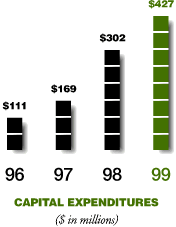
[Management's Discussion and Analysis] LIQUIDITY AND CAPITAL RESOURCES Cash flow is generated from the manufacture and sale of trucks and mid-range diesel engines and their associated service parts as well as from product financing and insurance coverage provided to the company's dealers and retail customers by the financial services segment. The company's current debt ratings have made sales of finance receivables the most economic sources of funding for NFC. Insurance operations are self-funded. The company had working capital of $340 million at October 31, 1999, compared to $482 million at October 31, 1998. The decrease from 1998 to 1999 is primarily due to a net change in operating assets and liabilities of $439 million as described below, and $144 million of purchases of common stock offset by net sales and maturities of marketable securities of $330 million. Consolidated cash, cash equivalents and marketable securities of the company were $576 million at October 31, 1999, $1,064 million at October 31, 1998, and $965 million at October 31, 1997. Cash, cash equivalents and marketable securities available to manufacturing operations, including a 1999 $659 million intercompany receivable from NFC, which NFC is obligated to repay upon request, totaled $1,045 million at October 31, 1999, $1,010 million at October 31, 1998 and $901 million at October 31, 1997. Cash provided by operations during 1999 totaled $302 million, primarily from net income of $544 million. Income tax expense for 1999 was $47 million, primarily composed of cash payments of $40 million to federal and certain state, local and foreign governments. The net change in operating assets and liabilities of $439 million includes a $445 million increase in receivables, primarily due to a net increase in wholesale note and account balances. The change also includes a $129 million increase in inventory due to higher production levels, offset by a related $139 million increase in accounts payable. During 1999, investment programs used $451 million in cash principally to fund $498 million of capital expenditures and investments in affiliates. Capital expenditures were made primarily for the NGV and NGD programs, increased engine production capacity, and increased capacity, infrastructure and facility enhancements at the Escobedo, Mexico plant. Investment programs also used cash for a $160 million net increase in retail notes and lease receivables and a $108 million net increase in property and equipment leased to others. These were offset by a net decrease in marketable securities of $330 million.
Financing activities provided an $88 million net increase in notes and debt outstanding under the bank revolving credit facility and other commercial paper programs, and a $39 million net increase in long-term debt. Additionally, $22 million was borrowed under the Mexican credit facility, of which approximately half is denominated in Mexican pesos. These were offset by purchases of $144 million of common stock during 1999 in accordance with board approved spending levels for 1999 and 2000. Cash flow from the company's manufacturing and financial services operations is currently sufficient to cover planned investment in the business. Capital investments for 2000 are expected to be nearly $600 million including approximately $100 million for the NGV program and $200 million for the NGD program. In addition to the NGV and NGD programs, capital expenditures are planned to purchase lease options on engine equipment, to add a school bus facility in Tulsa, Oklahoma, and for normal improvements to existing facilities and products. The company had outstanding capital commitments of $505 million at October 31, 1999, including $91 million for the NGV program and $325 million through 2003 for the NGD program. The company currently estimates $460 million and $500 million in capital spending and $190 million and $120 million in development expense through 2004 for the NGV and NGD programs, respectively. Approximately $90 million and $20 million of the development expenses are planned for 2000. Included in the NGD amounts for capital spending and development expense are the company's planned investment to produce new high technology diesel engines in Huntsville, Alabama. During October 1999, the company's board of directors approved a new share repurchase program for as much as $243 million. Under the new repurchase program, shares will be purchased on the open market from time to time; however, the company cannot purchase more than 4.5 million shares through March 2001 without impairing the use of its tax loss carryforwards. Through November 1999, the company has purchased $46 million worth of shares under this program, including $11 million in fiscal 1999. The company's truck assembly facility in Escobedo, Mexico is encumbered by a lien in favor of certain lenders of the company as collateral for a $125 million revolving Mexican credit facility. At October 31, 1999, $52 million of a Mexican subsidiary's receivables were pledged as collateral for bank borrowings. In addition, as of October 31, 1999, the company is contingently liable for approximately $204 million for various purchasing commitments, credit guarantees and buyback programs. Based on historical loss trends, the company's exposure is not considered material. Additionally, restrictions under the terms of the senior and senior subordinated notes and the Mexican credit facility include a limitation on indebtedness and a limitation on certain restricted payments. NFC has traditionally obtained funds to provide financing to the company's dealers and retail customers from sales of finance receivables, commercial paper, short and long-term bank borrowings, medium and long-term debt and equity capital. At October 31, 1999, NFC's funding consisted of sold finance receivables of $2,296 million, bank and other borrowings of $1,287 million, subordinated debt of $100 million, capital lease obligations of $323 million and equity of $280 million. Through the asset-backed markets, NFC has been able to fund fixed rate retail note receivables at rates offered to companies with investment grade ratings. During 1999, NFC sold $1,260 million of retail notes through Navistar Financial Retail Receivables Corporation (NFRRC), a wholly owned subsidiary of NFC. At October 31, 1999, the remaining shelf registration available to NFRRC for the public issuance of asset-backed securities was $2,257 million. Also, at October 31, 1999, Navistar Financial Securities Corporation, a wholly owned subsidiary of NFC, had in place a revolving wholesale note trust that provides for the funding of $600 million of wholesale notes. At October 31, 1999, available funding under NFC's bank revolving credit facility and the asset-backed commercial paper facility was $87 million, of which $35 million was used to back short-term debt. The remaining $52 million, when combined with unrestricted cash and cash equivalents, made $90 million available to fund the general business purposes of NFC. In November 1999, NFC sold $533 million of retail notes, net of unearned finance income, through NFRRC to two multi-seller asset-backed commercial paper conduits sponsored by a major financial institution. The gain on the sale, which was not material, was recognized in November 1999. NFC's maximum contractual exposure under all receivable sale recourse provisions at October 31, 1999, was $257 million. However, management believes the recorded reserves for losses on sold receivables are adequate. See Note 5 to the Financial Statements. At October 31, 1999, NFC held forward interest rate contracts with notional amounts of $500 million and $75 million in anticipation of retail receivable sales to occur in November 1999 and March 2000, respectively. These contracts were entered into to reduce exposure to future changes in interest rates. NFC intends to close these positions on the pricing dates of the sales. Any resulting gain or loss will be included in the gain or loss on the sales of receivables. For the protection of investors in NFC's debt securities, NFC issued an interest rate cap. The notional amount of the cap, $374 million, amortizes based on the expected outstanding principal balance of the sold retail receivables. Under the terms of the cap agreement, NFC will make payments if interest rates exceed certain levels. The interest rate cap is recorded at fair value with changes in fair value recognized in income. At October 31, 1999, the impact on income was not material. In addition, the company held German mark, Japanese yen and Canadian dollar forward contracts with notional amounts of $49 million, $13 million and $10 million, respectively, and other derivative contracts with notional amounts of $19 million. At October 31, 1999, the unrealized net loss on these contracts was not material. At October 31, 1999, the Canadian operating subsidiary was contingently liable for retail customers' contracts and leases financed by a third party. The Canadian operating subsidiary is subject to maximum recourse of $251 million on retail contracts and $22 million on retail leases. The Canadian operating subsidiary, NFC and certain other subsidiaries included in the financial services operations are parties to agreements that may result in the restriction of amounts which can be distributed to Transportation in the form of dividends or loans and advances. At October 31, 1999, the maximum amount of dividends which were available for distribution under the most restrictive covenants was $220 million. The company and Transportation are obligated under certain agreements with public and private lenders of NFC to maintain the subsidiary's income before interest expense and income taxes at not less than 125% of its total interest expense. No income maintenance payments were required for the three years ended October 31, 1999. In May 1999, Moody's and Duff and Phelps raised the company's senior debt ratings from Ba1 and BB+ to Baa3 and BBBÐ, respectively and raised the company's subordinated debt ratings from Ba3 and BBÐ to Ba2 and BB, respectively. NFC's senior debt ratings increased from Ba1 and BBBÐ to Baa3 and BBB, respectively. NFC's subordinated debt ratings were also raised from Ba3 and BB+ to Ba2 and BBBÐ, respectively. It is the opinion of management that, in the absence of significant unanticipated cash demands, current and forecasted cash flow will provide a basis for financing operating requirements, capital investments and planned repurchases of common stock. Management also believes that collections on the outstanding receivables portfolios as well as funds available from various funding sources will permit the financial services operations to meet the financing requirements of the company's dealers and customers. |
|
|
Annual Report 1999 |
|
|
©
1999 Navistar International - www.navistar.com
|