Annual Report
1999 |
investor relations | corporate home
|
Annual Report
1999 |
investor relations | corporate home
|
|
MD
& A
|
|
MD
& A
|
|
|
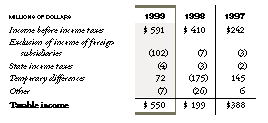
[Management's Discussion and Analysis] NEW ACCOUNTING PRONOUNCEMENTS In March 1998, the American Institute of Certified Public Accountants issued Statement of Position 98-1, "Accounting for the Costs of Computer Software Developed or Obtained for Internal Use." This statement defines whether or not certain costs related to the development or acquisition of internal use software should be expensed or capitalized, and is effective for fiscal years beginning after December 15, 1998. The company adopted this statement effective November 1, 1999. At planned 2000 spending levels, adoption of this statement will result in the company capitalizing approximately $25 million of certain costs that would have otherwise been expensed. In June 1998, the Financial Accounting Standards Board (FASB) issued Statement of Financial Accounting Standards No. 133, "Accounting for Derivative Instruments and Hedging Activities" (SFAS 133), to establish accounting and reporting requirements for derivative instruments. This standard requires recognition of all derivative instruments in the statement of financial condition as either assets or liabilities, measured at fair value. This statement additionally requires changes in the fair value of derivatives to be recorded each period in current earnings or comprehensive income depending on the intended use of the derivatives. The company is currently assessing the impact of this statement on the company's results of operations, financial condition and cash flows. In June 1999, the FASB issued Statement of Financial Accounting Standards No. 137, "Accounting for Derivative Instruments and Hedging ActivitiesÑDeferral of the Effective Date of FASB Statement No. 133," which amends SFAS 133 by deferring for one year, the effective date of SFAS 133, to those fiscal years beginning after June 15, 2000. INCOME TAXES The Statement of Financial Condition at October 31, 1999 and 1998 includes a deferred tax asset of $896 million and $912 million, respectively, net of valuation allowances of $86 million and $264 million, respectively, related to future tax benefits.The deferred tax asset has been reduced by the valuation allowance as management believes it is more likely than not that some portion of the deferred tax asset may not be realized in the future. The deferred tax asset includes the tax benefits associated with cumulative tax losses of $1,134 million and temporary differences, which represent the cumulative expense of $1,224 million recorded in the Statement of Income that has not been deducted on the company's tax returns. The valuation allowance at October 31, 1999, assumes that it is more likely than not that approximately $226 million of cumulative tax losses will not be realized before their expiration date. Realization of the net deferred tax asset is dependent on the generation of approximately $2,400 million of future taxable income. Until the company has utilized its significant net operating loss carryforwards, the cash payment of U.S. federal income taxes will be minimal. See Note 3 to the Financial Statements. The company performs extensive analysis to determine the amount of the deferred tax asset. Such analysis is based on the premise that the company is, and will continue to be, a going concern and that it is more likely than not that deferred tax benefits will be realized through the generation of future taxable income. Management reviews all available evidence, both positive and negative, to assess the long-term earnings potential of the company. The financial results are evaluated using a number of alternatives in economic cycles at various industry volume conditions. One significant factor considered is the company's role as a leading producer of heavy and medium trucks and school buses and mid-range diesel engines. As a result of the increase in 1999 industry demand, the continued successful implementation of the company's manufacturing strategies, changes in the company's operating structure, and other positive operating indicators, management reviewed its projected future taxable income and evaluated the impact of these changes on its deferred tax asset valuation allowance. This review was completed during the third quarter of 1999 and resulted in a reduction to the deferred tax asset valuation allowance of $178 million which has been recorded as a reduction of income tax expense resulting in an effective tax rate of 8%. In addition, a $45 million reduction in the allowance was recorded during the fourth quarter of 1998 based on a similar review. Management believes that, with the combination of available tax planning strategies and the maintenance of significant market share, earnings are achievable in order to realize the net deferred tax asset of $896 million. Reconciliation of the company's income before income taxes for financial statement purposes to U.S. taxable income for the years ended October 31 is as follows:
|
|
|
Annual Report 1999 |
|
|
©
1999 Navistar International - www.navistar.com
|