Annual Report
1999 |
investor relations | corporate home
|
Annual Report
1999 |
investor relations | corporate home
|
|
MD
& A
|
|
MD
& A
|
|
|
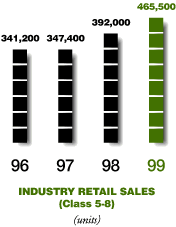
[Management's Discussion and Analysis] Certain statements under this caption that are not purely historical constitute "forward-looking statements" under the Private Securities Litigation Reform Act of 1995 and involve risks and uncertainties. These forward-looking statements are based on current management expectations as of the date made. The company assumes no obligation to update any forward-looking statements. Navistar International Corporation's actual results may differ significantly from the results discussed in such forward-looking statements. Factors that might cause such a difference include, but are not limited to, those discussed under the captions "Year 2000" and "Business Environment." Navistar International Corporation is a holding company and its principal operating subsidiary is Navistar International Transportation Corp. (Transportation). In this discussion and analysis, "company" or "Navistar" refers to Navistar International Corporation and its consolidated subsidiaries. Navistar operates in three principal industry segments: truck, engine (collectively called "manufacturing operations"), and financial services. The company's truck segment is engaged in the manufacture and marketing of Class 5 through 8 trucks, including school buses. The truck segment also provides customers with proprietary products needed to support the International truck and bus lines, together with a wide selection of other standard truck and trailer aftermarket parts. The truck segment operates primarily in the United States (U.S.) and Canada as well as in Mexico, Brazil and other selected export markets. The company's engine segment is engaged in the design and manufacture of mid-range diesel engines. The engine segment also provides customers with proprietary products needed to support the International engine lines, together with a wide selection of other standard engine and aftermarket parts. The engine segment operates primarily in the U.S. and Brazil. The financial services operations of the company provide wholesale, retail and lease financing, and domestic commercial physical damage and liability insurance coverage to the company's dealers and retail customers and to the general public through an independent insurance agency system. The discussion and analysis reviews the operating and financial results, and liquidity and capital resources of the manufacturing and financial services operations. Manufacturing operations reflect the financial results of the financial services operations included on a one-line basis under the equity method of accounting. Financial services operations include Navistar Financial Corporation (NFC) and the company's foreign finance companies. See Note 1 to the Financial Statements. RESULTS OF OPERATIONS The company reported net income of $544 million for 1999, or $8.20 per diluted common share, reflecting higher sales of engines as well as a $178 million reduction in the company's tax valuation allowance. Net income was $299 million, or $4.11 per diluted common share in 1998, and $150 million, or $1.65 per diluted common share in 1997. Net income in 1998 included a $45 million reduction in the company's tax valuation allowance. The company's manufacturing operations reported income before income taxes of $474 million in 1999 compared with $321 million in 1998 and $164 million in 1997. The truck segment's profits increased by 20% in 1999 and 91% in 1998 compared to revenue increases of 6% and 26%, respectively. The engine segment's profits increased by 58% in 1999 and 35% in 1998 compared to revenue increases of 21% and 22%, respectively. The truck and engine segments' profit increases during 1999 are attributable to economies of scale in engine production, improved truck pricing and various cost improvement initiatives by both the truck and engine segments. The truck and engine segments' profit increases during 1998 are attributable to economies of scale in truck and engine production, improved truck pricing and various other cost improvement initiatives by both the truck and engine segments. The truck and engine segments' revenue increases are attributable to increases in shipments of trucks and of mid-range diesel engines to other original equipment manufacturers (OEMs). The financial services segment's profit in 1999 was $28 million higher than in 1998. This is primarily attributable to the increase in NFC's pretax income and a legal settlement in favor of an insurance subsidiary of the company. NFC's pretax income in 1999 was $101 million, a 19% increase from $85 million in 1998, primarily as a result of an increase in wholesale and retail financing activity and proportionally lower interest expense and debt levels resulting from a higher level of average outstanding accounts payable to affiliates. This was partially offset by a higher provision for losses and higher costs to service the larger portfolio. The financial services segment's profit in 1998 was $7 million higher than in 1997, primarily due to the $10 million increase in NFC's pretax income from the $75 million reported in 1997. This increase is primarily due to an increase in wholesale and retail financing activity partially offset by lower financing margins. Sales and Revenues. Sales and revenues of $8,647 million in 1999 were 10% higher than the $7,885 million reported in 1998, which was 24% higher than the $6,371 million reported in 1997. Sales of manufactured products totaled $8,326 million in 1999, 9% above the $7,629 million reported for 1998, which was a 24% increase from the $6,147 million reported in 1997. U.S. and Canadian industry retail sales of Class 5 through 8 trucks totaled 465,500 units in 1999, a 19% increase from the 392,000 units sold in 1998, and 34% higher than the 347,400 units sold in 1997. Class 8 heavy truck sales totaled 286,000 units, a 23% increase from the 232,000 units sold in 1998, and 45% higher than the 196,800 units sold in 1997. Industry sales of Class 5, 6 and 7 medium trucks, including school buses, totaled 179,500 units in 1999, a 12% increase from 1998, when 160,000 units were sold, which was a 6% increase over the 150,600 units sold in 1997. Industry sales of school buses, which accounted for 19% of the medium truck market, increased approximately 3% from 1998 to 33,800 units.
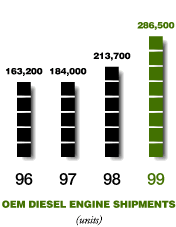
The company's 1999 market share of 25.6% in the combined U.S. and Canadian Class 5 through 8 truck market was constrained by the fact that continued industry demand for heavy and medium trucks outstripped system capacity. Market shares in 1998 and 1997 were 29.1% and 28.3%, respectively. (Sources: Ward's Communications and the Canadian Vehicle Manufacturers Association.) Total engine units shipped reached 374,200 in 1999, a 25% increase over 1998. This excludes the 48,200 units shipped by Maxion International Motores S.A., the company's joint venture in Brazil. Shipments of mid-range diesel engines by the company to other OEMs during 1999 were a record 286,500 units, a 34% increase over the 213,700 units shipped in 1998, which represented a 16% improvement over 1997. Higher shipments to Ford Motor Company to meet consumer demand for the light trucks and vans which use this engine was the primary reason for the increases. Finance and insurance revenue was $256 million for 1999, a $55 million increase over 1998 revenue of $201 million, which was a $27 million increase over 1997 revenue of $174 million. These increases are primarily due to increased wholesale and retail financing. The 1999 increase in other income is primarily due to a legal settlement in favor of an insurance subsidiary of the company. Costs and Expenses. Manufacturing gross margin was 18.0% of sales in 1999, compared with 15.3% in 1998, and 14.2% in 1997. The increase in 1999 gross margin is primarily due to improved pricing and improved operating efficiencies. The 1998 improvement in margin was primarily due to improved operating efficiencies offset by provisions for employee profit sharing. Postretirement benefits expense of $216 million in 1999 increased $42 million from $174 million in 1998 and approximated the 1997 expense of $215 million. The 1999 increase is mainly a result of higher retiree healthcare expense and higher profit sharing provisions to a retiree trust ($23 million and $16 million, respectively). The 1998 decrease was mainly a result of higher expected return on plan assets and lower amortization of prior service cost ($69 million and $9 million, respectively) offset by higher profit sharing provisions to a retiree trust ($38 million). Engineering and research expense increased to $281 million in 1999 from $192 million in 1998 and $124 million in 1997. Approximately 50% and 35%, respectively, of these increases reflect the company's continuing investment in its next generation vehicle (NGV) program and approximately 25% and 20%, respectively, of these increases reflect investment in the next generation diesel (NGD) program. Sales, general and administrative expense was $486 million in 1999 compared with $427 million in 1998 and $365 million in 1997. The 1999 increase is primarily due to marketing programs and the operational implementation of the company's integrated truck and engine strategies ($13 million and $34 million, respectively). The change between 1998 and 1997 primarily reflects investment in the company's five-point truck strategy and an increase in the provision for payment to employees as provided by the company's performance incentive programs ($24 million and $20 million, respectively). Interest expense increased to $135 million in 1999 from $105 million in 1998 and $74 million in 1997. The increase in 1999 resulted, in part, from higher average receivable funding requirements driven by higher sales levels. Additionally, a portion of the increase in 1999 and the majority of the increase in 1998 is due to a $358 million net increase in manufacturing operations debt during 1998 driven by the issuance of $350 million of senior and senior subordinated notes in February 1998. Other expense for 1998 includes $14 million related to the secondary public offering of 19.9 million shares of the company's common stock which was completed in June 1998.
|
|
|
Annual Report 1999 |
|
|
©
1999 Navistar International - www.navistar.com
|