Annual Report
1999 |
investor relations | corporate home
|
Annual Report
1999 |
investor relations | corporate home
|
|
Financials
|
|
Balance
Sheet |
Statement of Income | Statement
of Cash Flow | Notes 1 | Notes
2 | Notes 3 | Notes
4
Notes 5 | Notes 6 | Notes 7 | Notes 8 | Notes 9 | Notes 10 | Supplemental Info |
FINANCIALS
|
|
|
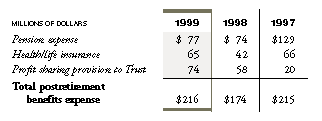
[Notes to Financial Statements] 2 POSTRETIREMENT BENEFITS The company provides postretirement benefits to substantially all of its employees. Costs associated with postretirement benefits include pension and postretirement health care expenses for employees, retirees and surviving spouses and dependents. In addition, as part of the 1993 restructured health care and life insurance plans, profit sharing payments to the Retiree Supplemental Benefit Trust (Trust) are required. The cost of postretirement benefits is segregated as a separate component in the Statement of Income and is as follows:
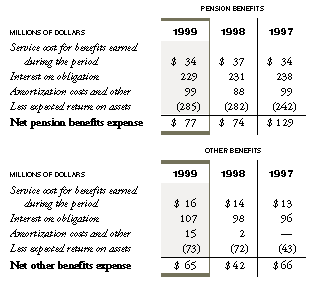
Generally, the pension plans are non-contributory. The company's policy is to fund its pension plans in accordance with applicable U.S. and Canadian government regulations and to make additional payments as funds are available to achieve full funding of the accumulated benefit obligation. At October 31, 1999, all legal funding requirements had been met. In 2000, the company expects to contribute approximately $85 million to its pension plans to meet legal requirements. In 1993, the Retiree Health Benefit Trust was established to provide a vehicle for funding the health care liability through company contributions and retiree premiums. The company made a required prefunding contribution of $200 million to this trust during 1998. POSTRETIREMENT BENEFITS EXPENSE Net periodic benefits expense included in the Statement of Income is composed of the following:
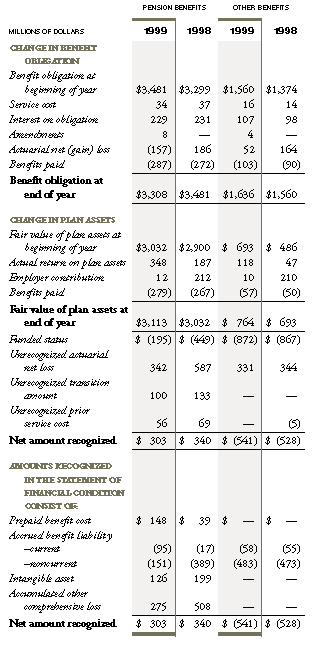
"Amortization costs and other" include amortization of cumulative gains and losses over the expected remaining service life of employees and amortization of the initial transition liability over 15 years. Also included is the expense related to yearly lump-sum payments to retirees required by negotiated labor contracts, expense related to defined contribution plans and amortization of plan amendments. Plan amendments are recognized over the remaining service life of employees, except for those plan amendments arising from negotiated labor contracts, which are amortized over the length of the contract. The funded status of the company's plans as of October 31, 1999 and 1998 and a reconciliation with amounts recognized in the Statement of Financial Condition are provided below.
The accumulated other comprehensive loss included in shareowners' equity is recorded in the Statement of Financial Condition net of deferred income taxes of $91 million and $172 million at October 31, 1999 and 1998, respectively. The projected benefit obligation, accumulated benefit obligation and fair value of plan assets for the pension plans with accumulated benefit obligations in excess of plan assets were $2,057 million, $2,056 million and $1,814 million, respectively, as of October 31, 1999, and $3,393 million, $3,336 million and $2,931 million, respectively, as of October 31, 1998. During 1998, the pension plans purchased 3 million shares of the company's common stock. At October 31, 1998, these shares accounted for approximately 2% of the plans' assets. During 1999, the pension plans sold all of their shares of the company's common stock. The weighted average rate assumptions used in determining expenses and benefit obligations were: For 2000, the weighted average rate of increase in the per capita cost of covered health care benefits is projected to be 9.7%. The rate is projected to decrease to 5.0% by the year 2005 and remain at that level each year thereafter. The effect of changing the health care cost trend rate by one-percentage point for each future year is as follows:
|
|
|
Annual Report 1999 |
|
|
©
1999 Navistar International - www.navistar.com
|