Annual Report
1999 |
investor relations | corporate home
|
Annual Report
1999 |
investor relations | corporate home
|
|
Financials
|
|
Balance
Sheet |
Statement of Income | Statement
of Cash Flow | Notes 1 | Notes
2 | Notes 3 | Notes
4
Notes 5 | Notes 6 | Notes 7 | Notes 8 | Notes 9 | Notes 10 | Supplemental Info |
FINANCIALS
|
|
|
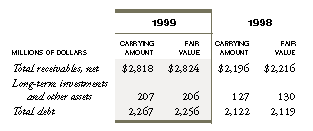
[Notes to Financial Statements] 10 FINANCIAL INSTRUMENTS FAIR VALUE OF FINANCIAL INSTRUMENTS The carrying amounts of financial instruments, as reported in the Statement of Financial Condition and described in various Notes to the Financial Statements, and their fair values at October 31 are as follows:
Cash and cash equivalents approximate fair value. The cost and fair value of marketable securities are disclosed in Note 4. The fair value of notes receivable and retail notes is estimated by discounting expected cash flows at estimated current market rates. Customer receivables, wholesale notes and retail and wholesale accounts approximate fair value as a result of the short-term nature of the receivables. The fair value of investments and other assets is estimated based on quoted market prices or by discounting future cash flows. The short-term debt and variable-rate borrowings under NFC's bank revolving credit agreement, which are repriced frequently, approximate fair value. The fair value of long-term debt is estimated based on quoted market prices, when available. If a quoted market price is not available, fair value is estimated using quoted market prices for similar financial instruments or discounting future cash flows. DERIVATIVES HELD OR ISSUED FOR PURPOSES OTHER THAN TRADING The company uses derivatives to transfer or reduce risks of foreign exchange and interest rate volatility, and to potentially increase the return on invested funds. The company periodically enters into forward contracts in order to reduce exposure to exchange rate risk related to purchases denominated in currencies other than the functional currency. The financial services operations manage exposures to fluctuations in interest rates by limiting the amount of fixed rate assets funded with variable rate debt generally by selling fixed rate receivables on a fixed rate basis and by utilizing derivative financial instruments. These derivative financial instruments may include interest rate swaps, interest rate caps and forward contracts. The fair value of these instruments is subject to risk as the instruments may become less valuable due to changes in market conditions or interest rates. NFC manages exposure to counter-party credit risk by entering into derivative financial instruments with major financial institutions that can be expected to fully perform under the terms of such agreements. NFC's credit exposure is limited to the fair value of contracts with a positive fair value at the reporting date. Notional amounts are used to measure the volume of derivative financial instruments and do not represent exposure to credit loss. The financial services operations enter into forward contracts to manage their exposure to fluctuations in the fair value of retail notes anticipated to be sold. The financial services operations manage such risk by entering into forward contracts to sell fixed debt securities or forward interest rate swaps whose fair value is highly correlated with that of its receivables. Income recognition of changes in fair value of the derivatives is deferred until the derivative instruments are closed. Gains or losses incurred with the closing of these agreements are included as a component of the gain or loss on sale of receivables. In November 1998, NFC sold $545 million of fixed rate retail receivables to a multi-seller asset-backed commercial paper conduit sponsored by a major financial institution on a variable rate basis. For the protection of investors, NFC issued an interest rate cap. The notional amount of the cap, $374 million, amortizes based on the expected outstanding principal balance of the sold retail receivables. Under the terms of the cap agreement, NFC will make payments if interest rates exceed certain levels. The interest rate cap is recorded at fair value with changes in fair value recognized in income. As of October 31,1999, the impact on income was not material. At October 31, 1999, NFC held forward interest rate contracts with notional amounts of $500 million and $75 million in anticipation of retail receivable sales to occur in November 1999 and March 2000, respectively. In addition, the company held German mark, Japanese yen and Canadian dollar forward contracts with notional amounts of $49 million, $13 million and $10 million, respectively, and other derivative contracts with notional amounts of $19 million. At October 31, 1999, the unrealized net loss on these contracts was not material.
|
|
|
Annual Report 1999 |
|
|
©
1999 Navistar International - www.navistar.com
|