R.H. Donnelley 1998 Annual Report
Management's Discussion and Analysis
The matters discussed in this annual report of R.H. Donnelley Corporation (the "Company") and R.H. Donnelley Inc. ("Donnelley") contain forward looking statements subject to the safe harbor created by the Private Securities Litigation Reform Act of 1995. Where possible, the words "believe," "expect," "anticipate," "should," "planned," "estimated," "potential," "goal," "outlook," and similar expressions, as they relate to the Company, Donnelley or its management, have been used to identify such forward looking statements. These statements and all other forward looking statements reflect the Company's and Donnelley's current beliefs and specific assumptions with respect to future business decisions and are based on information currently available. Accordingly, the statements are subject to significant risks, uncertainties and contingencies which could cause the Company's and Donnelley's actual operating results, performance or business prospects to differ from those expressed in, or implied by, these statements. Such risks, uncertainties and contingencies include the following: (1) loss of market share through competition; (2) uncertainties caused by the consolidation of the telecommunications industry; (3) introduction of competing products or technologies by other companies; (4) complexity and uncertainty regarding the development of new high technology products; (5) pricing pressures from competitors and/or customers; (6) changes in the yellow pages industry and markets; (7) the company's inability to complete the implementation of its Year 2000 plans on a timely basis; and (8) a sustained economic downturn in the United States.
of Financial Condition and
Results of OperationsThe Company
Except where otherwise indicated, the term "Company" refers to R.H. Donnelley Corporation and its wholly owned subsidiary R.H. Donnelley Inc. ("Donnelley"). Donnelley is a wholly owned subsidiary of the Company. The Company has no other operations other than through its Donnelley subsidiary. Therefore, on a consolidated basis, the financial statements of the Company and Donnelley are substantially identical.
The Company provides advertising sales and marketing services for yellow pages and other directory products under long-term sales agency agreements and joint venture partnerships with operating units of major telephone companies as well as through its own independent operations. The Company is a sales agent in New York State for an operating unit of Bell Atlantic and in Florida for an operating unit of Sprint. It also serves as a sales agent for the CenDon partnership ("CenDon"), a 50/50 partnership between Donnelley and an operating unit of Sprint that was formed to publish directories in Florida, Nevada, Virginia and North Carolina. The Company also began publishing its own independent yellow pages directory in the Cincinnati area in 1998. Due to their similarities, the Company aggregates these businesses in its Directory Advertising Services segment.
The Company is also a 50% partner in the DonTech Partnership ("DonTech"), a partnership with an operating unit of Ameritech, which acts as the exclusive sales agent for yellow pages directories published by Ameritech in Illinois and northwest Indiana. In addition to receiving 50% of the profits of DonTech, the Company also receives direct fees ("Revenue Participation") from an operating unit of Ameritech, which are tied to advertising sales. While DonTech provides advertising sales of yellow pages and other directory products, the partnership is considered a separate operating segment since, among other things, the employees of DonTech, including officers and managers, are not employees of the Company.
The Company also provides pre-press publishing services for yellow pages directories, including advertisement creation, sales contract management, listing database management, sales reporting and commissions, pagination, billing services and imaging, to independent yellow pages publishers and its existing customers under separately negotiated contracts. This business is classified as Directory Publishing Services.
Factors Affecting Comparability
Prior to July 1, 1998, the Company operated as part of The Dun & Bradstreet Corporation ("Old D&B"). On December 17, 1997, the Board of Directors of Old D&B approved in principle a plan to separate into two publicly-traded companies - R.H. Donnelley Corporation and The New Dun & Bradstreet Corporation ("New D&B"). The distribution ("Distribution") was the method by which Old D&B distributed to its shareholders shares of New D&B common stock. On July 1, 1998, as part of the Distribution, Old D&B distributed to its shareholders shares of New D&B stock. In connection with the Distribution, Old D&B changed its name to R.H. Donnelley Corporation.
The historical consolidated financial statements reflect the financial position, results of operations and cash flows of the Company as if it were a stand-alone entity for all periods presented. The historical financial statements include allocations of certain Old D&B general and administrative expenses and corporate assets and liabilities related to the Company's business. Management believes these allocations are reasonable; however, these costs and allocations are not necessarily indicative of the costs that would have been incurred had the Company performed or provided these functions as a separate entity. For example, the Company estimates that general and administrative expenses would have been approximately $4.4 million and $8.6 million higher than the amounts allocated from Old D&B during the first six months of 1998 and the full year of 1997, respectively. Additionally, in connection with the Distribution, the Company issued Debt (as defined below; see - "Liquidity and Capital Resources") and estimates that additional interest expense of $18.4 million and $42.7 million would have been incurred in 1998 and 1997, respectively, assuming the Debt was outstanding as of January 1, 1997.
Other items affecting the comparability of 1998 results to the prior periods include the sale of the Company's Proprietary-East ("P-East") business in December 1997 and the Proprietary-West ("P-West") business in May 1996. Also, in August 1997, the Company's sales agency contract with Cincinnati Bell expired. The Company made a strategic decision to leverage its expertise in yellow pages advertising sales and its knowledge of the Cincinnati area to launch its own independent yellow pages directory. During 1998, the Company published its initial Cincinnati directory. The revenues from the publication placed the Cincinnati directory among the nation's top five independent directories.
Advertising Sales
Calendar Cycle Sales Advertising sales is the billing value of advertisements sold by the Company and DonTech in a given calendar year. This is referred to as calendar cycle sales. The Company recognizes advertising sales on the same basis on which revenues are recognized (that is, when a sales contract is signed where the Company is a sales agent and when a directory is published where the Company is the publisher of the directories). For 1998, calendar cycle sales were $995.4 million compared to $1,067.2 million in 1997. Excluding sales from P-East of $73.8 million in 1997, sales in 1998 were consistent with 1997. However, advertising sales from the Cincinnati area were significantly lower in 1998 due to the expiration of the sales agency agreement with Cincinnati Bell, which was partially offset by the initiation of an independent directory. Excluding the impact of this change, sales showed a 4.5% increase in the underlying comparable businesses over 1997.
Advertising sales for the Directory Advertising Services segment decreased 14.0% in 1998 compared to 1997. However, excluding the sales from P-East and adjusting for the change in the Cincinnati operations, sales in the Directory Advertising Services segment showed a 4.1% increase in 1998 over 1997. This increase was driven by growth of 7.7% in the Sprint markets, particularly the Las Vegas, Nevada; Hickory, North Carolina; and Tallahassee, Florida areas, and a 2.6% increase in the Bell Atlantic markets. The increase in the Bell Atlantic markets was primarily due to $6.3 million of sales in the Buffalo and North Country markets. During 1998, the Company was appointed the exclusive sales agent by Bell Atlantic to service these markets. Advertising sales for DonTech increased 5.0% in 1998 compared to 1997 primarily due to strong growth in Chicago and surrounding areas.
Calendar cycle sales decreased 4.3% in 1997 to $1,067.2 million from $1,115.6 million in 1996. In the Directory Advertising Services segment, advertising sales decreased 7.5% in 1997 compared to 1996. Sales from Bell Atlantic directories were 7.4% lower than in 1996 due to the rescheduling of publication dates of certain directories from 1997 into 1998. Sales from Cincinnati Bell decreased 22.9% as the Company did not sell advertising for the November 1997 directories due to the expiration of the sales agency contract, and sales from P-East were down 18.0% due to the sale of that business. These declines were partially offset by 5.5% growth in the Sprint markets, primarily in Las Vegas. Advertising sales from DonTech increased 1.3% in 1997 over 1996.
Publication Cycle Sales The Company believes that an additional measurement of sales performance is the publication cycle method. This method calculates sales on the basis of the annual value of a directory according to its publication date regardless of when the advertising for that directory was sold. If a directory publication date changes from one year to the next, the prior year publication date is adjusted to conform to the present year to maintain comparability. In 1998, publication cycle sales were $993.9 million compared to $1,086.3 million in 1997. Sales in 1998 of $993.9 million were 1.8% lower than 1997 sales of $1,012.5 million, after excluding 1997 sales of P-East of $73.8 million. After further excluding advertising sales related to the Company's changing Cincinnati operations, as noted above, advertising sales increased 2.2% from $962.4 million to $983.5 million in 1998. The increase was due to strong growth in the Sprint and DonTech markets.
Advertising sales from the Directory Advertising Services segment decreased 15.7% in 1998 compared to 1997. Excluding sales from P-East and sales related to the Company's changing Cincinnati operations, sales increased 0.6%. Strong growth of 7.7% in the Sprint markets was offset by a decline in sales in the Bell Atlantic markets of 2.2%. This decrease was driven primarily by lower sales in the New York City area (including Manhattan, Queens, Staten Island and Brooklyn).
Advertising sales from DonTech increased 4.6% over 1997 due to growth in the DonTech markets and sales efficiencies as a result of the completion of the final phase of a two-year initiative to rebalance the publication schedules for the Ameritech directories. Prior to 1997, sales and production inefficiencies arose from an unbalanced production schedule in which the majority of the directories with which DonTech is affiliated were published in the fourth quarter. The publication dates of the directories are now more evenly distributed throughout the year, enabling DonTech to achieve higher sales through increased productivity and utilization and enhanced customer satisfaction. Publication cycle sales of $1,086.3 million in 1997 were consistent with 1996 sales of $1,081.9 million. Sales from the Directory Advertising Services segment decreased approximately 1.6% as strong growth from the Sprint markets was offset by a decrease resulting from the expiration of the Cincinnati Bell contract and the sale of the P-East business during 1997. Sales from DonTech increased 4.3% over 1996 due to growth in the Chicago markets.
Results of Operations - 1998 vs. 1997
Revenues in 1998 of $170.0 million decreased 29.1% from $239.9 million in 1997. Excluding revenues from P-East ($78.0 million), 1998 revenues increased 5.0%, or $8.1 million. The increase was due to higher revenues from the Directory Advertising Services and Directory Publishing Services segments. The increase in Directory Advertising Services' revenues was due to strong growth in the Sprint markets of Nevada and Florida, partially offset by lower revenues in the Bell Atlantic and Cincinnati markets. The increase in Directory Publishing Services' revenues resulted from a new long-term contract with the purchaser of the Company's P-East business.
Operating expenses in 1998 of $123.5 million decreased 25.3% from $165.3 million in 1997; however, excluding the operating expenses of P-East in 1997 ($50.6 million), operating expenses increased 7.6%, or $8.7 million. This increase is primarily attributable to an increase in costs related to the new Buffalo operation, costs relating to the publication of the Company's first Cincinnati independent directory and higher information technology costs.
General and administrative expenses in 1998 of $28.4 million decreased 3.8% from $29.6 million in 1997, but excluding the general and administrative expenses of P-East ($8.6 million), general and administrative expenses increased 35.3%, or $7.4 million. This increase is due to increased costs related to being a stand-alone company, increased information technology spending and costs associated with the start-up of a Chinese joint venture with China Unicom (see - "Liquidity and Capital Resources").
Provision for bad debts of $8.6 million in 1998 decreased $9.9 million from 1997; however, excluding $7.1 million related to P-East, the provision decreased $2.8 million. This reduction is mainly attributable to lower Bell Atlantic revenues.
Income from partnerships and related fees includes the Company's share of the profits from the CenDon and DonTech partnerships and Revenue Participation. This income increased 4.4% in 1998 to $135.9 million from $130.2 million in 1997, driven mainly by a 3.3% increase in DonTech income. DonTech's increase was primarily due to the strong growth in advertising sales. However, DonTech income was held down by a charge for adjustments for billing and receivables. The charge mainly relates to the Company's share of those accounts deemed uncollectible. Equity income from CenDon increased $3.6 million in 1998 to $15.8 million, primarily due also to strong growth in advertising sales.
Interest expense of $23.1 million in 1998 represents interest on the Debt incurred in connection with the Distribution. In June, the Company borrowed $350 million under variable rate credit facilities and issued $150 million of fixed rate notes. At the current level of debt and interest rates, the Company anticipates interest expense to be in the range of $40 - $42 million per year.
The effective tax rate in 1998 was 40.0% compared to 41.1% in 1997. The higher effective tax rate in 1997 was due to the amortization of goodwill, which is a non-deductible expense for tax purposes. The Company anticipates that its effective tax rate in future years will approximate 40%.
Net income in 1998 was $61.6 million, or $1.78 per diluted share compared to $84.9 million, or $2.48 per diluted share in 1997. As previously stated, management believes that the historical results are not indicative of the current operations as they include the results of businesses that have been sold by the Company and do not include the full year effect of certain costs and expenses that the Company has incurred as a result of its separation from Old D&B. If the historical results are adjusted to (i) exclude the operations of the P-East business, (ii) include the estimated additional general and administrative expenses associated with being a stand-alone company and (iii) assume the Debt was outstanding for all periods prior to the Distribution, net income for 1998 would have been $47.9 million or $1.39 per diluted share compared to $42.7 million or $1.25 per diluted share for 1997.
Directory Advertising Services Segment Revenues from Directory Advertising Services consist of sales commissions from the Company's sales agency agreements and the billing value of advertisements sold from the Company's independent operation. Sales commission revenues from the Bell Atlantic and Sprint sales agency operations are recognized when an advertising contract is signed with a customer. Sales commission revenues from CenDon, for which CenDon is the publisher, are recognized when a directory is published. The Company does not record its share of the revenues of CenDon, but recognizes its share of the profits as Income from partnerships and related fees, a component of operating income. Revenues from the Company's independent operation are recognized when a directory is published. Revenues from Directory Advertising Services were $138.1 million in 1998 compared to $214.8 million in 1997. Excluding P-East revenues of $78.0 million, revenues increased 1% in 1998. Revenues from the Sprint markets were up 10.9%, but were offset by a 19.6% decrease in Cincinnati and a 2.3% decrease in the Bell Atlantic markets.
Operating income from Directory Advertising Services includes the revenues and direct costs incurred by these businesses plus an allocation of certain centralized operating and general and administrative costs not charged directly to the businesses. Operating income in 1998 for Directory Advertising Services was $32.6 million compared to $41.0 million in 1997. Excluding P-East operating income of $11.0 million in 1997, operating income increased 8.5% due to a 34.0% increase in the operating income from the Sprint markets, including CenDon, partially offset by lower operating income from Cincinnati and the Bell Atlantic business.
DonTech Partnership Segment The Company does not record its share of the revenues and costs of the DonTech Partnership, but recognizes its share of the profits as Income from partnerships and related fees. The Company's Income from partnerships related to DonTech increased 3.3% in 1998, or $3.9 million, due to a 5.0% increase in sales. This increase in income was held down by the charge previously mentioned.
Directory Publishing Services Segment Revenues of $31.9 million were 27.2% higher than 1997 revenues of $25.1 million, after elimination of intercompany revenues of $0.8 million and $9.9 million, respectively. This increase was primarily due to increased revenue resulting from a new long-term contract with the purchaser of the Company's P-East business. This revenue replaced the work that Directory Publishing Services performed for the P-East business when it was owned by the Company. Operating income from Directory Publishing Services includes the revenues and direct costs incurred by this business, plus an allocation of certain centralized operating and general and administrative costs not charged directly to the business. This segment incurred an operating loss of $3.0 million in 1998 compared to $4.6 million in 1997. This improvement is principally due to reduced expenses. Depreciation and amortization of $6.3 million and $6.9 million, respectively, in 1998 and 1997, is the result of the Company's investment in the Raleigh operations.
Results of Operations - 1997 vs. 1996
Revenues in 1997 were $239.9 million compared to $270.0 million in 1996. This decrease of 11.2% was primarily due to lower revenues from P-East due to the sale of the business in 1997 and lower revenues in Cincinnati due to the expiration of the Company's sales agency agreement in 1997. Revenues were also adversely affected by scheduling shifts in the publication schedules for certain Bell Atlantic directories.
Total expenses in 1997 of $235.3 million were consistent with the 1996 amount of $235.5 million. Expenses in 1997 related to P-East and P-West were $10.8 million lower than in 1996. However, offsetting this decrease was $4.0 million in start-up costs in 1997 associated with the Cincinnati independent directories and $5.7 million higher depreciation due to the completion of the Raleigh publishing facility.
Income from partnerships and related fees decreased 2.1% to $130.2 million in 1997 compared to $132.9 million in 1996. Of this, income and related fees from DonTech decreased 4.2% in 1997 to $116.2 million compared to $121.4 million in 1996. The decrease in DonTech earnings is principally due to a contractual reduction in the Company's share of DonTech profits from 54% in 1996 to 53% in 1997. A portion of the decline was also due to sales and production inefficiencies that arose from an unbalanced production schedule in which the majority of the directories with which DonTech is affiliated were published in the fourth quarter. The Company's partnership income from CenDon increased to $12.2 million in 1997 from $9.7 million in 1996, primarily due to strong sales growth in the Sprint markets, especially Las Vegas.
Operating income in 1997 decreased $32.7 million, or 19.5%, compared to 1996. This decrease was primarily due to lower operating income due to the sale of P-East, lower Income from partnerships from DonTech, the expiration of the Cincinnati Bell contract during 1997 and the decrease in Bell Atlantic revenues mentioned above.
The effective tax rate in 1997 was 41.1% compared to 43.8% in 1996. The higher tax rate in 1996 was due to a non-deductible capital loss for tax purposes related to the sale of the P-West business in 1996.
Directory Advertising Services Segment Revenues from Directory Advertising Services decreased 12.5% to $214.8 million in 1997 compared to $245.3 million in 1996. This decrease was due to the sale of the P-East business and the rescheduling of certain Bell Atlantic directories in 1997, partially offset by higher revenues from the Sprint markets. Operating income from Directory Advertising Services decreased 36.5% in 1997 primarily due to the sale of the P-East business in 1997, additional start-up costs associated with the Cincinnati independent directories and the decrease in revenues from Bell Atlantic directories.
DonTech Partnership Segment As previously stated, the Company's Income from partnerships from DonTech decreased 4.2%, or $5.1 million, in 1997, primarily due to the contractual decrease in the Company's share of the profits and sales and production inefficiencies that arose from an unbalanced production schedule.
Directory Publishing Services Segment Revenues of $25.1 million in 1997 were consistent with 1996 revenues of $24.7 million, after elimination of intercompany revenues of $9.9 million and $10.1 million, respectively. Operating loss in 1997 of $4.6 million was $2.3 million higher than in 1996 due to higher depreciation on the Company's investment in the Raleigh facility, which became operational in the second quarter of 1997. Operating income excluding depreciation was $2.3 million, which was consistent with 1996.
Liquidity and Capital Resources
In connection with the Distribution, Donnelley borrowed $300 million under its Senior Secured Term Facilities ("Term Facilities") and issued $150 million of Senior Subordinated Notes (the "Notes"). Donnelley also borrowed $50 million against its $100 million Senior Revolving Credit Facility (the "Revolver", together with the Term Facilities, the "Credit Agreement"). The net proceeds from these borrowings (the "Debt"), were dividended to Old D&B and distributed to New D&B in connection with the Distribution. The Term Facilities mature between June 4, 2004, and December 5, 2006, and require quarterly principal repayments. The Notes pay interest semi-annually at the annual rate of 9.125%, and are due in 2008. The Credit Agreement and the Indenture governing the Notes each contain various financial and other restrictive covenants, including restrictions on indebtedness, capital expenditures and commitments. At February 28, 1999, Donnelley had $310.9 million of outstanding debt under the Credit Agreement at a weighted average interest rate of 7.2% per annum, and available borrowing capacity of $88.0 million under the Revolver.
To reduce the exposure to changes in interest rates on its floating rate long-term debt under the Credit Agreement, Donnelley entered into interest rate swap agreements having a total notional principal amount of $175 million. These agreements effectively change the interest rate on $175 million of floating rate borrowing to fixed rates. The interest rate swap agreements expire between June 2001 and June 2003. The notional amount of the swap agreements is used to measure interest to be paid or received and does not represent the amount of exposure to credit loss. Donnelley is exposed to credit risk in the event of nonperformance by the other party to the interest rate swap agreements. However, Donnelley does not anticipate nonperformance by the counterparty. In June 1998, the Financial Accounting Standards Board issued Statement No. 133, "Accounting for Derivative Instruments and Hedging Activities," which is required to be adopted in years beginning after June 15, 1999. Because of the Company's limited use of derivatives, management does not anticipate that the adoption of the new Statement will have a significant effect on earnings or the financial position of the Company.
During 1998, the Company entered into a joint venture with China United Telecommunications Corporation ("China Unicom") to publish yellow pages directories and to offer Internet directory services in the People's Republic of China. Under the terms of the joint venture agreement, the Company will invest cash of approximately $15.6 million to acquire a 15% equity interest in the joint venture. In 1998, the Company invested $1.3 million and will make additional contributions totaling $14.3 million over the next two to three years. The Company anticipates contributing approximately $8.0 million in 1999, $3.8 million in 2000 and $2.5 million in 2001. These payments will be funded from cash flows from operations or from borrowings under the Revolver. During 1998, the Board of Directors authorized the Company to repurchase its Common Stock under a systematic repurchase plan to offset the dilutive effect on earnings from the exercise of employee stock options and also authorized a general repurchase plan of up to $20 million of its Common Stock, from time to time, depending on market conditions. At February 28, 1999, the Company had spent approximately $4.7 million to repurchase shares under both the systematic and general repurchase plans.
The Company believes that cash from operations, together with available debt capacity under the Revolver, will be sufficient to permit the Company to fund its cash requirements, including its operating expenses, anticipated capital expenditures and debt service requirements, for the foreseeable future.
Cash Flow Net cash flow provided by operations was $97.7 million in 1998, $99.7 million in 1997, and $100.5 million in 1996. Net income has declined in the three year period mainly due to the loss of income from businesses that were sold, lower earnings in the Bell Atlantic and Cincinnati operations, and increases in expenses, principally interest and general and administrative expenses, as a result of the Company's separation from Old D&B. This decline was offset by the timing of partnership cash receipts, receivables changes and certain changes in liabilities over the three year period. Fluctuations from cash received in partnerships relative to income from partnerships is a result of the timing of receipts and is not anticipated to fluctuate significantly in the future. Cash generated by accounts receivable was positive in 1997, mainly due to lower Bell Atlantic sales because of timing of directory publications. This situation reversed itself in 1998. New receivables associated with the Cincinnati directory in 1998 coupled with the reversal of the Bell Atlantic receivables situation caused a negative effect on cash flow that year. Cash flow from operations was also impacted by changes in net deferred tax liabilities over the three year period principally as a result of estimates used to approximate tax balances as if the Company was a separate entity for 1996 and 1997. Accounts payable, accrued liabilities and other current liabilities were higher in 1998 as a result of accrued interest payable related to the Debt. It is not anticipated that cash flow will fluctuate in the future as it had in this three year period with respect to these liabilities.
Net cash flow from investing activities used $12.7 million in 1998, provided $105.7 million in 1997 and used $16.5 million in 1996. The amount in 1997 includes $122.0 million from the sale of the P-East business and the 1996 amount includes $21.4 million received from the sale of the P-West business. Expenditures for property and equipment and computer software were $12.7 million in 1998, $16.3 million in 1997 and $37.8 million in 1996. The higher spending in 1996 was due to the Company's investment in its new publishing facility in Raleigh, North Carolina. The Company currently has no material commitments for capital expenditures.
Net cash used in financing activities was $82.8 million in 1998, $205.4 million in 1997 and $85.5 million in 1996. Prior to July 1, 1998, all cash deposits were transferred to Old D&B on a daily basis and Old D&B funded the Company's disbursement bank accounts as required. The net amounts transferred to Old D&B were $529.3 million in 1998, $205.4 million in 1997 and $85.5 million in 1996. The amount transferred in 1998 includes the net proceeds from the Debt and the amounts for 1997 and 1996 include the proceeds from the sale of the P-East and P-West businesses, respectively. Additionally, cash was used in 1998 to repay debt ($31.4 million), to repurchase common stock under the Company's systematic stock repurchase plan ($1.0 million) and to pay dividends to shareholders ($12.0 million). During 1998, the Company announced that it would cease paying a dividend after the payment of the fourth quarter 1998 cash dividend.
Year 2000 Issue
The Year 2000 ("Y2K") issue is the result of computer programs being written using two digits rather than four digits to define the applicable year. Computer programs that have date sensitive software may recognize a date using "00" as the year 1900 rather than the year 2000. This could result in a system failure or miscalculations causing disruptions of operations, including, among other things, a temporary inability to process transactions.
As part of its Y2K compliance program, all of the Company's installed computer systems and software products have been assessed for Y2K problems. The Company has replaced its financial systems (General Ledger, Accounts Payable, and Fixed Assets) with systems that use programs from Oracle Corporation, which have been tested and certified to be Y2K compliant. For all remaining systems, software programs are being modified or replaced. The Company is requesting assurances from all software vendors from which it has purchased or licensed software, or from which it may purchase or license software, that such software will correctly process all date information at all times. Additionally, all modifications to existing software, or new software installed by the Company are subjected to the Company's internal Y2K compliance program described below. Through continued modifications to existing software and the conversions to new software, the Company believes that it will be able to mitigate its exposure to the Y2K issue before 2000. However, if continued modifications and conversions are not made, or not completed on a timely basis, the Y2K issue could have a material adverse effect on the Company's operating results and financial condition.
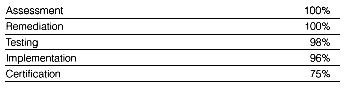
The Company's Y2K compliance program is divided into five major phases - (1) the assessment of all computer systems and software products (collectively the "Computer Systems") for Y2K compliance, (2) the remediation (i.e. conversion or modification) of each Computer System to be Y2K compliant, (3) the testing of the remediation to confirm that such remediation has not adversely impacted the operation of the Computer Systems, and that it can process dates in the year 2000 and beyond, (4) the implementation of the remediated Computer Systems into production and (5) certification of the remediation for Y2K compliance. The percentage of completion of each phase at the end of February 1999 is shown in the table below:
In addition, it is possible that certain computer systems or software products with which the Company's computer systems, software, databases or other technology interface or are integrated with may not accept input of, store, manipulate and output dates in the year 2000 or thereafter without error or interruption. The Company has conducted a review of its computer systems to attempt to identify ways in which its systems could be affected by interface- or integration-related problems in correctly processing date information. The Company is communicating with those third parties with which it maintains business relationships to monitor and evaluate their progress in identifying and addressing their Y2K issues and assessing the potential impact, if any, to the Company. Currently, nothing has come to the Company's attention that would indicate that the Y2K compliance efforts of a major third party would have a material adverse effect on the Company's results of operations and financial condition. However, there can be no assurance that the Company will identify all interface- or integration-related or third party-related problems in advance of their occurrence, or that the Company will be able to successfully remedy problems that are discovered. The expenses of the Company's efforts to identify and address such problems, or the expenses and liabilities to which the Company may become subject to as a result of such problems, could have a material adverse effect on its results of operations and financial condition.
The Company expects to have its Y2K compliance program substantially completed by the first quarter of 1999. The Company continually assesses the risk of non-compliance of its systems and the systems of major third parties and is currently in the process of developing contingency plans and alternative arrangements for circumstances outside the direct control of the Company.
The Company has spent approximately $4.1 million addressing the Y2K issues and estimates that it will spend an additional $1.2 million in 1999. These costs will be funded through cash flows from operations.
Market Risk Sensitive Instruments
Interest Rate Risk The Company is exposed to interest rate risk through its Credit Agreement, where it borrows at prevailing short-term variable rates. In order to manage its exposure to fluctuations in interest rates, the Company uses interest rate swap agreements which allow the Company to raise funds at floating rates and effectively swap them into fixed rates that are lower than those available to it if fixed rate borrowings were made directly. These derivative financial instruments are viewed by the Company as risk management tools that are entered into for hedging purposes only. The Company does not use derivative financial instruments for trading or speculative purposes. A discussion of the Company's accounting policies for derivative financial instruments is included in Note 2 - Summary of Significant Accounting Policies, and further disclosure relating to financial instruments is included in Note 12 - Financial Instruments.
The fair value of interest rate risk is calculated by the Company utilizing estimates of the termination value of the Company's interest rate swaps based upon a 10% increase, or decrease in interest rates from December 31, 1998, levels. Fair values are the present value of projected future cash flows based on the market rates and prices chosen. At December 31, 1998, the unrealized fair value of the interest rate swaps was a loss of $3.6 million. Assuming an instantaneous parallel upward shift in the yield curve of 10% from December 31, 1998, levels, the unrealized fair value of the Company's interest rate swaps would be a loss of $0.6 million. Assuming an instantaneous parallel downward shift in the yield curve of 10% from December 31, 1998, levels, the unrealized fair value of the Company's interest rate swaps would be a loss of $6.5 million.
Foreign Exchange Risk The Company's 15% equity interest in the joint venture with China Unicom represents the Company's only foreign operations. Given the current size of the joint venture operations and the Company's 15% equity interest, exposure to changes in foreign exchange rates at this time is minimal.
Previous | Return to Annual Report Main page | Next