R.H. Donnelley 1998 Annual Report
Notes to Consolidated Financial Statements
10. Employee Stock Option PlansSFAS No. 123, "Accounting for Stock-Based Compensation," requires that companies with stock-based compensation plans either recognize compensation expense based on the fair value of options granted or continue to apply the existing accounting rules and disclose pro forma net income and earnings per share assuming the fair value method had been applied. The Company has chosen to continue applying Accounting Principles Board Opinion No. 25 and related interpretations in accounting for its plans. Accordingly, no compensation cost has been recognized for the fixed stock option plans. The following table reflects the pro forma net income and earnings per share assuming the fair value method had been applied in accordance with SFAS No. 123.
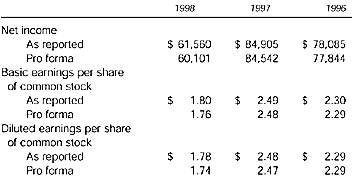
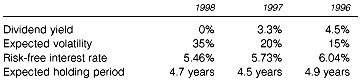
The pro-forma disclosures shown are not representative of the effects on income and earnings per share in future years. The fair value of stock options used to compute the Company's pro forma income disclosures is the estimated present value at grant date using the Black-Scholes option-pricing model with the following weighted average assumptions:
Under the terms of the Old D&B 1982 Key Employees Stock Option Plan and the 1991 Key Employees Stock Option Plan, as amended, (collectively "Stock Option Plans"), certain key employees of the Company were eligible to receive stock options, stock appreciation rights and limited stock appreciation rights in tandem with stock options. Immediately after the Distribution, these plans were amended and adopted by the Company and outstanding awards under the Stock Option Plans held by Company employees were adjusted to have the same ratio of the exercise price per option to the market value per share, the same aggregate difference between market value and exercised price and the same vesting provisions, option periods and other terms and conditions applicable prior to the Distribution.
The vesting period for awards under the Stock Option Plans are determined by the Board at the date of the grant. Options may not be granted at less than fair market value of the Company's common stock at the date of the grant and may not expire more than ten years from the grant date. At December 31, 1998, 1997 and 1996, options for 1,456,610 shares, 121,291 shares and 115,188 shares of common stock, respectively, were exercisable. Options for 4,272,093 shares, 290,039 shares and 848,154 shares were available for future grants under the Stock Option Plans at December 31, 1998, 1997 and 1996, respectively.
Changes in stock options for the three years ended December 31, 1998, are summarized below:
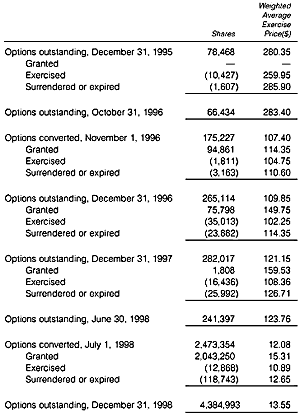
The weighted average fair value of options granted during 1998, 1997 and 1996 was $4.91, $27.70 and $18.00, respectively. The information above has been prepared based on historical Old D&B prices after giving retroactive effect for the reverse one-for-five stock split in August 1998. Options outstanding as of June 30, 1998, were converted on July 1, 1998, to give effect to the Distribution.
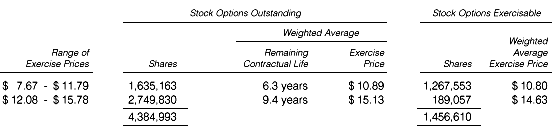
The following table summarizes information about stock options outstanding at December 31, 1998:
In 1998, the Board of Directors adopted the 1998 Directors' Stock Option Plan. Under the terms of the plan, non-employee directors receive an annual award of 1,500 shares of restricted common stock and options to purchase 1,500 shares of the Company's common stock. Additionally, non-employee directors receive 1,500 shares of restricted common stock upon election to the Board. These shares vest equally over a three-year period. The Company reserved 150,000 shares of common stock for issuance under the plan. During the year, the Company granted 17,677 stock options and restricted shares and at December 31, 1998, 132,323 shares remain available for future issuance.
Previous | Return to Annual Report Main page | Next