R.H. Donnelley 1998 Annual Report
Notes to Consolidated Financial Statements
2. Summary of Significant Accounting PoliciesPrinciples of Consolidation
The consolidated financial statements include the accounts of the Company and its wholly-owned subsidiary. All intercompany transactions and balances have been eliminated. Investments in the Company's 50% or less owned partnerships are accounted for under the equity method of accounting. The Company's share of partnerships' operating results is reflected in Income from partnerships and related fees. Related fees represent the revenue participation earnings from an operating unit of Ameritech Corporation ("Ameritech") (see Note 4).Revenue Recognition
The Company recognizes revenue as earned, which is based on contractual relationships. For agreements where the Company is a sales agent, revenue is comprised of sales commissions and is recognized upon execution of contracts for the sale of advertising. For businesses where the Company is the publisher, revenues are recognized when directories are published. Revenues from publishing services are recognized on a straight-line basis throughout the year as the services are performed.Cash and Cash Equivalents
Cash equivalents include highly liquid investments with a maturity of less than three months at the time of acquisition.Unbilled Receivables
For agreements where the Company is a sales agent, unbilled receivables represent revenues earned from the sale of advertising in directories that are scheduled to be published by the publisher. These receivables will be billed to the publisher upon directory publication in accordance with contractual provisions. For businesses where the Company is the publisher, unbilled receivables represent revenues earned on published directories. In most cases, advertisers are billed ratably over the life of the directories, which is generally 12 months.Deferred Contract Costs
Direct costs incurred by the Company as publisher are deferred until the related directory is published. Direct costs incurred where the Company is a sales agent are expensed in the period incurred.Property and Equipment
Property and equipment are recorded at cost. Depreciation is provided over the estimated useful lives of depreciable assets using the straight-line method. Estimated useful lives are five years for machinery and equipment, ten years for furniture and fixtures, and three to five years for computer equipment. Leasehold improvements are amortized on a straight-line basis over the shorter of the term of the lease or the estimated useful life of the improvement.Capitalized Software Costs
Certain direct costs incurred for computer software to meet the needs of the Company and its customers are capitalized. These costs are amortized on a straight-line basis over five years. In March 1998, the Accounting Standards Executive Committee of the AICPA issued Statement of Position (SOP) 98-1, "Accounting for the Costs of Computer Software Developed or Obtained for Internal Use." The SOP requires the capitalization of certain costs incurred in connection with developing or obtaining software for internal use and is effective for fiscal years beginning after December 15, 1998. The Company's existing accounting policy is in compliance with the requirements of the SOP.Long-Lived Assets
The Company has adopted the provisions of Statement of Financial Accounting Standards ("SFAS") 121, "Accounting for the Impairment of Long-Lived Assets and Long-Lived Assets to be Disposed Of." This statement requires that long-lived assets and certain identifiable intangibles held and used by an entity be reviewed for impairment whenever events or changes in circumstances indicate that the carrying amount of an asset may not be recoverable. In general, an impairment loss would be recognized when the sum of the undiscounted expected future cash flows is less than the carrying amount of such assets. The measurement for such an impairment loss is then based on the fair value of the asset.Income Taxes
The Company accounts for income taxes under the liability method in accordance with SFAS 109, "Accounting for Income Taxes." Prior to the Distribution, the Company was included in the Federal and certain state income tax returns of Old D&B. The provision for income taxes for the three years ended December 31, 1998, 1997 and 1996 have been calculated on a separate-company basis and the income taxes paid on behalf of the Company through June 30, 1998, by Old D&B have been included in equity.Concentration of Credit Risk
The Company maintains significant accounts receivable balances from its agreements with operating units of Ameritech, Bell Atlantic and Sprint. The Company establishes an allowance for doubtful accounts based on the expected collectibility of accounts receivable from advertisers principally from historical trends. The Company does not currently forsee a credit risk associated with these receivables due to the high credit ratings of its counterparties.Comprehensive Income
Effective January 1, 1998, the Company adopted SFAS No. 130, "Reporting Comprehensive Income." This statement requires that all items recognized under accounting standards as components of comprehensive earnings be reported in a financial statement for the period in which they are recognized and displayed with the same prominence as other financial statements. There were no additional components of comprehensive income and, as a result, the Company's total comprehensive income for the periods presented were equal to net income.Derivative Financial Instruments
The Company uses interest rate swap contracts to manage market risk and reduce its exposure to fluctuations in interest rates on its variable rate debt. Periodic payments and receipts under the interest rate swaps are recorded as part of interest expense. The related amounts payable to, or receivable from, the counterparty are included in accrued and other current liabilities or other current assets. The fair value of the interest rate swaps are not recognized in the consolidated financial statements as they are accounted for as hedges. If the interest rate swaps cease to qualify as a hedge, any subsequent gains and losses are recognized currently in income. The Company is subject to credit risk in the event of nonperformance by the counterparty to the interest rate swap agreements. However, the Company does not anticipate nonperformance by the counterparty. The Company does not use derivative financial instruments for trading or speculative purposes.In June,1998, the Financial Accounting Standards Board issued Statement No. 133, "Accounting for Derivative Instruments and Hedging Activities," which is required to be adopted in years beginning after June 15, 1999. Because of the Company's limited use of derivatives, management does not anticipate that the adoption of the new Statement will have a significant effect on earnings or the financial position of the Company.
Earnings Per Share of Common Stock
Basic earnings per share are calculated by dividing net income by the weighted average common shares outstanding during the year. Diluted earnings per share are calculated by dividing net income by the weighted average common shares outstanding and potentially dilutive common shares, primarily employee stock options. Potentially dilutive common shares are calculated in accordance with the treasury stock method, which assumes that proceeds from the exercise of all employee options are used to repurchase common stock at market value. The amount of shares remaining after the proceeds are exhausted represent the number of potentially dilutive options.The table below provides a reconciliation of basic weighted average shares outstanding to dilutive weighted average shares outstanding. At December 31, 1998, options to purchase 2,026,740 shares of common stock were not included in the computation of diluted earnings per share because the effect would have been antidilutive.
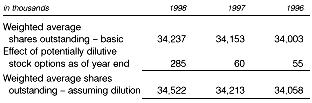
During 1998, the Company executed a one-for-five split of its outstanding common stock. All share and per share data provided herein has been adjusted to reflect such a reverse stock split.
Estimates
The preparation of financial statements in conformity with generally accepted accounting principles requires management to make estimates and assumptions that affect the reported amounts of assets, liabilities, revenues and expenses and the disclosure of contingent assets and liabilities. Actual results could differ from those estimates. Estimates are used in the determination of allowances for bad debts, depreciation and amortization and employee benefit plans, among others.Reclassification
In 1998, the Company reclassified certain expenses related to the sale of advertising, historically included as general and administrative expenses, to operating expenses. To better measure the contribution of each operating unit and facilitate decision making and resource allocation, these costs have been reclassified from general and administrative to operating expenses on the Consolidated Statements of Operations. As a result, general and administrative costs of $33,040 and $34,629 were reclassified to operating expenses for 1997 and 1996, respectively. In addition, certain prior year amounts have been restated to conform to the 1998 presentation. These reclassifications had no impact on previously reported results of operations or shareholders' equity.
Previous | Return to Annual Report Main page | Next