
Notes to Consolidated Financial Statements Notes
Note 14: Notes Payable
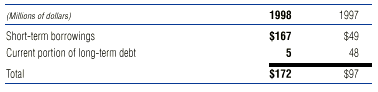
Short-term borrowings include commercial paper and bank debt owed by foreign subsidiaries. The weighted-average interest rate of short-term borrowings was 6.5% and 7.8% at December 31, 1998 and 1997, respectively.
At December 31, 1998, the company has revolving credit agreements totaling $400 million, of which $150 million expire in 1999, $20 million in 2002 and $230 million in 2003. These agreements, which carry various interest rates and fees, are available to support commercial paper borrowings. Several permit foreign subsidiaries to borrow local currencies. At December 31, 1998, $74 million was outstanding under these agreements.
Note 15: Long-Term Debt
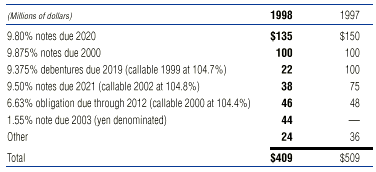
The various loan agreements contain certain restrictions with respect to tangible net worth and maintenance of working capital. There are no restrictions on the payment of dividends.
In 1998 the company retired $130 million of high interest long-term debt through a tender offer. These debt retirements resulted in an after-tax extraordinary loss of $13 million, or $.07 per share.
Total cash used for the payment of interest expense, net of amounts capitalized, was $36 million, $40 million and $39 million in 1998, 1997 and 1996 , respectively.
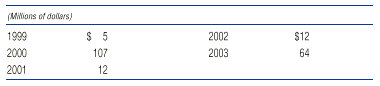
Long-term debt maturing in the next five years is:
Note 16: Accounts Payable and Accrued Liabilities
Note 17: Other Liabilities
Note 18: Stockholders' Equity
In 1998, the board of directors declared a three-for-one split of the company's common stock. The stock split was effected in the form of a 200% common stock dividend. The par value of the common stock remained unchanged at $2.50 per share. Also in 1998, the company retired 39 million treasury shares. As a result of these transactions, the company reclassified $296 million from retained earnings to common stock. This amount represents the total par value of new shares issued, net of retirements of treasury shares. Amounts per share, numbers of common shares and capital accounts have been restated to give retroactive effect to the stock split.The company has the authorization to issue up to 25 million shares of preferred stock. The outstanding preferred stock was issued in connection with the acquisition of Shipley Company in 1992. This preferred stock pays an annual cumulative dividend of $2.75 per share. It has antidilution protection against stock splits, stock dividends and certain issuances of additional securities and extraordinary dividends. This preferred stock is convertible at any time at the holder's option into Rohm and Haas common stock at the rate of 2.34 shares of common stock for each share of preferred stock. Holders of the preferred stock are entitled to one vote per share. The company has the option to redeem the preferred stock on or after June 12, 1999, at a fixed redemption price of $50.62, payable in Rohm and Haas common stock. The redemption price reduces each year to a final price of $50 on or after June 12, 2002.
Dividends paid on ESOP shares, used as a source of funds for meeting the ESOP financing obligation, were $12 million in 1998 and $11 million in 1997. These dividends were recorded net of the related U.S. tax benefits. The number of ESOP shares not allocated to plan members at December 31, 1998 and 1997 were 13.5 million and 14.2 million, respectively.
The company recorded compensation expense of $6 million in 1998, 1997 and 1996 for ESOP shares allocated to plan members. The company expects to record annual compensation expense at approximately this level over the next 22 years as the remaining $132 million of ESOP shares are allocated. The allocation of shares from the ESOP is expected to fund a substantial portion of the company's future obligation to match employees savings plan contributions as the market price of Rohm and Haas stock appreciates.
Purchases of treasury stock in 1998 totaled 17,459,435 shares, compared with 7,653,453 and 13,292,913 shares in 1997 and 1996, respectively. Most of the shares were obtained in August 1998 through an accelerated stock repurchase program with a third party. Under the terms of this purchase, the final cost to the company will reflect the average share price paid by the third party in the market over an extended trading period. Through December 31, 1998, the company had repurchased two-thirds of the 12 million shares of common stock authorized under the current buyback program, and received board approval in October 1998 for another buyback of an additional 9 million shares.
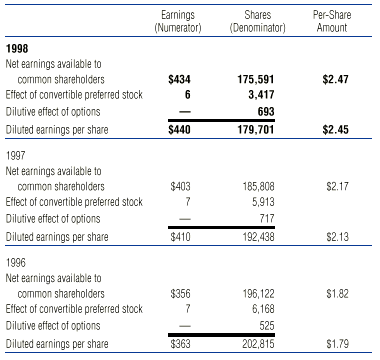
The reconciliation from basic to diluted earnings per share is as follows:
Note 19: Stock Compensation Plans
As permitted under SFAS No. 123, "Accounting for Stock-Based Compensation," the company continues to apply the provisions of APB Opinion No. 25. Accordingly, no compensation expense has been recognized for the fixed stock option plans. For restricted stock awards, compensation expense equal to the fair value of the stock on the date of the grant is recognized over the five-year vesting period. Total compensation expense for restricted stock was $3 million in 1998 and $1 million in 1997 and 1996. Had compensation expense for the company's fixed stock option plans been determined in accordance with SFAS No. 123, the company's net earnings would have been reduced to $437 million in 1998, $407 million in 1997 and $361 million in 1996. Diluted earnings per common share would have been reduced to $2.43, $2.12 and $1.78 in 1998, 1997 and 1996, respectively.Non-Employee Directors' Stock Plan of 1997
Under the 1997 Non-Employee Directors Stock Plan, directors receive half of their annual retainer in deferred stock. Each share of deferred stock represents the right to receive one share of company common stock upon leaving the board. Directors may also elect to defer all or part of their cash compensation into deferred stock. Annual compensation expense is recorded equal to the number of deferred stock shares awarded multiplied by the market value of the company's common stock on the date of award. Additionally, directors receive dividend equivalents on each share of deferred stock, payable in deferred stock, equal to the dividend paid on a share of common stock.Restricted Stock Plan of 1992
Under this plan, executives were paid some or all of their bonuses in shares of restricted stock instead of cash. Most shares vest after 5 years. The plan covers an aggregate 450,000 shares of common stock. Shares of restricted stock issued in 1998 totaled 74,106 at a weighted-average grant date fair value of $34 per share. In 1997, 93,714 shares of restricted stock were granted at a weighted-average grant-date fair value of $28 per share. As of January 1, 1999, restricted stock grants will be made, subject to shareholder approval, under the 1999 Stock Plan.Fixed Stock Option Plans
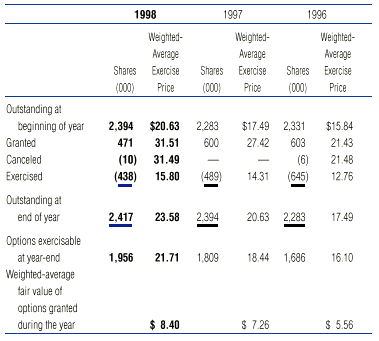
The company has granted stock options to key employees under its Stock Option Plans of 1984 and 1992. Options granted pursuant to the plans are priced at the fair market value of the common stock on the date of the grant. Options vest after one year and most expire 10 years from the date of grant. The Stock Option Plan of 1992, as amended in 1994, limits the number of options that can be granted to any one individual within a five-year period to 300,000 shares. These plans have been superseded by the 1999 Stock Plan, subject to shareholder approval. Under the 1999 Stock Plan, the company may grant options for up to eight million shares of common stock, subject to shareholder approval.The status of the company's stock options as of December 31 is presented below:
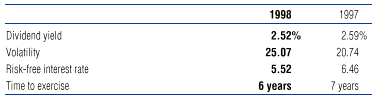
The Black-Scholes option pricing model was used to estimate the fair value for each grant made during the year. The following are the weighted-average assumptions used for all shares granted in the years indicated:
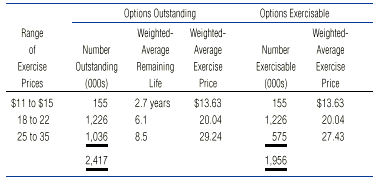
The following table summarizes information about stock options outstanding and exercisable at December 31, 1998:
Note 20: Leases
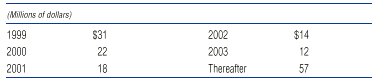
The company leases certain properties and equipment used in its operations, primarily under operating leases. Total net rental expense incurred under operating leases amounted to $57 million in 1998, $62 million in 1997 and $63 million in 1996.Total future minimum lease payments under the terms of non-cancellable operating leases are as follows:
Note 21: Contingent Liabilities, Guarantees and Commitments
There is a risk of environmental damage in chemical manufacturing operations. The company's environmental policies and practices are designed to ensure compliance with existing laws and regulations and to minimize the possibility of significant environmental damage. These laws and regulations require the company to make significant expenditures for remediation, capital improvements and the operation of environmental protection equipment. Future developments and even more stringent environmental regulations may require the company to make additional unforeseen environmental expenditures. The company's major competitors are confronted by substantially similar environmental risks and regulations.The company is a party in various government enforcement and private actions associated with former waste disposal sites, many of which are on the U.S. Environmental Protection Agency's (EPA) Superfund priority list. The company is also involved in corrective actions at some of its manufacturing facilities. The company considers a broad range of information when determining the amount of its remediation accruals, including available facts about the waste site, existing and proposed remediation technology and the range of costs of applying those technologies, prior experience, government proposals for this or similar sites, the liability of other parties, the ability of other principally responsible parties to pay costs apportioned to them and current laws and regulations. These accruals are updated quarterly as additional technical and legal information becomes available. Major sites for which reserves have been provided are the non-company-owned Lipari, Woodland and Kramer sites in New Jersey, and Whitmoyer in Pennsylvania and company-owned sites in Bristol and Philadelphia, Pennsylvania, and in Houston, Texas. In addition, the company has provided for future costs at approximately 80 other sites where it has been identified as potentially responsible for cleanup costs and, in some cases, damages for alleged personal injury or property damage.
The amount charged to earnings before tax for environmental remediation, net of insurance recoveries, was $9 million in 1998. In 1997, remediation related settlements with insurance carriers, a $20 million charge resulting from an unfavorable arbitration decision relating to the Woodlands sites, and other waste remediation expenses resulted in a net gain of $13 million. The 1996 charge, net of insurance recoveries, was $27 million.
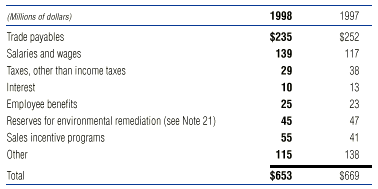
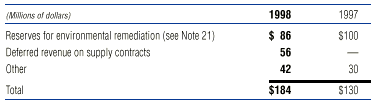
The reserves for remediation were $131 million and $147 million at December 31, 1998 and 1997, respectively, and are recorded as "other liabilities" (current and long-term). The company is in the midst of lawsuits over insurance coverage for environmental liabilities. It is the company's practice to reflect environmental insurance recoveries in results of operations for the quarter in which the litigation is resolved through settlement or other appropriate legal process. Resolutions typically resolve coverage for both past and future environmental spending. Insurance recoveries receivable, included in accounts receivable, net, were $2 million at December 31, 1998, and $19 million at December 31, 1997. The company settled with several of its insurance carriers in January 1999 for approximately $17 million. These settlements will be recognized in income in 1999.
In addition to accrued environmental liabilities, the company has reasonably possible loss contingencies related to environmental matters of approximately $65 million at December 31, 1998 and 1997. Further, the company has identified other sites, including its larger manufacturing facilities in the United States, where additional future environmental remediation may be required, but these loss contingencies are not reasonably estimable at this time. These matters involve significant unresolved issues, including the number of parties found liable at each site and their ability to pay, the outcome of negotiations with regulatory authorities, the alternative methods of remediation and the range of costs associated with those alternatives. The company believes that these matters, when ultimately resolved, which may be over an extended period of time, will not have a material adverse effect on the consolidated financial position or consolidated cash flows of the company, but could have a material adverse effect on consolidated results of operations in any given year because of the company's obligation to record the full projected cost of a project when such costs are probable and reasonably estimable.
Capital spending for new environmental protection equipment was $17 million in 1998. Spending for 1999 and 2000 is expected to be approximately $22 million and $15 million, respectively. Capital expenditures in this category include projects whose primary purposes are pollution control and safety, as well as environmental aspects of projects that are intended primarily to improve operations or increase plant efficiency. The company expects future capital spending for environmental protection equipment to be consistent with prior-year spending patterns. Capital spending does not include the cost of environmental remediation of waste disposal sites.
Cash expenditures for waste disposal site remediation were $26 million in 1998, $37 million in 1997 and $58 million in 1996. The expenditures for remediation are charged against accrued remediation reserves. The cost of operating and maintaining environmental facilities was $94 million, $95 million and $104 million in 1998, 1997 and 1996, respectively, and was charged against current-year earnings.
Subsequent to the sale of the AtoHaas joint venture, the buyer asserted a claim against the company in late 1998 related to the value of certain joint venture assets. Because the investigation and assessment of this claim is not expected to be completed until the latter part of the first quarter of 1999, the potential amount of the claim and its impact on results of operations and financial position, if any, cannot be reasonably estimated at this time.
In addition, the company and its subsidiaries are parties to litigation arising out of the ordinary conduct of its business. The company is also a subject of an investigation by U.S. Customs into the labeling of some products imported into the U.S. from some of the company's non-U.S. locations. Recognizing the amounts reserved for such items and the uncertainty of the ultimate outcomes, it is the company's opinion that the resolution of these pending lawsuits, investigations and claims will not have a material adverse effect, individually or in the aggregate, upon the results of operations and the consolidated financial position of the company.
In the ordinary course of business, the company has entered into certain purchase commitments, has guaranteed certain loans (with recourse to the issuer), and has made certain financial guarantees, primarily for the benefit of its non-U.S. and unconsolidated subsidiaries and affiliates. It is believed that these commitments and any liabilities that may result from these guarantees will not have a material adverse effect upon the consolidated financial position of the company.
At December 31, 1998, construction commitments totaled approximately $23 million.
Previous | Return to Annual Report Main page | Next