Performance Polymers
High-Value Acrylic Technology
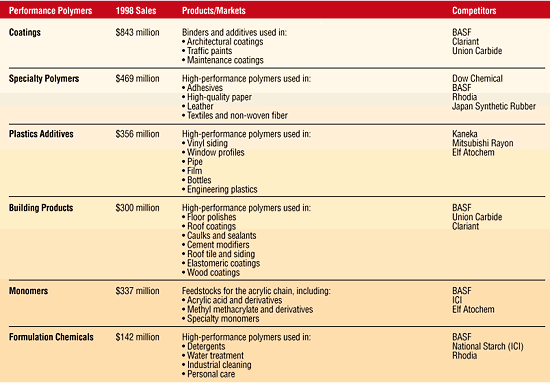
Performance Polymers includes all six of Rohm and Haas's acrylic-technology businesses, which accounted for 66% of the company's sales in 1998. Following the company's divestiture of its stakes in AtoHaas and RohMax early in 1998, the group emerged in this year's new organization (see page 2) strengthened by a more fully integrated strategy and operations. The result is a stronger focus on current and potential customers of the company's specialty polymer-based products for a wide range of end uses. The integration also streamlines Performance Polymers management and improves its cost structure.Click to view
Overall, the Performance Polymers group performed quite well given the highly uncertain economic environment that prevailed in Asia, Europe and Latin America during 1998. Sales for the year totaled $2.4 billion, a decrease of 10% following the sale of AtoHaas. Volume was flat. Earnings, including several one-time items, increased 24%. Operating earnings increased slightly.
In 1998, the six Performance Polymers businesses began to benefit from a newly integrated supply chain. The creation of a single infrastructure for the production and distribution of raw materials leverages the combination of all six of Rohm and Haas's acrylics businesses to significantly reduce costs and improve customer service. The Performance Polymers supply-chain initiative produced more than $50 million in permanent cost reductions during the year. In addition, Performance Polymers' inventories at year-end were about 9% lower than at the end of 1997. Supply chain improvement yielded a platform for consistent volume growth, while allowing Performance Polymers to defer construction of significant new monomers capacity until at least 2002.
Coatings, the largest of the six Performance Polymers businesses, delivered volume increases of more than twice the rate of GDP growth in many markets around the world. Customers' continuing migration from solvent-based coatings to Rohm and Haas's environmentally friendly water-based systems contributed to this growth. Coatings' strong product line drove increases in its share of many key markets, notably in Germany. Important new products, including advancements in opaque polymers and rheology modifiers, aided both market share gains and continued healthy profitability. The business also benefited from geographic expansion into Eastern Europe and South Africa. In 1999, Coatings looks forward to continued gains in market share and geographic growth, as well as the development of new technologies that will continue to broaden its range of product offerings.
Specialty Polymers posted small declines in its volume and sales due to global overcapacity in adhesives, paper chemicals and leather resulting in part from Asia's economic turmoil. Its textiles and non-woven binding unit, however, made healthy gains in profitability. The business also made significant progress in the development of new, lower cost-in-use products for both coated paper and paperboard and pressure sensitive adhesives markets. These and other new products to be introduced in 1999 will offer Rohm and Haas customers the means to improve their competitive position. Specialty Polymers expects to return to its accustomed rates of sales and volume growth in the second half of 1999, driven by improved market conditions and the impact of its new product introductions.
Plastics Additives faced a very competitive environment in 1998, as a portion of its customer base faced weakened demand for polyvinyl chloride packaging. Profitability was solid in most regions, driven by continued growth in building and construction markets, while Asian results failed to meet expectations due to the region's continuing macroeconomic crises. Plastics Additives made a number of advancements in new products, including the development of new and improved weatherable impact modifiers sought by customers. Capacity additions were announced in many geographic regions, as new technology yielded the prospect of greater volume at modest cost. During the year, Plastics Additives received several supplier achievement awards, including the respected Six Sigma Quality Award from General Electric Co. in recognition of a new product that has delivered significant process improvements, along with greatly reduced downtime and rejects, to one of GE Plastics' customers.
Building Products posted strong growth thanks to continued market penetration of its recently introduced products as well as renewed alignment with its strategic customers. Latin America, North America and Europe each contributed to the growth. The roof tile and siding business expanded its customer base in North America, Latin America, Southeast Asia and China. The strongest growth in the floor care business came in Latin America and North America. The exterior finishings and installation systems business increased its penetration of the European market, and continued to benefit from its relationships with strategic customers in North America. The caulks and sealants business, meanwhile, offset significant competitive pressures with improved positions among its major customers. In 1999, Building Products expects continued growth in excess of GDP rates, driven by new product introductions and expanded geographic presence.
Monomers: Most of Rohm and Haas's monomer production is used internally in the manufacture of specialty products by the other Performance Polymers businesses. During 1998, external sales by the Monomers business totaled $337 million, up 26% from 1997. The divestiture of the company's stake in AtoHaas resulted in new external sales to that business, which accounted for most of the overall sales increase. Monomers also saw significant growth in sales to producers of superabsorbent materials and other acrylic polymers. The company foresees continued expansion of its monomers production for both internal and external use in 1999.
Formulation Chemicals grew at double-digit rates in Asia and Latin America, as its products continued to attract new customers around the world. In order to keep pace with geographic growth, the business will open a new polyacrylate production facility in Map Ta Phut, Thailand, in early 1999. Asian and Latin American growth offset modest volume declines in North America and Europe, where some consumers switched from powder detergents. Formulation Chemicals commercially launched Optidose™ polymers and test kits for the water treatment industry. The business's alliance with International Specialty Products Inc., meanwhile, continues to extend the reach of Rohm and Haas's acrylic technology into a wide range of personal-care products, from hair sprays to skin lotions to sunscreens. Formulation Chemicals expects future growth to come in part from the sale of Duramax™ ceramic additives, a key new product line, as well as from the worldwide expansion of our strategic customer's premium laundry detergent brands, which drives the demand for multi-benefit Acusol® polymers.
Together, Performance Polymers expects growth in 1999 from a number of sources. New technology development will expand the product offerings of each of the group's businesses. Geographic growth, meanwhile, will be enhanced by the addition of significant emulsion facilities in KwaZulu, South Africa, and Shanghai, China, as well as by the expansion of production capacity at Tudela, Spain.
Previous | Return to Annual Report Main page | Next