THE RYLAND GROUP, INC. & SUBSIDIARIES
Management's Discussion and Analysis of Results of
Operations and Financial Condition
RESULTS OF OPERATIONS
Consolidated
The Company reported consolidated net earnings from operations (before extraordinary
item) of $43.6 million, or $2.90 per share, for 1998, compared with consolidated net
earnings of $21.9 million, or $1.33 per share, for 1997, and consolidated net earnings of
$15.8 million, or $.88 per share, for 1996.
The homebuilding segment reported pretax earnings of $80.1 million for 1998, compared
with pretax earnings of $35.2 million for 1997 and pretax earnings of $22.6 million for
1996. Homebuilding results in 1998 increased from 1997 primarily due to higher gross
profit margins combined with increased closings and lower interest expense. Homebuilding
results in 1997 increased from 1996 primarily due to higher gross profit margins combined
with lower interest expense.
The financial services segment reported pretax earnings of $11.8 million for 1998,
compared with $15.6 million for 1997 and $15.8 million for 1996. The decrease in 1998 from
1997 was primarily attributable to the significant reduction in the Company's
loan-servicing operations due to portfolio sales in 1997 and the first quarter of 1998.
Corporate expenses represent the costs of corporate functions, which support the
business segments. Corporate expenses of $16.7 million for 1998 and $14.3 million for
1997, were up $2.4 million and $2.2 million, respectively, from the prior year levels
primarily due to increases in incentive compensation attributable to the higher earnings
levels in 1998 and 1997, respectively.
The Company's limited-purpose subsidiaries no longer issue mortgage-backed securities
and mortgage-participation securities, but they continue to hold collateral for previously
issued mortgage-backed bonds in which the Company maintains a residual interest. Revenues,
expenses and portfolio balances continue to decline as the mortgage collateral pledged to
secure the bonds decreases due to scheduled payments, prepayments and exercises of early
redemption provisions. Revenues have approximated expenses for the last three years.
Extraordinary Item
In the third quarter of 1998, the Company recognized an extraordinary loss of $3.3
million (net of taxes of $2.2 million), or $.23 per share. The loss was recorded in
connection with the redemption on July 15, 1998 of $100 million of 10.5 percent senior
subordinated notes due 2002. The redemption of the notes was at the stated call price of
103.9 percent of par and was funded by the April 1998 issuance of lower cost debt. Net
earnings for the year 1998 after the extraordinary item were $40.3 million, or $2.67 per
share, versus $1.33 per share for 1997.
Homebuilding Segment
Results of operations for the homebuilding segment are summarized as follows (amounts
in thousands, except average closing price):
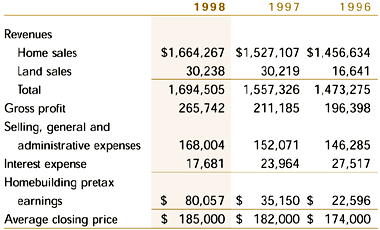
Homebuilding revenues increased 9 percent in 1998, compared with 1997, due to a 7
percent increase in closings and an increase in the average closing price. The increase in
closings in 1998 was due to the higher backlog at the beginning of the year and the
increase in homes sold during the year. Homebuilding revenues increased 6 percent in 1997,
compared with 1996, primarily due to an $8,000 increase in the average closing price and
increased revenues from land sales, which more than offset the slight decline in closings.
The increase in average closing price in 1997 was primarily due to increased closings in
the Company's higher priced markets. Homebuilding results included pretax gains from land
sales of $1.2 million in 1998, $4.8 million in 1997 and $3.7 million in 1996.
Gross profit margins from home sales averaged 15.9 percent for the year 1998, a
significant increase from 13.5 percent for 1997 and 13.2 percent for 1996. The improvement
was primarily due to increased closings from newer communities which have better land
positions and a more cost-effective product. Sales price increases in excess of increases
in direct construction costs have also contributed to improved margins. Company
initiatives to reduce direct construction costs have helped to limit increases in these
costs.
Selling, general and administrative expenses as a percent of revenues were 9.9 percent
for 1998, 9.8 percent for 1997 and 9.9 percent for 1996, basically flat as a percentage of
revenues. Total selling, general and administrative expenses increased in 1998 and 1997
primarily due to higher selling costs associated with increased closings and higher
incentive compensation expense as a result of improved earnings. Interest expense
decreased $6.3 million, or 26 percent in 1998 due to lower average homebuilding
borrowings, lower effective rates paid on borrowings and an increase in the amount of
interest capitalized due to an increase in land under development. The lower effective
rate on borrowings was primarily due to the Company's issuance of lower cost long-term
debt combined with the early redemption of higher cost debt. Interest expense decreased in
1997 due to a decrease in average homebuilding borrowings primarily attributable to a
decline in average homebuilding inventories.
New orders increased 5 percent in 1998 compared with 1997 with increases in all regions
except the Mid-Atlantic. The largest increases in new orders were in the Southeast and
Midwest regions where growth occurred in both new and existing markets. In the West
region, sales were relatively flat due to strong sales in California in 1997 and early
1998 which reduced the number of communities currently open for sales. The Company is
opening new communities in California and expects increased sales in 1999. The decline in
the Mid-Atlantic reflects the Company's reduced investment in those markets.
On October 30, 1998, the Company completed the acquisition of The Regency Organization
("Regency"), a privately held homebuilder with operations in Pasco, Hernando and
Citrus Counties, Florida, immediately north of the Company's existing Tampa Bay
operations. Regency's operational focus has been primarily on age-restricted and
active-adult retirement communities. The acquisition affords the Company the opportunity
to gain market share in a rapidly growing area of Florida and an immediate presence in the
Florida retirement market. The Company purchased Regency and retired Regency's
indebtedness for a total cash investment of approximately $18 million. Results of
Regency's operations have been included in the Company's results from the date of
acquisition. The Company anticipates that this acquisition could add approximately 350-400
closings to its results for 1999 at sales prices ranging from $90-$150 thousand.
As of December 31, 1998, the Company had outstanding contracts for 3,452 units, an
increase of 23 percent from year-end 1997 due to the increase in new orders during the
year and the acquisition of Regency. Outstanding contracts represent the Company's backlog
of sold but not closed homes, which generally are built and closed, subject to
cancellation, over the next two quarters. The $653 million value of outstanding contracts
increased 28 percent from year-end 1997.