THE RYLAND GROUP, INC. & SUBSIDIARIES
Notes to Consolidated Financial Statements
(amounts in thousands, except share data, in all notes unless
otherwise noted)
NOTE A: SUMMARY OF SIGNIFICANT ACCOUNTING POLICIES
Basis of Presentation
The consolidated financial statements include the accounts of The Ryland Group, Inc.
and its wholly owned subsidiaries (the "Company"). Intercompany transactions
have been eliminated in consolidation. Certain amounts in the consolidated statements of
prior years have been reclassified to conform to the 1998 presentation.
Use of Estimates
The preparation of financial statements in conformity with generally accepted
accounting principles requires management to make estimates and assumptions that affect
the amounts reported in the financial statements and accompanying notes. Actual results
could differ from those estimates.
Per Share Data
Basic net earnings per common share is computed by dividing net earnings, after
considering preferred stock dividend requirements, by the weighted-average number of
common shares outstanding. Diluted net earnings per common share additionally gives effect
to dilutive common stock equivalent shares, including the assumed conversion of the
preferred shares held by The Ryland Group, Inc. Retirement Savings Opportunity Plan Trust
(RSOP Trust) into common stock. The effect of the RSOP Trust was dilutive for the year
ended December 31, 1998. For the years ended December 31, 1997 and 1996, the conversion of
preferred shares was not assumed due to an antidilutive effect.
Income Taxes
The Company files a consolidated federal income tax return. Certain items of income and
expense are included in one period for financial reporting purposes and another for income
tax purposes. Deferred income taxes are provided in recognition of these differences.
Deferred tax assets and liabilities are determined based on the enacted tax rates and are
subsequently adjusted for changes in these rates. A change in the deferred tax assets or
liabilities results in a charge or credit to deferred tax expense.
Homebuilding Revenues
Homebuilding revenues are recognized when home sales are closed and title passes to the
customer.
Service Liabilities
Service and warranty costs are estimated and accrued for at the time a home closes.
Housing Inventories
Housing inventories consist principally of homes under construction and land under
development and improved lots.
Inventories to be held and used are stated at cost, unless a subdivision is determined
to be impaired, in which case the impaired inventories are written down to fair value.
Writedowns of impaired inventories to fair value are recorded as adjustments to the cost
basis of the respective inventory. Inventories to be disposed of are stated at the lower
of cost or fair value less cost to sell and are reported net of valuation reserves.
Valuation reserves related to inventories to be disposed of amounted to $6.2 million at
December 31, 1998, and $3.0 million at December 31, 1997. The net carrying value of the
related inventories amounted to $16.2 million and $8.9 million at December 31, 1998 and
1997, respectively.
Costs of inventory include direct costs of land, material acquisition, home
construction and related direct overhead expenses. Real estate taxes, insurance and
interest are capitalized during the land development stage. The costs of acquiring and
developing land and constructing certain related amenities are allocated to the parcels to
which these costs relate.
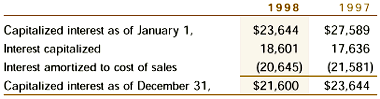
The following table is a summary of capitalized interest:
Property, Plant and Equipment
Property, plant and equipment, which includes model home furnishings, are carried at
cost, less accumulated depreciation and amortization. Depreciation is provided for,
principally, by the straight-line method over the estimated useful lives of the assets.
Model home furnishings are amortized over the life of the community as homes are closed.
Purchase Price in Excess of Net Assets Acquired
Costs in excess of net assets of acquired businesses (goodwill) are being amortized on
a straight-line basis over their estimated useful lives for periods of up to 30 years. On
a periodic basis, the Company evaluates the businesses to which goodwill relates in order
to insure that the carrying value of goodwill has not been impaired.
Mortgage Loans Held-For-Sale
Mortgage loans held-for-sale are reported net of discounts and are valued at the lower
of cost or market determined on an aggregate basis. Any gain or loss on the sale of the
loans is recognized at the time of sale.
Mortgage-Backed Securities
The Company classifies its mortgage-backed securities into three categories:
held-to-maturity, available-for-sale and trading. Management determines the appropriate
classification of these securities at the time of purchase and re-evaluates such
designations as of each balance sheet date.
Mortgage-backed securities are classified as held-to-maturity when the Company has the
positive intent and ability to hold the securities to maturity. Securities classified as
held-to-maturity are stated at amortized cost. Securities classified as available-for-sale
are measured at fair value with the unrealized gains and losses, net of tax, reflected as
accumulated other comprehensive income in stockholders' equity. Securities classified as
trading are measured at fair value with gains and losses, both realized and unrealized,
recognized in the Consolidated Statement of Earnings. The Company may at times have
securities in each category.
Loan Origination Fees, Costs and Mortgage Discounts
Loan origination fees, net of the related direct origination costs, and loan discount
points are deferred as an adjustment to the carrying value of the related mortgage loans
held-for-sale and are recognized into income upon the sale of the mortgage loans.
Discounts on mortgage collateral for the bonds of the limited-purpose subsidiaries
primarily represent loan origination discount points and purchase price discounts. These
discounts are deferred as an adjustment to the recorded book value of the related mortgage
loans. They are amortized into interest income over their respective lives using the
interest method, which is adjusted for the effect of prepayments.
Hedging Contracts
The Company enters into forward delivery contracts, options on forward delivery
contracts, futures contracts and options on futures contracts, as an end-user, for the
purpose of minimizing its exposure to movements in interest rates on mortgage loan
commitments, mortgage loans held-for-sale and mortgage-backed securities classified as
trading. These contracts primarily represent commitments or options to purchase or sell
mortgages or securities generally within 90 days and at a specified price or yield.
Forward delivery contracts and futures are commitments only and, as such, are not recorded
on the Company's balance sheet or statement of earnings. Option premiums are deferred when
paid and recognized as an adjustment to gains on sales of mortgages over the lives of the
options on a straight-line basis. Changes in the fair value of contracts are deferred and
included in mortgage loans held-for-sale and mortgage-backed securities classified as
trading. Changes in fair value are recognized in income as an adjustment to gains on sales
of mortgages when the mortgages and securities are sold.
In addition, the Company entered into an interest rate swap and collar agreement to
moderate the interest rate risks inherent in the financing of its investment securities
classified as available-for-sale. During the term of the agreement, the net settlements
are accrued and recognized as an adjustment to interest expense. The agreement is not
required to be marked to market and therefore is not recorded on the Company's balance
sheet.
Mortgage Servicing Rights
Retained mortgage servicing rights on originated loans are capitalized by allocating
the total cost of the mortgage loans between the mortgage servicing rights and the loans
based on their relative fair values. Mortgage servicing rights are amortized in proportion
to and over the period of estimated net servicing revenue.
The book value of capitalized mortgage servicing rights at December 31, 1998 and 1997,
was $4.5 million and $8.2 million, respectively, and the aggregate fair value totaled $4.5
million and $8.9 million, respectively. Comparable market values and the present value of
future cash flows are used to estimate fair value. For purposes of measuring impairment,
when deemed material, risk characteristics including product type, investor type and
interest rates are used to stratify mortgage servicing rights.
Deferred Financing Costs
Financing costs incurred in connection with the issuance of bonds by the
limited-purpose subsidiaries are capitalized and amortized over the respective lives of
the bonds using the interest method.
Stock Based Compensation
The Company has elected to follow the intrinsic value method to account for
compensation expense related to the award of stock options and to furnish the pro forma
disclosures required under Statement of Financial Accounting Standards No. 123 (FASB 123),
"Accounting for Stock-Based Compensation." Since stock option awards are granted
at prices no less than the fair-market value of the shares at the date of grant, no
compensation expense is recognized.
New Accounting Pronouncements
FASB 130
As of January 1, 1998, the Company adopted Statement of Financial Accounting Standards
No.130 (FASB 130), "Reporting Comprehensive Income." FASB 130 defines
comprehensive income and establishes new rules for the reporting of comprehensive income
and its components; however, the adoption of this Statement had no impact on the Company's
net income or stockholders' equity. FASB 130 requires unrealized gains or losses on the
Company's available-for-sale securities, which are included in stockholders' equity, to be
reported as other comprehensive income which is added to net income to arrive at total
comprehensive income. The Company has elected to report its comprehensive income in its
Consolidated Statement of Stockholders' Equity. Prior year financial statements have been
reclassified to conform to the FASB 130 requirements.
FASB 131
In June 1997, the FASB issued Statement of Financial Accounting Standards No. 131 (FASB
131), "Disclosures about Segments for an Enterprise and Related Information."
FASB 131 establishes standards for the way that public business enterprises report
selected information about operating segments in financial reports issued to shareholders.
The Company has adopted the provisions of FASB 131 which did not have a significant impact
on the Company's definition of operating segments and related disclosures.
FASB 133
In June 1998, the Financial Accounting Standards Board issued Statement of Financial
Accounting Standards No. 133 (FASB 133), "Accounting for Derivative Instruments and
Hedging Activities," which is required to be adopted in years beginning after June
15, 1999. FASB 133 requires all derivatives to be recorded on the balance sheet at fair
value and establishes new accounting procedures for hedges that will effect the timing of
recognition and the manner in which hedging gains and losses are recognized in the
Company's financial statements. The Company has not completed its evaluation of FASB 133;
however, management does not anticipate that the adoption of FASB 133 will have a material
impact on the Company's earnings or financial position. The Company currently expects to
adopt FASB 133 beginning on January 1, 2000.