THE RYLAND GROUP, INC. & SUBSIDIARIES
Notes to Consolidated Financial Statements
(amounts in thousands, except share data, in all notes unless
otherwise noted)
NOTE F: OFF BALANCE SHEET FINANCIAL INSTRUMENTS RELATED TO MORTGAGE LOAN ORIGINATIONS
The Company is a party to financial instruments in the normal course of business. The
financial services segment uses financial instruments to meet the financing needs of its
customers and reduce its exposure to fluctuations in interest rates. These instruments
involve, to varying degrees, elements of credit and market risk not recognized in the
consolidated balance sheets. The Company has no derivative financial instruments that are
held for trading purposes.
The contract or notional amounts of these financial instruments as of December 31 are
as follows:
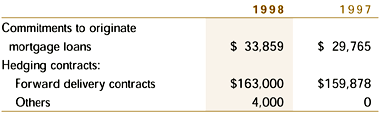
In addition, to protect against exposure to interest rate fluctuations on
adjustable-rate mortgage loan commitments, at December 31, 1998 and 1997, the Company
contracted with various parties to deliver $12,308 and $24,440, respectively, in
adjustable and fixed-rate mortgage loans for a specified price on primarily a best-efforts
basis.
Commitments to originate mortgage loans represent loan commitments with customers at
market rates up to 120 days before settlement. Loan commitments have no carrying value on
the balance sheet. These commitments expose the Company to market risk as a result of
increases in mortgage interest rates. The amount of risk is limited to the difference
between the contract price and current market value, and is mitigated by fees collected
from the customer and by the Company's hedging activities. Loan commitments had interest
rates ranging from 6.0 percent to 10.3 percent as of December 31, 1998, and 6.5 percent to
10.3 percent as of December 31, 1997.
Hedging contracts are regularly entered into by the Company for the purpose of
mitigating its exposure to movements in interest rates on mortgage loan commitments and
mortgage loans held-for-sale. The selection of these hedging contracts is based upon the
Company's secondary marketing strategy, which establishes a risk tolerance level. The
major factors influencing the use of the various hedging contracts include general market
conditions, interest rate, types of mortgages originated and the percentage of mortgage
loan commitments expected to be funded. The market risk assumed while holding the hedging
contracts, generally mitigates the market risk associated with the mortgage loan
commitments and mortgage loans held-for-sale.
The Company is exposed to credit related losses in the event of non-performance by
counterparties to certain hedging contracts. Credit risk is limited to those instances
where the Company is in a net unrealized gain position. The Company manages this credit
risk by entering into agreements with counterparties meeting the credit standards of the
Company and monitoring position limits.