
 |
|
|
|
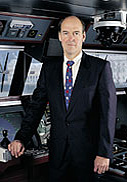
| David
G. Benson Senior Vice President, Passenger Transport |
Ferry Operations Cross
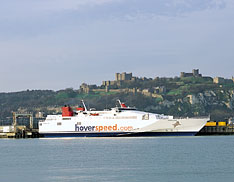
English Channel operations under our Hoverspeed brand carried
2.67 million passengers in 2000 (1999 3.5 million) and 615,000
vehicles (1999 722,000) as the total market contracted following
the withdrawal of duty-free sales |
||
|
|||
 |
On the Irish Sea, our route between Belfast, Northern Ireland, and Troon, Scotland, operated by SeaCat Scotland, proved popular in its first full year of operation. The seasonal service between Belfast and Heysham will be operated by the SeaCat Hoverspeed Great Britain in 2001. On these two Irish Sea routes 609,000 passengers and 124,000 vehicles were carried (1999 486,000 passengers and 137,000 vehicles). Revenue from these routes, including retail sales, totalled $24.9 million (1999 $23.5 million). SuperSeaCat
Three continued in service between Liverpool, England, and Dublin,
Ireland, on a reduced frequency with one round trip per day, better
matching capacity with demand. 167,000 passengers and 36,000 vehicles
were carried (1999 264,000 passengers and 49,000 vehicles), and
revenue totalled $9.8 million including retail sales (1999 $17.3
million based on two round trips daily on Liverpool-Dublin). Additionally,
this ship made a daily round trip between Liverpool and the Isle
of Man. 50% of its costs and the revenue are included within the
|
||
 |
|
Strong growth was once again exhibited by the Steam Packet. Total revenue increased to $57.2 million from $53.3 million, with passenger carryings of 601,000, up from 557,000 in 1999. Cars, coaches and motorcycles increased to 159,000 from 148,000 in 1999. Freight meterage was 393,000 (1999 355,000), reflecting continuing strengthening of the economy of the Isle of Man. SeaStreak
commuter services between New Jersey, Brooklyn and Manhattan carried
430,000 passengers (1999 374,000 in 11 months under our control)
with revenue totalling $6 million (1999 $5.1 million). A new craft,
SeaStreak New York, which can carry 400 passengers at 38 knots
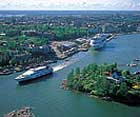
will join the fleet in May, 2001. The year 2000 will not go down in history as one of the most successful, but it was eventful, and thus significant, in many ways. As with all other ferry operators, Silja Line was hit by the high oil price, and bunker costs were $17.5 million higher than in 1999. Only a small part could be recovered through fuel surcharges but Silja Line succeeded in raising the price level on all routes, except for the Gulf of Bothnia service, both for tickets and onboard sales, an important achievement with respect to the future profitability. The Gulf of Bothnia service was strongly hit by the abolition of duty-free sales and, after having been heavily loss-making, it was closed down on December 31, 2000. Sea Containers’ fast monohull ferry SuperSeaCat Four entered Silja Line’s service between Helsinki and Tallinn from the middle of April 2000. The vessel achieved the position of market leader among the fast ferries. The profitability was, however, hit by higher than expected start-up costs. After labor action by the Finnish Seamen’s Union, an agreement was reached permitting employment of Estonian cabin crew at international wage rates on this ship. This achievement paved the way for an agreement signed with the union in November to produce savings in the labor costs of Finnish passenger ships of about 8% - 12%. The agreement comes into effect gradually from March, 2001. |
|
|
|||
 |
The total market for passenger ferry services between Finland and Sweden and between Finland and Estonia decreased by 3%. In 2000 Silja Line carried a total of 5.2 million passengers, a 5% decrease from 1999. The decrease is mainly attributable to the drop of passenger volume by 44% in the Gulf of Bothnia service following the abolition of duty- free sales on July 1, 1999. Duty-free sales continue on all Silja Line’s other routes. Of Silja's three cruise ships, the Walrus and the Superstar Taurus are on bareboat charter in the Far East until late 2002. The third, Crown Dynasty, was sold to Commodore Holdings Ltd. in January, 2000, for $86 million, of which $24 million was in the form of a seller’s credit. Commodore ran into liquidity problems and filed for Chapter 11 in December, 2000. Silja has made a provision for a loss of $13.8 million. The trend of revenues on Silja Line’s main routes was satisfactory, and its gross revenues amounted to $466.2 million (1999 $474.5 million) and from other operations, mainly the cruise ships, $18.4 million (1999 $23 million). At the end of 2000, Silja’s interest bearing liabilities amounted to $386.9 million (1999 $453.3 million), of which $50.7 million (1999 $50.7 million) constituted a convertible subordinated bond loan. In addition to this, Silja has a capital loan of $7.4 million (1999 $7.4 million) entered as equity. Of its liabilities, the amount of $340.9 million was renegotiated with a syndicate of banks. Repayment will take place over eight years. As most of the reasons for the sharp deterioration of Silja Line’s result have been addressed, the basis for an improvement of the result from operations has been created. Longer term, improvement in Silja’s performance requires that, by decision of the respective governments, the cost level on Swedish and Finnish passenger ships be placed on a par with the level of the other Nordic countries. A decision on this question is expected shortly. Failing this, Silja will be forced to reflag its vessels to another EU country. Cargo Ships Our two remaining
containerships, the Puerto Cortes and the Boxer Captain Cook are
on charter trading in the Arabian Gulf and Far East, respectively.
One small Ports Revenue at Heysham was $13.5 million (1999 $13.5 million) and regulatory approval for its sale has now been received so that disposal of this port can be completed shortly. At Newhaven, revenue totalled $3.6 million (1999 $4.3 million). At Folkestone, revenue totalled $2.3 million (1999 $2.3 million). A large part of Newhaven port was recently sold to French interests for $22 million. Rail During 2000, GNER carried 14.3 million passengers and had total revenue of $581 million, of which $495 million was passenger revenue. Total revenue was 3.6% up on 1999. Prior to the Hatfield derailment, GNER was operating 125 departures per day. This was an increase of 13 over 1999 following the approval and introduction in May, 2000 of two new Class 373/2 trainsets leased from Eurostar (UK) Ltd. These new services, marketed as “White Rose”, run between King’s Cross and York and have been well received, especially by leisure passengers, with initial volumes exceeding expectations. 2000 saw continued product improvements with the launch of an improved on-board service for business passengers between Newcastle and London marketed as “Standard Plus”. This follows from a lengthy trial on Leeds-London, which saw an encouraging growth in revenue. New car parks opened at Wakefield and Peterborough have also proved popular with business passengers. GNER continued its success in improving the reliability of its fleet of electric locomotives with the signing of an important repair contract to complete a major overhaul and refurbishment of all 31 units. The first locomotive was completed by the end of 2000, and three are now in service. During 2000 GNER once again received recognition for the high quality of its customer service, winning a number of national rail awards including Best Train Operator, Best Station (Doncaster), Best Customer Experience and the U.K. Rail Industry Innovation Award for Customer Service. |
||
|
|||
 |
|||
|
|||
| David G. Benson Senior Vice President |
