|
Year Ended February
27, 1998 Compared to Year Ended February 28, 1997
Net
sales. Net sales increased
$351.6 million, or 14.6% (16.7% after adjusting 1997 for the 53rd week),
to $2,760.0 million for 1998, from $2,408.4 million for 1997. The Company’s
U.S. net sales increased $325.5 million, or 14.9% (17.2% after adjusting
1997 for the 53rd week), to $2,509.4 million from $2,183.9 million and
non-domestic net sales increased $26.1 million, or 11.6%, to $250.6 million
from $224.5 million, respectively, from 1997 to 1998. The growth in the
U.S. business has been driven primarily by increases in unit sales across
most product lines reflecting strong industry fundamentals. The non-domestic
net sales growth resulted from industry growth in Canada and strong export
sales to both Latin America and the Middle East.
Gross profit.
The Company’s gross profit increased $146.6 million, or 17.1%, to
$1,003.4 million for 1998, from $856.8 million for 1997. As a percentage
of net sales, gross profit increased to 36.4% for 1998 from 35.6% for
1997. The improvement resulted primarily from the increased unit sales
volume in the period without a comparable increase in overhead, as well
as continued success of the 1996 cost reduction program. In addition,
this improvement in gross profit absorbed incremental costs related to
furniture distribution process changes, the restructuring and disposition
of a non-furniture related manufacturing facility, a portion of the Employee
Stock Grant, as defined in Note 10 to the Consolidated Financial Statements,
and certain manufacturing equipment write-offs, which aggregated $18.3
million for 1998. Similar incremental costs aggregated $4.5 million for
1997.
Selling,
general and administrative expenses. Selling, general and administrative
expenses increased $55.6 million, or 8.8%, to $686.0 million for 1998,
from $630.4 million for 1997. As a percentage of net sales, the Company’s
selling, general and administrative expenses decreased to 24.9% for 1998
from 26.2% for 1997, reflecting management’s cost containment efforts.
The decrease was partially offset by investments in new product development
and information systems. In addition, selling, general and administrative
expenses for 1998 include aggregate costs of $11.0 million relating to
the restructuring of a foreign subsidiary, the relocation of a showroom
facility and the initial public offering and receipt by the Company of
a net litigation settlement in the amount of $9.8 million. Selling, general
and administrative expenses for 1997 include a subsidiary restructuring
charge and an intangible asset write-off aggregating approximately $8.6
million.
Patent
litigation expenses.
In December 1996, the Company concluded a 17-year patent litigation, which,
net of reserves, reduced net income by $123.5 million for 1997. See Note
11 to the Consolidated Financial Statements of the Company.
Other income,
net. Other income,
net increased $1.2 million, or 5.6%, to $22.6 million for 1998 from $21.4
million for 1997 primarily as a result of increased interest income.
Provision
for income taxes.
Income tax expense for 1998 was 38.5% of income before taxes as compared
to 46.0% for 1997. The decrease in the effective tax rate was primarily
attributable to the impact of recurring non-deductible expenses relative
to the level of income for each of the respective periods.
Net income.
For the reasons set forth above, primarily patent litigation expenses
incurred in 1997, net income increased $189.3 million to $217.0 million
for 1998 from $27.7 million for 1997. Excluding patent litigation expenses,
net income would have increased $65.8 million, or 43.5%, to $217.0 million
for 1998 from $151.2 million for 1997.
Year Ended February
28, 1997 Compared to Year Ended February 23, 1996
Net
sales. Net sales increased $252.5 million, or 11.7%, to $2,408.4
million for 1997 from $2,155.9 million for 1996. The Company’s U.S.
net sales increased $216.7 million, or 11.0%, to $2,183.9 million from
$1,967.2 million and non-domestic net sales increased $35.8 million, or
19.0%, to $224.5 million from $188.7 million, respectively, from 1996
to 1997. The U.S. net sales growth resulted from increases in unit sales
across most product categories reflecting strong industry fundamentals
and, in part, from acquisitions. The non-domestic net sales growth resulted
from acquisitions and strong export sales to both Latin America and the
Middle East.
Gross profit.
The Company’s gross profit increased $169.1 million, or 24.6%, to
$856.8 million for 1997 from $687.7 million for 1996. As a percentage
of net sales, gross profit increased to 35.6% for 1997 from 31.9% for
1996. The improvement during 1997 primarily resulted from increased unit
sales volume growth while overhead costs remained relatively fixed due
to a full year’s impact of the 1996 cost reduction program.
Selling,
general and administrative expenses.
Selling, general and administrative expenses increased $106.3 million,
or 20.3%, to $630.4 million for 1997 from $524.1 million for 1996. As
a percentage of net sales, selling, general and administrative expenses
increased to 26.2% for 1997 from 24.3% for 1996. This planned increase
was attributable primarily to increased investments in new product development
and information systems, as well as acquisitions and international expansion.
The Company also absorbed $8.6 million of charges related to a subsidiary
restructuring and an intangible asset write-off in 1997 and $6.6 million
of charges relating to the restructuring of a foreign subsidiary and termination
of a management incentive compensation program in 1996.
Patent
litigation expenses.
In December 1996, the Company concluded a 17-year patent litigation, which,
net of reserves, reduced net income by $123.5 million for 1997. See Note
11 to the Consolidated Financial Statements of the Company.
Other income,
net. Other income,
net decreased $2.6 million, or 10.8%, to $21.4 million for 1997 from $24.0
million for 1996 primarily as a result of losses incurred on dealer transitions
and decreased interest income.
Provision
for income taxes.
Income tax expense for 1997 was 46.0% of income before taxes as compared
to 36.3% for 1996. The increase in the effective tax rate was primarily
attributable to the impact of recurring non-deductible expenses relative
to the level of income for each of the respective periods.
Net income.
For the reasons set forth above, primarily patent litigation expenses,
net income decreased $95.8 million, or 77.6%, to $27.7 million for 1997
from $123.5 million for 1996. Excluding patent litigation expenses, net
income would have increased $27.7 million, or 22.4%, to $151.2 million
for 1997 from $123.5 million for 1996.
Liquidity and Capital Resources
 Historically,
the Company’s cash and capital requirements have been satisfied through
cash generated from operating activities. The Company has no long-term
debt. Cash, cash equivalents and short-term investments were $116.1 million
at February 27, 1998. These funds, in addition to cash generated from
future operations, are expected to be sufficient to finance the known
or foreseeable future liquidity and capital needs of the Company. Historically,
the Company’s cash and capital requirements have been satisfied through
cash generated from operating activities. The Company has no long-term
debt. Cash, cash equivalents and short-term investments were $116.1 million
at February 27, 1998. These funds, in addition to cash generated from
future operations, are expected to be sufficient to finance the known
or foreseeable future liquidity and capital needs of the Company.
The Company’s capital
expenditures were $126.4 million in 1998 compared to $122.0 million in
1997 and $104.6 million in 1996. These capital expenditures include increased
investments in manufacturing equipment expected to improve productivity
and safety, increase capacity and facilitate the first shipment of Pathways-based
products in the fourth quarter of 1998. In addition, capital expenditures
for 1997 and 1996 reflect costs associated with replacing the Company’s
aircraft and investing in corporate and showroom facilities. The Company
expects capital expenditures to continue to be significant due to the
continued investment in new product development, SAP implementation and
new manufacturing equipment intended to increase plant capacity. While
the costs of purchasing and implementing SAP will be capitalized and amortized
over the software’s expected useful life, costs associated with certain
modifications, year 2000 related matters, data preparation and training
will be expensed as incurred. Since 1995, the Company has been reviewing
potential issues associated with computer applications that could fail
or generate erroneous results by or at the year 2000 (“Year 2000
Issues”) and expects to conclude its review of all these issues during
1999. To date, the cost to the Company of analyzing these potential problems,
identifying actual applications that need to be addressed and modifying
its computer applications has not been material. Based upon its current
estimates, management expects that the additional cost of concluding its
review and addressing any identified problems will not be material and
that any remaining Year 2000 Issues, including those that relate to interfacing
with customers, dealers and suppliers, will be addressed and rectified
in a timely manner and will not have any material adverse effect on the
Company’s financial condition or results of operations.
Cash provided
by operating activities.
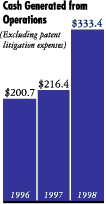
Cash provided by operating activities totaled $333.4 million for 1998,
$80.8 million for 1997 and $200.7 million for 1996. Cash from operating
activities resulted primarily from net income, excluding non-cash items
such as depreciation and amortization, net of increases in accounts and
notes receivable and leased assets. In addition, cash provided by operating
activities for 1998 reflects increases in accrued employee compensation,
employee benefit plan obligations and other expenses.
Cash used
in investing activities.
Cash used in investing activities totaled $149.9 million for 1998 and
was comprised primarily of capital expenditures and net increases in investments.
Cash used in investing activities totaled $75.4 million for 1997 and was
comprised primarily of capital expenditures, net of a repayment of a note
receivable from Steelcase Strafor. Cash used in investing activities totaled
$115.9 million for 1996 and was comprised primarily of capital expenditures
and corporate acquisitions.
Cash used
in financing activities.
Cash used in financing activities totaled $254.4 million for 1998, $40.4
million for 1997 and $39.8 million for 1996. The cash was used primarily
to fund quarterly dividends paid by the Company, along with a special
dividend and a common stock repurchase in 1998 in the amounts of $150.9
million and $43.5 million, respectively. See Note 2 to the Consolidated
Financial Statements of the Company.
Safe Harbor Provision
There are certain forward-looking
statements under the Liquidity and Capital Resources section, particularly
those with respect to the Company’s future liquidity and capital
needs and the expected ability of the Company and its key customers, dealers
and suppliers to successfully manage Year 2000 Issues. Such statements
involve certain risks and uncertainties that could cause actual results
to vary from the stated expectations.
Recently Issued Accounting
Standards
Statement of Financial Accounting
Standards (“SFAS”) No. 130, Reporting Comprehensive Income,
establishes standards for reporting and display of comprehensive income,
its components and accumulated balances in a financial statement that
is displayed with the same prominence as other financial statements. Comprehensive
income is defined to include all changes in equity except those resulting
from investments by owners and distributions to owners. This statement
is effective for the Company for 1999 and requires comparative information
for earlier years to be restated.
SFAS No. 131, Disclosures
about Segments of an Enterprise and Related Information, which supersedes
SFAS No. 14, Financial Reporting for Segments of a Business Enterprise,
establishes standards for reporting information about operating segments
in annual and interim financial statements. It also establishes new standards
for disclosures regarding products and services, geographic areas and
major customers. This statement is effective for the Company for 1999.
SFAS No. 132, Employers’
Disclosures about Pensions and Other Postretirement Benefits, revises
existing disclosure requirements for pension and other postretirement
benefit plans thereby intending to improve the understandability of benefit
disclosures, eliminate certain requirements that the Financial Accounting
Standards Board believes are no longer necessary, and standardize footnote
disclosures. This statement is effective for the Company for 1999 and
requires comparative information for earlier years to be restated.
The Company’s consolidated
balance sheets and the related consolidated statements of income, changes
in shareholders’ equity and cash flows will not be materially affected
by implementation of SFAS No. 130, SFAS No. 131 and SFAS No. 132. No other
recently issued accounting pronouncements are expected to have a material
impact on the Company.
|


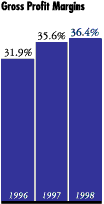 Gross margins have improved
to 36.4% for 1998 from 31.9% for 1996. This improvement reflects increased
overhead absorption through increased sales and the impact of a cost reduction
program, initiated in 1996, designed primarily to improve raw materials
sourcing, contain costs and rationalize facilities.
Gross margins have improved
to 36.4% for 1998 from 31.9% for 1996. This improvement reflects increased
overhead absorption through increased sales and the impact of a cost reduction
program, initiated in 1996, designed primarily to improve raw materials
sourcing, contain costs and rationalize facilities. 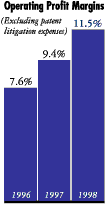 The
gross margin improvement has been slightly offset by selling, general
and administrative expenses which increased to 24.9% of net sales for
1998 from 24.3% of net sales for 1996, reflecting strategic investments
in new product developments, such as Pathways, and in information systems,
such as SAP, a comprehensive information management system (“SAP”).
As a result of the improvements in gross margin net of the increases in
selling, general and administrative expenses, operating margins have improved
significantly to 11.5% for 1998 from 7.6% for 1996.
The
gross margin improvement has been slightly offset by selling, general
and administrative expenses which increased to 24.9% of net sales for
1998 from 24.3% of net sales for 1996, reflecting strategic investments
in new product developments, such as Pathways, and in information systems,
such as SAP, a comprehensive information management system (“SAP”).
As a result of the improvements in gross margin net of the increases in
selling, general and administrative expenses, operating margins have improved
significantly to 11.5% for 1998 from 7.6% for 1996. 
