|
Management's Discussion and Analysis of Financial Condition and Results of Operations
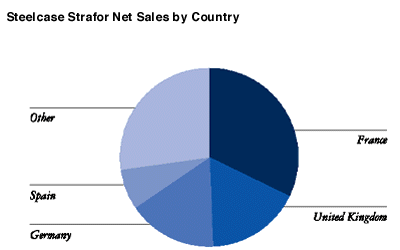
Net sales In accordance with Statement of Financial Accounting Standards No. 131, Disclosure about Segments of an Enterprise and Related Information, the Company operates on a worldwide basis within a single reportable segment, the office furniture industry. The office furniture segment includes all of the Company's operating segments within consolidated net sales except for services and other businesses, plus the unconsolidated net sales of its European joint venture, Steelcase Strafor. Net sales from all other unconsolidated joint ventures and dealer transitions are not material. The Company offers its extensive range of products and services to commercial and non-commercial organizations worldwide through a network of independent dealers in approximately 680 locations (including approximately 230 outside of North America). These dealers, in conjunction with the Company's sales force, provide local expertise, installation services and ongoing customer support services, remaining in close contact with customers during and after the completion of a project to help ensure customer satisfaction, offer ongoing services and encourage repeat business. The following table sets forth consolidated and pro forma worldwide net sales by geographical segment for 1999, 1998 and 1997. In addition, 1999 and 1998 geographical segments are presented versus the prior year.
(1) Steelcase Strafor net sales have been adjusted from amounts previously reported in order to conform the classifications of sales deductions with those reflected in the Company's consolidated net sales. These reclassifications were identified in connection with the Company's April 22, 1999 acquisition of Strafor Facom's 50% interest in Steelcase Strafor. See Notes 8 and 20 to the Consolidated Financial Statements. (2) In local currency, Steelcase Strafor net sales increased 9.8% in 1999 and 19.1% in 1998. (3) Worldwide net sales include, on a pro forma basis, the Company's consolidated net sales plus those of its unconsolidated European joint venture, Steelcase Strafor. Net sales of all other unconsolidated joint ventures and dealer transitions are not material.
Domestic - U.S. only. The Company's largest market, the U.S., includes the following Steelcase operations: Steel, the Steelcase Design Partnership ("SDP"), Turnstone, Steelcase Wood and Revest. While substantially all U.S. net sales are processed and serviced through the dealer network, the Company segregates dealer sales between those contracted solely by its dealers - its primary U.S. distribution channel, and those contracted directly by the Company - typically large corporate account business. Fluctuations within the different operations and distribution channels have resulted in U.S. net sales growth rates of 0.6%, 15.8% and 8.3% in 1999, 1998 and 1997, respectively.
For 1999, 1998 and 1997, sales contracted solely by the Company's dealers grew by approximately six percent, 12 percent and 14 percent, respectively. Large corporate account business in the same periods experienced double-digit growth in 1998 and 1997, and a double-digit decline in 1999. Other distribution channels include government, education and institution, and other sectors, none of which significantly impacted U.S. growth trends in the reported periods. U.S. net sales growth in 1998 and 1997 resulted primarily from increases in unit sales across most product categories reflecting strong industry fundamentals. In 1999, the industry began to soften due to the financial volatility in Asian and Latin American markets, which, along with a high level of domestic merger and acquisition activity within the U.S. Fortune 500 companies, contributed to the double-digit decline in the Company's large corporate account business channel. Management believes that the uncertainties posed by these global economics significantly influenced corporate capital spending decisions, thereby causing delays of anticipated projects throughout the course of 1999. While some of these projects are beginning to resurface during the current year, many remain delayed, possibly due to ongoing global economic uncertainty and general corporate concern over the potential impact of Year 2000 issues and their disruption on the business world. In 1998 and 1997, the Company's Steel operations, which include its primary product lines (office furniture systems, seating, storage solutions, interior architectural products, and desks and casegoods), benefited from strong industry fundamentals, resulting in growth in unit sales across most product categories. In 1999, as the industry softened, these product categories were impacted by the deferred spending actions within the Company's large corporate account business, resulting in declines across the same product categories that benefited from a strong industry in 1998 and 1997. However, in 1999, the Company continued to experience double-digit growth in all other U.S. operations. Acquisitions did not have a material impact on U.S. net sales for any of the reported periods.
International and Canada. In 1998 and 1997, the International and Canadian segment experienced growth of 11.6% and 19.0%, respectively, due to strong export sales to both Latin America and the Middle East in both years, office furniture industry growth in Canada in 1998 and acquisitions in 1997. In 1999, the International and Canadian segment decreased 9.8% due to several factors including: first, although Canadian net sales in local currency increased 6.0% for the year, unfavorable exchange rates entirely offset the growth; second, the Company experienced a reduction in export projects to Latin America and flat sales in Asia due to local economic conditions; and third, the Company's Japanese subsidiary was reorganized during the third quarter of 1998 and as a result now receives royalty income instead of recording the related net sales. Services and other businesses. Services and other businesses, which more than doubled in 1997, were virtually flat in 1998 and declined by 6.2% in 1999, were impacted by an acquisition at the beginning of 1997 and the disposal of a product line and distributor within the Company's marine business at the end of the third quarter of 1998.
|