|
Notes to Consolidated Financial Statements
Note 12 STOCK INCENTIVE PLANS The Stock Incentive Plans for employees and affiliates of the Company include the Steelcase Inc. Employee Stock Purchase Plan (the "Purchase Plan") and the Steelcase Inc. Incentive Compensation Plan (the "Incentive Compensation Plan").
Employee Stock Purchase Plan The initial purchase period under the Purchase Plan began on the date of the pricing of the Offerings in 1998 and ended on April 17, 1998. Eligible employees who wished to participate in the Purchase Plan were allowed to purchase by April 17, 1998 a maximum of 100 shares of Class A Common Stock at 85% of the initial public offering price (the "Employee Discount Option Grant"). The Company granted approximately 15,000 employees the option to participate in the Purchase Plan during the initial purchase period, which resulted in the issuance of 1,045,279 shares of Class A Common Stock and the receipt by the Company of related proceeds approximating $24.8 million. Pursuant to APB Opinion No. 25, the Employee Discount Option Grant did not result in any compensation expense to be recognized by the Company.
Incentive Compensation Plan Awards may be made to employees and non-employee directors of the Company or its affiliates. A variety of Awards may be granted under the Incentive Compensation Plan including stock options, stock appreciation rights ("SARs"), restricted stock, performance shares, performance units, cash-based awards, phantom shares and other share-based awards as the Compensation Committee may determine. Stock options granted under the Incentive Compensation Plan may be either incentive stock options intended to qualify under Section 422 of the Code or non-qualified stock options not so intended. The Board may amend or terminate the Incentive Compensation Plan. In the event of a "change of control," as defined in the Incentive Compensation Plan, (i) all outstanding options and SARs granted under the Incentive Compensation Plan will become immediately exercisable and remain exercisable throughout their entire term, (ii) any performance-based conditions imposed with respect to outstanding Awards shall be deemed to be fully earned and a pro rata portion of each such outstanding Award granted for all outstanding performance periods shall become payable in shares of Class A Common Stock, in the case of Awards denominated in shares of Class A Common Stock, and in cash, in the case of Awards denominated in cash, with the remainder of such Award being canceled for no value and (iii) all restrictions imposed on restricted stock that are not performance-based shall lapse. Concurrent with the Offerings in 1998, the Company issued 10 shares of Class A Common Stock each to certain employees of the Company and its subsidiaries as designated by the Compensation Committee (the "Employee Stock Grant"). The Employee Stock Grant included 149,540 shares of Class A Common Stock in the aggregate and resulted in $4.2 million of compensation expense which was recognized by the Company in 1998 upon issuance. In addition, the Company issued options to purchase 2,661,000 shares of Class A Common Stock to certain employees and non-employee directors of the Company in connection with the Offerings in 1998. These stock options have an exercise price equal to the initial public offering price per share of $28.00 and will typically vest over a period of five years. In 1999, the Company issued options to purchase 9,350 shares of Class A Common Stock with an exercise price equal to $36.50 per share and a vesting period of five years. Pursuant to APB Opinion No. 25, these stock options did not result in any material compensation expense recognized by the Company. As of February 26, 1999, there had been no exercises or terminations of options since their issuance and there were 3,464,377 options available for future issuance.
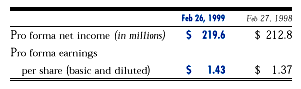
SFAS No. 123 Pro Forma Data
The estimated fair value of the Employee Discount Option Grant approximated the 15% discount discussed above. The fair value of the Company's stock options was estimated at the date of the grant using the Black-Scholes option pricing model with the following weighted average assumptions:
|