From the Chief Executive
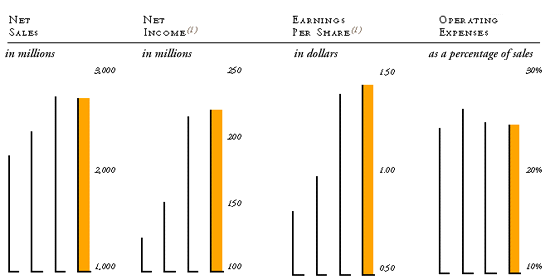
Fiscal 1999 was an exceptional year. At a time when the market for the company's and its competitors' products was softening, thanks to international financial pressures, Steelcase set records in both net income and earnings per share, and enjoyed the second best net sales year in its 87-year history.
Now, as the company's performance over the last four years illustrates, my management team and I regard sales growth as particularly important, so we're disappointed that our net sales did not surpass fiscal 1998's.
(1) Net income and EPS for 1997 exclude the effect of patent litigation, which, net of reserves, reduced net income by $123.5 million. See Note 13 to the Consolidated Financial Statements.
Our disappointment was tempered by market conditions, however. In fact, we believe the company's performance in fiscal 1999 affirms the rightness of the course we have charted and the value of our efforts to improve our productivity.
Both affirmations are especially important, given indications that our customers' belt-tightening efforts will continue for at least the next six months.
A WORD ABOUT OUR STOCK PRICE
You may wonder how Steelcase could post these financial results and see its stock price drop, especially after it climbed so nicely when it was first offered to the public. So do I.
However, when I've discussed my concerns with investment professionals, I typically hear that, "While stock markets behave erratically from one day to the next, over time a company's stock price will accurately reflect its financial performance."
And I draw two conclusions: leave predicting to others, and focus on boosting performance.
HOW WE'RE BOOSTING PERFORMANCE
In a year of leaps (some of which you'll read about later in this report), there were three company-wide developments that promise to add significantly to the company's earning power, short and long-term.
[1] The first - and I think most important - involves corporate strategy. One of the first things we did when I became Steelcase's president was to initiate a comprehensive strategy review, which led to the formulation of a strategic plan. Ten months ago, I challenged the company's policy team to review this plan. I asked them to revisit two central questions with me: where do we want to go? and how do we plan to get there?
This led to a "new and improved" strategic plan that is both broader and deeper than its predecessor. What's especially impressive is that it can be summarized in four sentences:


Become a work
effectiveness company.
Achieve operational perfection.
Live our core values.
Achieve ambitious
financial goals.
|
What is a "work effectiveness company?" Here's our definition: a company that supplies mindful innovations ("spaceware") that help individuals and organizations work more effectively by improving the quality of their work environments.
We define "operational perfection" as "executing our strategy quickly and flawlessly." Industry leaders tend to be obsessed with - and very, very good at - executing. They not only invent breakthroughs, they implement them quickly and effectively.
There is no either/or here. Only both/and. We must have vision, strategy and execution, or we'll quickly cease to be industry leaders.
Our "ambitious financial goals" are: increase worldwide net sales to $6 billion in five years; reduce operating expenses to 22 percent of sales; and achieve a 14 percent operating income margin.
CITIZENS OF THE WORLD
 [2] The second development concerns acquisitions we made in support of our corporate strategy. We've said we'll grow by acquiring companies that add to our capabilities and fit our culture, and we did this on four occasions in fiscal 1999.
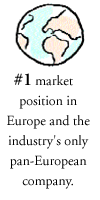
We initiated the purchase of Strafor Facom's interest in our Steelcase Strafor joint venture, and we acquired Europe's finest wood furniture company, Werndl BuroMobeL AG, headquartered in Rosenheim, Germany. These were major steps, "leaps," if you will, for four reasons:
- They position Steelcase as the market sales leader across Europe and as the only pan-European company in the industry.
- They enable us to better serve our sizable and growing group of international customers.
- They enable us to compete more effectively for African, East Asian and Middle Eastern customers by giving us a strong European base.
- They accelerate an essential transition - from "Grand Rapids company with international operations" to "international company headquartered in Grand Rapids."