UNION PLANTERS CORPORATION AND SUBSIDIARIES
FINANCIAL HIGHLIGHTS
| 1998 | 1997 | % Change | |
|---|---|---|---|
| (Dollars in thousands, except per share data) | |||
| Year Ended December 31, | |||
| Net earnings | $ 225,606 | $ 339,835 | (33.61)% |
| Per Common Share: | |||
| Basic | 1.61 | 2.53 | (36.36) |
| Diluted | 1.58 | 2.47 | (36.03) |
| Cash dividends | 2.00 | 1.495 | 33.78 |
| Book value | 20.86 | 20.96 | (.48) |
| Earnings before merger-related charges, other significant items, | |||
| and goodwill and other intangibles amortization, net of taxes | $ 351,866 | $ 392,476 | (10.35)% |
| Per Common Share: | |||
| Basic | 2.52 | 2.93 | (13.99) |
| Diluted | 2.47 | 2.85 | (13.33) |
| At December 31, | |||
| Assets | $31,691,953 | $29,974,463 | 5.73% |
| Earning assets | 28,737,886 | 27,384,302 | 4.94 |
| Loans, net of unearned income | 19,576,826 | 20,302,969 | (3.58) |
| Allowance for losses on loans | 321,476 | 324,474 | (.92) |
| Deposits | 24,896,455 | 22,875,879 | 8.83 |
| Shareholders' equity | 2,984,078 | 2,874,473 | 3.81 |
| Common shares outstanding (in thousands) | 141,925 | 134,532 | 5.50 |
| Profitability and Capital Ratios | |||
| Net earnings | |||
| Return on average assets | .73% | 1.16% | |
| Return on average common equity | 7.71 | 12.45 | |
| Earnings before merger-related charges, other significant items, | |||
| and goodwill and other intangibles amortization, net of taxes | |||
| Return on average assets | 1.14 | 1.34 | |
| Return on average common equity | 12.06 | 14.41 | |
| Net interest income (taxable-equivalent) as a percentage of | |||
| average earning assets | 4.40 | 4.57 | |
| Expense ratio | 1.58 | 1.59 | |
| Efficiency ratio | 55.98 | 54.45 | |
| Shareholders' equity to total assets | 9.42 | 9.59 | |
| Leverage ratio | 8.86 | 9.62 | |
| Tier 1 capital to risk-weighted assets | 13.34 | 14.32 | |
| Total capital to risk-weighted assets | 16.78 | 16.39 | |
| Credit Quality Ratios | |||
| Allowance for losses on loans as a percentage of loans | 1.71 | 1.71 | |
| Nonperforming loans as a percentage of loans | .83 | .81 | |
| Allowance for losses on loans as a percentage of nonperforming | |||
| loans | 206 | 210 | |
| Nonperforming assets as a percentage of loans and foreclosed | |||
| properties | .97 | 1.01 | |
| Provision for losses on loans as a percentage of average loans | 1.04 | .83 | |
| Net charge-offs as a percentage of average loans | .95 | .63 | |
CONTENTS
Calendar year 1998 was a year of enormous change within the banking industry and within Union Planters. In many ways it was a watershed year for your company. While we were disappointed at the performance of our stock price during the year, we are positive about our growth and the changes taking place in Union Planters, and believe they will lead to greater earnings per share and greater value for our shareholders over the longer term.
Industry consolidation continued at a record pace including mergers of several of the largest franchises in the United States (Wells Fargo and Norwest; Bank One and First Chicago; and NationsBank and BankAmerica) giving rise to the possibility of a truly national geographic franchise. Travelers and Citicorp merged to form the largest financial services company in the United States, testing the limits of Glass-Steagall by offering insurance, brokerage, asset management, and traditional bank services under a single umbrella. These combinations and numerous others in 1998 have significantly changed the banking landscape in the United States.
Union Planters continued to be an active participant in this consolidation activity in 1998. We closed calendar year 1997 with approximately $18 billion in assets including the December 31, 1997 acquisition of Capital Bank in Miami. By year-end 1998 we had completed an additional 18 acquisitions, almost doubling assets to $32 billion, and greatly strengthening our position in a number of markets where we already had a presence. In the process we became the 29th largest bank holding company in the United States and in the fourth quarter were added to the S&P 500.
The largest concentration of the Union Planters franchise is in a corridor running roughly 150 miles either side of the Mississippi River beginning in Baton Rouge, Louisiana and following the river north past Jackson, Mississippi, through Memphis and on to St Louis, Missouri. Many of the acquisitions were in this corridor and were franchises similar to the very profitable franchises we already own and operate in the corridor. The mid-year Magna acquisition had the additional benefit of giving Union Planters the number three market share position in the St Louis area. In addition, we have a major presence outside of this corridor in Tennessee, Florida, and Iowa. The Florida acquisitions (including the recently announced acquisition of Republic) give us a significant presence in a fast growing market and the third largest market share in Miami. Our second largest deposit state behind Tennessee, which represents 24 percent of our deposit base, is Florida with about 17 percent (pro forma) of our deposits. Illinois and Missouri are next with 13 percent and 10 percent, respectively. Sixty-seven percent of our franchise is now in metropolitan areas. The acquisitions bring our total number of customers to more than two million.
We believe the 1998 acquisitions will be accretive to earnings per share when fully consolidated. We originally estimated that we could save an amount equal to roughly 25 percent to 30 percent (approximately $100 million) of the operating costs of the acquired institutions. For reasons discussed below, and because we did not want to disrupt the newly acquired customer base, our best estimate is that by year-end 1998 we had achieved about 50 percent of this amount. We remain confident that we will achieve the remainder during 1999. It was again necessary to take charges related to the acquisition activity and our full year ROA and ROE were reduced accordingly.
Extraordinary consolidation within the industry and exceptional growth by Union Planters were not the only changes, however. Technology advances continued at an astonishing pace. Just three or four years ago many of us would not have even heard of the Internet. Today it is a tool used at home and work almost on a daily basis. The increased power of personal computers and the software that drives them has provided significant opportunities in our organization. Data processing and Internet companies will become either our worst competitors or our biggest allies. To effectively manage in this environment we must develop, learn, adapt to, and take advantage of this new technology, or see our market position erode and many of our payment system functions forfeited to less-regulated competitors. Our continued growth and the rapid advances in technology led us in the third quarter of 1997 to address a number of organizational issues including our separate bank charters and the economies of scale which would be made possible by the application of technology.
Union Planters' organizational structure may be logically thought of as divided into the traditional affiliate bank group and the specialty bank group. Traditional affiliates provide commercial and retail bank services throughout our twelve-state franchise. They operate traditional bank branches and they function in many ways as a community bank in a local market. They are defined by local geographic area, and provide UPC products and services to this market. The community bank structure has been the cultural anchor of our operating philosophy. Each UPC traditional affiliate has a locally focused marketing program based on its size, presence, history in the community, and knowledge of its customers. The intent of this philosophy is to ensure that we remain good corporate citizens within the communities and to foster strong relationships at the local level between our customers and loan officers, customer service representatives and tellers.
Specialty bank activities include those business lines or functions (e.g., mortgage, trust, SBA, brokerage services and insurance) that require specialized knowledge or skills that are not generally available, or would be expensive to duplicate at each of our traditional affiliates, and those that are given to substantial economies of scale. Our affiliate bankers have tended to view themselves as community bankers while our specialty product bankers have tended to view themselves as product line managers. Specialty bank products or services are sold throughout the entire affiliate franchise, sometimes by personnel of the specialty bank but just as often by bank personnel trained in the product. Secondary market mortgage loans, for example, are originated by dedicated mortgage lenders within the affiliates, or if the required skills are not available at the local affiliate, by personnel working directly for the mortgage company. Specialty bank customers are thus often customers of one of the traditional affiliates.
Prior to the study undertaken in the third quarter of 1997, our traditional affiliates maintained separate bank charters. Their performance was generally excellent (many consistently in the top quartile of their peer group) despite the additional expense of the separate charters and the attendant organizational redundancy. As a result of the study, Union Planters adopted a comprehensive charter consolidation plan. The decision to eliminate the separate charters was recognition that our growth in assets had, or soon would, become an impediment to continued improvement in customer service, operating efficiency, and profitability. The plan called for the retention of one bank charter and one thrift charter, the merger of electronic information databases, and the creation of regional bank support centers to provide call center, back office operations, credit administration and underwriting support functions for the entire Corporation. The intent was more than just making an organizational structure change and placing our affiliates on common data processing systems. They had been on common systems for a number of years. The plan called for a complete and common product line in all of our markets, common systems and procedures at the local level throughout the organization, common back office support centers, and a substantial leap forward in the application of technology to reduce costs, better serve our customers, and to provide better information to manage the organization. We viewed the charter consolidations and the technology issues as interdependent. Finally, we wanted to accomplish the transition without destroying the community bank philosophy, or the sense of responsibility and empowerment that exists at the community level. Our intent was to provide the local affiliate with better information for local market management and better support of back office functions at less cost. At the same time we wanted to provide corporate management with better management information regarding customers, segments, channels, and product profitability.
A model bank plan was conceived, designed, and the process of development and implementation begun. Best practices developed in or for one affiliate were adopted in the form of model bank policies and procedures. Standard bank staffing and quality of service models were developed and implemented and have become an integral part of the management process throughout our affiliate system, and in the back office support centers. Software best suited to Union Planters' needs was chosen.
The information platform selected is a consolidated customer view (all logically related customer information), a high-speed operational data store, a data warehouse to retain delivery channel (branch, ATM, telephone, etc.) and customer information, high-speed high-volume data lines, common channel presentations, and image technology. The software support systems include all traditional legacy systems, middleware for maintaining the consolidated customer view and interconnecting the foundation systems to the customer and vice versa, the information warehouse driver, a Windows(R) based common platform software, and integrated use of image technology for check processing and loan documentation. Significant parts of the consolidated customer view will be available to our customers on the Internet in a secure environment including customer account balances, statements, transaction histories, and even the image of individual checks. Balance transfers between accounts, bill payments to the bank and third parties, and check orders are among the self-service conveniences being afforded the customer.
UPC closed the calendar year 1997 with 35 bank charters. On January 1, 1998, 31 of the 35 separate charters were consolidated into a single charter. Those not eliminated were essentially those organizations that had not yet been converted to UPC's data processing systems. With the legal boundaries between our affiliates eliminated, we could begin to move forward to obtain the benefits of size and technology available in a single charter environment. The entire project was estimated to take 18 months to fully implement.
We are well along in that process. The foundation for our model bank is in place. A common menu of products and services is offered throughout our entire affiliate network. Common account and general ledger coding has been established. We have common data processing foundation systems and a common platform in use throughout a substantial part of our network. We have established a model back office credit administration and underwriting support center. The significant number of acquisitions slowed the process of development and implementation, and the implementation of the model bank concept slowed the conversion of some of the new affiliates to our computer systems. However, approximately 85 percent of our assets, including recent 1999 purchases, have now been converted to common foundation systems with back office support operations moved to a support center. Credit administration and underwriting support are operational for approximately 30 percent of our assets at the present time. Most of the Internet services described above were made available to customers in January. Without advertising support, over 5,000 customers have signed up for this service. Implementation of the common customer view at the platform is scheduled for May and image for platform and research in September. Our last major foundation system conversion is scheduled for August, and the credit support centers are scheduled to be fully operational by year-end.
Personnel savings from the charter consolidation were estimated originally at 600 employees (approximately 10 percent of staff at the time). Savings would be proportionally larger today because of our greater size. Although it is difficult to differentiate between charter consolidation and merger cost savings from the new acquisitions, we believe we have achieved only about 40 percent of the total savings that will be made possible by this effort. Savings are only a part of the benefit, however. Management at all levels will have more and better information on which to base their decisions. Product profitability, consolidated customer profitability, customer segment profitability and delivery channel profitability will be systematically recorded and retained. Our intent is to be able to mass customize, promote, price differentiate, and encourage different channel usage through customer segmentation. Channel productivity and profitability will be measured on the cost of operating the channel point, the number of transactions, and the profitability of the customers actually using the channel point. To a great extent, our future profitability, customer service levels, and ability to compete will be driven by the success of these systems and technology initiatives.
The charter consolidation and technology initiatives were necessarily an added expense burden throughout all of 1998. The new software for the support centers involved significant development, installation, and testing. Each affiliate merger into the consolidated database is similar to a data processing conversion and has roughly the same internal and third party expenses associated with it as that of a newly acquired bank. Personnel must learn new systems coding, procedures, etc., and there always is a period of adjustment as personnel become both familiar and efficient with use of the new systems. Further, it was necessary to increase personnel at the central support sites to provide a training period for new personnel before transferring affiliate work into the support centers. Thus, there has been overlap of staff and costs. Despite this additional burden, core earnings among our older affiliates (those owned prior to 12/31/97) remained excellent at an estimated 1.59 percent ROA and 15.9 percent ROE.
The banking industry perhaps more than any other industry tends to be a mirror of the economy and the environment in which it operates. In recent years we have benefited from a sustained period of economic stability and growth. The economic picture began to erode for the banking industry in 1997 with a gradual flattening of the yield curve. Many institutions have tried to address the flattened yield curve problem with increased volume and by cutting loan rates and terms, further increasing competition and ultimately reducing margins further. The United States economy remained strong, so strong in fact that during the latter part of 1997 and in the first half of 1998 there was continuous speculation that the Federal Reserve would raise the fed funds target and the discount rate to slow growth. Economic turmoil in the international markets, particularly in Asia and Russia, caused a flight to quality in the capital markets (primarily to U.S. bonds) in 1998 further flattening the yield curve. Then, in the third and fourth quarter of 1998, hedge fund losses brought to an end the long period of increasing earnings for the industry. Broker financing using secondary market funding almost came to a standstill in early October. The Federal Reserve quickly made several reductions in the fed funds target, but secondary marketing financing has not fully recovered and the yield curve and intense competition for loans will continue to keep pressure on margins.
In this less favorable economic environment, 1999 industry earnings become somewhat more problematic, and with many of the industry consolidators occupied by already announced mergers, merger and acquisitions activity is not likely to maintain the pace of recent years. As a result bank stocks have gone from a period of over-weighting in many institutional investment portfolios to under-weighting, and it appears that banks with greater dependence on net interest margin, buyout targets, and acquirers were punished the worst. Unfortunately we fell into all three categories.
On balance we think 1999 will be a good year for Union Planters. In the near term our profitability will depend on the net interest margin and how quickly we can achieve the operating expense savings from the charter consolidations and complete the conversions of recently acquired institutions. Achieving the savings projected from each on a timely basis will be a major operating objective for Union Planters in 1999. We feel confident that we will complete both efforts by the end of the third quarter, and should benefit as the final phases of the technology initiatives are implemented and all affiliates gain use of the credit administration and underwriting support centers. Savings should be recognized quarter by quarter with the greater savings coming later in the year. We are somewhat less sanguine about the net interest margin. The margin percentage is likely to be less in 1999 than it was in 1998. In recent years we have been able to maintain a good margin and even today have one of the best margins among the larger bank group. Part of our 1998 margin decline was related to the acquisitions, not just the flattening of the yield curve or absolute rates. That can be corrected with greater pricing discipline on both assets and liabilities. Like most banks we would benefit from slightly rising rates and greater steepness in the Treasury yield curve.
Some thoughts on the year 2000 issue. The best place for your money on December 31, 1999, is in a bank. Some well-meaning, but not very well-informed parties, and some outright charlatans might say otherwise, but they are wrong and may cause more harm than good. The industry as a group, at no small expense, is well along in its Y2K preparedness. At Union Planters we have completed date forward testing on all of our core banking critical systems. Where systems or hardware were found non-compliant they have been corrected or replaced, or we are in the process of doing so at present. We are looking forward to the year 2000.
Let me close by recognizing Marvin Bruce and Stanley Overton for their years of service to the Board and the Corporation. Mr. Bruce joined the Board in 1989 serving as a member of the Directors' Audit and Examining Committee and Chairman of the Directors' Salary and Benefits Committee. Mr. Overton joined the Board in 1992 while continuing as Chairman of Union Planters Bank of Middle Tennessee. He was a member of the Directors' Audit and Examining Committee. I want to thank both of them and say that their guidance, wise counsel, and support will be missed.
Thank you for your support and for being a shareholder of Union Planters.
Yours very truly,

Benjamin W. Rawlins, Jr.
Chairman and Chief Executive Officer
ECONOMIC OVERVIEW OF UNION PLANTERS' MARKETS
The following report was prepared by Luke Jaramillo, Associate Economist, and Dr. David Stiff, Senior Economist, Standard & Poor's DRI.
Union Planters' service territory includes 12 states located in the South and Midwest regions of the United States. Accounting for nearly one-third of the nation's population; this region includes Alabama, Arkansas, Florida, Illinois, Indiana, Iowa, Kentucky, Louisiana, Mississippi, Missouri, Tennessee, and Texas. As the Union Planters region expands, its market will more closely match the economy of the United States. The Union Planters region has experienced strong economic growth since the 1990-92 recession. Employment gains averaged 2.7% annually from 1993 to 1998, compared with 2.5% at the national level. Real personal income rose 5.7% annually during the same period. Tight labor markets stemming from low population growth in the Midwest and exceptionally strong job growth in the South, however, have started to constrain economic development and put upward pressure on wages. In 1998, the regional unemployment rate averaged 4.4%.
Current forecasts call for milder economic growth during the next five years, with the Southern states generally outperforming the Midwestern states. According to these forecasts, low tax rates and incentive packages, as well as low housing, labor, and energy costs will continue to attract new businesses and residents to the South. The region's expansion will moderate in response to slower national growth and the effects of global economic weakness. Consumer spending, which accounts for two-thirds of gross domestic product, will be bridled by slower income growth and volatile financial markets. Prolonged and widening international turmoil will result in greater import competition and weaker export markets. Regional employment gains will average 1.4% annually during the next five years, compared with 1.3% annual growth at the national level. Top-performing sectors will include services, trade, and state and local government. On a less favorable note, manufacturers will trim payrolls by approximately 300,000 workers, with the largest job losses in apparel, electrical machinery, non-electrical machinery, transportation equipment, and food processing. Despite restructuring within the industrial sector, manufacturing will remain vital to the region's economy.
The state and regional economies located within the Union Planters region are quite diverse. Manufacturing is key to the region's economy. Indiana is heavily dependent on Detroit's automotive industry. Cheaper labor and aggressive tax incentives have attracted automotive assembly and parts plants from the Midwest and overseas to communities in Kentucky, Tennessee, Missouri and Alabama. Much of the nation's construction and farm equipment is manufactured in the metro areas of Iowa and Illinois. Also, one of the world's largest food processing companies, Archer-Daniels-Midland Company, is located in Decatur, Illinois. The aerospace industry is a significant contributor to the economies of Alabama and Missouri. Shipbuilding is an important industry for port cities in Alabama, Louisiana, and Mississippi. Despite the persistent relocation of textile and apparel manufacturing to cheaper labor markets abroad, much of the South is still dependent on these labor-intensive industries. Industry restructuring and outsourcing has led to phenomenal gains in business services throughout the region. The South's warm climate and countless attractions, particularly in Florida, sustain the region's tourism industry.
The region is rich in natural resources. The fertile soil of the Midwest has made agriculture the dominant business in the region's less populated areas. In Iowa, Illinois, and Indiana the main crops are corn, soybeans, and hogs. Further south in Kentucky, Tennessee, Mississippi, and Arkansas; tobacco, soybeans, rice, and cotton drive agricultural business. In Arkansas and Louisiana, the timber and paper industries are important. Oil and natural gas exploration, as well as petrochemicals, fuel the economies of Texas and Louisiana. Steel production is vital to local economies in Indiana, Missouri, Alabama, and Arkansas. Transportation, distribution, and warehousing industries are also important to the region's economy. The numerous ports along Lake Michigan, the Gulf of Mexico, and the Atlantic Ocean, as well as barge services on the Mississippi, Ohio, Missouri, and Illinois rivers facilitate the shipment of goods to domestic and international markets.
Prolonged economic turmoil abroad has strained certain sectors of the region's economy. Declining oil prices resulting from a global oversupply and weak demand in Asia have hurt the region's energy industry. The agriculture sector has suffered from recession in Asia, which has caused exports to plummet in 1998. Good crop harvests last year exacerbated commodity surpluses, causing prices to fall sharply. Likewise, farm and construction equipment manufacturing has suffered. The deterioration of Brazil's economy is affecting Florida and other Southern economies that export large volumes of merchandise to South America. The region's manufacturers are expected to experience greater import competition due to the prolonged and widening global economic turmoil. Surging steel imports from recession-bound countries in Asia, South America and from Russia have resulted in plant closures and job losses within the region.
As indicated in the table below; employment, consumption, and gross state product growth projections suggest that economic growth in the Union Planters' service territory should continue to exceed that of the country in general, as it has during the past five-year period.
Key Economic Performance by UPC States
| Employment Annual Growth |
Retail Sales Annual Growth |
Gross State Product Annual Growth |
State Unemployment Rate as of |
||||
|---|---|---|---|---|---|---|---|
| 1993-1998 | 1998-2003 | 1993-1998 | 1998-2003 | 1993-1998 | 1998-2003 | December 1998 | |
| Alabama | 1.87% | .83% | 5.70% | 3.40% | 3.47% | 1.82% | 4.0% |
| Arkansas | 2.48 | 1.25 | 5.46 | 3.72 | 3.94 | 2.28 | 5.3 |
| Florida | 3.68 | 2.29 | 6.16 | 4.40 | 4.21 | 3.01 | 4.2 |
| Illinois | 1.94 | .80 | 4.09 | 3.29 | 3.79 | 1.79 | 4.2 |
| Indiana | 1.88 | .61 | 5.03 | 2.69 | 3.94 | 1.71 | 3.0 |
| Iowa | 2.39 | .78 | 4.04 | 2.81 | 4.55 | 1.85 | 2.7 |
| Kentucky | 2.48 | 1.02 | 5.24 | 3.48 | 4.33 | 2.00 | 4.0 |
| Louisiana | 2.57 | .85 | 5.18 | 3.27 | 4.97 | 1.32 | 5.3 |
| Mississippi | 2.25 | .66 | 6.24 | 3.42 | 3.90 | 1.70 | 5.3 |
| Missouri | 2.21 | 1.03 | 4.76 | 3.47 | 4.33 | 1.91 | 3.3 |
| Tennessee | 2.41 | 1.09 | 5.48 | 3.75 | 3.95 | 2.12 | 4.3 |
| Texas | 3.50 | 1.91 | 6.13 | 4.30 | 4.93 | 2.72 | 4.8 |
| UPC States | 2.72 | 1.36 | 5.43 | 3.77 | 4.30 | 2.25 | 4.2 |
| All States | 2.58 | 1.31 | 5.09 | 3.70 | 3.81 | 2.19 | 4.3 |
The following is a summary of DRI's forecasts for each of the states in Union Planters' region:
Alabama
Alabama is the 23rd most-populous state in the nation and the eighth-largest in Union Planters' 12-state region. Alabama's economic expansion moderated last year. Price competition and over-capacity in its textile, apparel, and paper industries have led to manufacturing employment losses. However, the state's services and trade sectors have experienced rapid growth. Surprisingly, state exports have shown strength, despite weakness in the Asian and South American markets. In fact, during the first three-quarters of 1998, total exports were up 3.0% over a year ago, compared with a 1.1% decline at the national level. Declining exports to Asia and Latin America, which were down 22.4% and 10.9% respectively, were offset by a sharp increase of 29.1% in shipments to Europe and a 9.2% rise in exports to Canada.
Alabama's economy is expected to downshift into a decidedly slower pace during the next five years. Employment gains will average a meager 0.8% per year from 1998 to 2003. The state will continue to lose textile and apparel jobs to cheaper labor markets abroad. However, investments by aerospace companies and the emergence of automotive production within the state will offset some of these losses. Lower rates of population growth will further limit economic development.
Arkansas
Arkansas is the least inhabited state in the Union Planters region; with 2.5 million residents, it ranks 33rd nationally. Job creation has slowed sharply in response to a moderating national economy and a tight labor market. The state's manufacturing sector, which accounts for 23% of total employment, has suffered from job losses in apparel, leather, and lumber. However, the state's largest manufacturing sector, food processing (anchored by Tyson Foods), continues to expand. Rebuilding in the wake of natural disasters has provided a temporary boost to the construction industry. The outlook for Arkansas' economy calls for slower growth during the next five years. Employment gains will average 0.8% per year from 1998 to 2003, matching the national pace. The manufacturing sector will shed workers, while the nonmanufacturing sectors will be steady job creators. Substantial investments in highways, the Port of Little Rock, and the Northwest Arkansas Regional Airport will boost construction employment and bolster activity in the trade and transportation sectors.
Florida
Florida is the second most-populous state in the Union Planters region, with 14.7 million residents. Florida's economy continues to surge with broad-based growth. Nonfarm payrolls advanced 3.8% last year, matching the pace of the last five years. However, tourism has suffered because of weak South American economies and the wildfires of 1998. Low prices and increased import competition resulted in the closure of several paper mills last year.
Florida's economic expansion will experience a marked slow down beginning this year. Decelerating national growth combined with weakness from Latin America will limit employment to a 2.8% increase this year. During the next five years, job gains will average 2.3% annually. The state's top performing sectors will be services, financial services, and the combined transportation, communications, and public utilities sector. The largest risk to the forecast is potential fallout from deterioration of the Brazilian economy — Florida's largest single export market.
Illinois
With 11.9 million residents, Illinois is the sixth-most-populous state in the nation and the third largest in the Union Planters region. Chicago and its suburbs dominate the state's economy, accounting for 65% of its population and 73% of personal income. Since the recession of 1991, Illinois' diversified economy has tracked that of the nation, albeit at a slightly slower pace. The state's top-performing sectors have been business services, finance, retail trade, and "other" services. Although advances in industrial payrolls have been moderate, the largest increases have been food processing, fabricated metals, electrical machinery, and non-electrical machinery manufacturing. Illinois' unemployment rate averaged 4.4% last year.
Illinois will lag the nation in economic growth during the next five years. Job gains will continue to trail most states, averaging just 0.8% annually. Slower national growth will force manufacturers to trim payrolls. While Canada is the state's largest export market, continued weakness in Asia and Latin America will limit growth with increased import competition and sagging export markets.
Indiana
Indiana is the fourth-largest state in the Union Planters region, with 5.9 million residents. The state's highly industrialized economy has slowed considerably during the past few years. Tight labor markets, as well as slower national growth, and fall out from failing economies abroad are responsible for the sluggish performance. Surging imports are hurting the state's steel industry. The unemployment rate averaged 2.9% in 1998, far below the national average of 4.5%. The state's economic growth will moderate during the next five years — employment gains will average 0.6% annually. Demand for durables produced in the state will drop as the nation's economy cools. Consolidation within the automotive industry will also contribute to job losses in the state's manufacturing sector. On a more positive note, research for more effective medicines and the success of direct-to-consumer advertising will sustain the state's pharmaceutical industry, which is anchored by Indianapolis-based Eli Lilly.
Iowa
Iowa has 2.9 million residents, and is the third smallest state in the Union Planters region. The state's economy has experienced moderate growth since 1995. Employment gains improved last year; payrolls advanced 2.6%, led by hiring in the construction services, financial services, and combined transportation, communications, and utilities sectors. However, employers in the Davenport-Moline-Rock Island metro area have suffered from weakness in the agricultural sector. Farm and construction equipment manufacturer John Deere has cut production and laid off workers as farmers have delayed equipment purchases in the wake of falling commodity prices. Likewise, currency devaluations in Asia and Russia have caused farm equipment exports to tumble. The forecast calls for moderating growth for the state's economy. Tight labor markets and anemic population growth will curb future development within the state. In fact Iowa's unemployment rate, which averaged 2.6% last year, will remain far below the national average. Nonfarm payroll gains are expected to average 0.8% per year from 1998 to 2003.
Kentucky
Kentucky has 3.9 million residents and is the ninth-largest state in the Union Planters region. The state's economy has decelerated in response to slower national growth. Employment advanced a strong 2.1% last year, with the largest job gains in services; retail trade; transportation, communications, and public utilities; and construction. Manufacturing has benefited from the southerly migration of automotive assembly and parts plants. However, sluggish population growth combined with solid job development has tightened Kentucky's labor market. Kentucky's unemployment rate averaged 4.3% in 1998.
Kentucky's economy will slow considerably during the next five years. Employment growth will weaken, averaging 1.0% per year from 1998 to 2003. Construction activity, which has been an engine for growth throughout the state, will moderate during the forecast period. Despite restructuring in the automotive industry, recent investments by Ford and Toyota will help sustain transportation manufacturing growth. The tobacco industry, which produces the state's leading cash crop, will continue to downsize in response to ongoing litigation.
Louisiana
With 4.4 million residents, Louisiana is the seventh-largest state in the Union Planters region. The state has experienced strong growth during the past five years. Robust construction activity, driven by the renovation of the Baton Rouge Metropolitan Airport, road and highway construction, and plant expansions within the chemical industry fueled growth last year. The state's apparel industry continues to suffer, as Fruit of the Loom completed a major layoff within the state last year. Louisiana's economy will slow markedly this year — nonfarm payroll gains will average 0.9% annually from 1998 to 2003. Gas and oil exploration, as well as chemicals manufacturing, will suffer because of low global oil prices. Yet, the state's shipbuilding industry will benefit from Avondale Industries procurement of a $1.5 billion contract to build amphibious ships for the Navy during the next 10 to 14 years. High tech employment will receive a boost during the next two years as the Navy consolidates its information and personnel systems in New Orleans.
Mississippi
With 2.7 million residents, Mississippi is the second least-populous state in the Union Planters region. The state's economic growth has moderated during the past few years and will continue to do so, partially as a result of the maturation of the gaming industry as it begins to cannibalize itself to gain market share. Job growth averaged 1.3% last year, led by wholesale trade, construction, services, and the combined transportation, communications, and utilities sectors. The apparel industry continues to migrate to cheaper labor markets south of the border. Chemicals' manufacturing was hurt by low commodity prices. The forecast for Mississippi is weak. Employment gains are expected to average 0.6% per year from 1998 to 2003, ranking 49th nationally.
Missouri
Missouri is the fifth-largest state in the Union Planter's region, with 5.4 million residents. Like most Midwestern states, Missouri experienced slower economic growth last year. Moderating national growth and global economic turmoil are to blame for this downturn. Weaker gains in construction, services, and combined transportation, communications, and utilities limited state job growth to 2.1% last year. Manufacturing employment has suffered from cuts at Boeing, as the company responds to softer international markets and reduced defense budgets. During the next five years, economic activity within the state will moderate in response to slower national growth. Employment gains will average 1.0% from 1998 to 2003, compared with the national average of 1.3% per year. In manufacturing, Ford plans to relocate the production of the Contour from its Kansas City plant to Mexico; the company announced that it would begin production of its new sport utility vehicle in Kansas City by 2000. Expansion of Lambert International Airport, at a cost of $2.7 billion, will boost construction employment by several thousand during the next five years.
Tennessee
Tennessee is home to 5.4 million residents and is the sixth-largest state in the Union Planters region. The state's economy has experienced solid growth during the past few years. Nonfarm payrolls advanced by 1.6% last year. The southerly migration of the automotive industry has benefited the state economy. On the downside, the apparel, textile, and leather industries continue to be hit hard by firms migrating to cheaper labor costs in foreign countries. In fact, Levi Strauss closed two large plants in Knoxville in 1998. The forecast calls for employment gains to moderate, averaging 1.1% per year from 1998 to 2003. The state's top-performing sectors will be services, trade, and state and local government. Increased import competition and industry restructuring will cause manufacturers to trim payrolls by 1.3% annually during the forecast period. Manufacturing employment will suffer from consolidation in the automotive industry. Excess global capacity and weak Asian demand will hurt the state's chemicals manufacturing sector. Transportation and distribution industries will benefit as several national and international firms are investing in warehousing operations within the state. Construction will continue to be an engine for the state's economy, despite moderating activity.
Texas
Texas is the largest state in the Union Planters region, with 19.5 million residents. The state's economy has experienced stellar performance during the past five years. While slowing slightly in 1997, employment gains were still exceptional at 3.3% last year. However, certain sectors of the economy were vulnerable to international forces. Low oil prices, stemming from global over-production and weak demand in Asia, have halted exploration activities and resulted in layoffs. Nevertheless, Texas's economy will outpace that of the nation over the next five years. Employment gains will average 1.9% annually through 2003. Cut backs in the federal defense budget, however, will affect Texas' manufacturing sector. Defense-contractor Raytheon has announced it will cut nearly 2,000 workers in 1999. Continuing global economic and financial turmoil is a threat to the state's export-oriented high-tech manufacturing sector. Slumping chip prices have forced manufacturers, such as Applied Materials and Texas Instruments, to announce layoffs for this year. On a more positive note, Texas will benefit from trade spurred on by NAFTA.
UNION PLANTERS CORPORATION AND SUBSIDIARIES
SELECTED FINANCIAL DATA
| Years Ended December 31, (1) –––––––––––––––––––––––––––––––––––––––––––––––––––––––––– |
|||||
|---|---|---|---|---|---|
| 1998 ––––––––––– |
1997 ––––––––––– |
1996 ––––––––––– |
1995 ––––––––––– |
1994 ––––––––––– |
|
| (Dollars in thousands, except per share data) | |||||
| Income Statement Data Net interest income |
$ 1,207,233 | $ 1,199,899 | $ 1,114,989 | $ 1,010,501 | $ 943,608 |
| Provision for losses on loans | 204,056 | 153,100 | 86,381 | 50,696 | 25,007 |
| Investment securities gains (losses) | (9,074) | 4,888 | 4,934 | 2,288 | (21,398) |
| Other noninterest income | 577,833 | 465,863 | 399,833 | 370,972 | 312,662 |
| Noninterest expense | 1,200,014 –––––––––– |
1,001,701 –––––––––– |
987,618 –––––––––– |
861,528 –––––––––– |
885,425 –––––––––– |
| Earnings before income taxes | 371,922 | 515,849 | 445,757 | 471,537 | 324,440 |
| Applicable income taxes | 146,316 –––––––––– |
176,014 –––––––––– |
153,055 –––––––––– |
156,718 –––––––––– |
103,193 –––––––––– |
| Net earnings | $ 225,606 ========= |
$ 339,835 ========= |
$ 292,702 ========= |
$ 314,819 ========= |
$ 221,247 ========= |
| Per Common Share Data(2) Earnings per share Basic |
$ 1.61 | $ 2.53 | $ 2.28 | $ 2.55 | $ 1.79 |
| Diluted | 1.58 | 2.47 | 2.21 | 2.47 | 1.76 |
| Cash dividends | 2.00 | 1.495 | 1.08 | .98 | .88 |
| Book value | 20.86 | 20.96 | 20.13 | 18.93 | 15.89 |
| Balance Sheet Data (at period end) Total assets |
$31,691,953 | $29,974,463 | $28,108,528 | $26,131,594 | $24,024,917 |
| Loans, net of unearned income | 19,576,826 | 20,302,969 | 18,811,441 | 16,614,031 | 15,207,934 |
| Allowance for losses on loans | 321,476 | 324,474 | 270,439 | 255,103 | 248,482 |
| Investment securities | 8,301,703 | 6,414,197 | 6,185,699 | 6,425,174 | 6,237,106 |
| Total deposits | 24,896,455 | 22,875,879 | 21,330,304 | 20,322,078 | 19,141,966 |
| Short-term borrowings | 1,648,039 | 1,824,513 | 1,758,027 | 1,086,369 | 999,092 |
| Long-term debt(3) Parent company |
378,249 | 373,746 | 373,459 | 214,758 | 114,790 |
| Subsidiary banks | 1,060,483 | 1,365,753 | 1,451,712 | 1,219,744 | 964,793 |
| Total shareholders' equity | 2,984,078 | 2,874,473 | 2,557,117 | 2,312,892 | 1,910,472 |
| Average assets | 30,744,326 | 29,188,805 | 27,610,263 | 24,812,394 | 23,208,117 |
| Average shareholders' equity | 2,931,703 | 2,755,209 | 2,417,913 | 2,125,796 | 1,922,556 |
| Average shares outstanding (in thousands)(2) Basic |
139,034 | 132,451 | 125,449 | 119,995 | 117,898 |
| Diluted | 142,693 | 138,220 | 133,452 | 127,416 | 124,730 |
| Profitability and Capital Ratios Return on average assets |
.73% | 1.16% | 1.06% | 1.27% | .95% |
| Return on average common equity | 7.71 | 12.45 | 12.26 | 15.14 | 11.69 |
| Net interest income (taxable-equivalent)/average earning assets(4) |
4.40 | 4.57 | 4.48 | 4.53 | 4.55 |
| Loans/deposits (period end) | 78.63 | 88.75 | 88.19 | 81.75 | 79.45 |
| Common and preferred dividend payout ratio |
113.67 | 48.84 | 40.03 | 30.46 | 33.94 |
| Shareholders' equity/total assets (period end) |
9.42 | 9.59 | 9.10 | 8.85 | 7.95 |
| Average shareholders' equity/average total assets |
9.54 | 9.44 | 8.76 | 8.57 | 8.28 |
| Leverage ratio | 8.86 | 9.62 | 9.40 | 8.54 | 8.11 |
| Tier 1 capital/risk-weighted assets | 13.34 | 14.32 | 14.49 | 13.46 | 12.90 |
| Total capital/risk-weighted assets | 16.78 | 16.39 | 16.66 | 15.75 | 14.64 |
| Credit Quality Ratios(5) Allowance/period end loans |
1.71 | 1.71 | 1.57 | 1.63 | 1.72 |
| Nonperforming loans/total loans | .83 | .81 | .79 | .79 | .76 |
| Allowance/nonperforming loans | 206 | 210 | 199 | 207 | 225 |
| Nonperforming assets/loans and foreclosed properties |
.97 | 1.01 | 1.03 | 1.03 | 1.08 |
| Provision/average loans | 1.04 | .83 | .52 | .33 | .19 |
| Net charge-offs/average loans | .95 | .63 | .47 | .31 | .21 |
(1) Reference is made to "Basis of Presentation" in Note 1 to the Corporation's consolidated financial statements.
(2) Share and per share amounts have been restated for acquisitions accounted for as poolings of interests.
(3) Long-term debt includes Medium-Term Bank Notes, Federal Home Loan Bank (FHLB) advances, Trust Preferred Securities, variable rate asset-backed certificates, subordinated notes and debentures, obligations under capital leases, mortgage indebtedness, and notes payable with original maturities greater than one year.
(4) Average balances and calculations exclude the impact of the net unrealized gains or losses on available for sale securities.
(5) FHA/VA government-insured/guaranteed loans have been excluded, since they represent minimal credit risk to the Corporation. See Tables 9 and 10 and the "Loans" discussion which follow.
MANAGEMENT'S DISCUSSION
AND ANALYSIS OF RESULTS OF
OPERATIONS AND FINANCIAL CONDITION
The following provides a narrative discussion and analysis of the major trends affecting the results of operations and financial condition of Union Planters Corporation (the Corporation or Union Planters). This discussion supplements the Corporation's consolidated financial statements and accompanying notes which begin on page 37 and should be read in conjunction with the consolidated financial statements and the related financial tables following this discussion.
The Company
Union Planters is a $32 billion, multi-state bank holding company whose primary business is banking. The Corporation is the largest bank holding company headquartered in Tennessee and as of December 31, 1998 was the 29th largest bank holding company headquartered in the United States. Union Planters Bank, National Association (Union Planters Bank or UPB), headquartered in Memphis, Tennessee, is the Corporation's largest subsidiary with $27 billion in total assets. The principal banking markets of the Corporation are in Alabama, Arkansas, Florida, Illinois, Indiana, Iowa, Kentucky, Louisiana, Mississippi, Missouri, Tennessee, and Texas. The Corporation as of March 5, 1999 had 885 banking offices and 1,106 ATMs to serve its twelve-state market. A wholly-owned subsidiary, Capital Factors, Inc. (Capital Factors), provides receivable-based commercial financing and related fee-based credit, collection, and management information services. Capital Factors has four regional offices located in New York, New York; Los Angeles, California; Charlotte, North Carolina; and its headquarters in South Florida (Boca Raton, Florida) and an asset-based lending office in Atlanta, Georgia. The mortgage operations of UPB operate 16 standalone mortgage production offices in California, Florida, Georgia, Louisiana, Mississippi, Tennessee, and Texas in addition to mortgage production offices located in branch banking locations of UPB.
Union Planters is managed along traditional banking and non-traditional banking lines. The Corporation's only reportable business segment is its banking operation, which accounted for 84% and 83%, respectively, of the Corporation's revenues and 90% and 94%, respectively, of earnings before merger-related and other significant items for the years ended December 31, 1998 and 1997. This segment consists of traditional deposit taking and lending functions, including commercial and trade-finance activities. These functions are organized and managed along geographic lines.
In addition to the banking operations, management manages non-traditional banking lines on a separate basis, although none of these operations qualify as separate business segments due to their relative size. The operations that are managed separately include the following:
• Mortgage — origination and mortgage servicing for other investors
• SBA Trading — purchasing, packaging, and securitizing the government-guaranteed portions of Small Business Administration (SBA) loans
• Trust — investment management and personal trust services, including stock transfer and dividend disbursement services
• Financial Services — full-service and discount brokerage services and the sale of bank-eligible insurance products and investment products, including annuities and mutual funds
• Capital Factors — a subsidiary providing receivable-based commercial financing and related fee-based credit, collections, and management information services
• FHA/VA Loans — the purchase of delinquent FHA/VA government-insured/ guaranteed loans from GNMA pools and third parties; securitization and sale of these loans
• Bank Cards — credit card portfolio which was sold in 1998 (see "Noninterest Income" for a discussion of the sale and the resulting gain)
• Parent Company — funding source for acquisition activities
Reference is made to Note 18 to the consolidated financial statements for additional information regarding the Corporation's operating segments. The following table summarizes pretax earnings for banking operations, the other operating units as a group, the parent company and merger-related expenses and other significant items for the past two years. Comparable information for 1996 is not available due to the number of acquisitions and internal reorganizations of the operating units.
| Earnings (Loss) Before Taxes ––––––––––––––––– |
||
|---|---|---|
| 1998 –––––– |
1997 ––––– |
|
| (Dollars in millions) | ||
| Banking operations | $437 | $529 |
| Other operating units | 50 | 44 |
| Parent company (1) | — | (9) |
| Merger-related and other significant items |
(115) ––––– |
(48) ––––– |
| Consolidated pretax earnings |
$372 ==== |
$516 ==== |
(1) Net of the elimination of intercompany earnings and dividends.
Cautionary Statement About Forward-Looking Information
This discussion contains certain forward-looking statements (as defined in the Private Securities Litigation Reform Act of 1995). Such statements are based on management's expectations as well as certain assumptions made by, and information available to management. Specifically, this discussion contains forward-looking statements with respect to the following items:
• effects of projected changes in interest rates
• effects of changes in general economic conditions
• the adequacy of the allowance for losses on loans
• the effect of legal proceedings on the Corporation's financial condition, results of operations, and liquidity
• estimated charges related to pending acquisitions and estimated cost savings related to the integration of completed acquisitions and the consolidation of banking subsidiaries
• Year 2000 issues related to the Corporation and third parties
When used in this discussion, the words "anticipate," "project," "expect," "believe," and similar expressions are intended to identify forward-looking statements.
These forward-looking statements involve significant risks and uncertainties including changes in general economic and financial market conditions, the Corporation's ability to execute its business plans, including its plan to address the Year 2000 issue, and the ability of third parties to address Year 2000 issues. Although Union Planters believes that the expectations reflected in the forward-looking statements are reasonable, actual results could differ materially.
Earnings Analysis
Union Planters Corporation reported net earnings of $225.6 million, or $1.58 per diluted share, in 1998 compared to $339.8 million, or $2.47 per diluted share, in 1997, and $292.7 million, or $2.21 per diluted share in 1996. Included in net earnings were merger-related and other significant items which reduced earnings. Table 1 presents a summary of these items for the last five years. The net after-tax impact of these items was $99.0 million, or $.69 per diluted share, in 1998, compared to $32.2 million, or $.23, in 1997, and $71.6 million, or $.54 per diluted share in 1996.
Earnings before merger-related charges, other significant items, and goodwill and other intangibles amortization, net of taxes were $351.9 million, or $2.47 per diluted share, in 1998 compared to $392.5 million, or $2.85 per diluted share, in 1997 and $381.2 million, or $2.87 per diluted share, in 1996. Earnings in 1998 were lower than the previous year primarily due to higher provisions for losses on loans. Reference is made to "Earnings Analysis" discussion and Table 1 for additional information regarding the items impacting earnings.
Acquisitions
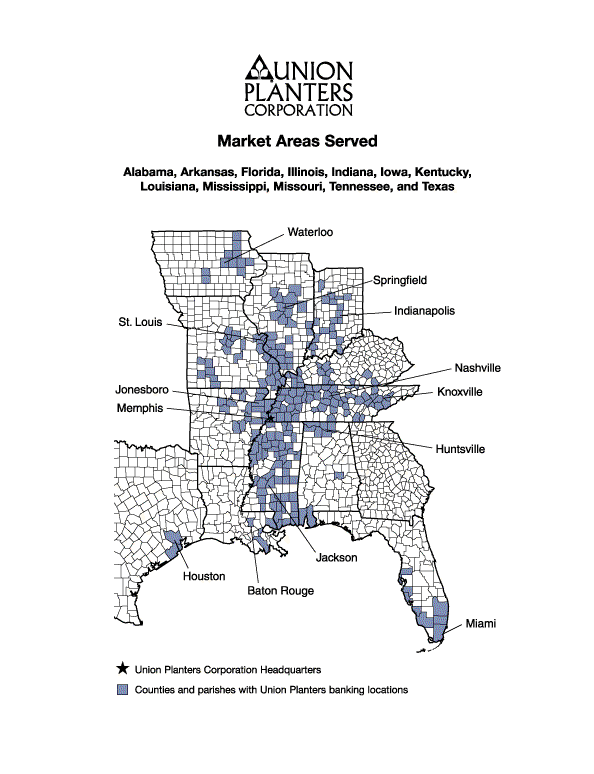
The Corporation completed 18 acquisitions in 1998 as shown in the table on page 14. The acquisitions expanded Union Planters' presence into new markets in Illinois, Indiana, Iowa, and Texas. At the same time, other acquisitions were made to enhance the Corporation's market share in existing markets. The map on the inside front cover of this report highlights the markets currently served by Union Planters. Table 3 and Note 2 to the consolidated financial statements present additional information regarding acquisitions.
Strategy. Management's philosophy has been to provide additional diversification of the revenue sources and earnings of the Corporation through the acquisition of well-managed financial institutions. This strategy generally targets in-market institutions, institutions in contiguous markets, and institutions having significant local market share. Acquisitions are sought that provide the opportunity to enhance the Corporation's product lines and provide the opportunity for new products and services. This strategy is also designed to enhance the Corporation's branch network, to lower overall distribution costs, and to leverage existing banking and operational capabilities.
Operating Philosophy. Prior to 1997, it was Union Planters' policy to acquire institutions and operate them as separate banks. Acquiring banks and allowing them to retain their name and continuing to operate on a decentralized basis was believed to provide customers the best service. This philosophy was reevaluated in 1997 due to competitive changes occurring in the banking industry. A decision was made to merge existing banking subsidiaries and newly acquired institutions into the Corporation's lead bank, Union Planters Bank.
Management continues to believe it is imperative that customer decisions should be made locally as was the past practice. Local management's primary focus is serving its customers and broad discretion is given in achieving this end. Operational functions including accounting, deposit services, item processing, mortgage servicing, and credit administration are provided on a centralized or regional basis.
The centralization of operational functions related to management's new philosophy started at the end of 1997 and is continuing. The level of acquisition activity in 1998 slowed this process and created new opportunities related to integrating the newly acquired institutions into Union Planters' systems. The centralization and integration of acquired entities is now expected to continue throughout 1999. Management expects significant cost savings to result from the centralization of operational functions.
Original cost savings estimates from consolidation of banking subsidiaries under one bank charter were estimated to be approximately $15 million to $20 million, on a pretax basis, with unquantified revenue enhancements expected. Additionally, cost savings related to the 1998 acquisitions were originally estimated in the range of 25% to 30% of the acquired institutions expenses (approximately $100 million). Overall savings are expected to be proportionally larger today because of the Corporation's 1998 acquisitions, although the exact savings cannot be quantified at this time. While it is difficult to differentiate between charter consolidation and merger cost savings from the new acquisitions, management estimates that 40% to 50% of the total savings have been achieved.
Management is currently evaluating the organization taking into account the changes that occurred in 1998 and future plans. While the savings are expected, the number of acquisitions in 1998, efforts related to Year 2000, efforts to standardize products, and other operational changes have delayed the cost savings. The total anticipated savings are not expected to be totally realized until the end of 1999 or early 2000.
Merger-Related Costs. Historically, as the Corporation acquires entities, merger-related and other charges have been incurred (see Table 1). Typically, these charges include the following:
• salaries, employee benefits, and other employment-related charges for employment contract payments, change in control agreements, early retirement and involuntary separation and related benefits, postretirement expenses, and assumed pension termination expenses of acquired entities
• write-downs of office buildings and equipment to be sold, lease buyouts, assets determined to be obsolete or no longer of use, and equipment not compatible with the Corporation's equipment
• professional fees for legal, accounting, consulting, and financial advisory services
• expenses such as asset write-offs, cancellation of vendor contracts, and other costs which normally arise from consolidation of operational activities
These charges totaled $165.3 million (net of a $829,000 gain on disposal of assets), $48.1 million, and $52.8 million in 1998, 1997, and 1996, respectively. The level of the charges is directly related to the size of the institution being acquired. In 1999, these charges are not anticipated to be as significant, unless a number of other acquisitions are announced. The pending, and now completed, acquisitions as of December 31, 1998 and the recently announced acquisition of Republic Banking Corporation in Miami, Florida, which will be accounted for using the purchase method of accounting, are not expected to generate merger-related charges that will significantly impact earnings. Additional acquisition activity during 1999 is expected to be limited. Acquisitions will only be made if the entities are Year 2000 compliant, since it is unlikely that they could be acquired and converted to Union Planters' systems by year end 1999.
In 1997 the Corporation incurred charges totaling approximately $16.7 million related to the decision to combine substantially all of its subsidiary banks under one charter. In 1998 similar charges totaling approximately $17.0 million were incurred. These charges included the following:
• employee severance payments
• write-offs of data processing equipment
• costs related to combining operations, like FHLB prepayment penalties
• costs related to implementing new technology, such as imaging
• other costs related to integrating the operations of the combined organization
In this process, technology is being upgraded and products are being standardized. Management does not expect significant charges of this type in 1999, although operating expenses are expected to be higher than normal as the integration process continues throughout 1999. The impact of the higher operating costs related to the integration cannot be quantified.
Restatement of Financial Data. Financial data for all prior years have been restated to reflect the acquisitions accounted for as poolings of interests. Purchase acquisitions have been included from their respective dates of acquisition. Reference is made to Note 2 to the consolidated financial statements for additional information regarding the acquisitions the Corporation has completed over the last three years.
Recently Completed and Pending Acquisitions. On February 22, 1999, the Corporation announced an agreement to acquire Republic Banking Corporation in Miami, Florida (Republic). Additionally, three other acquisitions pending at December 31, 1998 have been subsequently completed. The three recently completed acquisitions consist of the purchase of 56 branches, purchase of approximately $830 million of loans, and assumption of approximately $1.8 billion of deposits in Indiana (Indiana Branch Purchase); the acquisition of First Mutual Bancorp, Inc. (First Mutual); and the acquisition of First & Farmers Bancshares, Inc. (First & Farmers). Reference is made to Note 2 to the Corporation's consolidated financial statements for additional information regarding acquisitions completed subsequent to December 31, 1998 and the pending acquisition of Republic. The following table provides a pro forma summary at December 31, 1998 of the Corporation's recently completed and pending acquisitions based on currently available information. Since these acquisitions are being accounted for as purchases, the pro forma information will change due to ongoing operations between December 31, 1998 and the date of acquisition and purchase accounting adjustments at the date of acquisition.
| Union Planters –––––––– |
Indiana Branch Purchase –––––––– |
First & Farmers ––––––– |
First Mutual –––––– |
Republic Banking Corp. –––––––– |
Pro Forma Total ––––––– |
|
|---|---|---|---|---|---|---|
(Dollars in millions) |
||||||
| Loans | $ 19,577 | $ 830 | $ 183 | $290 | $1,031 | $21,911 |
| Goodwill and other intangibles | 387 | 300(a) | 50(a) | 23(a) | 250(a) | 1,010 |
| Total assets | 31,692 | 1,810 | 296(b) | 318(b) | 1,405(b) | 35,521 |
| Deposits | 24,896 | 1,810 | 274 | 312 | 1,285 | 28,577 |
| Purchase price | NA | 300 | 76 | 56 | 412 | NA |
| Equity to assets | 9.42% | — | — | — | — | 8.40% |
| Leverage ratio | 8.86 | — | — | — | — | 6.10 |
NA — Not applicable
(a) Estimated goodwill and other intangibles created by these acquisitions which will be accounted for using the purchase method of accounting.
(b) Net of cash paid or cash used for repurchase of shares.
ACQUISITIONS COMPLETED SINCE JANUARY 1, 1996
| Institution Acquired ––––––––––––––––––––––––––––––––––––––––––– |
Date ––––– |
State ––––––––––––– |
Assets –––––––––– (Millions) |
Consideration –––––––––––––––––––––––––––––– |
Accounting Method –––––––––––––– |
|||
|---|---|---|---|---|---|---|---|---|
| First Bancshares of Eastern Arkansas, Inc. | 1/96 | Arkansas | $ 64 | $ 10.9 | million in cash | Purchase | ||
| First Bancshares of N. E. Arkansas, Inc. | 1/96 | Arkansas | 65 | $ 9.2 | million in cash | Purchase | ||
| Leader Financial Corporation | 10/96 | Tennessee | 3,411 | 15.3 | million shares of common stock | Pooling | ||
| Franklin Financial Group, Inc. | 10/96 | Tennessee | 137 | .7 | million shares of common stock | Pooling | ||
| Valley Federal Savings Bank | 10/96 | Alabama | 122 | .4 | million shares of common stock | Pooling | ||
| BancAlabama, Inc. | 10/96 | Alabama | 98 | .4 | million shares of common stock | Pooling | ||
| Financial Bancshares, Inc. | 12/96 | Missouri | 326 | 1.2 | million shares of common stock | Pooling | ||
| PFIC Corporation | 2/97 | Tennessee | 4 | .1 | million shares of common stock | Purchase | ||
| SBT Bancshares, Inc. | 10/97 | Tennessee | 99 | .6 | million shares of common stock | Pooling | ||
| Citizens of Hardeman County Financial | ||||||||
| Services, Inc. | 10/97 | Tennessee | 62 | .2 | million shares of common stock | Pooling | ||
| Magna Bancorp, Inc. | 11/97 | Mississippi | 1,191 | 7.1 | million shares of common stock | Pooling | ||
| First Acadian Bancshares, Inc. | 12/97 | Louisiana | 81 | .3 | million shares of common stock | Pooling | ||
| Capital Bancorp | 12/97 | Florida | 2,156 | 6.5 | million shares of common stock | Pooling | ||
| Sho-Me Financial Corp. | 1/98 | Missouri | 374 | 1.2 | million shares of common stock | Purchase | ||
| Security Bancshares, Inc. | 4/98 | Arkansas | 146 | .5 | million shares of common stock | Pooling | ||
| Peoples First Corporation | 7/98 | Kentucky | 1,427 | 6.0 | million shares of common stock | Pooling | ||
| Magna Group, Inc. | 7/98 | Missouri | 7,683 | 33.4 | million shares of common stock | Pooling | ||
| Capital Savings Bancorp, Inc. | 7/98 | Missouri | 207 | .7 | million shares of common stock | Pooling | ||
| C B & T, Inc. | 7/98 | Tennessee | 278 | 1.4 | million shares of common stock | Pooling | ||
| Merchants Bancshares, Inc. | 7/98 | Texas | 565 | 2.0 | million shares of common stock | Pooling | ||
| First National Bancshares of Wetumpka, Inc. | 7/98 | Alabama | 202 | .8 | million shares of common stock | Pooling | ||
| Alvin Bancshares, Inc. | 8/98 | Texas | 117 | .4 | million shares of common stock | Pooling | ||
| Duck Hill Bank | 8/98 | Mississippi | 21 | — | million shares of common stock | Purchase | ||
| First Community Bancshares, Inc. | 8/98 | Tennessee | 39 | .1 | million shares of common stock | Pooling | ||
| Transflorida Bank | 8/98 | Florida | 334 | 1.7 | million shares of common stock | Pooling | ||
| AMBANC Corp. | 8/98 | Indiana | 740 | 3.4 | million shares of common stock | Pooling | ||
| Florida Branch Purchase | 9/98 | Florida | 1,389 | $110.0 | million in cash | Purchase | ||
| Ready State Bank | 12/98 | Florida | 622 | 3.2 | million shares of common stock | Pooling | ||
| Southeast Bancorp, Inc. | 12/98 | Tennessee and | 324 | 1.2 | million shares of common stock | Pooling | ||
| Kentucky | ||||||||
| FSB, Inc. | 12/98 | Tennessee | 145 | .9 | million shares of common stock | Pooling | ||
| LaPlace Bancshares, Inc. | 12/98 | Louisiana | 64 | .4 | million shares of common stock | Pooling | ||
| First Mutual Bancorp, Inc. | 1/99 | Illinois | 403 | 1.4 | million shares of common stock | Purchase | ||
| First & Farmers Bancshares, Inc. | 2/99 | Kentucky | 410 | $ 76.0 | million in cash | Purchase | ||
| Indiana Branch Purchase | 3/99 |
Indiana |
1,810 ––––––– |
$300.0 |
million in cash |
Purchase |
||
| Total assets of completed acquisitions | $ 25,116 ====== |
|||||||
EARNINGS ANALYSIS
Net Interest Income
Net interest income is comprised of interest income and loan-related fees less interest expense. Net interest income is affected by a number of factors including the level, pricing, mix, and maturity of earning assets and interest-bearing liabilities; interest rate fluctuations; and asset quality. For purposes of this discussion, net interest income is presented on a fully-taxable equivalent basis (FTE), which adjusts tax-exempt income to an amount that would yield the same after-tax income had the income been subject to taxation at the federal statutory income tax rate (currently 35% for the Corporation). Reference is made to Tables 4 and 5 that present the Corporation's average balance sheet and volume/ rate analysis for each of the three years in the period ended December 31, 1998.
Net interest income (FTE) in 1998 was $1.24 billion, an increase of 1.3% from $1.23 billion reported in 1997. In 1997, net interest income grew 7.4% from $1.14 billion in 1996. The net interest margin (net interest income (FTE) as a percentage of average earning assets) was 4.40% in 1998 compared to 4.57% in 1997 and 4.48% in 1996. The interest-rate spread between earning assets and interest-bearing liabilities was 3.60%, a decrease of 19 basis points from the 1997 spread of 3.79% and compared to 3.71% in 1996.
Interest income (FTE) increased 2.5% in 1998 due primarily to the $1.4 billion growth in average earning assets, which accounted for $106.6 million growth in interest income. Partially offsetting this increase was a decrease in the average yield on earning assets of 22 basis points, or approximately $48.2 million.
The earning asset growth is attributable to a 15.0% increase in investment securities and a 2.5% growth in average loans during 1998. The increase in investment securities is attributable to the investment of funds received in exchange for the assumption of deposit liabilities in the September 1998 Florida Branch Purchase. Offsetting the loan growth was the sale of the credit card portfolio at the beginning of the fourth quarter of 1998 (approximately $440 million of loans) and the securitization and sale of approximately $380 million of FHA/VA loans in the second quarter of 1998. The decrease in the yield on average earning assets is attributable to the lower interest rate environment in 1998.
Interest expense increased $42.6 million in 1998 to $1.11 billion. The increase is attributable to the $1.1 billion increase in average interest- bearing liabilities, primarily interest-bearing deposit liabilities assumed in the Florida Branch Purchase, which accounted for $50.0 million of the increase. Average long-term debt outstanding also increased due to the issuance of $300 million of 6.5% Putable/Callable Subordinated Notes in March 1998. Offsetting these increases was a three basis point decrease in the average rate paid on interest-bearing liabilities, which was approximately $7.4 million.
The increase in net interest income between 1997 and 1996 is attributable to growth of average earning assets of $1.3 billion, primarily loans, which accounted for $140.2 million of the increase in interest income. Partially offsetting this increase was an increase in average interest-bearing liabilities of $996.3 million, which accounted for $54.9 million of the increase in interest expense. The impact of changes in yields on earning assets and rates paid for interest-bearing liabilities was minimal.
Union Planters' net interest margin has declined steadily over the last two years. This decline is attributable to the high level of prepayments on mortgage-backed investment securities and single family mortgage loans, approximately 39% of earning assets at December 31, 1998. During this period of time, lower mortgage rates have resulted in heavy refinancing activity by borrowers. This has forced the Corporation to reinvest funds in lower yielding assets. Also impacting net interest income is the fact that the Corporation's primary funding source is its deposits. The rates paid on deposits have not decreased as fast as yields on earning assets. Management believes this downward trend will likely continue in 1999. Management is constantly evaluating ways to increase net interest income.
The effects of changing interest rates on corporate performance are more fully discussed in the "Market Risk and Asset/Liability Management" discussion beginning on page 22.
A summary of the components of average earning assets and interest-bearing liabilities is as follows:
| 1998 ––––– |
1997 ––––– |
1996 ––––– |
||||
|---|---|---|---|---|---|---|
| Average earning assets (in billions) | $28.3 | $26.9 | $25.6 | |||
| Comprised of: | ||||||
| Loans | 72% | 74% | 70% | |||
| Investment securities | 25 | 23 | 27 | |||
| Other earning assets | 3 | 3 | 3 | |||
| Yield earned on average earning assets | 8.31 | 8.53 | 8.43 | |||
| Average interest-bearing liabilities (in billions) | $23.5 | $22.4 | $21.4 | |||
| Comprised of: | ||||||
| Deposits | 85% | 84% | 84% | |||
| Short-term borrowings | 6 | 8 | 9 | |||
| FHLB advances, short- and medium-term bank notes and other long-term debt | 9 | 8 | 7 | |||
| Rate paid on average interest-bearing liabilities | 4.71 | 4.74 | 4.72 |
Provision for Losses on Loans
The provision for losses on loans (the provision) in 1998 was $204.1 million, or 1.04% of average loans, excluding FHA/VA government-insured/guaranteed loans (FHA/VA loans). The provision in 1998 was $51.0 million higher than the 1997 provision of $153.1 million, or .83% of average loans, excluding FHA/VA loans. In 1996 the provision was $86.4 million, or .52% of average loans, excluding FHA/VA loans.
The increase in the provision in 1998 is attributable primarily to banks acquired in 1998 and the December 31, 1997 acquisitions. Upon acquisition, management immediately implements a more aggressive policy of dealing with problem credits. This involves setting goals for reducing the overall level of problem credits. Loans are charged down to estimated realizable values allowing for quicker disposal of the underlying assets pledged as collateral. This policy resulted in higher provisions and higher levels of specific credit charge-offs in 1998. Banks in this group accounted for approximately 57% of the 1998 provision and approximately 53% of the net charge-offs in 1998. Also impacting the provision were provisions and charge-offs related to two asset-based credits in Capital Factors' operations which deteriorated in the fourth quarter of 1998. The provision and charge-offs related to these loans were $20 million and $13 million, respectively. One of the loans in the amount of $11.9 million is considered an impaired loan and has a specific valuation reserve of $7.0 million.
The credit card portfolio, prior to its recent sale, accounted for a large percentage of the provision and net charge-offs. In 1998, credit card provisions and net charge-offs were approximately 16% and 25%, respectively, of the total provision and charge-offs. This compares to 39% for both in 1997 and 47% and 37%, respectively, in 1996.
Management expects the provision to be lower in 1999, excluding the impact of pending acquisitions, and increases are expected only in proportion to the level of loan growth. Provisions in the range of 35 to 45 basis points on average loans are anticipated for the existing portfolio.
Noninterest Income
Noninterest income increased 20.8% in 1998 to $568.8 million compared to $470.8 million in 1997 and $404.8 million in 1996. The major components of noninterest income are presented on the face of the statement of earnings and in Note 13 to the consolidated financial statements. Table 1, which follows this discussion, presents a five year trend of the major components, including certain significant items that impact the five-year trend.
The previously mentioned sale of the credit card portfolio resulted in a gross gain of $72.7 million. The remaining portion of the sale is scheduled to settle in the first quarter of 1999 but the resulting gain will not be significant. Other asset sales included the sale of an investment by one of the acquired institutions totaling $5.4 million. The Corporation also recognized gains on the sale of branches/deposits and other selected assets totaling $4.1 million in 1998 compared to $16.3 million in 1997 and $7.5 million in 1996. In 1997, the Corporation sold several upper east Tennessee branches and deposits acquired in the acquisition of Leader Financial Corporation.
Investment securities losses totaled $9.1 million in 1998 compared to investment securities gains of $4.9 million in both 1997 and 1996. The net loss in 1998 was attributable to the premium write-down of certain high-coupon mortgage-backed securities of an acquired entity resulting from the acceleration of prepayments of the underlying loans. The loss was $22.8 million and was partially offset by a $6.0 million gain in the fourth quarter of 1998 resulting primarily from a gain recognized in connection with the contribution of certain appreciated equity securities to a charitable foundation established by Union Planters. The Corporation recognized $7.6 million of expense resulting from the contribution (see the "Noninterest Expense" discussion below).
During the second quarter of 1998, the Corporation recognized a gain of $19.6 million from the securitization and sale of approximately $380 million of FHA/VA loans. The transaction involved the sale of previously past due FHA and VA guaranteed loans serviced by UPB. Additional gains from securitizations and sales are expected in 1999. A similar securitization and sale of approximately $133 million of FHA/VA loans was completed in February 1999 resulting in a pretax gain of approximately $5.4 million. Gains on the sale of originated residential mortgages decreased $4.6 million in 1998 to $10.8 million compared to $15.4 million in 1997 and $6.8 million in 1996. In 1997, the Corporation securitized and sold approximately $300 million of fixed- and adjustable-rate mortgage securities which was the primary reason for the increase in 1997 and a similar sale did not occur in 1998.
Mortgage servicing income increased 2.6% in 1998 to $60.5 million compared to $59.0 million and $64.7 million in 1997 and 1996, respectively. The increase is due to the acquisition of additional servicing which was offset by the high level of refinancing activity in 1998 due to the low interest rate environment. Increasing in 1998 were mortgage origination fees, which increased $6.8 million in 1998, primarily related to increased loan originations due in part to the low interest rate environment in 1998 and the large number of refinancings.
Brokerage fee income (fees received from discount brokerage and full-service brokerage transactions) increased $8.9 million in 1998 to $19.0 million compared to $10.1 million and $6.0 million in 1997 and 1996, respectively. The fees are based on transaction volumes and fluctuate year to year.
Management is continuing its emphasis on fee income as a means of increasing profitability. Areas receiving emphasis are the sale of bank- eligible insurance products (annuities, homeowners and automobile insurance, and life insurance), mutual funds, mortgage servicing income, mortgage origination, and trust services. The sale of the credit card portfolio will decrease bank card income in 1999 but the net impact of the sale is expected to be positive to net earnings. Most of the bank card income relates to the Corporation's merchant business which was not sold.
Noninterest Expense
Noninterest expense increased 19.8% in 1998 to $1.2 billion compared to $1.0 billion and $987.6 million in 1997 and 1996, respectively. The components of noninterest expense are presented on the face of the statement of earnings and in Note 13 to the consolidated financial statements. Table 1, which follows this discussion, presents a five year trend on the major components of noninterest expense, including certain significant items impacting the five-year trend, including merger-related charges.
The major items increasing noninterest expense over the last three years are merger-related expenses and expenses related to consolidation of the Corporation's separate banking subsidiaries and ongoing integration of operations. These expenses totaled $183.1 million, $64.9 million, and $52.8 million in 1998, 1997, and 1996, respectively, the nature of which is discussed in the "Acquisitions" discussion above.
Salaries and employee benefits, which represent the largest category of noninterest expense, were $479.8 million in 1998, an increase of $39.3 million from 1997. Salaries and employee benefits were $413.6 million in 1996. At December 31, 1998, the Corporation had 12,330 full-time equivalent employees compared to 12,304 and 11,926, respectively, at December 31, 1997 and 1996. The increase in salaries and employee benefits expense is attributable to merit salary increases, incentive compensation, and increases in salaries and employee benefits expense related to acquisitions accounted for as purchase transactions. Additionally, employee benefit expenses increased $11.1 million related to changes in certain benefit plans.
Net occupancy and equipment expense increased $11.2 million in 1998 to $148.7 million compared to $137.5 million in 1997 and $135.9 million in 1996. The increase relates primarily to the expansion of the Corporation's operations and technology upgrades, including upgrades related to the Year 2000, within the organization. See the "Year 2000" discussion.
Other noninterest expense increased $29.6 million in 1998 over 1997 due primarily to the following items:
• $7.9 million increase in goodwill and other intangibles amortization related to purchase acquisitions
• $7.0 million increase in contributions expense related primarily to the establishment of a charitable trust
• $4.5 million increase in amortization of mortgage servicing rights
• $3.2 million related to the loss on the sale of indirect loans of an acquired institution
In addition to the items discussed above, a significant amount of management time is being spent on the continuing consolidations of bank "back office" functions, integration of recently completed acquisitions, and compliance issues related to the Year 2000. In some cases, expenses are duplicated while the conversions or integration is in progress. While this is difficult to quantify, management believes that once these projects are completed, savings in noninterest expense will be realized.
The increase in noninterest expense in 1997 is related to the merger-related and charter consolidation charges, salaries and employee benefits expense, and occupancy and equipment expenses discussed above. Excluding these three categories, noninterest expense decreased $26.5 million between 1996 and 1997. In 1996, noninterest expense included a one-time special FDIC insurance assessment of $30.0 million, write-off of intangibles of $19.6 million and an additional provision for losses on FHA/VA foreclosure claims of an acquired entity of $19.8 million. Also, FDIC insurance assessments decreased $7.5 million. These decreases were partially offset by increases in expenses related primarily to the growth of the Corporation.
Taxes
Applicable income taxes consist of provisions for federal and state income taxes totaling $146.3 million in 1998, or an effective rate of 39.3%. This compares to applicable income taxes of $176.0 million in 1997 and $153.1 million in 1996. These amounts represent effective tax rates of 34.1% and 34.3%, respectively, in 1997 and 1996. The variances from federal statutory rates (35% for all three years) are attributable to the level of tax-exempt income from investment securities and loans, nondeductible merger-related expenses, and the effect of state income taxes. The increase in the effective tax rate in 1998 is attributable to a high level of non-deductible merger-related and other expenses. For additional information regarding the Corporation's effective tax rates for all periods, see Note 15 to the consolidated financial statements.
Realization of a portion of the $160.6 million net deferred tax asset, which is included in other assets, is dependent upon the generation of future taxable income sufficient to offset future deductions. Management believes that, based upon historical earnings and anticipated future earnings, normal operations will continue to generate sufficient future taxable income to realize in full these deferred tax benefits. Therefore, no extraordinary strategies are deemed necessary by management to generate sufficient taxable income for purposes of realizing the net deferred tax asset.
FINANCIAL CONDITION ANALYSIS
At December 31, 1998, the Corporation reported total assets of $31.7 billion compared to $30.0 billion for December 31, 1997. The amounts for December 31, 1997 have been restated for acquisitions accounted for as poolings of interests. Total assets increased $13.6 billion from the originally reported total assets at December 31, 1997 due primarily to the 18 acquisitions completed in 1998. Average total assets for 1998 were $30.7 billion compared to $29.2 billion for 1997.
Earning Assets
Earning assets are composed of loans, investment securities, trading account assets, federal funds sold, securities purchased under resale agreements, and interest-bearing deposits at financial institutions. These assets are the primary revenue streams for the Corporation. At December 31, 1998, earning assets totaled $28.7 billion compared to $27.4 billion at year end 1997. Average earning assets were $28.3 billion in 1998 compared to $26.9 billion in 1997. The increase in average earning assets is attributable to loan growth and to purchase acquisitions, primarily the Florida Branch Purchase.
Investment Securities
As part of its securities portfolio management strategy, the Corporation classifies all of its investment securities as available for sale securities, which are carried on the balance sheet at fair value. This strategy gives management flexibility to actively manage the investment portfolio as market conditions and funding requirements change.
The investment securities portfolio was $8.3 billion at December 31, 1998 compared to $6.4 billion at December 31, 1997. Average investment securities were $7.2 billion and $6.3 billion, respectively, for these periods. The investment portfolio had a net unrealized gain of $93.1 million at year end 1998 compared to a net unrealized gain of $85.4 million at year end 1997.
The increase in investment securities in 1998 resulted primarily from the investment of funds received in exchange for assuming $1.4 billion of deposit liabilities in the Florida Branch Purchase. Note 4 to the consolidated financial statements presents the composition of the portfolio at December 31, 1998 and 1997, along with a breakdown of the maturities and weighted average yields of the portfolio at December 31, 1998.
U.S. Treasury and U.S. Government agency obligations represented 63.1% of the investment securities portfolio at December 31, 1998, 63.7% of which are Collateralized Mortgage Obligation (CMO) and mortgage-backed security issues. The Corporation has some credit and market risk in the investment securities portfolio; however, management does not consider that risk to be significant and does not believe that cash flows will be significantly impacted. Reference is made to the "Net Interest Income" and "Market Risk and Asset/Liability Management" discussions for information regarding the market-risk in the investment securities portfolio.
The limited credit risk in the investment securities portfolio at December 31, 1998 consisted of 16.2% municipal obligations, 2.4% other stocks and securities (primarily equity securities and Federal Reserve Bank and Federal Home Loan Bank Stock), and 18.3% investment grade CMOs.
At December 31, 1998, the Corporation had approximately $45.3 million of "structured notes" which constituted approximately .5% of its investment securities portfolio. Structured notes have uncertain cash flows which are driven by interest-rate movements and may expose a company to greater market risk than traditional medium-term notes. All of the Corporation's investments of this type are government agency issues (primarily Federal Home Loan Banks and Federal National Mortgage Association).
Loans
Loans are the largest group of earning assets of the Corporation and represented approximately 70% of earning assets at December 31, 1998. Loans at December 31, 1998 totaled $19.6 billion compared to $20.3 billion at year end 1997. Average loans were $20.5 billion in 1998, an increase of 2.5% over 1997. During the fourth quarter of 1998, the Corporation sold substantially all of its credit card portfolio, approximately $440 million of loans. The Corporation also securitized and sold approximately $380 million of previously defaulted FHA and VA loans in the second quarter of 1998. Table 7 presents a five-year summary of the composition of the loan portfolio.
The various categories of loans are subject to varying levels of risk. Management mitigates this risk through portfolio diversification and geographic diversification. The Corporation's loan portfolio is spread over the twelve states in which it has banking locations. The Corporation has a limited amount of foreign exposure, approximately 1% of the loan portfolio. The foreign loans are primarily U.S. dollar trade finance loans to correspondent banks in Central and South America and there are no significant loans to foreign governments. The largest concentration of loans is in single family residential loans, comprising 33% of the loan portfolio, which historically has had low loan loss experience. The Corporation does not have any loans to hedge funds.
Single Family Residential Loans. Single family residential loans totaled $5.6 billion at December 31, 1998 compared to $5.7 billion at December 31, 1997. The lack of growth in this sector of the portfolio reflects the high level of prepayments from refinancing activity in the low interest rate environment present in 1998. The overall decline was partially offset by single family loans from acquisitions accounted for as purchases that totaled approximately $225 million during 1998.
Commercial Loans. Commercial, financial, and agricultural loans, including foreign loans and direct lease financing, totaled $3.8 billion, or 19% of the portfolio, at December 31, 1998 which compares to $3.7 billion at December 31, 1997. The modest growth in this segment of the portfolio reflects favorable economic conditions in the markets served by the Corporation.
Other Mortgage Loans. This segment of the portfolio totaled $4.4 billion, or 22% of the portfolio at December 31, 1998. This compares to $4.2 billion at December 31, 1997. At December 31, 1998 loans for nonfarm nonresidential properties (commercial real estate) were $3.5 billion, or 80% of this category. Loans secured by multifamily residential properties and loans secured by farmland comprised 12% and 8%, respectively, of this portion of the portfolio.
Real Estate Construction Loans. These loans totaled $1.2 billion at December 31, 1998 which compares to $1.1 billion at December 31, 1997. At year end approximately 40% are single family construction loans, approximately 40% commercial construction loans, and approximately 20% are land development loans.
FHA/VA Government-Insured/Guaranteed Loans (FHA/VA Loans). The FHA/VA loans declined $572 million in 1998 to $760 million at December 31, 1998. The decrease relates partially to the securitization and sale of approximately $380 million of previously defaulted FHA/VA loans in the second quarter of 1998, for a gain of approximately $19.6 million. Management continues to purchase these loans out of its servicing portfolio. The number of past due loans at above current market rates in the servicing portfolio has significantly declined which has reduced the opportunities to increase interest income from the purchase of these loans. Additional securitizations and sales are expected in 1999.
As a loan servicer, the Corporation is obligated to pass through to the holders of a GNMA mortgage-backed security, the coupon rate, whether or not the interest due on the underlying loans has been collected from the borrower. When an FHA/VA government-insured/guaranteed single-family loan which carries an above-market rate of interest has been in default for more than 90 days, it is the Corporation's policy to buy the delinquent FHA/VA loan out of the GNMA pools serviced by the Corporation. This action eliminates the Corporation's obligation to pay the coupon rate. The Corporation thereby earns the net interest-rate differential between the coupon rate which it would otherwise be obligated to pay to the GNMA holder and the Corporation's lower cost of funds. Furthermore, management has purchased in prior years additional delinquent FHA/VA government-insured/guaranteed loans from other GNMA servicers to leverage the operating costs of this operation.
Since all of these loans are FHA/VA government-insured/guaranteed loans, the Corporation's investment is expected to be recoverable through claims made against the FHA or the VA. Management believes the credit risk and the risk of principal loss is minimal. For this reason, management has excluded these loans from the credit quality data and resulting ratios. Any losses incurred would not be significantly greater or less than if the Corporation had continued solely as servicer of the FHA/VA loans. The risk involving these loans arises from not complying timely with FHA/VA's foreclosure process and certain non-reimbursable foreclosure costs.
The Corporation, by purchasing the delinquent FHA/VA loans, also assumes the interest-rate risk associated with funding a loan if timely foreclosure should not occur. Risk also exists, under certain circumstances, that claims might be rejected by FHA or VA or otherwise not be able to be collected in full. FHA/VA claims receivables totaled $126.2 million at December 31, 1998 compared to $134.1 million at December 31, 1997.
Provisions for losses related to the claims are provided through noninterest expense as provisions for losses on FHA/VA foreclosure claims (see the "Noninterest Expense" discussion) and the corresponding liability is carried in other liabilities. Provisions for losses on FHA/VA foreclosure claims totaled $4.7 million, $8.0 million, and $25.5 million, respectively, in 1998, 1997, and 1996. At December 31, 1998, the Corporation had a reserve for FHA/VA claims losses of $27.5 million as compared to $33.3 million at December 31, 1997.
Consumer Loans. This segment of the loan portfolio totaled $2.7 billion at December 31, 1998, or 14% of the portfolio. Consumer loans to individuals totaled $2.6 billion at year end compared to $2.7 billion at year end 1997. Credit card and related loans (lines of credit related to checking accounts) totaled $96 million at December 31, 1998 compared to $617 million at December 31, 1997. During the fourth quarter of 1998 the Corporation sold substantially all of the credit card portfolio, approximately $440 million of loans. A small portion of the sale will settle in the first quarter of 1999.
Home Equity Loans. These loans totaled $483 million at December 31, 1998 compared to $453 million at December 31, 1997. These loans are revolving, open-ended single-family residential loans that consumers use for various purposes.
Accounts Receivable - Factoring. This category of the portfolio totaled $616 million at December 31, 1998, an increase of $37 million from the December 31, 1997 total of $579 million. Capital Factors, a separate subsidiary of Union Planters Bank, provides factoring and other specialized commercial financial services to small- and medium-size companies. Capital Factors purchases accounts receivable from its clients pursuant to factoring agreements with them. Its clients primarily include manufacturers, importers, wholesalers and distributors in the apparel and textile-related industries and, to a lesser extent, in consumer goods-related industries. More recently, Capital Factors has provided services to companies in the healthcare industry. Also included in this category are asset-based loans which are collateralized primarily by receivables owned by the borrowers.
Loan Outlook. Management expects modest loan growth in 1999 as the markets served by the Corporation generally have a good economic outlook. Reference is made to the discussion at the beginning of this report regarding the economic conditions in the various markets.
Allowance for Losses On Loans
The allowance for losses on loans (the allowance) at December 31, 1998 was $321.5 million, or 1.71% of loans, compared to $324.5 million, or 1.71% of loans, at December 31, 1997. In calculating the allowance to loans ratio, FHA/VA loans have been excluded (see "FHA/VA Government-Insured/Guaranteed Loans" discussion above). Management's policy is to maintain the allowance at a level deemed sufficient to absorb estimated losses inherent in the loan portfolio. The allowance is reviewed quarterly in accordance with the methodology described in Note 1 to the consolidated financial statements. Tables 8 and 10, which follow this discussion, provide detailed information regarding the allowance for each of the five years in the period ended December 31, 1998.
Net charge-offs were $186.3 million in 1998 compared to $116.3 million in 1997 and $77.4 million in 1996. The $70.0 million increase in net charge-offs relates primarily to institutions the Corporation acquired in 1998 and the December 31, 1997 acquisitions and to one asset-based loan discussed earlier (see the "Provision for Losses on Loans" discussion). Union Planters' policies for charging off loans and dealing with problem credits is generally more aggressive than the practice of the acquired entities. Approximately 53% of the charge-offs in 1998 related to these institutions. Credit card related charge-offs totaled $50.7 million in 1998 compared to $52.2 million in 1997. With the sale of this portfolio, credit card charge-offs in 1999 should be minimal.
Nonperforming Assets
Loans Other than FHA/VA Loans. Nonperforming assets consist of nonaccrual loans, restructured loans, and foreclosed properties less specific valuation allowances. Table 9 presents nonperforming assets in two categories, FHA/VA loans and all other loans. For this discussion and for the credit quality information presented in this annual report, FHA/VA loans are excluded from the calculations because of their minimal exposure to principal loss. (Reference is made to the discussion of "FHA/VA Government-Insured/Guaranteed Loans" above.)
At December 31, 1998, nonperforming assets totaled $182.6 million, or .97% of loans and foreclosed properties. This compares to $191.1 million, or 1.01% of loans and foreclosed properties at December 31, 1997. Nonaccrual loans at year end 1998 totaled $150.4 million, or .80% of total loans which compares to $138.9 million, or .73% of total loans for the same period in 1997. Restructured loans decreased $9.6 million in 1998 to $5.6 million. The decrease relates primarily to two loans which were removed from restructured status since they had been and are currently paying in accordance with contractual terms of the restructuring and had effective interest rates, at the time of modification, equal to or greater than new loans with comparable risk. Foreclosed properties were $26.6 million and $37.0 million, respectively, at December 31, 1998 and 1997. Loans past due 90 days or more and still accruing interest, which are not included in nonperforming assets, were $48.6 million, or .26% of loans at December 31, 1998. This compares to $51.1 million, or .27%, of loans at December 31, 1997. A breakdown of nonaccrual loans and loans past due 90 days or more and still accruing interest, both excluding FHA/VA loans, follows:
| Nonaccrual Loans ––––––––––––––––––– December 31, ––––––––––––––––––– |
Loans Past Due 90 Days or More ––––––––––––––––– December 31, ––––––––––––––––– |
|||
|---|---|---|---|---|
| Loan Type ––––––––––––––––––––––––––––––––––––––––––––––––––––––––– |
1998 –––––––– |
1997 –––––––– |
1998 ––––––– |
1997 ––––––– |
| (Dollars in thousands) | ||||
| Secured by single family residential | $ 73,433 | $ 67,747 | $12,991 | $15,784 |
| Secured by nonfarm nonresidential | 25,242 | 15,415 | 8,193 | 4,458 |
| Other secured real estate | 17,616 | 19,676 | 5,387 | 4,395 |
| Commercial, financial, and agricultural, including foreign loans and direct lease financing |
26,831 | 27,267 | 15,041 | 4,754 |
| Credit card and related plans | 58 | 2 | 2,044 | 15,351 |
| Other consumer | 7,198 –––––––– |
8,789 –––––––– |
4,970 ––––––– |
6,386 ––––––– |
| Total | $150,378 ======= |
$138,896 ======= |
$48,626 ====== |
$51,128 ====== |
FHA/VA Loans. As discussed in the "Loans" section of this report, FHA/VA loans do not, in management's opinion, have traditional credit risk similar to the rest of the loan portfolio and risk of principal loss is considered minimal due to the government-guarantee. FHA/VA loans past due 90 days or more and still accruing interest totaled $355.1 million at December 31, 1998 compared to $517.1 million at December 31, 1997. The decrease in the loans past due relates to the decline in the volume of these loans. At December 31, 1998 and 1997, $9.2 million and $14.9 million, respectively, of FHA/VA loans were placed on nonaccrual status by management because the contractual payment of interest by FHA/VA had stopped due to missed filing dates; however, no loss of principal is expected from these loans.
Potential Problem Assets. Potential problem assets consist of assets which are generally secured and are not currently considered nonperforming and include those assets where information about possible credit problems has raised serious doubts as to the ability of the borrowers to comply with present repayment terms. Historically, such assets have been loans which have ultimately become nonperforming. At December 31, 1998, the Corporation had potential problem assets (all loans) aggregating $66.8 million, comprised of 52 loans, the largest of which was $18.9 million.
Other Earning Assets
Other earning assets include interest-bearing deposits at financial institutions, federal funds sold, securities purchased under agreements to resell, and trading account assets. These assets averaged $587 million, or 3% of average earning assets, in 1998 with an average yield of 5.93%. This compares to $609 million in 1997 with a 6.13% average yield and $687 million in 1996 with an average yield of 5.95%. Trading account assets, the largest category, are comprised of government-guaranteed SBA pools and the government-guaranteed portion of SBA loans. Management considers these assets to have minimal interest-rate and credit risk. Trading account assets fluctuate depending on market conditions and demand. The other categories fluctuate depending on funding needs and investment opportunities.
Deposits
The Corporation's deposit base is its primary source of liquidity and consists of deposits from the communities served by the Corporation. The mix of deposits has remained relatively constant with a slight decrease in the other time deposit category, which is attributable to consumers seeking higher yielding investment opportunities. Tables 4 and 6 present the components of the Corporation's average deposits. Note 8 to the consolidated financial statements presents the maturities of interest-bearing deposits at December 31, 1998.
Deposits were $24.9 billion at December 31, 1998 and averaged $23.6 billion for the year. This compares to period end and average deposits for 1997 of $22.9 billion and $22.2 billion, respectively. The increase in deposits in 1998 was due primarily to the Florida Branch Purchase in which the Corporation acquired 26 branches and assumed deposit liabilities of approximately $1.4 billion.
The composition of average deposits over the last three years was as follows:
| 1998 –––– |
1997 –––– |
1996 –––– |
||||
|---|---|---|---|---|---|---|
| Noninterest-bearing deposits | 15% | 15% | 14% | |||
| Money market deposits | 13 | 13 | 14 | |||
| Savings deposits | 19 | 19 | 19 | |||
| Other time deposits | 41 | 42 | 43 | |||
| Certificates of deposit of | ||||||
| $100,000 and over | 12 | 11 | 10 |
Capital and Dividends
Shareholders' equity increased 3.8% in 1998 to $3.0 billion, or 9.42% of total assets. This compares to shareholders' equity of $2.9 billion, or 9.59% of total assets at December 31, 1997. Union Planters has consistently maintained regulatory capital ratios above the "well capitalized" standard. Table 13, the consolidated statement of changes in shareholders' equity, and Note 12 to the consolidated financial statements present further information regarding the Corporation's capital adequacy and changes in shareholders' equity.
The Corporation and its subsidiaries must comply with the capital guidelines established by the regulatory agencies that supervise their operations. These agencies have adopted a system to monitor the capital adequacy of all insured financial institutions. The system includes ratios based on the risk-weighting of on- and off-balance-sheet transactions. At December 31, 1998 the Corporation's Tier 1 and Total risk-weighted capital ratios were 13.34% and 16.78%, respectively. The leverage ratio (Tier 1 capital divided by unweighted average quarterly total assets) was 8.86%. These ratios decreased from December 31, 1997, due primarily to the Florida Branch Purchase which increased total assets approximately $1.4 billion with no capital being issued. Also, the intangibles resulting from this purchase and the other purchase acquisitions completed in 1998 are deducted from Tier 1 capital, which in turn reduces the ratios. This purchase, the acquisitions completed subsequent to December 31, 1998, and the pending acquisition of Republic will employ the Corporation's excess capital, which is expected to improve overall profitability returns.
The increase in the total risk-weighted capital ratio resulted from UPB's issuance of $300 million of 6.50% Putable/Callable Subordinated notes due 2018, which qualified as Tier 2 capital. All of the Corporation's banking subsidiaries met the regulatory requirements for "well capitalized" at December 31, 1998.
The Corporation declared cash dividends on its common stock of $2.00 per share in 1998, an increase of 34% over the 1997 amount of $1.495 per share. In January 1999, a regular quarterly dividend was declared, $.50 per share ($2.00 per share annualized). The Corporation also declared and paid cash dividends on its 8% Series E Convertible Preferred Stock of $2.00 per share in both 1998 and 1997. Management's goal is to maintain a dividend pay-out ratio in the range of 40% to 60% of net earnings.
The primary sources for payment of dividends by the Corporation to its shareholders are dividends received from its subsidiaries, interest on loans to subsidiaries, and interest on its available for sale investment securities. Payment of dividends by the Corporation's banking subsidiaries is subject to various statutory limitations which are described in Note 12 to the consolidated financial statements. Reference is made to the "Liquidity" discussion for additional information regarding the parent company's liquidity.
Market Risk and Asset/Liability Management
The Corporation's assets and liabilities are principally financial in nature and the resulting earnings thereon, primarily net interest income, are subject to change as a result of changes in market interest rates and the mix of the various assets and liabilities. Interest rates in the financial markets affect the Corporation's decisions on pricing its assets and liabilities which impacts net interest income, the Corporation's primary cash flow stream. As a result, a substantial part of the Corporation's risk-management activities are devoted to managing interest-rate risk. Currently, the Corporation does not have any significant risks related to foreign exchange, commodities or equity risk exposures.
Interest-Rate Risk. One of the most important aspects of management's efforts to sustain long-term profitability for the Corporation is the management of interest-rate risk. Management's goal is to maximize net interest income within acceptable levels of interest-rate risk and liquidity. To achieve this goal, a proper balance must be maintained between assets and liabilities with respect to size, maturity, repricing date, rate of return, and degree of risk. Reference is made to the "Investment Securities," "Loans," and "Other Earning Assets" discussions for additional information regarding the risks related to these items.
The Corporation, on a limited basis, has used off-balance-sheet financial instruments to manage interest-rate risk. At December 31, 1998 and 1997, the Corporation had a limited number of such instruments, primarily those used in its mortgage operations to hedge loans held for sale.
The Corporation's Funds Management Committee oversees the conduct of global asset/ liability and interest-rate risk management. The Committee reviews the asset/liability structure and interest-rate risk reports on a quarterly basis.
The Corporation uses interest-rate sensitivity analysis (GAP analysis) to monitor the amounts and timing of balances exposed to changes in interest rates, as shown in Table 11. The analysis presented in Table 11 has been made at a point in time and could change significantly on a daily basis.
In addition to GAP analysis, the Corporation uses other methods such as simulation analysis in evaluating interest-rate risk. The key assumptions used in simulation analysis include the following:
• prepayment rates on mortgage related assets
• cash flow and maturities of financial instruments held for purposes other than trading
• changes in volumes and pricing
• deposit sensitivity
• management's capital plans
The assumptions are inherently uncertain and, as a result, the simulation cannot precisely estimate net interest income or precisely predict the impact of higher or lower interest rates on net interest income. Actual results will differ from simulated results due to timing, magnitude, and frequency of interest rate changes and changes in market conditions and management strategies.
At December 31, 1998, the GAP analysis indicated that the Corporation was asset sensitive with $693 million more assets than liabilities repricing within one year. At 2% of total assets, this position is within management's policy not to exceed 10% of total assets.
Balance sheet simulation analysis was conducted at year end to determine the impact on net interest income for the coming twelve months under several interest-rate scenarios. One such scenario uses rates at December 31, 1998, and holds the rates and volumes constant for simulation. When this position is subjected to immediate and parallel shifts in interest rates ("rate shock") of 200 basis points rising and 200 basis points falling, the annual impact on the Corporation's net interest income is a negative $2.0 million and a negative $24.5 million pretax, respectively. Another simulation using a "most likely" scenario of interest rates remaining level for the next twelve months results in a $7.9 million pretax increase in net interest income from the constant rate/volume projection. These scenarios are within the Corporation's policy limit of 5% of shareholders' equity.
Prior year comparative GAP analysis and rate simulation have not been presented because management does not believe the information would be meaningful. With the number of acquisitions completed in 1998, the prior year data would not be comparable due to the differences in strategy employed by the institutions prior to being acquired by the Corporation. Once acquired, the institution's asset/liability strategy is changed to be consistent with Union Planters. Also impacting the comparability of data between 1997 and 1998 is the consolidation of a majority of the Corporation's banking subsidiaries into one bank which changed the structure of the balance sheet.
Liquidity. Liquidity for the Corporation is its ability to meet cash requirements for deposit withdrawals, to make new loans and satisfy loan commitments, to take advantage of attractive investment opportunities, and to repay borrowings when they mature. As discussed previously, the Corporation's primary sources of liquidity are its deposit base, available for sale securities, and money-market investments. Liquidity is also achieved through short-term borrowings, borrowing under available lines of credit, and issuance of securities and debt instruments in the financial markets.
Note 9 to the consolidated financial statements presents information regarding the various types of borrowings the Corporation uses to provide liquidity. In December 1998, Union Planters Bank enhanced its existing Bank Note Program to provide access to additional funding. The Bank Note Program was increased from $1 billion to $5 billion and it now provides for issuance of senior notes as well as subordinated bank notes.
Parent company liquidity is achieved and maintained by dividends received from subsidiaries, interest on advances to subsidiaries, and interest on the available for sale investment securities portfolio. At December 31, 1998, the parent company had cash and cash equivalents totaling $315.6 million. The parent company's net working capital position at December 31, 1998 was $358.2 million.
At January 1, 1999, the parent company could have received dividends from subsidiaries of $193 million without prior regulatory approval. The payment of additional dividends by the Corporation's subsidiaries will be dependent on the future earnings of the subsidiaries. Management believes that the parent company has adequate liquidity to meet its cash needs, including the payment of its regular dividends, servicing of its debt, and cash needed for acquisitions.
Fair Value of Financial Instruments
The disclosures regarding the fair value of financial instruments are included in Note 19 to the consolidated financial statements along with a summary of the methods and assumptions used by the Corporation in determining fair value. The differences between the fair values and book values were primarily caused by differences between contractual and market interest rates at the respective year ends. Fluctuations in the fair values will occur from period to period due to changes in the composition of the balance sheet and changes in market interest rates.
Fourth Quarters Results
Net earnings for the fourth quarter of 1998 were $27.6 million, or $.19 per diluted share, compared to $40.1 million, or $.29 per diluted share in the fourth quarter of 1997. Table 14 presents selected quarterly financial data for 1998 and 1997. The significant items impacting results for both years were merger-related and other significant charges and the provision for losses on loans, partially offset by gains from the sale of assets.
The significant items impacting fourth quarter results in 1998 and 1997 are as follows:
| Three Months Ended December 31, ––––––––––––––––––––– |
||
|---|---|---|
| 1998 –––––– |
1997 –––––– |
|
| (Dollars in millions) | ||
| Gross gains on sale of assets, including investment securities gains | $ 80.0 | $ .3 |
| Merger-related charges and charges related to
previously acquired banks |
(61.6) | (42.7) |
| Charter consolidation expenses and other charges
related to ongoing integration of operations |
(8.9) | (16.6) |
| Charges related to employee benefit plan changes | (11.1) |
— |
| Other charges, net | (15.9) –––––– |
— –––––– |
| Total | $(17.5) ===== |
$(59.0) ===== |
Net interest income on a taxable-equivalent basis was $306.7 million for the fourth quarter of 1998 compared to $314.2 million for the same period in 1997. The net interest margin was 4.24% in 1998 compared to 4.55% in 1997. The decrease in net interest income related to the sale of the credit card portfolio, to declining interest rates, and to earning assets repricing more rapidly than interest-bearing liabilities.
The provision for losses on loans was $76.6 million for the fourth quarter of 1998 compared to $47.0 million in 1997. Most of the increase related to two asset-based loans that deteriorated during the quarter. Institutions acquired during the year had higher provisions as they provided for losses related to Union Planters more aggressive policy of dealing with problem credits. (See the "Provision for Losses on Loans" discussion above.)
Noninterest income increased $76.4 million to $197.8 million for the fourth quarter of 1998. The increase related to the sale of Union Planters' credit card portfolio which resulted in a gross gain of $72.7 million. Also increasing noninterest income were investment securities gains of $6.0 million which related to gains on equity securities contributed to a charitable foundation, and gains on sale of branches and deposits of $1.3 million. Noninterest expenses were impacted primarily by merger-related and other significant charges and the changes related to employee benefit plans identified above. The other charges in the table above included contribution expense of $7.6 million and a loss on the sale of loans of $3.2 million.
Year 2000
In February 1997, Union Planters initiated the formal process of addressing the potential problems associated with the Year 2000. The process involved identifying and remediating date recognition problems in computer systems and software and other equipment that could be caused by the date change from December 31, 1999 to January 1, 2000 and beyond. The Corporation's project reviewed both potential internal and external problems. The potential problem could affect a wide variety of automated systems such as mainframe applications, personal computers, communication systems, public utilities, and other information systems routinely used in all industries.
A senior-level committee, which reports periodically to the Board of Directors, was formed to oversee the project and a separate department was formed to coordinate the Corporation's efforts. A respected outside consulting firm was also engaged to provide support to the Corporation's efforts. The Corporation's efforts are being conducted in accordance with Federal Financial Institutions Examination Council (FFIEC) guidelines. The Federal Reserve and OCC, which are Union Planters primary regulators, include a review of the risk assessment and contingency plans in their quarterly examination of Union Planters Year 2000 preparedness.
Management has completed its assessment of business processes that could be affected by the Year 2000. The assessment involved a complete inventory of Union Planters' information technology structure related to the main computer system operations, interfaces, ancillary computer hardware and software, and the involvement of third parties. The assessment covered all electronic devices used by the Corporation that may be affected by the change in date to the Year 2000.
A summary of the critical dates for completion of various aspects of the Corporation's process and their status as of March 10, 1999 follows:
• September 30, 1997 — Identify mission critical applications and prepare action plans for Year 2000 compliance (Complete)
• June 30, 1998 — Develop written testing strategies and plans (Complete)
• September 1, 1998 — Commence testing of internal mission critical systems, including those programmed in-house and purchased software (Complete)
• September 30, 1998 — Begin development of Year 2000 Business Resumption Plan (Complete)
• December 31, 1998 — In-house code enhancements and revisions, hardware upgrades, and other associated changes are substantially complete. For mission critical applications, programming changes should be largely complete and testing well underway (99% complete)
• March 31, 1999 — Third-party vendor testing of mission critical systems should be substantially complete (95% complete)
• June 30, 1999 — Testing of mission critical systems should be complete and implementation should be substantially complete (95% complete)
• June 30, 1999 — Year 2000 Business Resumption Plan should be complete (80% complete)
As of March 10, 1999, 95% of all required unit-specific testing of the Corporation's several systems had been completed (including systems of pending and newly acquired institutions) and each system was found to be Year 2000 compliant. All new acquisitions are scheduled for conversion to Union Planters standard hardware and software systems, generally within six months of acquisition. As a contingency to the conversion, the institution is required to continue its date-forward testing and Union Planters also includes them in its existing plans for compliance. All financial institutions are required to be compliant by June 30, 1999, and the Corporation will not enter into an agreement to acquire an institution if the FFIEC guidelines cannot be met as required. All pending or newly acquired acquisitions are expected to be compliant by June 30, 1999. Integration testing of the communication links that permit the systems to interface with one another is 75% complete.
The Corporation uses a vendor-provided system as its "core" banking applications software to process data pertaining to its demand deposits, savings accounts, CDs and other deposits; certain loans; and like items. This core system was certified Year 2000 compliant in April 1998, has been successfully tested, and the Corporation is now operating on the Year 2000 compliant system.
Notwithstanding the foregoing, the Corporation continues to bear some risk arising from the advent of the Year 2000. There are three major risks that could result in a material adverse impact to the Corporation. First, the inability of the Corporation's systems to process data and information; inability to complete transactions; failure of time locks and security systems; inability to meet customers demands for currency; and the inability to process electronic transactions for the Corporation and its customers. Management believes this scenario to be unlikely. The second major risk is that one of the planned conversions of a subsidiary bank to the Corporation's system would be incomplete and that entity would not be Year 2000 compliant. The Corporation has, as of March 10, 1999, 12 acquired entities operating on their own systems that are scheduled to be converted to the Corporation's systems in 1999 (total assets of approximately $4.3 billion). Management believes the planned conversion schedule will be met and contingency plans have been developed, including ensuring Year 2000 compliance on the entity's existing systems. The last major risk category deals with risks associated with external parties including a shutdown of voice and data communication systems due to failure by systems, satellites or telephone companies; excessive cash withdrawal activities; ATM failures; cash courier delays or non-availability; problems with international accounts or offices, including inaccurate or delayed information or inaccessibility to data; and government facilities or utility companies not opening or operating.
The Corporation is developing business resumption contingency plans (80% complete) in three broad categories. The first set of contingency plans, which has been completed, is for all critical applications that are not currently Year 2000 compliant and tested, even though it is expected that these applications will be compliant on schedule. The second set of contingency plans will address any Year 2000 related failures of critical applications after they have been fully tested and put into production. Although there is a low probability that a fully compliant and tested application will have a Year 2000 related failure, it is deemed prudent to have a contingency plan in place. The third and final set of contingency plans will address other disruptions, some of which are beyond the control of the Corporation. Some examples would be disruption of utilities such as power, water, or telecommunications. Also included in this category would be any major hardware failures that would require processing to be moved to a disaster recovery alternate site. The Corporation's Business Resumption Plan does cover most of the potential disruptions in this category, and the appropriate sections from that plan will be incorporated into the Year 2000 contingency plan.
With a view to identifying and minimizing the Year 2000 risks related to the Corporation's loan customers, an evaluation of the Year 2000 preparedness of the Corporation's major customers was conducted. Credit relationships were reviewed based on their size and were assigned a risk assessment code of low, medium or high risk. As of December 31, 1998, 64% of the credit relationships had been rated, with 24% being medium risk relationships and 1% identified as high risk relationships. An additional 10% of the portfolio is scheduled to be rated, of which 74% are relationships under $500,000, 22% are relationships of $500,000 to $2 million and 4% are relationships over $2 million. If loan customers are not prepared for Year 2000 and their operations are adversely impacted, their ability to meet their obligations to the Corporation will be impacted which could have an adverse impact on the Corporation.
The Corporation's acquisition strategy will be impacted by Year 2000. Only institutions that are Year 2000 compliant, or expected to be compliant, will be acquired in 1999 since it is unlikely there will be sufficient time to convert the institutions to Union Planters' systems before Year 2000. Banking organizations whose Year 2000 readiness is in less than satisfactory condition are undergoing special scrutiny with acquisitions requiring regulatory approval, and may not be eligible to use expedited application procedures for acquisition transactions.
The total cost of the Year 2000 project is estimated to be $750,000 to achieve Year 2000 compliance with respect to its data processing systems, approximately 70% of which has been expended. The total cost does not include the cost of internal personnel time working on the project since these costs are not tracked separately. Also, the costs do not include an estimated $3.8 million of costs of computer hardware scheduled to be replaced in the normal course of business.
Table 1. Summary of Consolidated Results
| Years Ended December 31, ––––––––––––––––––––––––––––––––––––––––––––––––––––––– |
|||||
|---|---|---|---|---|---|
| 1998 ––––––––––– |
1997 ––––––––––– |
1996 ––––––––––– |
1995 –––––––––– |
1994 –––––––––– |
|
| (Dollars in thousands) | |||||
| Interest income | $ 2,314,381 | $ 2,264,485 | $ 2,126,230 | $1,908,150 | $1,597,866 |
| Interest expense | (1,107,148) ––––––––– |
(1,064,586) ––––––––– |
(1,011,241) ––––––––– |
(897,649) ––––––––– |
(654,258) ––––––––– |
| Net interest income | 1,207,233 | 1,199,899 | 1,114,989 | 1,010,501 | 943,608 |
| Provision for losses on loans | (204,056) ––––––––– |
(153,100) ––––––––– |
(86,381) ––––––––– |
(50,696) ––––––––– |
(25,007) ––––––––– |
| Net interest income after provision for losses on loans |
1,003,177 | 1,046,799 | 1,028,608 | 959,805 | 918,601 |
| Noninterest income Service charges on deposit accounts |
156,445 | 157,256 | 152,942 | 145,343 | 121,889 |
| Mortgage servicing income | 60,478 | 58,972 | 64,713 | 57,176 | 53,687 |
| Bank card income | 38,562 | 39,497 | 31,866 | 27,234 | 16,611 |
| Factoring commissions | 30,630 | 30,140 | 26,066 | 19,519 | 17,371 |
| Trust service income | 24,116 | 24,029 | 20,351 | 18,937 | 19,184 |
| Profits and commissions from trading | 5,402 | 7,323 | 5,768 | 12,364 | 5,073 |
| Other income | 159,562 ––––––––– |
132,356 ––––––––– |
89,348 ––––––––– |
88,474 ––––––––– |
76,647 ––––––––– |
| Total noninterest income | 475,195 ––––––––– |
449,573 ––––––––– |
391,054 ––––––––– |
369,047 ––––––––– |
310,462 ––––––––– |
| Noninterest expense Salaries and employee benefits |
468,675 | 440,511 | 413,640 | 393,818 | 388,102 |
| Net occupancy expense | 75,974 | 74,750 | 75,331 | 71,899 | 68,456 |
| Equipment expense | 72,718 | 62,736 | 60,531 | 56,620 | 51,609 |
| Other expense | 374,252 ––––––––– |
354,572 ––––––––– |
315,907 ––––––––– |
326,931 ––––––––– |
318,737 ––––––––– |
| Total noninterest expense | 991,619 ––––––––– |
932,569 ––––––––– |
865,409 ––––––––– |
849,268 ––––––––– |
826,904 ––––––––– |
| Earnings before other operating items and income taxes |
486,753 | 563,803 | 554,253 | 479,584 | 402,159 |
| Merger-related charges and other significant items Net gain on sale of the credit card portfolio |
70,100 | — | — | — | — |
| Gain on securitization and sale of loans |
19,605 | — | — | — | — |
| Net gain (loss) on sales of branches and other selected assets |
6,345 | 16,290 | 7,511 | 1,925 | (15) |
| Investment securities gains (losses) | (9,074) |
4,888 | 4,934 | 2,288 | (21,398) |
| Merger-related expenses, net | (165,263) | (48,112) | (52,786) | (12,114) | (15,123) |
| Charter consolidation and other charges related to ongoing integration of operations |
(16,990) | (16,742) | — | — | — |
| Expenses related to employee benefit plan changes |
(11,090) | — | — | — | — |
| Contribution of equity securities to a charitable foundation |
(7,609) | — | — | — | — |
| Restructuring charges | — | — | — | — | (28,929) |
| Consumer loan marketing program expenses |
— | — | — | — | (14,446) |
| Special regulatory assessment to recapitalize the SAIF |
— | — | (30,044) | — | — |
| Write-off of mortgage servicing rights, goodwill, and other intangibles |
(1,800) | (2,778) | (19,579) | — | — |
| Additional provisions for losses on FHA/VA foreclosure claims of acquired entity |
— | — | (19,800) | — | — |
| Other, net | 945 ––––––––– |
(1,500) ––––––––– |
1,268 ––––––––– |
(146) ––––––––– |
2,192 ––––––––– |
| Earnings before income taxes |
371,922 | 515,849 | 445,757 | 471,537 | 324,440 |
| Applicable income taxes | 146,316 ––––––––– |
176,014 ––––––––– |
153,055 ––––––––– |
156,718 ––––––––– |
103,193 ––––––––– |
| Net earnings | $ 225,606 ======== |
$ 339,835 ======== |
$ 292,702 ======== |
$ 314,819 ======== |
$ 221,247 ======== |
| Net earnings | $ 225,606 | $ 339,835 | $ 292,702 | $ 314,819 | $ 221,247 |
| Merger-related charges and other significant items, net of taxes |
98,971 | 32,241 | 71,607 | 5,311 | 51,295 |
| Goodwill and other intangibles amortization, net of taxes |
|
20,400 ––––––––– |
16,924 ––––––––– |
16,373 ––––––––– |
16,313 ––––––––– |
| Earnings before merger-related charges, other significant items, and goodwill and other intangibles amortization, net of taxes |
$ 351,866 ======== |
$ 392,476 ======== |
$ 381,233 ======== |
$ 336,503 ======== |
$ 288,855 ======== |
Table 2. Contribution to Diluted Earnings Per Share
| Years Ended December 31, ––––––––––––––––––––––––––––––––––––––––– |
|||||
|---|---|---|---|---|---|
| 1998 –––––––– |
1997 –––––––– |
1996 –––––––– |
1995 –––––––– |
1994 –––––––– |
|
| Net interest income — FTE | $ 8.72 | $ 8.89 | $ 8.58 | $ 8.18 | $ 7.83 |
| Provision for losses on loans | (1.43) ––––––– |
(1.11) ––––––– |
(0.65) ––––––– |
(0.40) ––––––– |
(0.20) ––––––– |
| Net interest income after provision for losses on loans — FTE |
7.29 | 7.78 | 7.93 | 7.78 | 7.63 |
| Noninterest income Service charges on deposit accounts |
1.10 | 1.14 | 1.15 | 1.14 | 0.98 |
| Mortgage servicing income | 0.42 | 0.43 | 0.48 | 0.45 | 0.43 |
| Bank card income | 0.27 | 0.29 | 0.24 | 0.21 | 0.13 |
| Factoring commissions | 0.21 | 0.22 | 0.20 | 0.15 | 0.14 |
| Trust service income | 0.17 | 0.17 | 0.16 | 0.15 | 0.15 |
| Profits and commissions from trading activities | 0.04 | 0.05 | 0.04 | 0.10 | 0.04 |
| Investment securities gains (losses) | (0.06) | 0.04 | 0.04 | 0.02 | (0.17) |
| Other income | 1.84 ––––––– |
1.08 ––––––– |
0.73 ––––––– |
0.71 ––––––– |
0.64 ––––––– |
| Total noninterest income | 3.99 ––––––– |
3.42 ––––––– |
3.04 ––––––– |
2.93 ––––––– |
2.34 ––––––– |
| Noninterest expense Salaries and employee benefits |
3.36 | 3.19 | 3.10 | 3.09 | 3.11 |
| Net occupancy expense | 0.53 | 0.54 | 0.56 | 0.56 | 0.55 |
| Equipment expense | 0.51 | 0.45 | 0.45 | 0.44 | 0.44 |
| Other expense | 4.01 ––––––– |
3.07 ––––––– |
3.28 ––––––– |
2.67 ––––––– |
3.00 ––––––– |
| Total noninterest expense | 8.41 ––––––– |
7.25 ––––––– |
7.39 ––––––– |
6.76 ––––––– |
7.10 ––––––– |
| Earnings before income taxes — FTE |
2.87 | 3.95 | 3.58 | 3.95 | 2.87 |
| Applicable income taxes — FTE | 1.29 ––––––– |
1.48 ––––––– |
1.37 ––––––– |
1.47 ––––––– |
1.09 ––––––– |
| Net earnings | 1.58 | 2.47 | 2.21 | 2.48 | 1.78 |
| Less preferred stock dividends | — ––––––– |
— ––––––– |
— ––––––– |
(0.01) ––––––– |
(0.02) ––––––– |
| Diluted earnings per share | $ 1.58 ====== |
$ 2.47 ====== |
$ 2.21 ====== |
$ 2.47 ====== |
$ 1.76 ====== |
| Change in net earnings applicable to diluted earnings per share using previous year average shares outstanding |
$ (0.84) | $ 0.35 | $ (0.14) | $ 0.76 | $ (0.00) |
| Change in average shares outstanding | (0.05) ––––––– |
(0.09) ––––––– |
(0.12) ––––––– |
(0.05) ––––––– |
(0.32) ––––––– |
| Change in net earnings | $ (0.89) ====== |
$ 0.26 ====== |
$ (0.26) ====== |
$ 0.71 ====== |
$ (0.32) ====== |
| Average diluted shares (in thousands) | 142,693 ====== |
138,220 ====== |
133,452 ====== |
127,416 ====== |
124,730 ====== |
FTE — Fully taxable-equivalent
Table 3. Balance Sheet Impact of Acquisitions
| 1998 –––––––––––––––––––––––––––––––––––––––––––––––––––– |
1997 Total –––––––– |
1996 Total ––––––––– |
|||||
|---|---|---|---|---|---|---|---|
| Magna –––––––––– |
Peoples –––––––––– |
Ambanc –––––––– |
Others –––––––––– |
Total ––––––––––– |
|||
| (Dollars in thousands) | |||||||
| Assets Interest-bearing deposits at financial institutions |
$ 22 | $ 569 | $ 216 | $ 7,397 | $ 8,204 | $ 41,573 | $ 2,781 |
| Loans, net of unearned income |
4,500,786 | 1,109,384 | 566,654 | 2,214,560 | 8,391,384 | 2,651,579 | 2,735,487 |
| Allowance for losses on loans |
(64,669) ––––––––– |
(16,265) ––––––––– |
(8,291) –––––––– |
(42,346) ––––––––– |
(131,571) –––––––––– |
(49,797) ––––––––– |
(38,124) ––––––––– |
| Net loans | 4,436,117 | 1,093,119 | 558,363 | 2,172,214 | 8,259,813 | 2,601,782 | 2,697,363 |
| Investment securities |
2,544,718 | 249,203 | 100,193 | 772,632 | 3,666,746 | 395,550 | 1,048,886 |
| Intangible assets | 166,842 | 11,459 | 2,263 | 146,261 | 326,825 | 15,274 | 62,341 |
| Cash and cash equivalents |
241,845 | 35,891 | 49,321 | 1,593,556 | 1,920,613 | 338,978 | 110,430 |
| Other real estate, net |
1,641 | 646 | 702 | 7,151 | 10,140 | 11,990 | 2,484 |
| Premises and equipment |
117,339 | 19,818 | 11,657 | 64,377 | 213,191 | 64,734 | 39,306 |
| Other assets | 174,772 ––––––––– |
16,761 ––––––––– |
17,321 –––––––– |
62,575 ––––––––– |
271,429 –––––––––– |
122,418 ––––––––– |
259,954 ––––––––– |
| Total assets |
$7,683,296 ======== |
$1,427,466 ======== |
$740,036 ======= |
$4,826,163 ======== |
$14,676,961 ========= |
$3,592,299 ======== |
$4,223,545 ======== |
| Liabilities Deposits |
$5,796,507 | $1,193,172 | $626,989 | $4,226,383 | $11,843,051 | $2,392,854 | $2,408,296 |
| Other interest-bearing liabilities |
1,186,998 | 71,774 | 26,345 | 172,354 | 1,457,471 | 571,774 | 1,403,195 |
| Other liabilities | 56,904 ––––––––– |
11,318 ––––––––– |
11,580 –––––––– |
59,781 ––––––––– |
139,583 –––––––––– |
327,940 ––––––––– |
82,074 ––––––––– |
| Total liabilities |
$7,040,409 ======== |
$1,276,264 ======== |
$664,914 ======= |
$4,458,518 ======== |
$13,440,105 ========= |
$3,292,568 ======== |
$3,893,565 ======== |
| Purchase price/capital contribution/equity |
$ 642,887 ======= |
$ 151,202 ======= |
$ 75,122 ====== |
$ 367,645 ======= |
$ 1,236,856 ======== |
$ 299,731 ======= |
$ 329,980 ======= |
Table 4. Average Balance Sheet and Average Interest Rates
| Years Ended December 31, ––––––––––––––––––––––––––––––––––––––––––––––––––––––––––––––––––––––––––––––––––––––––––––––– |
|||||||||
|---|---|---|---|---|---|---|---|---|---|
| 1998 ––––––––––––––––––––––––––––––– |
1997 –––––––––––––––––––––––––––––– |
1996 ––––––––––––––––––––––––––––––––– |
|||||||
| Average Balance ––––––––––– |
Interest Income/ Expense –––––––––– |
FTE Yield/ Rate ––––––– |
Average Balance ––––––––––– |
Interest Income/ Expense –––––––––– |
FTE Yield/ Rate ––––––– |
Average Balance ––––––––––– |
Interest Income/ Expense –––––––––– |
FTE Yield/ Rate ––––––– |
|
| (Dollars in thousands) | |||||||||
| ASSETS Interest-bearing deposits at financial institutions |
$ 36,131 | $ 1,807 | 5.00% | $ 63,671 | $ 3,207 | 5.04% | $ 38,727 | $ 2,278 | 5.88% |
| Federal funds sold and securities purchased under agreements to resell |
327,630 | 18,823 | 5.75 | 340,231 | 19,149 | 5.63 | 455,552 | 24,702 | 5.42 |
| Trading account assets |
223,122 | 14,197 | 6.36 | 204,765 | 14,956 | 7.30 | 192,856 | 13,895 | 7.20 |
| Investment securities(1)(2) Taxable securities |
6,102,670 | 373,934 | 6.13 | 5,336,847 | 348,247 | 6.53 | 6,119,315 | 395,777 | 6.47 |
| Tax-exempt securities |
|
90,352 | 8.11 |
937,539 | 76,733 | 8.18 | 867,446 | 76,409 | 8.81 |
| –––––––––– | ––––––––– | –––––––––– | –––––––––– | –––––––––– | ––––––––– | ||||
| Total investment securities |
7,217,180 | 464,286 | 6.43 | 6,274,386 | 424,980 | 6.77 | 6,986,761 | 472,186 | 6.76 |
| Loans, net of unearned income(1)(3)(4) |
20,498,773 |
1,852,569 | 9.04 | 19,992,626 | 1,830,965 | 9.16 | 17,888,375 | 1,642,361 | 9.18 |
| –––––––––– | ––––––––– | –––––––––– | –––––––––– | –––––––––– | ––––––––– | ||||
| Total | |||||||||
| earning | |||||||||
| assets(1)(2)(3)(4) | 28,302,836 | 2,351,682 | 8.31 | 26,875,679 | 2,293,257 | 8.53 | 25,562,271 | 2,155,422 | 8.43 |
| Cash and due from banks |
951,819 | 926,586 | 905,925 | ||||||
| Premises and equipment |
544,024 | 514,306 | 488,948 | ||||||
| Allowance for losses on loans |
(334,304) |
(284,131) |
(271,070) |
||||||
| Other assets | 1,279,951 –––––––––– |
1,156,365 –––––––––– |
924,189 –––––––––– |
||||||
| Total assets |
$30,744,326 ========= |
$29,188,805 ========= |
$27,610,263 ========= |
||||||
| LIABILITIES AND SHAREHOLDERS' EQUITY Money market accounts |
$ 3,128,028 | $ 122,081 | 3.90% | $ 2,908,405 | $ 106,066 | 3.65% | $ 2,876,970 | $ 98,507 | 3.42% |
| Savings deposits |
4,524,807 | 96,061 | 2.12 | 4,201,403 | 97,825 | 2.33 | 3,980,936 | 94,497 | 2.37 |
| Certificates of deposit of $100,000 and over |
2,810,295 | 163,415 | 5.81 | 2,545,210 | 145,357 | 5.71 | 2,123,133 | 121,775 | 5.74 |
| Other time deposits |
9,525,197 | 514,505 | 5.40 | 9,239,875 | 504,673 | 5.46 | 8,977,580 | 495,801 | 5.52 |
| Short-term borrowings |
1,516,496 | 79,415 | 5.24 | 1,607,145 | 81,780 | 5.09 | 1,818,811 | 95,362 | 5.24 |
| Short-term bank notes |
— | — | — | 119,493 | 6,973 | 5.84 | 88,361 | 5,136 | 5.81 |
| Long-term debt Federal Home Loan Bank advances |
907,689 | 47,979 | 5.29 | 1,011,275 | 60,972 | 6.03 | 1,062,584 | 61,761 | 5.81 |
| Subordinated capital notes |
419,789 | 28,249 | 6.73 | 197,569 | 14,229 | 7.20 | 240,807 | 18,551 | 7.70 |
| Medium-term bank notes |
123,986 | 8,252 | 6.66 | 135,000 | 8,943 | 6.62 | 42,637 | 2,801 | 6.57 |
| Trust Preferred Securities |
198,991 | 16,511 | 8.30 | 198,956 | 16,511 | 8.30 | 10,871 | 872 | 8.02 |
| Other | 352,541 –––––––––– |
30,680 ––––––––– |
8.70 |
272,511 –––––––––– |
21,257 –––––––––– |
7.80 |
217,805 –––––––––– |
16,178 ––––––––– |
7.43 |
| Total interest-bearing liabilities |
23,507,819 | 1,107,148 | 4.71 | 22,436,842 | 1,064,586 | 4.74 | 21,440,495 | 1,011,241 | 4.72 |
| Noninterest-bearing demand deposits |
3,594,978 –––––––––– |
— ––––––––– |
3,328,821 –––––––––– |
— –––––––––– |
3,085,490 –––––––––– |
— ––––––––– |
|||
| Total sources of funds |
27,102,797 | 1,107,148 | 25,765,663 | 1,064,586 | 24,525,985 | 1,011,241 | |||
| Other liabilities |
709,826 | 667,933 | 666,365 | ||||||
| Shareholders' equity Preferred stock |
32,331 | 66,188 | 87,991 | ||||||
| Common equity | 2,899,372 –––––––––– |
2,689,021 –––––––––– |
2,329,922 –––––––––– |
||||||
| Total shareholders' equity |
2,931,703 –––––––––– |
2,755,209 –––––––––– |
2,417,913 –––––––––– |
||||||
| Total liabilities and shareholders' equity |
$30,744,326 ========= |
$29,188,805 ========= |
$27,610,263 ========= |
||||||
| Net interest income(1) |
$1,244,534 ======== |
$1,228,671 ========= |
$1,144,181 ======== |
||||||
| Interest rate spread(1) |
3.60% ====== |
3.79% ====== |
3.71% ====== |
||||||
| Net interest margin(1) |
4.40% ====== |
4.57% ====== |
4.48% ====== |
||||||
| Taxable-equivalent adjustments Loans |
$ 10,144 | $ 5,160 | $ 5,303 | ||||||
| Investment securities |
27,157 ––––––––– |
23,612 –––––––––– |
23,889 ––––––––– |
||||||
| Total | $ 37,301 ======== |
$ 28,772 ========= |
$ 29,192 ======== |
||||||
(1) Fully taxable-equivalent yields are calculated assuming a 35% Federal income tax rate.
(2) Yields are calculated on historical cost and exclude the impact of the unrealized gain (loss) on available for sale securities.
(3) Includes loan fees in both interest income and the calculation of the yield on loans.
(4) Includes loans on nonaccrual status.
Table 5. Analysis of Volume and Rate Change
| 1998 versus 1997 ––––––––––––––––––––––––––– |
1997 versus 1996 ––––––––––––––––––––––––– |
|||||
|---|---|---|---|---|---|---|
| Increase (Decrease) Due to Change in:(1) ––––––––––––––––– |
Total Increase (Decrease) –––––––– |
Increase (Decrease) Due to Change in:(1) ––––––––––––––– |
Total Increase (Decrease) ––––––– |
|||
| Average Volume –––––––– |
Average Rate –––––––– |
Average Volume –––––––– |
Average Rate ––––––– |
|||
| (Dollars in thousands) | ||||||
| Interest income Interest-bearing deposits at financial institutions |
$ (1,377) | $ (23) | $ (1,400) | $ 1,294 | $ (365) | $ 929 |
| Federal funds sold and securities purchased under agreements to resell |
(719) | 393 | (326) | (6,460) | 907 | (5,553) |
| Trading account assets | 1,270 | (2,029) | (759) | 868 | 193 | 1,061 |
| Investment securities — FTE | 61,454 | (22,148) | 39,306 | (48,249) | 1,043 | (47,206) |
| Loans, net of unearned income — FTE |
45,952 ––––––– |
(24,348) ––––––– |
21,604 ––––––– |
192,722 ––––––– |
(4,118) –––––– |
188,604 ––––––– |
| Total interest income — FTE |
106,580 ––––––– |
(48,155) ––––––– |
58,425 ––––––– |
140,175 ––––––– |
(2,340) –––––– |
137,835 ––––––– |
| Interest expense Money market accounts |
8,300 | 7,715 | 16,015 | 1,086 | 6,473 | 7,559 |
| Savings deposits | 7,221 | (8,985) | (1,764) | 5,159 | (1,831) | 3,328 |
| Certificates of deposit of $100,000 and over |
15,373 | 2,685 | 18,058 | 24,107 | (525) | 23,582 |
| Other time deposits | 15,457 | (5,625) |
9,832 | 14,369 | (5,497) | 8,872 |
| Short-term borrowings | (10,978) | 1,640 | (9,338) | (9,328) | (2,417) | (11,745) |
| Long-term debt | 14,655 ––––––– |
(4,896) ––––––– |
9,759 ––––––– |
19,543 ––––––– |
2,206 –––––– |
21,749 ––––––– |
| Total interest expense | 50,028 ––––––– |
(7,466) ––––––– |
42,562 ––––––– |
54,936 ––––––– |
(1,591) –––––– |
53,345 ––––––– |
| Change in net interest income — FTE |
$ 56,552 ====== |
$(40,689) ====== |
$ 15,863 ====== |
$ 85,239 ====== |
$ (749) ===== |
$ 84,490 ====== |
| Percentage increase in net interest income (FTE) over prior period |
1.29% ====== |
7.38% ====== |
||||
FTE — Fully taxable-equivalent
(1) The change due to both rate and volume has been allocated to change due to volume and change due to rate in proportion to the relationship of the absolute dollar amounts of the change in each.
Table 6. Average Deposits (1)
| Years Ended December 31, ––––––––––––––––––––––––––––––––––––––––––––––––––––––––––– |
|||||
|---|---|---|---|---|---|
| 1998 ––––––––––– |
1997 ––––––––––– |
1996 ––––––––––– |
1995 ––––––––––– |
1994 ––––––––––– |
|
| (Dollars in thousands) | |||||
| Noninterest-bearing demand | $ 3,594,978 | $ 3,328,821 | $ 3,085,490 | $ 2,900,790 | $ 2,814,865 |
| Money market(2) | 3,128,028 | 2,908,405 | 2,876,970 | 2,674,304 | 2,929,287 |
| Savings(3) | 4,524,807 | 4,201,403 | 3,980,936 | 3,901,681 | 4,081,390 |
| Other time(4) | 9,525,197 –––––––––– |
9,239,875 –––––––––– |
8,977,580 –––––––––– |
8,445,621 –––––––––– |
7,626,517 –––––––––– |
| Total average core deposits | 20,773,010 | 19,678,504 | 18,920,976 | 17,922,396 | 17,452,059 |
| Certificates of deposit of $100,000 and over |
2,810,295 –––––––––– |
2,545,210 –––––––––– |
2,123,133 –––––––––– |
1,724,245 –––––––––– |
1,445,671 –––––––––– |
| Total average deposits | $23,583,305 ========= |
$22,223,714 ========= |
$21,044,109 ========= |
$19,646,641 ========= |
$18,897,730 ========= |
(1) Table 4 presents the average rate paid on the above deposit categories for the three years in the period ended December 31, 1998.
(2) Includes money market savings accounts and super NOW accounts.
(3) Includes regular savings accounts, NOW accounts, and premium savings accounts.
(4) Includes certificates of deposit of less than $100,000, investment savings deposits, IRAs, and Holiday accounts.
Table 7. Composition of the Loan Portfolio
| December 31, ––––––––––––––––––––––––––––––––––––––––––––––––––––––––– |
|||||
|---|---|---|---|---|---|
| 1998 ––––––––––– |
1997 ––––––––––– |
1996 ––––––––––– |
1995 ––––––––––– |
1994 ––––––––––– |
|
| (Dollars in thousands) | |||||
| Commercial, financial, and agricultural |
$ 3,543,925 | $ 3,397,348 | $ 3,078,268 | $ 2,993,409 | $ 2,797,533 |
| Foreign | 197,120 | 208,081 | 145,483 | 127,623 | 115,316 |
| Accounts receivable — factoring | 615,952 | 579,067 | 452,522 | 319,487 | 247,135 |
| Real estate — construction | 1,195,779 | 1,074,279 | 865,031 | 768,872 | 658,231 |
| Real estate — mortgage Secured by 1-4 family residential |
5,647,520 | 5,704,490 | 5,531,747 | 5,183,332 | 5,015,674 |
| FHA/VA government-insured/guaranteed | 759,911 | 1,331,993 | 1,569,027 | 1,006,397 | 744,891 |
| Other mortgage | 4,386,182 | 4,226,944 | 3,455,693 | 2,938,334 | 2,762,206 |
| Home equity | 482,665 | 452,870 | 365,945 | 328,961 | 297,158 |
| Consumer Credit cards and related plans |
96,091 | 617,113 | 700,584 | 490,919 | 346,235 |
| Other consumer | 2,622,402 | 2,685,845 | 2,631,352 | 2,452,983 | 2,252,080 |
| Direct lease financing | 63,621 –––––––––– |
66,039 –––––––––– |
75,218 –––––––––– |
77,333 –––––––––– |
52,957 –––––––––– |
| Total loans | 19,611,168 | 20,344,069 | 18,870,870 | 16,687,650 | 15,289,416 |
| Less: Unearned income | (34,342) –––––––––– |
(41,100) –––––––––– |
(59,429) –––––––––– |
(73,619) –––––––––– |
(81,482) –––––––––– |
| Total loans, net of unearned income |
$19,576,826 ========= |
$20,302,969 ========= |
$18,811,441 ========= |
$16,614,031 ========= |
$15,207,934 ========= |
Table 8. Allocation of the Allowance for Losses on Loans by
Category of Loans
and the Percentage of Loans by Category to Total Loans Outstanding
| December 31, –––––––––––––––––––––––––––––––––––––––––––––––––––––––––––––––––––––––––––––––––––––––––––––––––––––––––––– |
||||||||||
|---|---|---|---|---|---|---|---|---|---|---|
| 1998 ––––––––––––––––––––– |
1997 ––––––––––––––––––––– |
1996 ––––––––––––––––––––– |
1995 ––––––––––––––––––––– |
1994 ––––––––––––––––––––– |
||||||
| Amount –––––––– |
Percentage of Loans to Total Loans ––––––––––– |
Amount –––––––– |
Percentage of Loans to Total Loans ––––––––––– |
Amount –––––––– |
Percentage of Loans to Total Loans ––––––––––– |
Amount –––––––– |
Percentage of Loans to Total Loans ––––––––––– |
Amount –––––––– |
Percentage of Loans to Total Loans ––––––––––– |
|
| (Dollars in thousands) | ||||||||||
| Commercial, financial, and agricultural |
$ 86,275 | 22% | $ 77,618 | 21% | $ 59,372 | 21% | $ 69,236 | 21% | $ 73,383 | 21% |
| Foreign | 3,500 | 1 | 3,150 | 1 | 1,300 | 1 | 1,400 | 1 | 300 | 1 |
| Real estate — construction |
19,672 | 6 | 14,079 | 6 | 10,092 | 5 | 11,755 | 5 | 9,864 | 4 |
| Real estate — mortgage |
|
|
129,573 |
52 |
119,878 |
52 |
101,750 |
52 |
108,255 |
54 |
| Consumer | 50,043 | 17 | 99,129 | 20 | 78,806 | 21 | 69,767 | 21 | 56,148 | 20 |
| Direct lease financing |
1,258 –––––––– |
— ––––––– |
925 –––––––– |
— ––– |
991 –––––––– |
— ––– |
1,195 –––––––– |
— ––– |
532 –––––––– |
— ––– |
| Total | $321,476 ======= |
100% ====== |
$324,474 ======= |
100% ====== |
$270,439 ======= |
100% ====== |
$255,103 ======= |
100% === |
$248,482 ======= |
100% === |
The allocation of the allowance is presented based in part on evaluations of specific loans, past history, and economic conditions within specific industries or geographic areas. Since all of these factors are subject to change, the current allocation of the allowance is not necessarily indicative of the breakdown of future losses. No portion of the allowance for losses on loans has been allocated to FHA/VA government-insured/guaranteed loans since they represent minimal credit risk.
Table 9. Nonaccrual, Restructured, and Past Due Loans and Foreclosed Properties
| December 31, ––––––––––––––––––––––––––––––––––––––––––– |
|||||
|---|---|---|---|---|---|
| 1998 –––––––– |
1997 –––––––– |
1996 –––––––– |
1995 –––––––– |
1994 –––––––– |
|
| (Dollars in thousands) | |||||
| Nonaccrual loans Domestic |
$150,378 | $138,800 | $118,791 | $106,601 | $ 89,696 |
| Foreign | — | 96 | 96 | 2,072 | 334 |
| Restructured loans | 5,612 –––––––– |
15,250 –––––––– |
17,097 –––––––– |
14,656 –––––––– |
20,289 –––––––– |
| Total nonperforming loans | 155,990 –––––––– |
154,146 –––––––– |
135,984 –––––––– |
123,329 –––––––– |
110,319 –––––––– |
| Foreclosed properties Other real estate, net |
23,937 | 31,914 | 40,680 | 35,598 | 46,015 |
| Other foreclosed properties | 2,670 –––––––– |
5,062 –––––––– |
2,167 –––––––– |
2,823 –––––––– |
693 –––––––– |
| Total foreclosed properties | 26,607 –––––––– |
36,976 –––––––– |
42,847 –––––––– |
38,421 –––––––– |
46,708 –––––––– |
| Total nonperforming assets | $182,597 ======= |
$191,122 ======= |
$178,831 ======= |
$161,750 ======= |
$157,027 ======= |
| Loans past due 90 days or more and still
accruing interest Domestic |
$ 48,626 | $ 51,128 | $ 45,467 | $ 34,540 | $ 22,633 |
| Foreign | — –––––––– |
— –––––––– |
— –––––––– |
— –––––––– |
1,500 –––––––– |
| Total loans past due 90 days or more | $ 48,626 ======= |
$ 51,128 ======= |
$ 45,467 ======= |
$ 34,540 ======= |
$ 24,133 ======= |
| FHA/VA government-insured/guaranteed loans Loans past due 90 days or more and still accruing interest |
$355,124 | $517,124 | $724,691 | $558,038 | $282,523 |
| Nonaccrual | 9,232 | 14,933 | 77 | 404 | — |
Table 10. Allowance For Losses on Loans
| Years Ended December 31, ––––––––––––––––––––––––––––––––––––––––––––––––––––––––––– |
|||||
|---|---|---|---|---|---|
| 1998 ––––––––––– |
1997 ––––––––––– |
1996 ––––––––––– |
1995 ––––––––––– |
1994 ––––––––––– |
|
| (Dollars in thousands) | |||||
| Balance at beginning of period | $ 324,474 | $ 270,439 | $ 255,103 | $ 248,482 | $ 239,502 |
| Loans charged off Commercial, financial, and agricultural |
65,815 | 41,881 | 24,045 | 21,540 | 16,794 |
| Foreign | 1,831 | — | 3,391 | 743 | 6,893 |
| Real estate — construction | 3,714 | 400 | 765 | 529 | 498 |
| Real estate — mortgage | 28,654 | 10,618 | 10,245 | 12,881 | 13,957 |
| Consumer | 64,435 | 35,425 | 30,081 | 20,196 | 14,539 |
| Credit cards and related plans | 50,723 | 52,177 | 30,542 | 15,082 | 3,659 |
| Direct lease financing | 125 –––––––––– |
30 –––––––––– |
48 –––––––––– |
52 –––––––––– |
6 –––––––––– |
| Total charge-offs | 215,297 –––––––––– |
140,531 –––––––––– |
99,117 –––––––––– |
71,023 –––––––––– |
56,346 –––––––––– |
| Recoveries on loans previously charged off Commercial, financial, and agricultural |
8,931 | 8,259 | 8,569 | 9,263 | 13,292 |
| Foreign | 20 | 10 | — | 1,632 | 1,523 |
| Real estate — construction | 310 | 546 | 64 | 557 | 939 |
| Real estate — mortgage | 5,825 | 3,620 | 3,555 | 4,449 | 5,212 |
| Consumer | 9,812 | 4,916 | 7,350 | 6,374 | 6,290 |
| Credit cards and related plans | 4,113 | 6,903 | 2,209 | 1,122 | 937 |
| Direct lease financing | 5 –––––––––– |
27 –––––––––– |
4 –––––––––– |
52 –––––––––– |
133 –––––––––– |
| Total recoveries | 29,016 –––––––––– |
24,281 –––––––––– |
21,751 –––––––––– |
23,449 –––––––––– |
28,326 –––––––––– |
| Net charge-offs | (186,281) | (116,250) | (77,366) | (47,574) | (28,020) |
| Provisions charged to expense | 204,056 | 153,100 | 86,381 | 50,696 | 25,007 |
| Allowance related to the sale of certain loans |
(36,693) | — | (1,628) | — | — |
| Increase due to acquisitions | 15,920 –––––––––– |
17,185 –––––––––– |
7,949 –––––––––– |
3,499 –––––––––– |
11,993 –––––––––– |
| Balance at end of period | $ 321,476 ========= |
$ 324,474 ========= |
$ 270,439 ========= |
$ 255,103 ========= |
$ 248,482 ========= |
| Total loans, net of unearned income, at end of period |
$19,576,826 | $20,302,969 | $18,811,441 | $16,614,031 | $15,207,934 |
| Less: FHA/VA government- insured/guaranteed loans |
759,911 –––––––––– |
1,331,993 –––––––––– |
1,569,027 –––––––––– |
1,006,397 –––––––––– |
744,891 –––––––––– |
| Loans used to calculate ratios |
$18,816,915 ========= |
$18,970,976 ========= |
$17,242,414 ========= |
$15,607,634 ========= |
$14,463,043 ========= |
| Average total loans, net of unearned income, during period |
$20,498,773 | $19,992,626 | $17,888,375 | $16,162,983 | $13,956,994 |
| Less: Average FHA/VA government- insured/guaranteed loans |
958,921 –––––––––– |
1,500,120 –––––––––– |
1,300,065 –––––––––– |
881,082 –––––––––– |
603,181 –––––––––– |
| Average loans used to calculate ratios |
$19,539,852 ========= |
$18,492,506 ========= |
$16,588,310 ========= |
$15,281,901 ========= |
$13,353,813 ========= |
| Credit Quality Ratios(1) Allowance at end of period to loans, net of unearned income |
1.71% | 1.71% | 1.57% | 1.63% | 1.72% |
| Allowance at end of period to average loans, net of unearned income |
1.65 | 1.75 | 1.63 | 1.67 | 1.86 |
| Allowance for losses on loans as a percentage of nonperforming loans |
206 | 210 | 199 | 207 | 225 |
| Net charge-offs to average loans, net of unearned income |
.95 | .63 | .47 | .31 | .21 |
| Provision to average loans, net of unearned income |
1.04 | .83 | .52 | .33 | .19 |
| Nonperforming loans as a percentage of loans |
.83 | .81 | .79 | .79 | .76 |
| Nonperforming assets as a percentage of loans plus foreclosed properties |
.97 | 1.01 | 1.03 | 1.03 | 1.08 |
| Loans past due 90 days or more and still accruing interest as a percentage of loans |
.26 | .27 | .26 | .22 | .17 |
(1) Ratio calculations exclude FHA/VA government-insured/guaranteed loans since they represent minimal credit risk to the Corporation. See the "Loans" discussion for additional information regarding the FHA/VA government-insured/guaranteed loans and Table 9 for the detail of nonperforming assets.
Table 11. Rate Sensitivity Analysis at December 31, 1998
| Interest-Sensitive Within (1) (7) –––––––––––––––––––––––––––––––––––––––––––––––––––––––––––––––––––––––––– |
|||||||||
|---|---|---|---|---|---|---|---|---|---|
| 0-90 | 91-180 | 181-365 | 1-3 | 3-5 | 5-15 | Over | Noninterest- | ||
| Days –––––– |
Days ––––––– |
Days ––––––– |
Years –––––– |
Years –––––– |
Years –––––– |
15 Years –––––––– |
Bearing –––––––––––– |
Total ––––––– |
|
| (Dollars in millions) | |||||||||
| Assets Loans and leases(2)(3)(4) |
$7,401 | $1,876 | $3,155 | $4,448 | $1,806 | $ 617 | $ 17 | $ 291 | $19,611 |
| Investment securities(5)(6) |
1,454 | 554 | 1,074 | 2,899 | 1,059 | 890 | 372 | — | 8,302 |
| Other earning assets |
787 | 57 | 15 | 1 | — | — | — | — | 860 |
| Other assets | — –––––– |
— –––––– |
— –––––– |
— –––––– |
— –––––– |
— –––––– |
— ––––– |
2,919 –––––– |
2,919 ––––––– |
| Total assets |
$9,642 ===== |
$2,487 ===== |
$4,244 ===== |
$7,348 ===== |
$2,865 ===== |
$1,507 ===== |
$ 389 ==== |
$ 3,210 ===== |
$31,692 ====== |
| Sources of funds Money market deposits(7)(8) |
$1,189 | $ — | $1,189 | $1,592 | $ — | $ — | $ — | $ — | $ 3,970 |
| Other savings and time deposits |
4,064 | 2,018 | 2,776 | 3,421 | 296 | 1,538 | 4 | — | 14,117 |
| Certificates of deposit of $100,000 and over |
953 | 504 | 664 | 448 | 43 | 3 | — | — | 2,615 |
| Short-term borrowings |
1,634 | 3 | 10 | 1 | — | — | — | — | 1,648 |
| Short and medium- term bank notes |
— | — | 45 | 60 | — | — | — | — | 105 |
| Federal Home Loan Bank advances |
269 | — | 2 | 5 | 3 | 1 | — | — | 280 |
| Other long-term debt |
358 | 1 | 1 | 13 | 80 | 100 | 501 | — | 1,054 |
| Noninterest-bearing deposits |
— | — | — | — | — | — | — | 4,194 | 4,194 |
| Other liabilities | — | — | — | — | — | — | — | 725 | 725 |
| Shareholders' equity |
— –––––– |
— –––––– |
— –––––– |
— –––––– |
— –––––– |
— –––––– |
— ––––– |
2,984 –––––– |
2,984 ––––––– |
| Total sources of funds |
$8,467 ===== |
$2,526 ===== |
$4,687 ===== |
$5,540 ===== |
$ 422 ===== |
$1,642 ===== |
$ 505 ==== |
$ 7,903 ===== |
$31,692 ====== |
| Interest-rate sensitivity gap |
$1,175 | $ (39) | $ (443) | $1,808 | $2,443 | $ (135) | $ (116) | $ (4,693) | |
| Cumulative interest-rate sensitivity gap(8) |
1,175 | 1,136 | 693 | 2,501 | 4,944 | 4,809 | 4,693 | — | |
| Cumulative gap as a percentage of total assets(8) |
4% | 4% | 2% | 8% | 16% | 15% | 15% | —% | |
Management has made the following assumptions in presenting the above analysis:
(1) Assets and liabilities are generally scheduled according to their earliest repricing dates regardless of their contractual maturities.
(2) Nonaccrual loans and accounts receivable-factoring are included in the noninterest-bearing category.
(3) Fixed-rate mortgage loan maturities are estimated based on the currently prevailing principal prepayment patterns of comparable mortgage-backed securities.
(4) Delinquent FHA/VA loans are scheduled based on foreclosure and repayment patterns.
(5) The scheduled maturities of mortgage-backed securities and CMOs assume principal prepayment of these securities on dates estimated by management, relying primarily upon current and consensus interest-rate forecasts in conjunction with the latest three-month historical prepayment schedules.
(6) Securities are generally scheduled according to their call dates when valued at a premium to par.
(7) Money market deposits and savings deposits that have no contractual maturities are scheduled according to management's best estimate of their repricing in response to changes in market rates. The impact of changes in market rates would be expected to vary by product type and market.
(8) If all money market, NOW, and savings deposits had been included in the 0-90 Days category, the cumulative gap as a percentage of total assets would have been negative (14%), (15%), and (12%) for the 0-90 Days, 91-180 Days, and 181-365 Days categories and positive 3%, 11%, 15%,and 15%, respectively, for the 1-3 Years, 3-5 Years, 5-15 Years, and over 15 Years categories at December 31, 1998.
Table 12. Investment Securities and Other Earning Assets
| December 31, –––––––––––––––––––––––––––––––– |
|||
|---|---|---|---|
| 1998 –––––––––– |
1997 –––––––––– |
1996 –––––––––– |
|
| (Dollars in thousands) | |||
| U.S. Government obligations U.S. Treasury |
$ 396,287 | $1,160,451 | $1,368,463 |
| U.S. Government agencies | 4,842,792 ––––––––– |
3,752,796 ––––––––– |
3,461,333 ––––––––– |
| Total U.S. Government obligations | 5,239,079 | 4,913,247 | 4,829,796 |
| Obligations of states and political subdivisions | 1,345,666 | 1,033,944 | 873,384 |
| Other investment securities | 1,716,958 ––––––––– |
467,006 ––––––––– |
482,519 ––––––––– |
| Total investment securities | 8,301,703 | 6,414,197 | 6,185,699 |
| Interest-bearing deposits at financial institutions | 47,583 | 38,128 | 31,040 |
| Federal funds sold and securities purchased under
agreements to resell |
94,568 | 265,890 | 311,306 |
| Trading account assets | 275,992 | 187,419 | 260,266 |
| Loans held for resale | 441,214 ––––––––– |
175,699 ––––––––– |
113,604 ––––––––– |
| Total investment securities and other earning assets | $9,161,060 ======== |
$7,081,333 ======== |
$6,901,915 ======== |
Table 13. Risk-Based Capital
| December 31, ––––––––––––––––––––––––––––––––––– |
|||
|---|---|---|---|
| 1998 ––––––––––– |
1997 ––––––––––– |
1996 ––––––––––– |
|
| (Dollars in thousands) | |||
| Tier 1 capital Shareholders' equity |
$ 2,984,078 | $ 2,874,473 | $ 2,557,117 |
| Trust Preferred Securities and minority interest in consolidated subsidiaries |
202,197 | 214,360 | 211,522 |
| Less: Goodwill and other intangibles | (381,601) | (186,894) | (97,610) |
| Disallowed deferred tax asset | (1,144) | (1,651) | (1,896) |
| Unrealized gain on available for sale securities | (57,245) –––––––––– |
(52,964) –––––––––– |
(27,131) –––––––––– |
| Total Tier 1 capital | 2,746,285 | 2,847,324 | 2,642,002 |
| Tier 2 capital Allowance for losses on loans |
258,173 | 247,518 | 222,842 |
| Qualifying long-term debt | 461,110 | 174,232 | 174,121 |
| Other adjustments | 218 –––––––––– |
(71) –––––––––– |
— –––––––––– |
| Total capital before deductions | 3,465,786 | 3,269,003 | 3,038,965 |
| Less investment in unconsolidated subsidiaries | (10,736) –––––––––– |
(10,628) –––––––––– |
(1,812) –––––––––– |
| Total capital | $ 3,455,050 ========= |
$ 3,258,375 ========= |
$ 3,037,153 ========= |
| Risk-weighted assets | $20,590,574 ========= |
$19,879,568 ========= |
$18,228,605 ========= |
| Ratios Shareholders' equity to total assets |
9.42% | 9.59% | 9.10% |
| Leverage ratio(1) | 8.86 | 9.62 | 9.40 |
| Tier 1 capital to risk-weighted assets(1) | 13.34 | 14.32 | 14.49 |
| Total capital to risk-weighted assets(1) | 16.78 | 16.39 | 16.66 |
(1) Regulatory minimums for institutions considered "well capitalized" are 5%, 6%, and 10% for the Leverage, Tier 1 capital to risk-weighted assets, and Total capital to risk-weighted assets ratios, respectively. As of December 31, 1998, all of the Corporation's banking subsidiaries were considered "well capitalized" for purposes of FDIC deposit insurance assessments. See Note 12 to the consolidated financial statements for a comparison of the Corporation's capital levels and ratios to the regulatory minimums for "adequately capitalized" and "well capitalized."
Table 14. Selected Quarterly Data
| 1998 Quarters Ended(1) ––––––––––––––––––––––––––––––––––––––––––––––––––––––––––– |
|||||
|---|---|---|---|---|---|
| March 31 ––––––––––– |
June 30 ––––––––––– |
September 30 –––––––––––– |
December 31 –––––––––––– |
Total ––––––––––– |
|
| (Dollars in thousands, except per share data) | |||||
| Net interest income | $ 303,750 | $ 306,826 | $ 302,717 | $ 293,940 | $ 1,207,233 |
| Provision for losses on loans |
(33,212) | (43,038) | (51,222) | (76,584) | (204,056) |
| Investment securities gains (losses) |
5,854 | (22,584) | 1,635 | 6,021 | (9,074) |
| Noninterest income | 120,905 | 142,009 | 123,148 | 191,771 | 577,833 |
| Noninterest expense | (237,002) –––––––––– |
(257,119) –––––––––– |
(343,836) –––––––––– |
(362,057) –––––––––– |
(1,200,014) –––––––––– |
| Earnings before income taxes |
160,295 | 126,094 | 32,442 | 53,091 | 371,922 |
| Applicable income taxes | 55,834 –––––––––– |
46,690 –––––––––– |
18,292 –––––––––– |
25,500 –––––––––– |
146,316 –––––––––– |
| Net earnings | $ 104,461 ========= |
$ 79,404 ========= |
$ 14,150 ========= |
$ 27,591 ========= |
$ 225,606 ========= |
| Per common share data Net earnings Basic |
$ .76 | $ .57 | $ .10 | $ .19 | $ 1.61 |
| Diluted | .74 | .56 | .10 | .19 | 1.58 |
| Dividends | .50 | .50 | .50 | .50 | 2.00 |
| UPC common stock data(2) High trading price |
$ 67.31 | $ 62.56 | $ 61.94 | $ 50.25 | $ 67.31 |
| Low trading price | 58.38 | 53.94 | 40.25 | 43.19 | 40.25 |
| Closing price | 62.19 | 58.81 | 50.25 | 45.31 | 45.31 |
| Trading volume (in thousands)(3) |
12,901 | 14,013 | 31,000 | 20,927 | 78,841 |
| Key financial data Return on average assets |
1.41% | 1.04% | .18% | .35% | .73% |
| Return on average common equity |
14.87 | 10.97 | 1.84 | 3.66 | 7.71 |
| Expense ratio(4) | 1.54 | 1.53 | 1.52 | 1.74 | 1.58 |
| Efficiency ratio(5) | 53.52 | 54.53 | 55.74 | 60.18 | 55.98 |
| Equity/assets (period end) |
9.60 | 9.38 | 9.05 | 9.42 | 9.42 |
| Average earning assets | $27,588,514 | $28,338,325 | $28,566,359 | $28,703,013 | $28,302,836 |
| Interest income — FTE | 582,478 | 595,367 | 591,331 | 582,506 | 2,351,682 |
| Yield on average earning assets — FTE |
8.56% | 8.43% | 8.21% | 8.05% | 8.31% |
| Average interest-bearing liabilities |
$22,998,653 | $23,526,625 | $23,678,710 | $23,816,423 | $23,507,819 |
| Interest expense | 270,500 | 279,879 | 280,975 | 275,794 | 1,107,148 |
| Rate on average interest- bearing liabilities |
4.77% | 4.77% | 4.71% | 4.59% | 4.71% |
| Net interest income — FTE |
$ 311,978 | $ 315,488 | $ 310,356 | $ 306,712 | $ 1,244,534 |
| Net interest margin — FTE |
4.59% | 4.47% | 4.31% | 4.24% | 4.40% |
| 1997 Quarters Ended(1) ––––––––––––––––––––––––––––––––––––––––––––––––––––––––––––– |
|||||
|---|---|---|---|---|---|
| March 31 ––––––––––– |
June 30 ––––––––––– |
September 30 –––––––––––– |
December 31 –––––––––––– |
Total ––––––––––– |
|
| (Dollars in thousands, except per share data) | |||||
| Net interest income | $ 290,229 | $ 302,007 | $ 301,124 | $ 306,539 | $ 1,199,899 |
| Provision for losses on loans |
(39,133) | (27,337) | (39,597) | (47,033) | (153,100) |
| Investment securities gains | 328 | 623 | 3,574 | 363 | 4,888 |
| Noninterest income | 105,375 | 109,627 | 129,816 | 121,045 | 465,863 |
| Noninterest expense | (218,175) –––––––––– |
(229,200) –––––––––– |
(234,917) –––––––––– |
(319,409) –––––––––– |
(1,001,701) –––––––––– |
| Earnings before income taxes |
138,624 | 155,720 | 160,000 | 61,505 | 515,849 |
| Applicable income taxes | 47,343 –––––––––– |
52,639 –––––––––– |
54,647 –––––––––– |
21,385 –––––––––– |
176,014 –––––––––– |
| Net earnings | $ 91,281 ========= |
$ 103,081 ========= |
$ 105,353 ========= |
$ 40,120 ========= |
$ 339,835 ========= |
| Per common share data Net earnings Basic |
$ .70 | $ .77 | $ .78 | $ .29 | $ 2.53 |
| Diluted | .67 | .74 | .76 | .29 | 2.47 |
| Dividends | .32 | .375 | .40 | .40 | 1.495 |
| UPC common stock data(2) High trading price |
$ 47.75 | $ 52.13 | $ 56.50 | $ 67.88 | $ 67.88 |
| Low trading price | 38.38 | 41.25 | 49.25 | 57.00 | 38.38 |
| Closing price | 40.63 | 51.88 | 55.88 | 67.88 | 67.88 |
| Trading volume (in thousands)(3) |
11,211 | 11,449 | 8,310 | 10,001 | 40,971 |
| Key financial data Return on average assets |
1.31% | 1.42% | 1.42% | .53% | 1.16% |
| Return on average common equity |
14.92 | 16.76 | 13.43 | 5.55 | 12.45 |
| Expense ratio(4) | 1.55 | 1.56 | 1.42 | 1.82 | 1.59 |
| Efficiency ratio(5) | 52.95 | 53.21 | 52.70 | 58.80 | 54.45 |
| Equity/assets (period end) |
8.62 | 8.58 | 9.08 | 9.59 | 9.59 |
| Average earning assets | $26,167,753 | $27,050,417 | $26,890,326 | $27,380,726 | $26,875,679 |
| Interest income — FTE | 550,742 | 576,463 | 579,010 | 587,042 | 2,293,257 |
| Yield on average earning assets — FTE |
8.54% | 8.55% | 8.54% | 8.51% | 8.53% |
| Average interest-bearing liabilities |
$21,947,378 | $22,536,092 | $22,687,628 | $22,566,707 | $22,436,842 |
| Interest expense — FTE | 252,543 | 266,846 | 272,404 | 272,793 | 1,064,586 |
| Rate on average interest- bearing liabilities |
4.67% | 4.75% | 4.75% | 4.80% | 4.74% |
| Net interest income — FTE |
$ 298,199 | $ 309,617 | $ 306,606 | $ 314,249 | $ 1,228,671 |
| Net interest margin — FTE |
4.62% | 4.59% | 4.52% | 4.55% | 4.57% |
FTE — Fully taxable-equivalent basis
(1) Quarterly amounts for 1997 and 1998 have been restated for acquisitions using the pooling of interests method of accounting. Certain quarterly amounts for acquired entities have been restated from originally reported amounts due to certain adjustments to conform to the Corporation's policies.
(2) Union Planters Corporation's common stock is listed on the New York Stock Exchange (NYSE) and is traded under the symbol UPC. All share prices represent closing prices as reported by the NYSE. There were approximately 36,300 holders of the Corporation's common stock as of December 31, 1998.
(3) Trading volume represents total volume for the period shown as reported by NYSE.
(4) The expense ratio equals noninterest expense minus noninterest income (excluding significant nonrecurring revenues and expenses, investment securities gains and losses, and goodwill and other intangibles amortization) divided by average assets.
(5) The efficiency ratio is calculated excluding the same items as in the expense ratio calculation, dividing noninterest expense by net interest income (FTE) plus noninterest income.
The accompanying financial statements and related financial information were prepared by the management of Union Planters Corporation in accordance with generally accepted accounting principles and, where appropriate, reflect management's best estimates and judgment. Management is responsible for the integrity, objectivity, consistency, and fair presentation of the financial statements and all financial information contained in this annual report.
Management maintains and depends upon internal accounting systems and related internal controls. Internal controls are designed to ensure that transactions are properly authorized and recorded in the Corporation's financial records and to safeguard the Corporation's assets from material loss or misuse. The Corporation utilizes internal monitoring mechanisms and an extensive external audit to monitor compliance with, and assess the effectiveness of the internal controls. Management believes the Corporation's internal controls provide reasonable assurance that the Corporation's assets are safeguarded and that its financial records are reliable.
The Audit Committee of the Board of Directors meets periodically with representatives of the Corporation's independent accountants, the corporate audit manager, and management to review accounting policies, control procedures, and audit and regulatory examination reports. The independent accountants and corporate audit manager have free access to the Committee, with and without the presence of management, to discuss the results of their audit work and their evaluation of the internal controls and the quality of financial reporting.
The financial statements have been audited by PricewaterhouseCoopers LLP, independent accountants, who were engaged to express an opinion as to the fairness of presentation of such financial statements.
|
 |
|
| Benjamin W. Rawlins, Jr | Jack W. Parker | |
| Chairman and | Executive Vice President and | |
| Chief Executive Officer | Chief Financial Officer |
REPORT OF INDEPENDENT ACCOUNTANTS
To the Board of Directors and Shareholders of Union Planters Corporation
In our opinion, the accompanying consolidated balance sheet and the related consolidated statements of earnings, of changes in shareholders' equity and of cash flows present fairly, in all material respects, the financial position of Union Planters Corporation (the Corporation) and its subsidiaries at December 31, 1998 and 1997, and the results of their operations and their cash flows for each of the three years in the period ended December 31, 1998, in conformity with generally accepted accounting principles. These financial statements are the responsibility of the Corporation's management; our responsibility is to express an opinion on these financial statements based on our audits. We conducted our audits of these statements in accordance with generally accepted auditing standards which require that we plan and perform the audit to obtain reasonable assurance about whether the financial statements are free of material misstatement. An audit includes examining, on a test basis, evidence supporting the amounts and disclosures in the financial statements, assessing the accounting principles used and significant estimates made by management, and evaluating the overall financial statement presentation. We believe that our audits provide a reasonable basis for the opinion expressed above.

PricewaterhouseCoopers LLP
Memphis, Tennessee
January 21, 1999, except as to
Note 2 which is as of
March 5, 1999
UNION PLANTERS CORPORATION AND SUBSIDIARIES
CONSOLIDATED BALANCE SHEET
| December 31, ––––––––––––––––––––––– |
||
|---|---|---|
| 1998 ––––––––––– |
1997 ––––––––––– |
|
| (Dollars in thousands) | ||
| Assets Cash and due from banks |
$ 1,271,614 | $ 1,257,149 |
| Interest-bearing deposits at financial institutions | 47,583 | 38,128 |
| Federal funds sold and securities purchased under agreements to resell |
94,568 | 265,890 |
| Trading account assets | 275,992 | 187,419 |
| Loans held for resale | 441,214 | 175,699 |
| Available for sale investment securities (amortized cost: | ||
| $8,208,570 and $6,328,797, respectively) | 8,301,703 | 6,414,197 |
| Loans | 19,611,168 | 20,344,069 |
| Less: Unearned income | (34,342) |
(41,100) |
| Allowance for losses on loans | (321,476) –––––––––– |
(324,474) –––––––––– |
| Net loans | 19,255,350 | 19,978,495 |
| Premises and equipment, net | 553,251 | 528,434 |
| Accrued interest receivable | 293,066 | 287,680 |
| FHA/VA claims receivable | 126,164 | 134,112 |
| Mortgage servicing rights | 101,466 | 62,726 |
| Goodwill and other intangibles | 386,994 | 194,622 |
| Other assets | 542,988 –––––––––– |
449,912 –––––––––– |
| Total assets | $31,691,953 ========= |
$29,974,463 ========= |
| Liabilities and shareholders' equity Deposits Noninterest-bearing |
$ 4,194,402 | $ 3,572,896 |
| Certificates of deposit of $100,000 and over | 2,614,694 | 2,693,780 |
| Other interest-bearing | 18,087,359 –––––––––– |
16,609,203 –––––––––– |
| Total deposits | 24,896,455 | 22,875,879 |
| Short-term borrowings | 1,648,039 | 1,824,513 |
| Short- and medium-term bank notes | 105,000 | 135,000 |
| Federal Home Loan Bank advances | 279,992 | 859,744 |
| Other long-term debt | 1,053,740 | 744,755 |
| Accrued interest, expenses, and taxes | 278,237 | 241,133 |
| Other liabilities | 446,412 –––––––––– |
418,966 –––––––––– |
| Total liabilities | 28,707,875 –––––––––– |
27,099,990 –––––––––– |
| Commitments and contingent liabilities (Notes 14, 17, 20) | — | — |
| Shareholders' equity Convertible preferred stock (Note 10) |
23,353 | 54,709 |
| Common stock, $5 par value; 300,000,000 shares
authorized; 141,924,958 issued and outstanding (134,531,639 in 1997) |
709,625 | 672,658 |
| Additional paid-in capital | 691,789 | 562,994 |
| Retained earnings | 1,516,712 | 1,545,512 |
| Unearned compensation | (14,646) |
(14,364) |
| Accumulated other comprehensive income —
unrealized gain on available for sale securities, net |
57,245 –––––––––– |
52,964 –––––––––– |
| Total shareholders' equity | 2,984,078 –––––––––– |
2,874,473 –––––––––– |
| Total liabilities and shareholders' equity | $31,691,953 ========= |
$29,974,463 ========= |
The accompanying notes are an integral part of these consolidated financial statements.
UNION PLANTERS CORPORATION AND SUBSIDIARIES
CONSOLIDATED STATEMENT OF EARNINGS
| Years Ended December 31, ––––––––––––––––––––––––––––––––––––– |
|||
|---|---|---|---|
| 1998 –––––––––––– |
1997 –––––––––––– |
1996 –––––––––––– |
|
| (Dollars in thousands, except per share data) | |||
| Interest income Interest and fees on loans |
$ 1,828,340 | $ 1,817,748 | $ 1,629,774 |
| Interest on investment securities Taxable |
373,934 | 348,247 | 395,777 |
| Tax-exempt | 63,195 | 53,121 | 52,520 |
| Interest on deposits at financial institutions | 1,807 | 3,207 | 2,278 |
| Interest on federal funds sold and securities
purchased under agreements to resell |
18,823 | 19,149 | 24,702 |
| Interest on trading account assets | 14,197 | 14,956 | 13,895 |
| Interest on loans held for resale | 14,085 –––––––––– |
8,057 –––––––––– |
7,284 –––––––––– |
| Total interest income | 2,314,381 –––––––––– |
2,264,485 –––––––––– |
2,126,230 –––––––––– |
| Interest expense Interest on deposits |
896,062 | 853,921 | 810,580 |
| Interest on short-term borrowings | 79,415 | 88,753 | 100,498 |
| Interest on long-term debt | 131,671 –––––––––– |
121,912 –––––––––– |
100,163 –––––––––– |
| Total interest expense | 1,107,148 –––––––––– |
1,064,586 –––––––––– |
1,011,241 –––––––––– |
| Net interest income | 1,207,233 | 1,199,899 | 1,114,989 |
| Provision for losses on loans | 204,056 –––––––––– |
153,100 –––––––––– |
86,381 –––––––––– |
| Net interest income after provision for
losses on loans |
1,003,177 –––––––––– |
1,046,799 –––––––––– |
1,028,608 –––––––––– |
| Noninterest income Service charges on deposit accounts |
156,445 | 157,256 | 152,942 |
| Mortgage servicing income | 60,478 | 58,972 | 64,713 |
| Bank card income | 38,562 | 39,497 | 31,866 |
| Factoring commissions | 30,630 | 30,140 | 26,066 |
| Trust service income | 24,116 | 24,029 | 21,619 |
| Profits and commissions from trading activities | 5,402 | 7,323 | 5,768 |
| Investment securities gains (losses) | (9,074) | 4,888 | 4,934 |
| Other income | 262,200 –––––––––– |
148,646 –––––––––– |
96,859 –––––––––– |
| Total noninterest income | 568,759 –––––––––– |
470,751 –––––––––– |
404,767 –––––––––– |
| Noninterest expense Salaries and employee benefits |
479,765 | 440,511 | 413,640 |
| Net occupancy expense | 75,974 | 74,750 | 75,331 |
| Equipment expense | 72,718 | 62,736 | 60,531 |
| Other expense | 571,557 –––––––––– |
423,704 –––––––––– |
438,116 –––––––––– |
| Total noninterest expense | 1,200,014 –––––––––– |
1,001,701 –––––––––– |
987,618 –––––––––– |
| Earnings before income taxes | 371,922 | 515,849 | 445,757 |
| Applicable income taxes | 146,316 –––––––––– |
176,014 –––––––––– |
153,055 –––––––––– |
| Net earnings | $ 225,606 ========= |
$ 339,835 ========= |
$ 292,702 ========= |
| Net earnings applicable to common shares | $ 223,532 ========= |
$ 334,893 ========= |
$ 285,755 ========= |
| Earnings per common share (Note 16) Basic |
$ 1.61 | $ 2.53 | $ 2.28 |
| Diluted | 1.58 | 2.47 | 2.21 |
| Average shares outstanding Basic |
139,034,412 | 132,451,476 | 125,448,534 |
| Diluted | 142,692,842 | 138,219,919 | 133,451,659 |
The accompanying notes are an integral part of these consolidated financial statements.
UNION PLANTERS CORPORATION AND SUBSIDIARIES
CONSOLIDATED STATEMENT OF CHANGES IN SHAREHOLDERS' EQUITY
| Preferred Stock –––––––––– |
Common Stock ––––––– |
Additional Paid-In Capital –––––––– |
Retained Earnings –––––––––– |
Unearned Compensation ––––––––––– |
Unrealized Gain (Loss) on Available for Sale Securities –––––––––– |
Total –––––––– |
|
|---|---|---|---|---|---|---|---|
| (Dollars in thousands) | |||||||
| Balance, January 1, 1996 |
$ 91,810 | $599,678 | $294,414 | $1,289,162 | $ (6,086) | $43,914 | $2,312,892 |
| Comprehensive income Net earnings |
— | — | — | 292,702 | — | — | 292,702 |
| Other comprehensive income, net of taxes Net change in net unrealized gain on available for sale securities (Note 4) |
— |
— |
— |
— |
— |
(17,202) |
(17,202) ––––––––– |
| Total comprehensive income |
— | — | — | — | — | — | 275,500 |
| Cash dividends Common stock, $1.08 per share |
— | — | — | (54,333) | — | — | (54,333) |
| Preferred stock | — | — | — | (6,944) | — | — | (6,944) |
| Pooled institutions prior to pooling |
— | — | — | (55,904) | — | — | (55,904) |
| Common stock issued under employee benefit plans and dividend reinvestment plan, net of stock exchanged |
— | 6,228 | 32,807 | (6,539) | (4,413) | — | 28,083 |
| Issuance of stock for acquisitions (Note 2) |
— | 13,626 | 16,882 | 22,888 | — | 419 | 53,815 |
| Other stock transactions of pooled institutions prior to pooling |
— | 3,026 | 34,398 | (37,932) | — | — | (508) |
| Conversion of preferred stock |
(8,001) | 2,599 | 5,402 | — | — | — | — |
| Gain from issuance of subsidiary's common stock |
— ––––––– |
— –––––––– |
4,516 –––––––– |
— ––––––––– |
— ––––––– |
— ––––––– |
4,516 ––––––––– |
| Balance, December 31, 1996 |
83,809 | 625,157 | 388,419 | 1,443,100 | (10,499) | 27,131 | 2,557,117 |
| Comprehensive income Net earnings |
— | — | — | 339,835 | — | — | 339,835 |
| Other comprehensive income, net of taxes Net change in net unrealized gain on available for sale securities (Note 4) |
— |
— |
— |
— |
— |
25,409 |
25,409 ––––––––– |
| Total comprehensive income |
— | — | — | — | — | — |
365,244 |
| Cash dividends Common stock, $1.495 per share |
— | — | — | (108,003) | — | — | (108,003) |
| Preferred stock | — | — | — | (4,939) | — | — | (4,939) |
| Pooled institutions prior to pooling |
— | — | — | (53,044) | — | — | (53,044) |
| Common stock issued under employee benefit plans and dividend reinvestment plan, net of stock exchanged |
— | 6,477 | 32,824 | (5,595) | (3,865) | — | 29,841 |
| Issuance of stock for acquisitions (Note 2) |
— | 5,704 | (2,289) | 22,897 | — | 424 | 26,736 |
| Other stock transactions of pooled institutions prior to pooling |
— | 31,407 | 130,319 | (58,053) | — | — | 103,673 |
| Conversion of preferred stock |
(29,100) | 7,275 | 21,822 | — | — | — | (3) |
| Common stock repurchased | — ––––––– |
(3,362) –––––––– |
(8,101) –––––––– |
(30,686) ––––––––– |
— ––––––– |
— ––––––– |
(42,149) ––––––––– |
| Balance, December 31, 1997 |
54,709 | 672,658 |
562,994 | 1,545,512 | (14,364) | 52,964 | 2,874,473 |
| Comprehensive income Net earnings |
— | — | — | 225,606 | — | — | 225,606 |
| Other comprehensive income, net of taxes Net change in net unrealized gain on available for sale securities (Note 4) |
— |
— |
— |
— |
— |
3,893 |
3,893 ––––––––– |
| Total comprehensive income |
— | — | — | — | — | — | 229,499 |
| Cash dividends Common stock, $2.00 per share |
— | — | — | (217,613) | — | — | (217,613) |
| Preferred stock | — | — | — | (2,072) | — | — | (2,072) |
| Pooled institutions prior to pooling |
— | — | — | (36,768) | — | — | (36,768) |
| Common stock issued under employee benefit plans and dividend reinvestment plan, net of stock exchanged |
— | 10,869 | 53,210 | (279) | 184 | — | 63,984 |
| Issuance of stock for acquisitions (Note 2) |
— | 26,936 | 128,264 | 50,400 | (466) | 388 | 205,522 |
| Other stock transactions of pooled institutions prior to pooling |
— | — | 9,446 | (10,998) | — | — | (1,552) |
| Conversion of preferred stock |
(31,356) | 7,839 | 23,515 | — | — | — | (2) |
| Common stock repurchased | — | (13,035) | (100,985) | (37,076) | — | — | (151,096) |
| Conversion of debt of acquired entity |
— ––––––– |
4,358 –––––––– |
15,345 –––––––– |
— ––––––––– |
— ––––––– |
— ––––––– |
19,703 ––––––––– |
| Balance, December 31, 1998 |
$ 23,353 ====== |
$709,625 ======= |
$691,789 ======= |
$1,516,712 ======== |
$(14,646) ====== |
$57,245 ====== |
$2,984,078 ======== |
The accompanying notes are an integral part of these consolidated financial statements.
UNION PLANTERS CORPORATION AND SUBSIDIARIES
CONSOLIDATED STATEMENT OF CASH FLOWS
| Years Ended December 31, –––––––––––––––––––––––––––––––––– |
|||
|---|---|---|---|
| 1998 ––––––––––– |
1997 ––––––––––– |
1996 ––––––––––– |
|
| (Dollars in thousands) | |||
| Operating activities Net earnings |
$ 225,606 | $ 339,835 | $ 292,702 |
| Reconciliation of net earnings to net cash provided by | |||
| operating activities: | |||
| Provision for losses on loans, other real estate, and
FHA/VA foreclosure claims, net of decrease (Note 6) |
174,254 | 164,572 | 112,566 |
| Depreciation and amortization of premises and equipment | 63,424 | 56,609 | 55,945 |
| Amortization and write-offs of intangibles | 53,772 | 41,276 | 55,458 |
| Provisions for merger-related expenses | 50,806 | 30,635 | 36,095 |
| Provisions for charter consolidation and other expenses | — | 14,196 | — |
| Net amortization (accretion) of investment securities | 5,969 | (4,077) | (8,298) |
| Net (gains) loss on sales of investment securities | 9,074 | (4,888) | (4,940) |
| Deferred income tax benefit | (33,476) | (3,208) | (35,161) |
| (Increase) decrease in assets Trading account assets and loans held for resale |
(354,088) | 11,472 | (165,818) |
| Other assets | (122,217) | 15,290 | (113,907) |
| Increase (decrease) in accrued interest, expenses,
taxes, and other liabilities |
18,937 | (38,544) | 54,223 |
| Other, net | 9,631 ––––––––– |
(4,569) ––––––––– |
(8,901) ––––––––– |
| Net cash provided by operating activities | 101,692 ––––––––– |
618,599 ––––––––– |
269,964 ––––––––– |
| Investing activities Net decrease in short-term investments |
14,989 | 242 | 28,698 |
| Proceeds from sales of available for sale securities | 1,497,976 | 1,423,237 | 1,090,403 |
| Proceeds from maturities, calls, and prepayments of
available for sale securities |
4,780,164 | 2,525,859 | 3,009,315 |
| Purchases of available for sale securities | (7,974,518) | (3,874,273) | (3,328,340) |
| Net (increase) decrease in loans | 1,418,766 | (523,148) | (1,889,628) |
| Net cash received from acquired institutions | 1,306,523 | 16,907 | 54,764 |
| Purchases of premises and equipment, net | (82,052) | (73,558) | (52,296) |
| Other, net | — ––––––––– |
(22,446) ––––––––– |
16,805 ––––––––– |
| Net cash provided (used) by investing activities | 961,848 ––––––––– |
(527,180) ––––––––– |
(1,070,279) ––––––––– |
| Financing activities Net increase (decrease) in deposits |
(244,689) | 324,896 | 122,067 |
| Net increase (decrease) in short-term borrowings | (189,827) | (63,875) | 13,985 |
| Proceeds from long-term debt, net | 671,200 | 484,072 | 863,530 |
| Repayment of long-term debt | (1,091,478) | (550,753) | (311,227) |
| Proceeds from issuance of common stock | 42,364 | 33,944 | 21,026 |
| Purchases of common stock, including stock
transactions of acquired entities prior to acquisition |
(151,096) | (42,814) | (6,566) |
| Cash dividends paid | (256,871) | (165,036) | (116,184) |
| Other, net | — ––––––––– |
(23,398) ––––––––– |
5,726 ––––––––– |
| Net cash provided (used) by financing activities | (1,220,397) ––––––––– |
(2,964) ––––––––– |
592,357 ––––––––– |
| Net increase (decrease) in cash and cash equivalents | (156,857) | 88,455 | (207,958) |
| Cash and cash equivalents at the beginning of the period | 1,523,039 ––––––––– |
1,434,584 ––––––––– |
1,642,542 ––––––––– |
| Cash and cash equivalents at the end of the period | $ 1,366,182 ======== |
$ 1,523,039 ======== |
$ 1,434,584 ======== |
| Supplemental disclosures Cash paid for Interest |
$ 1,102,454 | $ 1,076,148 | $ 1,055,683 |
| Taxes | 183,979 | 194,039 | 199,226 |
| Unrealized gain on available for sale securities | 93,133 | 85,400 | 43,182 |
Noncash Activities. See Notes 1, 2, and 10, respectively, regarding other real estate transfers, acquisitions, and conversions of preferred stock.
The accompanying notes are an integral part of these consolidated financial statements.
Union Planters Corporation and Subsidiaries
Notes to Consolidated Financial Statements
Note 1. Business and Summary of Significant
Accounting Policies
Business. Union Planters Corporation (the Corporation) is a multi-state bank holding company headquartered in Memphis, Tennessee. The Corporation operates 14 banking subsidiaries with branches in Tennessee, Mississippi, Florida, Missouri, Arkansas, Louisiana, Alabama, Kentucky, Texas, Illinois, Iowa, and Indiana and has 885 banking offices and 1,106 ATMs. At December 31, 1998, the Corporation had consolidated total assets of $31.7 billion, making it one of the 30 largest bank holding companies based in the United States and the largest headquartered in Tennessee. Through its subsidiaries, the Corporation provides a diversified range of financial services in the communities in which it operates including consumer, commercial, and corporate lending; retail banking; and other ancillary financial services traditionally furnished by full-service financial institutions. Additional services offered include factoring operations; mortgage origination and servicing; investment management and trust services; the issuance of debit cards; the offering of credit cards; the origination, packaging, and securitization of loans, primarily the government-guaranteed portion of Small Business Administration (SBA) loans; the collection of delinquent FHA/VA government-insured/guaranteed loans purchased from third parties and from GNMA pools serviced for others; full-service and discount brokerage; and the sale of annuities and bank-eligible insurance products.
Summary of Significant Accounting Policies
Use of Estimates. The accounting and reporting policies of the Corporation and its subsidiaries conform with generally accepted accounting principles and general practices within the financial services industry. The preparation of financial statements in conformity with generally accepted accounting principles requires management to make estimates and assumptions that affect the amounts reported in the financial statements and accompanying notes. The most significant estimate relates to the adequacy of the allowance for losses on loans. Actual results could differ from those estimates. The following is a summary of the more significant accounting policies of the Corporation.
Basis of Presentation. The consolidated financial statements include the accounts of the Corporation and its subsidiaries after elimination of significant intercompany accounts and transactions. Prior period consolidated financial statements have been restated to include the accounts of acquisitions accounted for using the pooling of interests method of accounting. Business combinations accounted for as purchases are included in the consolidated financial statements from their respective dates of acquisition. Assets and liabilities of financial institutions accounted for as purchases are adjusted to their fair values as of their dates of acquisition. Certain 1996 and 1997 amounts have been reclassified to conform with the 1998 financial reporting presentation.
Statement of Cash Flows. Cash and cash equivalents include cash and due from banks and federal funds sold. Federal funds sold in the amounts of $95 million, $266 million, and $314 million at December 31, 1998, 1997, and 1996, respectively, are included in cash and cash equivalents. Noncash transfers to foreclosed properties from loans for the years ended December 31, 1998, 1997, and 1996 were $28.0 million, $35.7 million, and $34.1 million, respectively. Other noncash transactions are detailed in Notes 2 and 10.
Securities and Trading Account Assets. Debt and equity securities that are bought and principally held for the purpose of selling them in the near term are classified as trading securities. These consist primarily of the government-guaranteed portion of SBA loans and SBA participation certificates. Gains and losses on sales and fair-value adjustments of trading securities are included in profits and commissions from trading activities.
Debt and equity securities which the Corporation has not classified as held to maturity or trading are classified as available for sale securities and, as such, are reported at fair value, with unrealized gains and losses, net of deferred taxes, reported as a component of shareholders' equity. Gains or losses from sales of available for sale securities are computed using the specific identification method and are included in investment securities gains (losses) together with impairment losses considered other than temporary.
Debt securities that the Corporation has the positive intent and ability to hold to maturity are classified as held to maturity securities and carried at cost, adjusted for the amortization of premium and accretion of discount using the level-yield method. Generally, the held to maturity portfolios of acquired entities are reclassified to the available for sale portfolio upon acquisition. At December 31, 1998 and 1997, the Corporation had no securities classified as held to maturity.
Loans Held for Resale. Loans held for resale include mortgage and other loans and are carried at the lower of cost or fair value on an aggregate basis.
Loans. Loans are carried at the principal amount outstanding. Interest income on loans is recognized using constant yield methods except for unearned income which is recorded as income using a method which approximates the interest method. Loan origination fees and direct loan origination costs are deferred and recognized over the life of the related loans as adjustments to interest income.
Nonperforming Loans. Nonperforming loans consist of nonaccrual loans and restructured loans. Loans, other than consumer loans, are generally placed on nonaccrual status and interest is not recorded if, in management's opinion, payment in full of principal or interest is not expected or when payment of principal or interest is more than 90 days past due, unless the loan is both well-secured and in the process of collection. FHA/VA government-insured/guaranteed loans which are 90 days or more past due are placed on nonaccrual status when interest claim reimbursements are likely to be denied due to missed filing dates in the foreclosure process. Consumer loans are written down to realizable value and interest is discontinued upon an adverse change (e.g. bankruptcy or foreclosure). Unsecured consumer loans are charged-off after they become 90 days past due and secured consumer loans are charged off after they become 120 days past due.
Allowance for Losses on Loans. The allowance for losses on loans represents management's best estimate of potential losses inherent in the existing loan portfolio. The allowance for losses on loans is increased by the provision for losses on loans charged to expense and reduced by loans charged off, net of recoveries. The provision for losses on loans is determined based on management's assessment of several factors: current and anticipated economic conditions and the related impact on specific borrowers and industry groups, historical loan loss experience, the level of classified and nonperforming loans, reviews and evaluations of specific loans, changes in the nature and volume of the loan portfolio, and the results of regulatory examinations.
Premises and Equipment. Premises and equipment are stated at cost less accumulated depreciation and amortization. Depreciation expense is computed using the straight-line method and is charged to operating expense over the estimated useful lives of the assets. Depreciation expense has been computed principally using estimated lives of five to forty years for premises and two to ten years for furniture and equipment. Leasehold improvements are amortized using the straight-line method over the shorter of the initial term of the respective lease or the estimated useful life of the improvement. Costs of major additions and improvements are capitalized. Expenditures for maintenance and repairs are charged to operations as incurred.
Goodwill and Other Intangibles. The unamortized costs in excess of the fair value of acquired net tangible assets are included in goodwill and other intangibles. Identifiable intangibles, except for premiums on purchased deposits which are amortized on a straight-line method over 10 years, are amortized over the estimated periods benefited. The remaining costs (goodwill) are generally amortized on a straight-line basis over 15 years. For acquisitions where the fair value of net assets acquired exceeds the purchase price, the resulting negative goodwill is allocated proportionally to noncurrent, nonmonetary assets.
Impairment of Certain Assets. Effective January 1, 1996, the Corporation adopted the provisions of Statement of Financial Accounting Standards (SFAS) No. 121, "Accounting for the Impairment of Long-Lived Assets and for Long-Lived Assets to Be Disposed Of," which requires impairment losses to be recorded on long-lived assets used in operations and certain related identifiable intangibles when indications of impairment are present and the undiscounted cash flows estimated to be generated by those assets are less than the assets' carrying amount. Additionally, long-lived assets and certain related identifiable intangibles to be disposed of are reported at the lower of carrying amount or fair value, less selling costs. The Corporation has adopted this methodology for evaluating impairment of goodwill and other intangibles separate from any associated long-lived assets. In applying this methodology, the Corporation evaluates the carrying value of the goodwill and other intangibles against undiscounted after-tax cash flows from the acquired assets. If such cash flows exceed the carrying value, no impairment adjustment is recorded. If such cash flows are less than the carrying values, the cash flows are then discounted and the carrying values are adjusted to the amount of the discounted cash flows. Additionally, the fair value of the assets/business is also considered in evaluating the carrying value of the goodwill. The adoption of this statement did not have a material impact on the Corporation, since existing policies for determining impairment of long-lived assets, including goodwill and other intangibles, were similar to the new standard.
Mortgage Servicing Rights. Mortgage servicing rights are accounted for under the provisions of SFAS No. 125, "Accounting for Transfers and Servicing of Financial Assets and Extinguishments of Liabilities," which became effective January 1, 1997. SFAS No. 125 superseded SFAS No. 122, "Accounting for Mortgage Servicing Rights," but did not significantly change the methodology used to account for servicing rights. The Corporation had adopted SFAS No. 122 as of July 1, 1995 and at that time began capitalizing originated servicing rights. The adoption did not have a material impact on financial position or results of operations. Prior to that date, capitalization had been limited to purchased servicing. The servicing rights capitalized are amortized in proportion to and over the period of estimated servicing income. Management stratifies servicing rights based on interest rate and evaluates the recoverability in relation to the impact of actual and anticipated loan portfolio prepayment, foreclosure, and delinquency experience. The Corporation did not have a valuation allowance associated with the mortgage servicing rights portfolio as of December 31, 1998.
Other Real Estate. Properties acquired through foreclosure and unused bank premises are stated at the lower of the recorded amount of the loan or the property's estimated net realizable value, reduced by estimated selling costs. Write-downs of the assets at, or prior to, the date of foreclosure are charged to the allowance for losses on loans. Subsequent write-downs, income and expense incurred in connection with holding such assets, and gains and losses realized from the sales of such assets are included in noninterest income and expense.
Stock Compensation. The Corporation has elected not to adopt the recognition provisions of SFAS No. 123, "Accounting for Stock-Based Compensation," which requires a fair-value-based method of accounting for stock options and similar equity awards. The Corporation elected to continue applying Accounting Principles Board Opinion No. 25, "Accounting for Stock Issued to Employees," and related interpretations in accounting for its stock compensation plans and, accordingly, does not recognize compensation cost, except for stock grants. See Note 14 for a summary of the pro forma effect if the accounting provisions of SFAS No. 123 had been elected.
Income Taxes. The Corporation files a consolidated Federal income tax return which includes all of its subsidiaries except for credit life insurance companies and certain pass-through entities. Income tax expense is allocated among the parent company and its subsidiaries as if each had filed a separate return. The provision for income taxes is based on income reported for consolidated financial statement purposes and includes deferred taxes resulting from the recognition of certain revenues and expenses in different periods for tax-reporting purposes. Deferred tax assets and liabilities are measured using the enacted tax rates expected to apply to taxable income in the year in which those temporary differences are expected to be realized or settled. Recognition of certain deferred tax assets is based upon management's belief that, based upon historical earnings and anticipated future earnings, normal operations will continue to generate sufficient future taxable income to realize these benefits. A valuation allowance is established for deferred tax assets when, in the opinion of management, it is "more likely than not" that the asset will not be realized.
Recent Accounting Pronouncements
Accounting for Transfers and Servicing of Financial Assets and Extinguishments of Liabilities. Certain provisions of SFAS No. 125, "Accounting for Transfers and Servicing of Financial Assets and Extinguishments of Liabilities," relating to repurchase agreements, securities lending and other similar transactions, and pledged collateral, were deferred for one year by SFAS No. 127, and were adopted prospectively as of January 1, 1998. SFAS No. 125 established new criteria for determining whether a transfer of financial assets in exchange for cash or other consideration should be accounted for as a sale or as a pledge of collateral in a secured borrowing and also established new accounting requirements for pledged collateral. The adoption of these provisions did not have a material impact on financial position or results of operations.
Reporting Comprehensive Income. In June 1997, the Financial Accounting Standards Board (FASB) issued SFAS No. 130, "Reporting Comprehensive Income." This statement establishes standards for reporting the components of comprehensive income and requires that all items that are required to be recognized under accounting standards as components of comprehensive income be included in a financial statement that is displayed with the same prominence as other financial statements. Comprehensive income includes net income as well as certain items that are reported directly within a separate component of shareholders' equity and bypass net income. The Corporation adopted the provisions of this statement in 1998. These disclosure requirements had no impact on financial position or results of operations.
Disclosures About Segments of an Enterprise and Related Information. In June 1997, the FASB issued SFAS No. 131, "Disclosures about Segments of an Enterprise and Related Information." The provisions of this statement require disclosure of financial and descriptive information about an enterprise's operating segments in annual and interim financial reports issued to shareholders. The statement defines an operating segment as a component of an enterprise that engages in business activities that generate revenue and incur expense, whose operating results are reviewed by the chief operating decision maker in the determination of resource allocation and performance, and for which discrete financial information is available. The Corporation adopted the provisions of this statement for 1998 annual reporting. These disclosure requirements had no impact on financial position or results of operations.
Accounting for Derivative Instruments and Hedging Activities. In June 1998, the FASB issued SFAS No. 133, "Accounting for Derivative Instruments and Hedging Activities." The provisions of this statement require that derivative instruments be carried at fair value on the balance sheet. The statement continues to allow derivative instruments to be used to hedge various risks and sets forth specific criteria to be used to determine when hedge accounting can be used. The statement also provides for offsetting changes in fair value or cash flows of both the derivative and the hedged asset or liability to be recognized in earnings in the same period; however, any changes in fair value or cash flow that represent the ineffective portion of a hedge are required to be recognized in earnings and cannot be deferred. For derivative instruments not accounted for as hedges, changes in fair value are required to be recognized in earnings.
The provisions of this statement become effective for quarterly and annual reporting beginning January 1, 2000. Although the statement allows for early adoption in any quarterly period after June 1998, the Corporation has no plans to adopt the provisions of SFAS No. 133 prior to the effective date. The impact of adopting the provisions of this statement on the Corporation's financial position, results of operations and cash flow subsequent to the effective date is not currently estimable and will depend on the financial position of the Corporation and the nature and purpose of the derivative instruments in use by management at that time.
Note 2. Acquisitions
Poolings of Interests. The Corporation consummated the following acquisitions which were accounted for using the pooling of interests method of accounting. The information below is as of the date of acquisition.
| Date | Common | |||
|---|---|---|---|---|
| Acquired –––––––– |
Shares Issued –––––––––––– |
Total Assets –––––––––– |
Total Equity ––––––––––– |
|
| (Dollars in millions) | ||||
| 1998 Acquisitions Magna Group, Inc. (MGR) |
7/1/98 | 33,398,818 | $ 7,683 | $ 643 |
| Peoples First Corporation (Peoples) | 7/1/98 | 6,031,031 | 1,427 | 151 |
| C B & T, Inc | 7/7/98 | 1,449,127 | 278 | 34 |
| First National Bancshares of Wetumpka, Inc | 7/31/98 | 835,709 | 202 | 23 |
| Merchants Bancshares, Inc | 7/31/98 | 2,018,744 | 565 | 62 |
| Alvin Bancshares, Inc | 8/1/98 | 423,869 | 117 | 12 |
| AMBANC Corporation | 8/31/98 | 3,387,548 | 740 | 75 |
| Transflorida Bank | 8/31/98 | 1,655,371 | 334 | 40 |
| Southeast Bancorp, Inc | 12/31/98 | 1,203,942 | 324 | 20 |
| FSB, Inc | 12/31/98 | 907,177 | 145 | 17 |
| Ready State Bank | 12/31/98 | 3,196,954 | 622 | 50 |
| Other acquisitions (four acquisitions) | Various |
1,773,968 ––––––––– |
456 ––––––– |
45 –––––– |
| Total | 56,282,258 ======== |
$ 12,893 ====== |
$1,172 ===== |
|
| 1997 Acquisitions Capital Bancorp |
12/31/97 | 6,494,889 | $ 2,156 | $ 145 |
| Magna Bancorp, Inc | 11/1/97 | 7,103,272 | 1,191 | 128 |
| Other acquisitions (three acquisitions) | Various |
1,081,552 ––––––––– |
242 ––––––– |
25 –––––– |
| Total | 14,679,713 ======== |
$ 3,589 ====== |
$ 298 ===== |
|
| 1996 Acquisitions Leader Financial Corporation |
10/1/96 | 15,285,575 | $ 3,411 | $ 256 |
| Other acquisitions (four acquisitions) | Various |
2,779,655 ––––––––– |
683 ––––––– |
54 –––––– |
| Total | 18,065,230 ======== |
$ 4,094 ====== |
$ 310 ===== |
|
The following table summarizes the impact of the poolings of interests on the Corporation's net interest income, noninterest income, and net earnings:
| Net Interest Income ––––––––– |
Noninterest Income ––––––––– |
Net Earnings ––––––– |
|
|---|---|---|---|
| (Dollars in thousands) | |||
| 1997 Union Planters |
$ 770,385 | $ 361,610 | $208,761 |
| MGR | 239,028 | 71,282 | 72,675 |
| Peoples | 57,891 | 10,548 | 16,187 |
| All other poolings of interests | 132,595 ––––––––– |
27,311 –––––––– |
42,212 –––––––– |
| Union Planters pooled | $1,199,899 ======== |
$ 470,751 ======= |
$339,835 ======= |
| 1996 Union Planters |
$ 744,852 | $ 320,502 | $171,474 |
| MGR | 194,087 | 50,358 | 63,139 |
| Peoples | 54,114 | 8,535 | 17,164 |
| All other poolings of interests | 121,936 ––––––––– |
25,372 –––––––– |
40,925 –––––––– |
| Union Planters pooled | $1,114,989 ======== |
$ 404,767 ======= |
$292,702 ======= |
Purchase Acquisitions. The Corporation consummated three acquisitions in 1998 that were accounted for as purchases. The following table summarizes these transactions:
| Date | |||||
|---|---|---|---|---|---|
| Institution ––––––––––––––––––––––––––––––––––––– |
Acquired ––––––– |
Consideration –––––––––––––– |
Total Assets(3) ––––––––––– |
Total Equity ––––––––– |
|
| (Dollars in millions) | |||||
| Sho-Me Financial Corporation(1) | 1/1/98 | 1,153,459 shares of | $ 374 | $ 61 | |
| common stock | |||||
| Duck Hill Bank(1) | 8/1/98 | 42,396 shares of | 21 | 3 | |
| common stock | |||||
| Purchase of 24 branches and | 9/11/98 | $110 million | 1,389 | N/A | |
| assumption of $1.5 billion of | |||||
| deposits of California Federal | |||||
| Bank in Florida (Florida Branch | |||||
| Purchase)(2) | –––––– |
––– |
|||
| Total | $ 1,784 ===== |
$ 64 === |
|||
(1) The Corporation repurchased the majority of the shares issued in these transactions. Goodwill and other intangibles resulting from the transactions were approximately $29 million and $594,000, respectively.
(2) The premium paid for the deposits purchased and the resulting goodwill and other intangibles was approximately $110 million.
(3) Includes net cash received of $1.3 billion.
The Corporation acquired three institutions in 1997 and 1996 that were accounted for as purchases. Total assets of the institutions at their respective dates of acquisition were approximately $133.7 million. Cash in the amount of $22.6 million was paid for these purchases resulting in total intangibles of $8.4 million.
Because all of the above purchase acquisitions, in the aggregate, are insignificant to the consolidated results of the Corporation, pro forma information has been omitted. Additionally, pro forma information for the Florida Branch Purchase is not available due to lack of information available for operation of the branches on a historical basis.
Subsequent Events. On January 31, 1999, the Corporation exchanged 1,404,816 shares of its common stock for all of the outstanding shares of First Mutual Bancorp, Inc. (First Mutual), the parent of First Mutual Bank, S.B. in Decatur, Illinois, in a transaction accounted for as a purchase. The Corporation repurchased a majority of its common stock in the open market to facilitate the purchase. At the date of acquisition, First Mutual had total assets of approximately $403 million. The Corporation consummated on February 1, 1999, the acquisition of First & Farmers Bancshares, Inc. in Somerset, Kentucky, the parent of First & Farmers Bank of Somerset in Somerset, Kentucky, and Bank of Cumberland in Burkesville, Kentucky. Cash in the amount of $76 million was paid for the acquisition which was accounted for as a purchase. Total assets of First & Farmers Bancshares, Inc. at the date of acquisition were approximately $410 million. On March 5, 1999, the Corporation purchased 56 branches of First Chicago NBD Corporation in Indiana. In the transaction, the Corporation purchased approximately $830 million of loans, acquired certain branch locations and equipment, and assumed approximately $1.8 billion of deposit liabilities. The premium paid for the purchase was approximately $300 million.
On February 22, 1999, the Corporation and Republic Banking Corporation (Republic), the parent company of Republic National Bank of Miami, Florida, entered into an agreement to merge. Union Planters Bank will acquire Republic National Bank's 25 Miami-Dade and two Broward County banking centers and approximately $1.6 billion in assets. The purchase price is approximately $412 million in cash and it is expected the acquisition will close in mid-third quarter 1999. The transaction is subject to regulatory approval and approval of Republic's shareholders.
Note 3. Restrictions on Cash and Due From Banks
The Corporation's banking subsidiaries are required to maintain noninterest-bearing average reserve balances with the Federal Reserve Bank. Average balances required to be maintained for such purposes during 1998 and 1997 were $118 million and $175 million, respectively.
Note 4. Investment Securities
The following is a summary of the Corporation's investment securities, all of which were classified as "available for sale:"
| December 31, 1998 –––––––––––––––––––––––––––––––––––––– |
||||
|---|---|---|---|---|
| Amortized Cost ––––––––– |
Unrealized –––––––––––––––– |
Fair Value ––––––––– |
||
| Gains –––––––– |
Losses ––––––– |
|||
| (Dollars in thousands) | ||||
| U.S. Government obligations U.S. Treasury |
$ 390,538 | $ 5,809 | $ 60 | $ 396,287 |
| U.S. Government agencies Collateralized mortgage obligations |
2,581,446 | 12,908 | 6,051 | 2,588,303 |
| Mortgage-backed | 733,224 | 13,970 | 819 | 746,375 |
| Other | 1,491,394 ––––––––– |
17,695 –––––––– |
975 ––––––– |
1,508,114 ––––––––– |
| Total U.S. Government obligations | 5,196,602 | 50,382 | 7,905 | 5,239,079 |
| Obligations of states and political subdivisions | 1,293,257 | 53,558 | 1,149 | 1,345,666 |
| Other stocks and securities | 1,718,711 ––––––––– |
4,168 –––––––– |
5,921 ––––––– |
1,716,958 ––––––––– |
| Total available for sale securities | $8,208,570 ======== |
$108,108 ======= |
$14,975 ====== |
$8,301,703 ======== |
| December 31, 1997 ––––––––––––––––––––––––––––––––––––––– |
||||
|---|---|---|---|---|
| Amortized Cost –––––––––– |
Unrealized –––––––––––––––––– |
Fair Value –––––––– |
||
| Gains –––––––– |
Losses ––––––– |
|||
| (Dollars in thousands) | ||||
| U.S. Government obligations U.S. Treasury |
$1,155,907 | $ 5,474 | $ 930 | $1,160,451 |
| U.S. Government agencies Collateralized mortgage obligations |
1,323,943 | 5,767 | 4,881 | 1,324,829 |
| Mortgage-backed | 1,071,888 | 24,396 | 1,185 | 1,095,099 |
| Other | 1,325,029 ––––––––– |
10,158 ––––––– |
2,319 ––––––– |
1,332,868 ––––––––– |
| Total U.S. Government obligations | 4,876,767 | 45,795 | 9,315 | 4,913,247 |
| Obligations of states and political subdivisions | 988,762 | 46,062 | 880 | 1,033,944 |
| Other stocks and securities | 463,268 ––––––––– |
4,704 ––––––– |
966 ––––––– |
467,006 ––––––––– |
| Total available for sale securities | $6,328,797 ======== |
$ 96,561 ====== |
$11,161 ====== |
$6,414,197 ======== |
The following table presents the gross realized gains and losses on available for sale investment securities for the years ended December 31, 1998, 1997, and 1996:
| 1998 –––––––– |
1997 ––––––– |
1996 ––––––– |
|
|---|---|---|---|
| (Dollars in thousands) | |||
| Realized gains | $ 26,088 | $ 9,080 | $ 9,935 |
| Realized losses | (35,162) | (4,192) | (5,001) |
During the second quarter of 1998, the Corporation recorded a pretax loss of $22.8 million which is included in realized losses above. The loss was attributable to the premium write-down of certain high-coupon mortgage-backed securities of an acquired entity resulting from the acceleration of prepayments of the underlying loans.
Other Comprehensive Income. The following table presents a reconciliation of the net change in unrealized gains (losses) on available for sale securities:
| Before-Tax Amount –––––––––– |
Tax (Expense) Benefit ––––––––––––– |
Net of Tax Amount –––––––––– |
|
|---|---|---|---|
| (Dollars in thousands) | |||
| 1998 Net change in the unrealized gains on available for sale securities |
$ 823 | $ (320) | $ 503 |
| Less: Reclassification for losses included in net earnings | (9,074) ––––––– |
5,684 ––––––– |
(3,390) ––––––– |
| Net change in the unrealized gains on available for
sale securities |
$ 9,897 ====== |
$ (6,004) ====== |
$ 3,893 ====== |
| 1997 Net change in the unrealized gains on available for sale securities |
$ 46,663 | $ (18,152) | $ 28,511 |
| Less: Reclassification for gains included in net earnings | 4,888 ––––––– |
(1,786) ––––––– |
3,102 ––––––– |
| Net change in the unrealized gains on available for
sale securities |
$ 41,775 ====== |
$ (16,366) ====== |
$ 25,409 ====== |
| 1996 Net change in the unrealized gains on available for sale securities |
$(23,190) | $ 9,021 | $(14,169) |
| Less: Reclassification for gains included in net earnings | 4,934 ––––––– |
(1,901) ––––––– |
3,033 ––––––– |
| Net change in the unrealized gains on available for
sale securities |
$(28,124) ====== |
$ 10,922 ====== |
$(17,202) ====== |
Investment securities having a fair value of approximately $3.1 billion and $3.3 billion at December 31, 1998 and 1997, respectively, were pledged to secure public and trust funds on deposit, securities sold under agreements to repurchase, and Federal Home Loan Bank (FHLB) advances.
The fair values, contractual maturities, and weighted average yields of available for
sale
investment securities as of December 31, 1998 are as follows:
| Maturing –––––––––––––––––––––––––––––––––––––––––––––––––––––––––––––– |
||||||||||
|---|---|---|---|---|---|---|---|---|---|---|
| Within one year ––––––––––– |
After one but within five years –––––––––––––––– |
After five but within ten years –––––––––––––––– |
After ten years ––––––––––––––– |
Total ––––––––––––– |
||||||
| Amount –––––––– |
Yield ––––– |
Amount –––––––––– |
Yield ––––– |
Amount –––––––––– |
Yield ––––– |
Amount –––––––––– |
Yield ––––– |
Amount –––––––––– |
Yield ––––– |
|
| (Fully taxable-equivalent basis/Dollars in thousands) | ||||||||||
| U.S. Government obligations U.S. Treasury |
$199,291 | 5.90% | $ 190,918 | 5.81% | $ 329 | 6.87% | $ — | —% | $ 390,538 | 5.86% |
| U.S. Government agencies Collateralized mortgage obligations |
1,782 | 5.70 | 28,462 | 6.33 | 292,659 | 6.53 | 2,258,543 | 6.06 | 2,581,446 | 6.11 |
| Mortgage-backed | 13,662 | 5.84 | 131,971 | 6.38 | 268,678 | 6.60 | 318,913 | 7.09 | 733,224 | 6.76 |
| Other | 529,371 | 5.74 | 748,083 | 5.95 | 151,163 | 6.58 | 62,777 | 6.70 | 1,491,394 | 5.97 |
| –––––––– | ––––––––– | ––––––––– | ––––––––– | ––––––––– | ||||||
| Total U.S Government obligations |
744,106 | 5.78 | 1,099,434 | 5.99 | 712,829 | 6.57 | 2,640,233 | 6.20 | 5,196,602 | 6.14 |
| Obligations of states and political subdivisions |
64,131 | 9.48 | 206,502 | 8.77 | 455,791 | 8.77 | 566,833 | 7.94 | 1,293,257 | 8.44 |
| Other stocks and securities Federal Reserve Bank and Federal Home Loan Bank stock |
— | — | — | — | — | — | 154,742 | 7.53 | 154,742 | 7.53 |
| Bonds, notes, and debentures |
11,581 | 6.45 | 5,167 | 6.72 | 436 | 5.91 | — | — | 17,184 | 6.51 |
| Collateralized mortgage obligations |
— | 150,813 | 5.76 | 135,007 | 5.92 | 1,238,716 | 6.63 | 1,524,536 | 6.48 | |
| Other | 6 | 5.40 | 1,395 | 7.18 | 6,608 | 3.81 | 14,240 | 4.32 | 22,249 | 4.35 |
| –––––––– | ––––––––– | ––––––––– | ––––––––– | ––––––––– | ||||||
| Total other stocks and securities |
11,587 | 6.45 | 157,375 | 5.81 | 142,051 | 5.82 | 1,407,698 | 6.70 | 1,718,711 | 6.55 |
| –––––––– | ––––––––– | ––––––––– | ––––––––– | ––––––––– | ||||||
| Total amortized cost of available for sale securities |
|
6.08 |
$1,463,311 | 6.36 | $1,310,671 | 7.25 | $4,614,764 | 6.57 | $8,208,570 | 6.59 |
| ======= | ======== | ======== | ======== | ======== | ||||||
| Total fair value |
$822,588 ======= |
$1,485,910 ======== |
$1,347,791 ======== |
$4,645,414 ======== |
$8,301,703 ======== |
|||||
The weighted average yields are calculated by dividing the sum of the individual security yield weights (effective yield times book value) by the total book value of the securities. The weighted average yield for obligations of states and political subdivisions is adjusted to a taxable-equivalent yield, using a federal income tax rate of 35%. Expected maturities of securities will differ from contractual maturities because some borrowers have the right to call or prepay obligations without prepayment penalties. The investment securities portfolio is expected to have a principal weighted average life of approximately 3.8 years.
Note 5. Loans
The composition of loans is summarized as follows:
| December 31, ––––––––––––––––––––––––––– |
||
|---|---|---|
| 1998 ––––––––––– |
1997 ––––––––––– |
|
| (Dollars in thousands) | ||
| Commercial, financial, and agricultural | $ 3,543,925 | $ 3,397,348 |
| Foreign | 197,120 | 208,081 |
| Accounts receivable — factoring | 615,952 | 579,067 |
| Real estate — construction | 1,195,779 | 1,074,279 |
| Real estate — mortgage Secured by 1-4 family residential |
5,647,520 | 5,704,490 |
| FHA/VA government-insured/guaranteed | 759,911 | 1,331,993 |
| Other mortgage | 4,386,182 | 4,226,944 |
| Home equity | 482,665 | 452,870 |
| Consumer Credit cards and related plans |
96,091 | 617,113 |
| Other consumer | 2,622,402 | 2,685,845 |
| Direct lease financing | 63,621 –––––––––– |
66,039 –––––––––– |
| Total loans | $19,611,168 ========= |
$20,344,069 ========= |
Nonperforming loans are summarized as follows:
| December 31, ––––––––––––––––––––– |
||
|---|---|---|
| 1998 –––––––– |
1997 –––––––– |
|
| (Dollars in | ||
| thousands) | ||
| Nonaccrual loans | $150,378 | $138,896 |
| Restructured loans | 5,612 –––––––– |
15,250 –––––––– |
| Total | $155,990 ======= |
$154,146 ======= |
At December 31, 1998 and 1997, the Corporation had $9.2 million and $14.9 million, respectively, of FHA/VA government-insured/ guaranteed loans on nonaccrual status. Since these loans are government-insured/guaranteed, the Corporation does not expect any loss of principal. The loans were placed on nonaccrual status because the contractual payment of interest by FHA/VA had stopped.
The impact on net interest income of nonperforming loans was not material for the three years ended December 31, 1998. Also, there were no significant outstanding commitments to lend additional funds at December 31, 1998.
Certain of the Corporation's bank subsidiaries, principally Union Planters Bank, National Association (UPB), have granted loans to the Corporation's directors, executive officers, and their affiliates. These loans were made on substantially the same terms, including interest rates and collateral, as those prevailing at the time for comparable transactions with unrelated persons and do not involve more than normal risks of collectability. The aggregate dollar amount of these loans was $21.9 million and $115.8 million at December 31, 1998 and 1997, respectively. During 1998, $11.1 million of new loans and advances under credit lines were made to related parties; repayments totaled approximately $17.3 million. Additionally, the balance at December 31, 1998 was reduced by $87.7 million for loans related to former directors and other loans no longer considered related party relationships.
In the second quarter of 1998, UPB securitized approximately $380 million of FHA/VA government-insured/guaranteed loans which resulted in a pretax gain of $19.6 million. Additionally, in October 1998, the Corporation sold approximately $440 million of its credit card portfolio to a third party which resulted in a pretax gain of $72.7 million.
Note 6. Allowance for Losses on Loans
The changes in the allowance for losses on loans are summarized as follows:
| 1998 ––––––––– |
1997 ––––––––– |
1996 –––––––– |
|
|---|---|---|---|
| (Dollars in thousands) | |||
| Balance, January 1 | $ 324,474 | $ 270,439 | $255,103 |
| Increase due to acquisitions | 15,920 | 17,185 | 7,949 |
| Decrease due to the sale of certain loans | (36,693) | — | (1,628) |
| Provision for losses on loans | 204,056 | 153,100 | 86,381 |
| Recoveries of loans previously charged off | 29,016 | 24,281 | 21,751 |
| Loans charged off | (215,297) –––––––– |
(140,531) –––––––– |
(99,117) –––––––– |
| Balance, December 31 | $ 321,476 ======= |
$ 324,474 ======= |
$270,439 ======= |
At December 31, 1998, the Corporation had an impaired loan totaling $11.9 million which had a valuation reserve recorded in the fourth quarter of 1998 of $7 million.
Note 7. Premises and Equipment
A summary of premises and equipment follows:
| December 31, ––––––––––––––––––––– |
||
|---|---|---|
| 1998 ––––––––– |
1997 ––––––––– |
|
| (Dollars in | ||
| thousands) | ||
| Land | $ 108,307 | $ 102,672 |
| Buildings and improvements | 451,633 | 416,428 |
| Leasehold improvements | 47,243 | 44,551 |
| Equipment | 368,373 | 309,288 |
| Construction in progress | 19,751 –––––––– |
20,333 –––––––– |
| 995,307 | 893,272 | |
| Less accumulated depreciation and amortization | (442,056) –––––––– |
(364,838) –––––––– |
| Total premises and equipment | $ 553,251 ======= |
$ 528,434 ======= |
Note 8. Interest-Bearing Deposits
The following table presents the maturities of interest-bearing deposits at December 31, 1998 (Dollars in thousands):
| 1999 | $ 9,534,849 |
| 2000 | 1,894,092 |
| 2001 | 525,166 |
| 2002 | 177,187 |
| 2003 | 161,033 |
| 2004 and after | 45,933 –––––––––– |
| Total time deposits | 12,338,260 |
| Interest-bearing deposits with no stated maturity | 8,363,793 –––––––––– |
| Total interest-bearing deposits | $20,702,053 ========= |
Note 9. Borrowings
Short-Term Borrowings. Short-term borrowings include federal funds purchased and securities sold under agreements to repurchase, commercial paper, and other short-term borrowings having original maturities of less than one year. Federal funds purchased arise primarily from the Corporation's market activity with its correspondent banks and generally mature in one business day. Securities sold under agreements to repurchase are secured by U.S. Government and agency securities.
Short-term borrowings are summarized as follows:
| December 31, –––––––––––––––––––––––––––––– |
|||
|---|---|---|---|
| 1998 ––––––––– |
1997 ––––––––– |
1996 ––––––––– |
|
| (Dollars in thousands) | |||
| Year-end balances Federal funds purchased and securities sold under agreements to repurchase |
$1,647,249 | $1,559,952 | $1,121,035 |
| FHLB advances | — | 210,860 | 345,616 |
| Other short-term borrowings | 790 ––––––––– |
53,701 ––––––––– |
28,122 ––––––––– |
| Total short-term borrowings | $1,648,039 ======== |
$1,824,513 ======== |
$1,494,773 ======== |
| Federal funds purchased and securities sold
under agreements to repurchase Daily average balance |
$1,454,025 | $1,392,670 | $1,543,054 |
| Weighted average interest rate | 5.17% | 5.06% | 5.15% |
| Maximum outstanding at any month end | $1,892,426 | $1,731,605 | $1,965,725 |
| Weighted average interest rate at December 31 | 4.58% | 5.44% | 5.24% |
Bank Notes. In 1996, the Corporation's principal subsidiary, UPB, established a $1-billion short- and medium-term bank note program to supplement UPB's funding sources. In December 1998, UPB replaced its existing program with a $5 billion senior and subordinated bank note program. Under the program UPB may issue senior bank notes with maturities ranging from 30 days to one year from their respective issue dates (Short-Term Senior Notes), senior bank notes with maturities more than one year to 30 years from their respective dates of issue (Medium-Term Senior Notes), and subordinated bank notes with maturities from 5 years to 30 years from their respective dates of issue (Subordinated Notes). A summary of the bank notes follows:
| December 31, 1998 –––––––––––––––––––––––– |
December 31, 1997 –––––––––––––––––––––––– |
|||
|---|---|---|---|---|
| Short-Term Senior Notes –––––––––––– |
Medium-Term Senior Notes –––––––––––– |
Short-Term Senior Notes –––––––––––– |
Medium-Term Senior Notes ––––––––––– |
|
| (Dollars in thousands) | ||||
| Balances at year end | $ — | $ 105,000 | $ — | $ 135,000 |
| Average balance for the year | — | 123,986 | 119,493 | 135,000 |
| Weighted average interest rate | — | 6.66% | 5.84% | 6.62% |
| Weighted average interest rate at year end |
— | 6.67 | — | 6.59 |
| Fixed rate notes | $ — | $ 105,000 | $ — | $ 135,000 |
| Range of maturities | — | 10/00-10/01 | — | 8/98-10/01 |
The principal maturities of Medium-Term Senior Notes subsequent to December 31, 1998 are $45 million in 2000 and $60 million in 2001.
Federal Home Loan Bank Advances. Certain of the Corporation's banking and thrift subsidiaries had outstanding advances from the FHLB under Blanket Agreements for Advances and Security Agreements (the Agreements). The Agreements enable these subsidiaries to borrow funds from the FHLB to fund mortgage loan programs and to satisfy certain other funding needs. The value of the mortgage-backed securities and mortgage loans pledged under the Agreements must be maintained at not less than 115% and 150%, respectively, of the advances outstanding. At December 31, 1998, the Corporation's subsidiaries had an adequate amount of mortgage-backed securities and loans to satisfy the collateral requirements. A summary of the advances is as follows:
| December 31, –––––––––––––––––––––––– |
||
|---|---|---|
| 1998 –––––––––––– |
1997 –––––––––––– |
|
| (Dollars in thousands) | ||
| Balance at year end | $ 279,992 | $ 859,744 |
| Range of interest rates | 3.25%-8.36% | 3.25%-8.95% |
| Range of maturities | 1999-2015 | 1998-2017 |
The principal maturities of FHLB advances subsequent to December 31, 1998 are $62.2 million in 1999, $205.2 million in 2000, $2.8 million in 2001, $6.2 million in 2002, $.8 million in 2003, and $2.8 million after 2003.
Other Long-Term Debt. The Corporation's other long-term debt is summarized as follows:
| December 31, –––––––––––––––––– |
||
|---|---|---|
1998 |
1997 ––––––– |
|
| (Dollars in | ||
| thousands) | ||
| Corporation-Obligated Mandatorily Redeemable Capital Pass-through
Securities of Subsidiary Trust holding solely a Corporation-Guaranteed Related Subordinated Note (Trust Preferred Securities) |
$ 199,009 | $198,973 |
| Variable rate asset-backed certificates | 275,000 | 275,000 |
| 6 ¾% Subordinated Notes due 2005 | 99,595 | 99,536 |
| 6.25% Subordinated Notes due 2003 | 74,748 | 74,696 |
| 6.50% Putable/Callable Subordinated Notes due 2018 | 301,716 | — |
| Revolving loan | 74,500 | 43,600 |
| Subordinated notes of acquired entities due 1998 and 1999 | 4,896 | 24,542 |
| Other long-term debt | 24,276 ––––––––– |
28,408 –––––––– |
| Total other long-term debt | $1,053,740 ======== |
$744,755 ======= |
The Corporation-Obligated Mandatorily Redeemable Capital Pass-through Securities of Subsidiary Trust holding solely a Corporation-Guaranteed Related Subordinated Note represents Capital Securities issued by Union Planters Capital Trust A (the UPC Trust). In 1996, the UPC Trust issued $200 million liquidation amount of 8.20% Capital Trust Pass-through Securities(SM) (Trust Preferred Securities) at 99.468% which represented an undivided beneficial interest in the assets of the UPC Trust, a statutory business trust created under the laws of the state of Delaware. The Corporation owns all of the common securities of the UPC Trust representing an undivided beneficial interest in the assets of the UPC Trust. The sole asset of the UPC Trust is $206.2 million (carrying value of $205.2 million at December 31, 1998 and $205.1 million at December 31, 1997) of 8.20% Junior Subordinated Deferrable Interest Debentures of the Corporation issued at 99.468%, which will mature on December 15, 2026. The distributions payable on the Trust Preferred Securities are a fixed rate per annum, 8.20% of the stated liquidation amount, and are cumulative from the date of issuance.
The Corporation has the right, at any time, subject to certain conditions, to defer payments of interest on the Subordinated Debentures, in which case distributions on Trust Preferred Securities would likewise be deferred. Upon electing to defer such interest payments, the Corporation will be prohibited from paying dividends on its common and preferred stock and interest on certain outstanding borrowings. The Subordinated Debt and therefore, the Trust Preferred Securities are redeemable by the Corporation at a call price, plus accrued and unpaid interest to the date of redemption, in whole or in part and from time-to-time on or after December 15, 2006, subject to certain conditions. In certain limited circumstances, primarily related to certain tax events, the Subordinated Debt and therefore, the Trust Preferred Securities are redeemable at par, plus accrued interest to date of redemption. The Trust Preferred Securities qualify as Tier 1 regulatory capital and are reported in bank regulatory reports as a minority interest in a consolidated subsidiary.
In June 1994, December 1994, and July 1995, Capital Factors, Inc., a wholly owned subsidiary, through a wholly owned financing trust subsidiary, issued $100 million, $25 million, and $50 million, respectively, of Variable Rate Asset-Backed Certificates (Certificates) with maturity dates of December 1999, June 2000, and January 2001. The senior certificates bear an interest rate of LIBOR plus 1.25%. The interest rates on December 31, 1998 and 1997 were 6.79% and 7.23%, respectively. The senior certificates may not be redeemed prior to their stated maturity. In April 1997, a fourth series of variable rate asset-backed certificates (the Variable Funding Certificates) that mature in June 2004 were issued. Unlike the previously issued Certificates which were fixed as to principal amount, the Variable Funding Certificates provide for a monthly settlement of principal, which may increase or decrease the outstanding amount. The fourth series includes the issuance of $95.25 million of senior Variable Funding Certificates and $4.75 million of senior subordinated Variable Funding Certificates which bear interest rates of LIBOR plus 0.75% and LIBOR plus 1.50%, respectively. The interest rates on December 31, 1998 were 6.29% and 7.04%, respectively, and 6.73% and 7.48%, respectively, at December 31, 1997. Interest on all certificates is payable monthly. The senior certificates are collateralized by interest-earning advances to factoring clients which totaled approximately $354.1 million at December 31, 1998. Such advances are made on receivables before they are due or collected by Capital Factors, Inc., which services and administers these advances and related receivables under an agreement with another financial institution. The senior certificates are subject to acceleration if certain collateral requirements are not maintained. A cash collateral account is required pursuant to the terms of the aforementioned agreement. Such restricted cash collateral amounted to $10.1 million at December 31, 1998 and 1997.
During November 1993, the Corporation issued in a public offering $75 million of 6.25% Subordinated Capital Notes due 2003 at 99.305%. In November 1995, the Corporation issued in another public offering $100 million of 6 ¾% Subordinated Capital Notes due 2005 at 99.408%. The Notes qualify as Tier II regulatory capital.
In March 1998, UPB issued $300 million of 6.50% Putable/Callable Subordinated Notes due March 15, 2018, Putable/Callable March 15, 2008. These notes were issued at 99.306% and interest is payable semiannually. The notes are subject to mandatory redemption from the holders on March 15, 2008 through either the exercise of the call option by the callholder or in the event the callholder does not exercise the call option or for any reason fails to pay the call price, the automatic exercise of the put option. If the callholder elects to purchase the notes, the notes will be acquired by the callholder from the holders on March 15, 2008 at 100% of the entire principal amount thereof. If the callholder does not elect to purchase the notes or fails to make the payment of the call price, UPB will be required to repurchase the entire principal amount of the notes from the holders thereof on March 15, 2008 at 100% of the principal amount. Except in limited circumstances, the notes are not subject to redemption by UPB prior to March 15, 2018. The notes are unsecured debt obligations of UPB and are subordinated to the claims of UPB's depositors and general creditors. The notes qualify for Tier II capital for regulatory purposes.
Capital Factors has a $75-million revolving loan payable to another financial institution. At December 31, 1998 and 1997, $74.50 million and $43.6 million, respectively, was outstanding under the revolving line. Interest accrues on this line at LIBOR plus 1.25% (6.88% and 8.09% at December 31, 1998 and 1997) with interest payable monthly. The loan was paid off subsequent to December 31, 1998.
Included in other long-term debt at December 31, 1998 and 1997 is a privately placed $10 million 7.95% subordinated note issued in connection with Capital Factors' securitized financing. Interest on the note is payable monthly and it matures in July 2001. The balance at December 31, 1998 and 1997, included in other long-term debt was $10.0 million and $9.1 million, respectively.
The subordinated notes of acquired entities represent two issues. One of these issues matured in 1998 and one issue will mature in 1999.
The principal maturities of other long-term debt subsequent to December 31, 1998 are $190.6 million in 1999, $27.3 million in 2000, $60.5 million in 2001, $.1 million in 2002, $74.8 million in 2003, and $700.4 million after 2003.
The ability of the Corporation to service its long-term debt obligations is dependent upon the future profitability of its banking subsidiaries and their ability to pay dividends to the Corporation (see Note 12).
Note 10. Shareholders' Equity
Common Stock. At the Corporation's 1998 annual meeting, shareholders approved an increase in the number of authorized common shares from 100 million to 300 million.
Dividends. The payment of dividends is determined by the Board of Directors taking into account the earnings, capital levels, cash requirements, and the financial condition of the Corporation and its subsidiaries, applicable government regulations and policies, and other factors deemed relevant by the Board of Directors, including the amount of dividends payable to the Corporation by its subsidiaries. Various federal laws, regulations, and policies limit the ability of the Corporation's subsidiary banks to pay dividends. See Note 12, "Regulatory Capital and Restrictions on Dividends and Loans from Subsidiaries."
Preferred Stock. The Corporation's preferred stock is summarized as follows:
| December 31, ––––––––––––––––– |
||
|---|---|---|
| 1998 ––––––– |
1997 ––––––– |
|
| (Dollars in thousands) | ||
| Preferred stock, without par value, 10,000,000 shares authorized for all | ||
| issues: | ||
| Series A Preferred Stock | $ — | $ — |
| Series E Preferred Stock | 23,353 ––––––– |
54,709 ––––––– |
| Total preferred stock | $23,353 ====== |
$54,709 ====== |
Series A Preferred Stock (Shareholder Rights Plan). In 1989, the Board of Directors of the Corporation adopted a Share Purchase Rights Plan and distributed a dividend of one Preferred Share Purchase Right (Right) for each outstanding share of the Corporation's $5 par value Common Stock and for each share to be issued thereafter. The Rights are generally designed to deter coercive takeover tactics and to encourage all persons interested in acquiring control of the Corporation to deal with each shareholder on a fair and equal basis. Each Right trades in tandem with its respective share of common stock until the occurrence of certain events, in which case it would separate from the common stock and entitle the registered holder, subject to the terms of the Rights Agreement, to purchase certain equity securities at a price below their market value. No shares have been issued.
The Board has adopted a new Shareholder Rights Plan, which became effective upon the expiration of the former Shareholder Rights Plan on January 19, 1999. Under the new Shareholder Rights Plan, each share of common stock received a tax-free dividend of one Right. The Rights are not exercisable unless a third party acquires 15% of the common stock, or an offer is commenced for 15% or more of the common stock. At that time, the Rights can be exercised to purchase Units of the Corporation's Series F Preferred Stock. Each Unit has the same voting and dividend rights as one share of the common stock, and each Right entitles the holder to purchase one Unit at a 50% discount from the then market value of one share of the common stock. If a third party merges with or otherwise acquires the Corporation, each Right can be exercised to purchase one share of common stock of the acquiring company at a 50% discount from the then market value of that stock. Rights held by the potential acquiring company cannot be exercised. The Board may extend the time period before the Rights become exercisable or redeem the Rights at $.01 per Right. These provisions give the Board the flexibility to negotiate a transaction with a potential acquiring company in the best interests of the shareholders. The new Shareholder Rights Plan will expire on January 19, 2009. The Corporation authorized 300,000 shares of Series F Preferred Stock for issuance under the Shareholder Rights Plan, none of which has been issued.
Series B Preferred Stock. All 44,000 outstanding shares of Series B Preferred Stock were converted by holders into 339,765 shares of the Corporation's common stock in 1996.
Series E Preferred Stock. At December 31, 1998 and 1997, 934,128 and 2,188,358 shares, respectively, of the Corporation's 8% Cumulative, Convertible, Preferred Stock, Series E (Series E Preferred Stock) were issued and outstanding. Such shares have a stated value of $25 per share on which dividends accrue at the rate of 8% per annum; dividends are cumulative and are payable quarterly. The Series E Preferred Stock is not subject to any sinking fund provisions and has no preemptive rights. Such shares have a liquidation preference of $25 per share plus unpaid dividends accrued thereon, and with the prior approval of the Federal Reserve, may be redeemed by the Corporation in whole or in part at any time at $25 per share. At any time prior to redemption, each share of Series E Preferred Stock is convertible, at the option of the holder, into 1.25 shares of the Corporation's common stock. Holders of Series E Preferred Stock have no voting rights except for those provided by law and in certain other limited circumstances.
Dividend Reinvestment and Stock Purchase Plan. The Dividend Reinvestment and Stock Purchase Plan (the Plan) authorizes the issuance of 2,000,000 shares (1,525,671 issued through December 31, 1998) of common stock to shareholders who choose to invest all or a portion of their cash dividends or make optional cash purchases. On certain investment dates, shares may be purchased with reinvested dividends and optional cash payments without brokerage commissions. Shares issued under the Plan totaled 337,804, 271,615, and 241,060 in 1998, 1997, and 1996, respectively.
Note 11. Union Planters Corporation
(Parent Company Only)
Financial Information
Condensed Balance Sheet
| December 31, ––––––––––––––––––––– |
||
|---|---|---|
| 1998 –––––––––– |
1997 –––––––––– |
|
| (Dollars in thousands) | ||
| Assets Cash and cash equivalents at subsidiary banks |
$ 315,632 | $ 432,947 |
| Investment securities available for sale | 171,999 | 132,690 |
| Advances to and receivables from subsidiaries | 2,144 | 5,112 |
| Investment in bank and bank holding company subsidiaries | 2,811,643 | 2,646,099 |
| Investment in nonbank subsidiaries | 17,817 | 22,700 |
| Other assets | 109,291 ––––––––– |
67,965 ––––––––– |
| Total assets | $3,428,526 ======== |
$3,307,513 ======== |
| Liabilities and Shareholders' Equity Long-term debt (Note 9) |
$ 384,404 | $ 379,360 |
| Loans from and payables to subsidiaries | 22,747 | 5,324 |
| Other liabilities | 37,297 | 48,356 |
| Shareholders' equity (Note 10) | 2,984,078 ––––––––– |
2,874,473 ––––––––– |
| Total liabilities and shareholders' equity | $3,428,526 ======== |
$3,307,513 ======== |
Condensed Statement of Earnings
| Years Ended December 31, –––––––––––––––––––––––––– |
|||
|---|---|---|---|
| 1998 –––––––– |
1997 –––––––– |
1996 –––––––– |
|
| (Dollars in thousands) | |||
| Income Dividends from bank and bank holding company subsidiaries |
$234,632 | $233,990 | $152,534 |
| Dividends from nonbank subsidiaries | 2,459 | 3,355 | 950 |
| Fees and interest from subsidiaries | 21,889 | 73,919 | 46,326 |
| Interest and dividends on investments, loans, and
interest-bearing deposits at other financial institutions |
11,279 | 8,265 | 12,888 |
| Other income | 3,590 –––––––– |
1,775 –––––––– |
398 –––––––– |
| Total income | 273,849 –––––––– |
321,304 –––––––– |
213,096 –––––––– |
| Expenses Interest expense |
28,953 | 28,776 | 16,351 |
| Salaries and employee benefits | — | 34,413 | 22,233 |
| Other expense | 24,880 –––––––– |
42,911 –––––––– |
37,032 –––––––– |
| Total expenses | 53,833 –––––––– |
106,100 –––––––– |
75,616 –––––––– |
| Earnings before income taxes and equity in
undistributed earnings (loss) of subsidiaries |
220,016 | 215,204 | 137,480 |
| Tax benefit | (8,502) –––––––– |
(10,283) –––––––– |
(5,701) –––––––– |
| Earnings before equity in undistributed
earnings (loss) of subsidiaries |
228,518 | 225,487 | 143,181 |
| Equity in undistributed earnings (loss) of subsidiaries | (2,912) –––––––– |
114,348 –––––––– |
149,521 –––––––– |
| Net earnings | $225,606 ======= |
$339,835 ======= |
$292,702 ======= |
Condensed Statement of Cash Flows
| Years Ended December 31, ––––––––––––––––––––––––––––– |
|||
|---|---|---|---|
| 1998 ––––––––– |
1997 ––––––––– |
1996 ––––––––– |
|
| (Dollars in thousands) | |||
| Operating activities Net earnings |
$ 225,606 | $ 339,835 | $ 292,702 |
| Equity in undistributed earnings (loss) of subsidiaries | 2,912 | (114,348) | (149,521) |
| Deferred income tax benefit | (6,446) | (8,660) | (2,770) |
| Other, net | 1,865 –––––––– |
(1,018) –––––––– |
7,472 –––––––– |
| Net cash provided by operating activities | 223,937 –––––––– |
215,809 –––––––– |
147,883 –––––––– |
| Investing activities Net decrease in short-term investments |
— | — | 10,000 |
| Purchases of available for sale securities | (288,039) | (122,802) | (437,340) |
| Proceeds from sales of available for sale securities | 249,381 | 205,029 | 397,931 |
| Net increase in investment in and receivables from subsidiaries |
32,026 | (34,259) | (36,778) |
| Purchases of premises and equipment, net | 1,946 | (3,981) | (126) |
| Net cash received from acquired entities | — | 18,384 | — |
| Other | 951 –––––––– |
— –––––––– |
— –––––––– |
| Net cash provided (used) by investing activities | (3,735) –––––––– |
62,371 –––––––– |
(66,313) –––––––– |
| Financing activities Proceeds from issuance of long-term debt, net |
4,896 | 439 | 205,089 |
| Repayment and defeasance of long-term debt | (541) | (488) | (40,349) |
| Net proceeds (repayments) from loans from and
payables to subsidiaries |
(5,324) | (3,060) | 5,133 |
| Proceeds from issuance of common stock, net | 34,834 | 22,781 | 16,336 |
| Repurchase of common stock | (151,279) | (35,009) | — |
| Cash dividends paid | (220,103) | (105,151) | (61,352) |
| Other, net | — –––––––– |
633 –––––––– |
— –––––––– |
| Net cash provided (used) by financing activities | (337,517) –––––––– |
(119,855) –––––––– |
124,857 –––––––– |
| Net increase (decrease) in cash and cash equivalents | (117,315) | 158,325 | 206,427 |
| Cash and cash equivalents at the beginning of the year | 432,947 –––––––– |
274,622 –––––––– |
68,195 –––––––– |
| Cash and cash equivalents at the end of the year | $ 315,632 ======= |
$ 432,947 ======= |
$ 274,622 ======= |
Noncash Activities. See Note 2 and Note 10, respectively, regarding acquisitions in 1998, 1997, and 1996 and the conversions of Series B and E Preferred Stock.
Note 12. Regulatory Capital and Restrictions
on Dividends and Loans From
Subsidiaries
Regulatory Capital. The Corporation and its banking subsidiaries are subject to various regulatory capital requirements administered by the federal banking agencies. Failure to meet minimum capital requirements can initiate certain mandatory and possibly additional discretionary actions by regulators that, if undertaken, could have a direct material effect on the Corporation or its banking subsidiaries' financial statements. Under capital adequacy guidelines and the regulatory framework for prompt corrective action, the Corporation and its banking subsidiaries must meet specific capital guidelines that involve quantitative measures of the Corporation's and its banking subsidiaries' assets, liabilities, and certain off-balance-sheet items as calculated under regulatory accounting practices. The Corporation's and its banking subsidiaries' capital amounts and classifications are also subject to qualitative judgments by the regulators about components, risk weightings, and other factors.
Quantitative measures established by regulation to ensure capital adequacy require the Corporation and its banking subsidiaries to maintain minimum amounts and ratios (set forth in the table below for the Corporation and its significant subsidiaries, UPB and Magna Bank) of Total and Tier 1 capital (as defined in the regulations) to risk-weighted assets (as defined), and Tier 1 capital (as defined) to average assets (as defined). As of December 31, 1998, management believes that the Corporation, UPB, and the Corporation's other banking subsidiaries met all capital adequacy requirements to which they are subject.
At December 31, 1998, the most recent notification from the Office of the Comptroller of the Currency (OCC) categorized UPB as well capitalized under the regulatory framework for prompt corrective action. Additionally, all of the Corporation's other banking subsidiaries were categorized as well capitalized and the Corporation's capital levels and ratios would be considered well capitalized. To be categorized as well capitalized, an institution must maintain Tier 1 leverage, Tier 1 risk-based, and Total risk-based capital ratios as set forth in the table below. There are no conditions or events since the latest notification that management believes have changed any of the institutions' categories. The capital and ratios of the Corporation, UPB, and Magna Bank are presented in the table below. No amount was deducted from capital for interest-rate risk.
| Actual –––––––––––––– |
For Minimum Capital Adequacy –––––––––––––––– |
Minimum To Be Well Capitalized(1) –––––––––––––––– |
||||
|---|---|---|---|---|---|---|
| Amount ––––––– |
Ratio –––––– |
Amount ––––––– |
Ratio ––––– |
Amount ––––––– |
Ratio ––––– |
|
| (Dollars in millions) | ||||||
| As of December 31, 1998: | ||||||
| Leverage (Tier 1 Capital to Average Assets) Consolidated |
$2,746 | 8.86% | $1,240 | 4.00% | N/A | N/A |
| UPB | 2,072 | 7.71 | 1,075 | 4.00 | $1,344 | 5.00% |
| Tier 1 Capital (to Risk-Weighted Assets) Consolidated |
$2,746 | 13.34% | $ 823 | 4.00% | N/A | N/A |
| UPB | 2,072 | 11.45 | 724 | 4.00 | $1,085 | 6.00% |
| Total Capital (to Risk-Weighted Assets) Consolidated |
$3,455 | 16.78% | $1,647 | 8.00% | N/A | N/A |
| UPB | 2,599 | 14.37 | 1,447 | 8.00 | $1,809 | 10.00% |
| As of December 31, 1997: | ||||||
| Leverage (Tier 1 Capital to Average Assets) Consolidated |
$2,847 | 9.62% | $1,184 | 4.00% | N/A | N/A |
| UPB(2) | 489 | 9.21 | 212 | 4.00 | $ 265 | 5.00% |
| Magna Bank(3) | 488 | 7.07 | 276 | 4.00 | 345 | 5.00 |
| Tier 1 Capital (to Risk-Weighted Assets) Consolidated |
$2,847 | 14.32% | $ 795 | 4.00% | N/A | N/A |
| UPB(2) | 489 | 15.02 | 130 | 4.00 | $ 195 | 6.00% |
| Magna Bank(3) | 488 | 10.86 | 180 | 4.00 | 269 | 6.00 |
| Total Capital (to Risk-Weighted Assets) Consolidated |
$3,258 | 16.39% | $1,590 | 8.00% | N/A | N/A |
| UPB(2) | 530 | 16.28 | 260 | 8.00 | $ 326 | 10.00% |
| Magna Bank(3) | 542 | 12.09 | 359 | 8.00 | 449 | 10.00 |
(1) Not applicable (N/A) for bank holding companies such as the Corporation.
(2) Excludes the impact of the subsequent merger of the majority of the Corporation's banking subsidiaries into UPB.
(3) In October 1998, Magna Bank was merged with UPB.
Restrictions on Dividends and Loans from Subsidiaries. The amount of dividends which the Corporation's subsidiaries may pay is limited by applicable laws and regulations. For the subsidiary national banks, prior regulatory approval is required if dividends to be declared in any year would exceed net earnings of the current year (as defined under the National Bank Act) plus retained net profits for the preceding two years. The payment of dividends by state-chartered bank subsidiaries is regulated by applicable state laws and the regulations of the Federal Deposit Insurance Corporation (FDIC). The payment of dividends by savings and loan subsidiaries is subject to the regulations of the Office of Thrift Supervision (OTS). At January 1, 1999, its banking subsidiaries could have paid dividends to the Corporation aggregating $193 million without prior regulatory approval. Future dividends will be dependent on the level of earnings of the subsidiary financial institutions. The actual amount of dividends planned to be paid in the first quarter of 1999 will be limited by management to approximately $84 million due to capital and liquidity requirements.
The Corporation's banking subsidiaries are limited by federal law in the amount of credit which they may extend to their nonbank affiliates, including the Corporation. Loans and other extensions of credit (loans) to a single nonbank affiliate may not exceed 10% nor shall loans to all nonbank affiliates exceed 20% of an individual bank's capital plus its allowance for losses on loans. Such loans must be collateralized by assets having market values of 100% to 130% of the loan amount depending on the nature of the collateral. The law imposes no restrictions upon extensions of credit between FDIC-insured banks which are 80%-owned subsidiaries of the Corporation.
Note 13. Other Noninterest Income and
Expense
The major components of other noninterest
income and expense are summarized as follows:
| Years Ended December 31, –––––––––––––––––––––––––– |
|||
|---|---|---|---|
| 1998 –––––––– |
1997 –––––––– |
1996 –––––––– |
|
| (Dollars in thousands) | |||
| Other noninterest income Gain on sale of credit card portfolio |
$ 72,680 | $ — | $ — |
| Gain on sale of FHA/VA loans | 19,605 | — | — |
| Customer ATM usage fee | 19,312 | 15,703 | 8,337 |
| Brokerage fee income | 19,009 | 10,056 | 5,999 |
| Insurance commissions | 14,078 | 12,851 | 14,463 |
| Gain on sale of residential mortgages | 10,779 | 15,375 | 6,777 |
| Mortgage origination fees(1) | 10,700 | 3,916 | — |
| Annuity sales income | 7,818 | 10,500 | 3,920 |
| Letter of credit fees | 6,580 | 5,830 | 6,279 |
| Gain on sale of branches/deposits and other selected assets | 4,123 | 16,290 | 7,526 |
| VSIBG partnership earnings | 3,819 | 2,332 | 2,890 |
| Other income | 73,697 –––––––– |
55,793 –––––––– |
40,668 –––––––– |
| Total other noninterest income | $262,200 ======= |
$148,646 ======= |
$ 96,859 ======= |
| Other noninterest expense Amortization of mortgage servicing rights |
$ 21,963 | $ 17,506 | $ 18,276 |
| Amortization of goodwill and other intangibles | 29,333 | 21,386 | 17,910 |
| Write-off of mortgage servicing rights, goodwill, and
other intangibles |
1,800 | 2,778 | 19,579 |
| Other contracted services | 30,811 | 23,681 | 19,885 |
| Postage and carrier | 29,271 | 26,421 | 24,166 |
| Stationery and supplies | 27,773 | 29,736 | 26,080 |
| Communications | 25,980 | 20,652 | 19,599 |
| Advertising and promotion | 25,037 | 22,900 | 21,960 |
| Other personnel services | 15,628 | 10,815 | 10,156 |
| Dues, subscriptions, and contributions | 15,589 | 8,583 | 7,101 |
| Merchant credit card charges | 12,987 | 9,329 | 9,088 |
| Legal fees | 12,528 | 13,115 | 13,321 |
| Taxes other than income | 11,781 | 11,409 | 9,639 |
| Miscellaneous charge-offs | 11,698 | 11,602 | 7,573 |
| Consultant fees | 11,108 | 10,110 | 7,749 |
| Travel | 10,002 | 8,218 | 6,924 |
| Other real estate expense | 9,737 | 10,158 | 4,668 |
| Accounting and audit fees | 5,501 | 5,729 | 6,538 |
| Brokerage and clearing fees on trading activities | 5,153 | 4,339 | 4,207 |
| Provision for losses on FHA/VA foreclosure claims(2) | 4,700 | 8,016 | 25,492 |
| Insurance | 4,480 | 5,545 | 5,998 |
| Federal Reserve fees | 4,269 | 3,469 | 3,350 |
| FDIC insurance | 3,014 | 4,768 | 12,256 |
| One-time SAIF assessment on deposits | — | — | 30,044 |
| Merger-related expenses(3) | 166,092 | 48,112 | 52,786 |
| Charter consolidation and ongoing integration expenses(4) | 16,990 | 16,742 | — |
| Other expense | 58,332 –––––––– |
68,585 –––––––– |
53,771 –––––––– |
| Total other noninterest expense | $571,557 ======= |
$423,704 ======= |
$438,116 ======= |
(1) Fees for 1996 were not captured separately and are not available.
(2) The amount for 1996 includes $19.8 million of provisions for losses on FHA/VA foreclosure claims related to an acquired entity.
(3) Includes amounts for employment contract payments, severance, postretirement benefit expenses, and pension expense of acquired entities; write-downs of office buildings and equipment including assets to be sold, lease buyouts, assets determined to be obsolete or no longer of use and equipment not compatible with the Corporation's equipment; professional fees including legal, accounting, consulting, and financial advisory services; and other expenses including write-off of assets, charge-offs of prepaid expenses, and miscellaneous merger-related expenses. The majority of these charges are being paid in cash over the 12 month period subsequent to the year they were recorded, excluding asset write-downs.
(4) Effective January 1, 1998, the Corporation merged most of its separate banking subsidiaries with UPB. Charter consolidation expenses include amounts for employee severance payments, write-offs of data processing equipment, and other miscellaneous costs related to combining most of the Corporation's banking subsidiaries into UPB. The majority of these charges are being paid in cash over the next 12 to 18 months subsequent to December 31, 1998 and 1997, excluding asset write-downs, respectively.
Note 14. Employee Benefit Plans
401(k) Retirement Savings Plan. The Corporation's 401(k) Retirement Savings Plan (401(k) Plan) is available to employees having one or more years of service and who work in excess of 1,000 hours per year. Employees may voluntarily contribute 1 to 16 percent of their gross compensation on a pretax basis up to a maximum of $10,000 in 1998 and the Corporation makes a matching contribution of 50 to 100 percent of the amounts contributed by the employee (up to 6% of compensation) depending upon his or her eligible years of service. The Corporation's contributions to the 401(k) Plan for 1998, 1997, and 1996 were $5.4 million, $4.0 million, and $3.0 million, respectively.
Employee Stock Ownership Plan and Trust. The Employee Stock Ownership Plan and Trust (ESOP) is noncontributory and covers employees having one or more years of service and who work in excess of 1,000 hours per year. The amounts of contributions to the ESOP are determined annually at the discretion of the Board of Directors and were $4.5 million, $3.5 million, and $3.5 million for 1998, 1997, and 1996, respectively. At December 31, 1998, the ESOP held 1,270,013 shares of the Corporation's common stock which were allocated to participants and 347,700 unallocated shares which will be allocated to participants as the related debt is paid. The debt is related to the leveraged ESOP of an acquired institution which was merged with the Corporation's ESOP effective January 1, 1998. Included in unearned compensation in shareholders' equity at December 31, 1998 and 1997, respectively, is $2.3 million and $2.8 million, which represents the ESOP's debt to the Corporation. The $3.9 million market value of shares allocated to participants during 1998 is included in the $4.5 million ESOP contribution expense.
Stock Incentive Plans. Employees and directors of the Corporation and its subsidiaries are eligible to receive options or restricted grants under the following plans:
The 1992 Stock Incentive Plan allows for a maximum of 6 million shares of the Corporation's common stock to be issued through the exercise of nonstatutory or incentive stock options and as restricted stock awards to employees and directors of the Corporation. The option price is the fair value of the Corporation's shares at the date of grant. Options granted generally become exercisable immediately or in installments of 20% to 33% each year beginning one year from the date of grant and expire ten years after the date of grant. Subsequent to December 31, 1998, the plan was amended to increase the maximum number of shares from 6 million to 13 million. The amendment is subject to ratification by shareholders.
The 1998 Stock Incentive Plan for Officers and Employees was adopted in October 1998. The Board of Directors authorized a maximum of 3.5 million shares of the Corporation's common stock to be issued through the exercise of nonstatutory stock options to all officers (except executive officers) and employees of the Corporation and its subsidiaries who were employed on October 14, 1998. The option price is the fair value of the Corporation's shares at the date of grant. Options granted become exercisable three years after the date of grant and expire ten years after the date of grant.
Additional options under a former plan and options assumed in connection with various acquisitions remain outstanding; however, no further options will be granted under such plans. Additional information with respect to the number of shares of the Corporation's common stock which are subject to stock options is as follows:
| Year Ended December 31, ––––––––––––––––––––––––––––––––––––––––––––––––––––––––––––––– |
||||||
|---|---|---|---|---|---|---|
| 1998 ––––––––––––––––––––– |
1997 ––––––––––––––––––– |
1996 –––––––––––––––––– |
||||
| Weighted- Average Price ––––––––– |
Number –––––––––– |
Weighted- Average Price ––––––––– |
Number –––––––––– |
Weighted- Average Price ––––––––– |
Number ––––––––– |
|
| Options Outstanding, beginning of year |
$ 30.32 | 6,139,321 | $ 21.55 | 5,834,471 | $ 14.76 | 4,519,581 |
| Granted | 49.36 | 5,792,064 | 50.66 | 1,546,240 | 32.96 | 2,291,317 |
| Exercised | 28.90 | (2,623,439) | 13.82 | (1,186,000) | 15.66 | (895,304) |
| Canceled or surrendered | 46.12 |
(121,723) ––––––––– |
28.81 |
(55,390) ––––––––– |
18.15 |
(81,123) –––––––– |
| Outstanding at year end | 41.88 |
9,186,223 ======== |
30.32 |
6,139,321 ======== |
21.55 |
5,834,471 ======= |
| Options exercisable at year end | $ 34.37 |
3,685,460 ======== |
$ 24.38 |
3,912,638 ======== |
$ 15.13 |
3,134,720 ======= |
| Weighted | |||||
|---|---|---|---|---|---|
| Number of | Weighted Average | Outstanding | Average | ||
| Range of | Shares | Remaining | Weighted Average | Shares | Exercise |
| Exercise Prices ––––––––––––– |
Outstanding ––––––––––– |
Contractual Life –––––––––––––––– |
Exercise Price –––––––––––––––– |
Exercisable ––––––––––– |
Price –––––– |
| $ 6.56 - $35.88 | 2,877,457 | 6.34 | $24.26 | 2,182,095 | $21.31 |
| $36.00 - $46.50 | 816,767 | 7.37 | $40.40 | 643,838 | $39.15 |
| $46.94 - $46.94 | 3,879,854 | 9.79 | $46.94 | 81,637 | $46.94 |
| $47.35 - $67.88 |
1,612,145 –––––––– |
8.52 |
$61.88 |
777,890 –––––––– |
$65.70 |
| 9,186,223 ======= |
8.27 |
$41.88 |
3,685,460 ======= |
$34.37 |
Restricted stock grants aggregating 327,000 shares ($16.5 million fair value) and 209,000 shares ($7.5 million fair value) were awarded in 1998 and 1996, respectively. Restrictions on the grants generally lapse in annual increments over twelve years. Certain grants related to acquisitions lapse over shorter periods. The market value of the restricted stock grants is charged to expense as the restrictions lapse. During 1998 the Corporation approved the vesting (lapse of restrictions) of the annual increments which would otherwise not have vested until after the 62nd birthday for applicable executive officers. Total amounts expensed for 1998, 1997, and 1996 were $11.2 million, $490,000, and $238,000, respectively; and the ending balance at December 31, 1998 was $12 million which is included in unearned compensation in shareholders' equity.
Had compensation cost for the Corporation's stock option plans been consistently determined based upon the fair value at the grant date for awards under the methodology prescribed under SFAS No. 123, the Corporation's net income and earnings per share would have been reduced as shown in the table below. The fair value of each option grant is estimated on the date of grant using the Black-Scholes option-pricing model with the following assumptions in 1998, 1997, and 1996, respectively; expected dividend yield 4.12%, 2.50%, and 3.16%; expected volatility of 24.73%, 22.79%, and 25.73%; risk-free interest rate of 4.70%, 5.89%, and 5.94%; and an expected life of 4.8, 4.0, and 4.55 years. Forfeitures are recognized as they occur. This schedule excludes the earnings impact of options acquired and accelerated through acquisitions.
| Years Ended December 31, –––––––––––––––––––––– |
|||
|---|---|---|---|
| 1998 –––––– |
1997 –––––– |
1996 –––––– |
|
| (Dollars in millions, | |||
| except per share data) | |||
| Net earnings — as reported | $225.6 | $339.8 | $292.7 |
| Net earnings — pro forma | 214.7 | 332.8 | 289.8 |
| Earnings per share — as reported Basic |
1.61 | 2.53 | 2.28 |
| Diluted | 1.58 | 2.47 | 2.21 |
| Earnings per share — pro forma Basic |
1.53 | 2.48 | 2.25 |
| Diluted | 1.50 | 2.42 | 2.19 |
Due to the inclusion of option grants since January 1, 1995, the effects of applying SFAS No. 123 may not be representative of the pro forma impact in future years.
Retiree Healthcare and Life Insurance. The Corporation provides certain healthcare and life insurance benefits to retired employees who had completed 20 years of unbroken full-time service immediately prior to retirement and who have attained age 60 or more. Healthcare benefits are provided partially through an insurance company (for retirees age 65 and above) and partially through direct payment of claims.
The following table reflects the Corporation's net periodic postretirement benefit costs for 1998, 1997, and 1996 which were determined assuming a discount rate of 6.5% for 1998 and 7% for 1997 and 1996 and an expected return on Plan assets of 5%.
| Years Ended December 31, –––––––––––––––––––––– |
|||
|---|---|---|---|
| 1998 –––––– |
1997 –––––– |
1996 –––––– |
|
| (Dollars in thousands) | |||
| Service cost | $ 299 | $ 330 | $ 322 |
| Interest cost of accumulated postretirement benefit obligation | 860 | 919 | 938 |
| Expected return on Plan assets | (511) | (509) | (534) |
| Recognized net actuarial gain | (292) ––––– |
(113) ––––– |
(39) ––––– |
| Total | $ 356 ==== |
$ 627 ==== |
$ 687 ==== |
The following table reflects the change in the benefit obligation and change in the fair value of plan assets:
| Years Ended December 31, –––––––––––––––––––––– |
||
|---|---|---|
| 1998 ––––––– |
1997 ––––––– |
|
| (Dollars in thousands) | ||
| Change in benefit obligation: | ||
| Balance at beginning of year | $12,996 | $13,866 |
| Service cost | 299 | 330 |
| Interest cost | 860 | 919 |
| Acquisitions | 2,507 | 625 |
| Actuarial loss | (1,200) |
(1,253) |
| Benefits expected | (1,453) ––––––– |
(1,491) ––––––– |
| Balance at year end | $14,009 ====== |
$12,996 ====== |
| Change in fair value of plan assets: | ||
| Balance at beginning of year | $10,968 | $10,928 |
| Actual return on plan assets | 397 | 458 |
| Employer contributions | 956 | 809 |
| Plan participants' contributions | 573 | 629 |
| Benefits paid | (2,279) ––––––– |
(1,856) ––––––– |
| Balance at year end | $10,615 ====== |
$10,968 ====== |
| Funded status | $(3,394) |
$(2,028) |
| Unrecognized net actuarial gain | (4,927) ––––––– |
(4,385) ––––––– |
| Accrued benefit cost at year end | $(8,321) ====== |
$(6,413) ====== |
The assumed discount rate used to measure the APBO was 6.5% for 1998 and 7% for 1997. The weighted average healthcare cost trend rate in 1998 was 8%, gradually declining to an ultimate projected rate in 2001 of 5%. A one percent increase or decrease in the assumed healthcare cost trend rate would have changed the total of the 1998 service and interest cost components by $123,000 and ($162,000), respectively, and would have changed the APBO as of December 31, 1998 by $1.4 million and ($1.2 million), respectively. Due to the granting of prior credit for service to the employees of the acquisitions completed in 1998, the APBO increased by approximately $2.5 million which was expensed in the period of acquisition.
Acquired Institutions. Certain of the acquired institutions have sponsored various employee benefit and retirement plans. Such plans have been or are in the process of being terminated and their employees now participate in the Corporation's benefit and retirement plans. At December 31, 1998, certain institutions acquired in 1998 had outstanding plans including defined benefit pension plans, 401(k) plans, and ESOPs. The liabilities, if any, for such terminations have been recorded as of December 31, 1998.
Note 15. Income Taxes
The components of income tax expense are as follows:
| Years Ended December 31, ––––––––––––––––––––––––– |
|||
|---|---|---|---|
| 1998 –––––––– |
1997 –––––––– |
1996 –––––––– |
|
| (Dollars in thousands) | |||
| Current tax expense Federal |
$169,577 | $166,737 | $167,041 |
| State | 21,803 –––––––– |
13,111 –––––––– |
20,932 –––––––– |
| Total current tax expense | 191,380 –––––––– |
179,848 –––––––– |
187,973 –––––––– |
| Deferred tax (benefit) expense Federal |
(33,606) | (5,930) | (28,402) |
| State | (11,458) –––––––– |
2,096 –––––––– |
(6,516) –––––––– |
| Total deferred tax benefit | (45,064) –––––––– |
(3,834) –––––––– |
(34,918) –––––––– |
| Total income tax | $146,316 ======= |
$176,014 ======= |
$153,055 ======= |
Deferred tax assets/liabilities are comprised of the following:
| December 31, –––––––––––––––––– |
||
|---|---|---|
| 1998 –––––––– |
1997 –––––––– |
|
| (Dollars in thousands) | ||
| Deferred tax assets Losses on loans and other real estate |
$114,144 | $111,574 |
| Employee benefit plans | 17,783 | 5,770 |
| Amortization of intangibles | 7,370 | 11,665 |
| Deferred compensation plans | 13,853 | 19,080 |
| Merger-related and charter consolidation expenses | 38,127 | 6,340 |
| Allowance for losses on FHA/VA foreclosure claims | 9,912 | 8,895 |
| Mortgage servicing rights | 3,410 | 5,642 |
| Other | 35,133 –––––––– |
16,220 –––––––– |
| Total deferred tax assets | 239,732 –––––––– |
185,186 –––––––– |
| Deferred tax liabilities Basis difference on FHLB stock |
16,227 | 14,062 |
| Unrealized gain on available for sale securities | 35,896 | 32,073 |
| Other | 26,995 –––––––– |
24,623 –––––––– |
| Total deferred tax liabilities | 79,118 –––––––– |
70,758 –––––––– |
| Deferred tax asset, net | $160,614 ======= |
$114,428 ======= |
The change in the net deferred tax asset during the year is a result of the addition of net deferred tax assets of acquired companies, the net change in unrealized gain on available for sale securities, and the current period deferred tax benefit.
A reconciliation of income tax expense computed at the applicable statutory income tax rate of 35% to actual income tax expense is computed below:
| Years Ended December 31, ––––––––––––––––––––––––– |
|||
|---|---|---|---|
| 1998 –––––––– |
1997 –––––––– |
1996 –––––––– |
|
| (Dollars in thousands) | |||
| Computed "expected" tax | $130,173 | $180,547 | $156,015 |
| State income taxes, net of federal tax benefit | 6,724 | 10,811 | 10,358 |
| Tax-exempt interest, net | (22,795) | (19,779) | (19,067) |
| Nondeductible merger charges | 28,526 | 3,283 | 1,947 |
| Other, net | 3,688 –––––––– |
1,152 –––––––– |
3,802 –––––––– |
| Applicable income tax | $146,316 ======= |
$176,014 ======= |
$153,055 ======= |
Income tax expense (benefit) applicable to securities transactions was ($5,684,000) for 1998, $1,786,000 for 1997, and $1,901,000 for 1996.
Note 16. Earnings per Share
The calculation of net income per common share follows:
| Years Ended December 31, ––––––––––––––––––––––––––––––––––––– |
|||
|---|---|---|---|
| 1998 –––––––––––– |
1997 –––––––––––– |
1996 –––––––––––– |
|
| (Dollars in thousands, except per share data) | |||
| Basic Net earnings |
$ 225,606 | $ 339,835 | $ 292,702 |
| Less preferred dividends | (2,074) –––––––––– |
(4,942) –––––––––– |
(6,947) –––––––––– |
| Net earnings applicable to common shares | $ 223,532 ========= |
$ 334,893 ========= |
$ 285,755 ========= |
| Average common shares outstanding | 139,034,412 ========= |
132,451,476 ========= |
125,448,534 ========= |
| Net earnings per common share — basic | $ 1.61 ========= |
$ 2.53 ========= |
$ 2.28 ========= |
| Diluted Net earnings |
$ 225,606 | $ 339,835 | $ 292,702 |
| Less dividends on nonconvertible preferred stock | — | (3) | (3) |
| Elimination of interest on convertible debt | 220 –––––––––– |
1,892 –––––––––– |
2,083 –––––––––– |
| Net earnings applicable to common shares | $ 225,826 ========= |
$ 341,724 ========= |
$ 294,782 ========= |
| Average common shares outstanding | 139,034,412 | 132,451,476 | 125,448,534 |
| Stock option adjustment | 1,696,869 | 1,967,208 | 2,072,649 |
| Preferred stock adjustment | 1,591,565 | 2,581,482 | 4,438,833 |
| Effect of other dilutive securities | 369,996 –––––––––– |
1,219,753 –––––––––– |
1,491,643 –––––––––– |
| Average common shares outstanding | 142,692,842 ========= |
138,219,919 ========= |
133,451,659 ========= |
| Net earnings per common share — diluted | $ 1.58 ========= |
$ 2.47 ========= |
$ 2.21 ========= |
Note 17. Financial Instruments with
Off-Balance-Sheet Risk
In the normal course of business, the Corporation becomes a party to various types of financial instruments in order to meet the financing needs of its customers and to reduce its exposure to fluctuations in interest rates. These instruments involve, to varying degrees, elements of credit and interest-rate risk and are not reflected in the accompanying consolidated financial statements. For these instruments, the exposure to credit loss is limited to the contractual amount of the instrument. The Corporation follows the same credit policies in making commitments and contractual obligations as it does for on-balance-sheet instruments. In addition, controls for these instruments related to approval, monetary limits, and monitoring procedures are established by the Corporation's Directors' Loan Committee. The following table presents the contractual amounts of these types of instruments:
| Contract Amount December 31, –––––––––––––––– |
|||
|---|---|---|---|
| 1998 –––––– |
1997 –––––– |
||
| (Dollars in millions) | |||
| Financial instruments whose contract amounts represent
credit risk Commitments to extend credit (excluding credit card plans) |
$3,125 | $2,934 | |
| Commitments to extend credit under credit cards and related plans | 157 | 2,329 | |
| Standby, commercial, and similar letters of credit | 402 | 279 | |
Commitments to extend credit are legally binding agreements to extend credit to customers for specific purposes, at stipulated rates, with fixed expiration and review dates if the conditions in the agreement are met, and may require payment of a fee. Since many of the commitments normally expire without being drawn upon, the total commitment amounts do not necessarily represent future cash requirements. Collateral held, if any, varies but may include accounts receivable; inventory; property; plant and equipment; income producing properties; or securities. Loan commitments with an original maturity of one year or less or which are unconditionally cancelable totaled $1.9 billion and loan commitments with a maturity over one year which are not unconditionally cancelable totaled $459 million.
Letters of credit are conditional commitments issued by the Corporation to guarantee the performance of a customer to a third party. The credit risk involved in issuing letters of credit is essentially the same as that involved in extending loan facilities to customers. The Corporation in some cases holds various types of collateral to support those commitments for which collateral is deemed necessary. The outstanding letters of credit expire between 1999 and 2011.
Other outstanding off-balance-sheet instruments are forward contracts, interest-rate swap agreements, and commitments to purchase or sell when-issued securities. The following table presents the notional amounts of these types of instruments:
| Notional Amount December 31, –––––––––––––– |
|||
|---|---|---|---|
| 1998 –––––– |
1997 ––––––– |
||
| (Dollars in millions) | |||
| Financial instruments whose notional contract amounts
exceed the amounts of actual credit risk Forward contracts |
$669 | $333 | |
| When-issued securities Commitments to sell |
4 | 61 | |
| Commitments to purchase | — | 79 | |
Forward contracts are contracts for delayed delivery of securities or money market instruments in which the seller agrees to make delivery at a specified future date of a specified instrument, at a specified price or yield. Risks arise from the possible inability of the counterparties to meet the terms of their contracts and from market movements in securities values and interest rates. The Corporation as seller utilizes short-term forward commitments to deliver mortgages to protect the Corporation against the risk of rate changes which could impact the value of mortgage originations to be securitized or otherwise sold to investors. Such commitments to deliver mortgages generally have maturities of 90 days or less.
The Corporation has a policy for its use of derivative products, including interest-rate swaps, which has been approved and is monitored by the Funds Management Committee and the Board of Directors. The Corporation is not currently trading derivative products. The policy requires that individual positions for derivative products shall not exceed $100-million notional amount and that open positions in the aggregate shall not exceed 10% of consolidated total assets. Any exceptions to the policy must be approved by the Board of Directors. The policy requires open positions to be reviewed monthly by the Funds Management Committee to ensure compliance with established policies. At December 31, 1998, the Corporation had no interest-rate swap/cap agreements outstanding.
When-issued securities are commitments to either purchase or sell securities when, as, and if they are issued. The trades are contingent upon the actual issuance of the security. These transactions represent conditional commitments made by the Corporation and risk arises from the possible inability of the counterparties to meet the terms of their contracts and from market movements in securities values and interest rates.
Mortgage Loan Servicing. The Corporation was acting as servicing agent for residential mortgage loans totaling approximately $12.0 billion at December 31, 1998 compared to $10.9 billion at December 31, 1997. The loans serviced for others are not included in the Corporation's consolidated balance sheet. The following table presents a reconciliation of the changes in mortgage servicing rights for the two years ended December 31, 1998:
| Years Ended December 31, ––––––––––––––––––– |
||
|---|---|---|
| 1998 –––––––– |
1997 ––––––– |
|
| (Dollars in thousands) | ||
| Beginning balance | $ 62,726 | $ 67,490 |
| Additions | 62,503 | 12,742 |
| Write-off of servicing rights | (1,800) | — |
| Amortization of servicing rights | (21,963) –––––––– |
(17,506) ––––––– |
| Ending balance | $101,466 ======= |
$ 62,726 ====== |
In its capacity as servicer of certain of these loans, the Corporation is responsible for foreclosure and the related costs of foreclosure. These costs are estimated each period based on historical loss experience and are shown as provisions for losses on FHA/VA foreclosure claims in noninterest expense. At December 31, 1998 and 1997, the Corporation had reserves for these losses of $27.5 million and $33.3 million, respectively.
In the normal course of business, the Corporation sells mortgage loans and makes certain limited representations and warranties to the purchaser. Management does not expect any significant losses to arise from these representations and warranties.
Note 18. Lines of Business Reporting
Union Planters operates one major line of business, Banking. Other lines of business are evaluated by management, although none of the other operations qualifies as a separate business segment.
Banking includes the traditional deposit taking and lending functions of a bank, including consumer, commercial and corporate lending, retail banking, and consumer services normally furnished by a bank. The Banking unit is managed along geographic lines. Nontraditional services such as mortgage, SBA trading, trust, financial services (brokerage services and insurance products), factoring operations, bank cards, and FHA/VA operations are managed separately but do not qualify as separate business segments due to their relative size.
The accounting policies of the Banking unit are the same as those of the Corporation described in Note 1. Expenses for centrally provided services are allocated among the various business units. Cost of funds are allocated between funds providers and funds users. Transactions between business units are primarily conducted at book value. Banking and other operating units are evaluated based on results before merger-related and other significant items.
The following table presents selected segment information for Banking, the Other Operating Units, and the Parent Company. The Parent Company is primarily the funding source for acquisition activities. Due to the number of acquisitions and internal reorganizations, comparable information for 1996 is not available.
| Year Ended December 31, 1998 –––––––––––––––––––––––––––––––––––––––––––––––––––––––– |
|||||
|---|---|---|---|---|---|
| Banking ––––––––––– |
Other Operating Units ––––––––––––––– |
Parent Company(1) ––––––––––––––––– |
Consolidated Total –––––––––––– |
||
| (Dollars in thousands) | |||||
| Net interest income | $ 1,106,927 | $ 99,910 | $ 396 | $ 1,207,233 | |
| Provision for losses on loans | (142,406) | (61,650) | — | (204,056) | |
| Noninterest income | 285,639 | 182,147 | 7,409 | 475,195 | |
| Noninterest expense | (813,311) | (169,995) | (8,313) | (991,619) | |
| Merger-related and other significant items, net |
(163,157) –––––––––– |
64,893 ––––––––– |
(16,567) –––––––– |
(114,831) –––––––––– |
|
| Earnings before taxes | $ 273,692 ========= |
$ 115,305 ======== |
$ (17,075) ======= |
$ 371,922 ========= |
|
| Average assets | $27,253,006 ========= |
$ 2,939,797 ======== |
$ 551,523 ======= |
$ 30,744,326 ========= |
|
| Year Ended December 31, 1997 ––––––––––––––––––––––––––––––––––––––––––––––––––––––––– |
||||
|---|---|---|---|---|
| Banking ––––––––––– |
Other Operating Units ––––––––––––––– |
Parent Company(1) ––––––––––––––––– |
Consolidated Total –––––––––––– |
|
| (Dollars in thousands) | ||||
| Net interest income | $ 1,091,206 | $ 105,444 | $ 3,249 | $ 1,199,899 |
| Provision for losses on loans | (86,450) | (66,650) | — | (153,100) |
| Noninterest income | 293,294 | 154,525 | 1,754 | 449,573 |
| Noninterest expense | (769,488) | (149,666) | (13,415) | (932,569) |
| Merger-related and other significant items, net |
(34,225) –––––––––– |
— ––––––––– |
(13,729) –––––––– |
(47,954) –––––––––– |
| Earnings before taxes | $ 494,337 ========= |
$ 43,653 ======== |
$ (22,141) ======= |
$ 515,849 ========= |
| Average assets | $25,322,742 ========= |
$ 3,261,992 ======== |
$ 604,071 ======= |
$ 29,188,805 ========= |
(1) Parent Company noninterest income and earnings before taxes are net of the intercompany dividend eliminations of $237 million in 1998 and $237 million in 1997.
Note 19. Fair Value of Financial
Instruments
The carrying values and fair values of the Corporation's financial instruments are summarized as follows:
| December 31, 1998 –––––––––––––––––––––– |
December 31, 1997 –––––––––––––––––––––– |
|||
|---|---|---|---|---|
| Carrying Value ––––––––––– |
Fair Value ––––––––––– |
Carrying Value ––––––––––– |
Fair Value ––––––––––– |
|
| (Dollars in thousands) | ||||
| Financial assets Cash and short-term investments |
$ 1,413,765 | $ 1,413,765 | $ 1,561,167 | $ 1,561,167 |
| Trading account assets | 275,992 | 275,992 | 187,419 | 187,419 |
| Loans held for resale | 441,214 | 441,214 | 175,699 | 175,730 |
| Investment securities — available for sale | 8,301,703 | 8,301,703 | 6,414,197 | 6,414,197 |
| Net loans | 19,255,350 | 19,442,499 | 19,978,495 | 20,099,338 |
| Mortgage servicing rights | 101,466 | 149,249 | 62,726 | 112,962 |
| Financial liabilities Noninterest-bearing |
$ 4,194,402 | $ 4,194,402 | $ 3,572,896 | $ 3,572,896 |
| Interest-bearing | 20,702,053 | 20,800,166 | 19,302,983 | 19,237,448 |
| Short-term borrowings | 1,648,039 | 1,647,202 | 1,824,513 | 1,825,761 |
| Short- and medium-term notes | 105,000 | 106,832 | 135,000 | 136,918 |
| Federal Home Loan Bank advances | 279,992 | 280,328 | 859,744 | 859,262 |
| Other long-term debt, excluding capital lease obligations |
1,052,783 | 1,064,985 | 743,609 | 742,858 |
| Off-balance-sheet financial instruments Forward contracts |
— | (584) | — | (1,037) |
The following methods and assumptions were used by the Corporation in estimating the fair value for financial instruments:
Cash and short-term investments. The carrying amount for cash and short-term investments approximates the fair value of the assets. Included in this classification are cash and due from banks (non-earning assets), federal funds sold, securities purchased under agreements to resell, and interest-bearing deposits at financial institutions.
Trading account assets. These instruments are carried in the consolidated balance sheet at values which approximate their fair values based on quoted market prices of similar instruments.
Loans held for resale. These instruments are carried in the consolidated balance sheet at the lower of cost or fair value. The fair values of these instruments are based on subsequent liquidation values of the instruments which did not result in any significant gains or losses.
Investment securities. Fair values of these instruments are based on quoted market prices, where available. If quoted market prices are not available, fair values are based on the quoted values of similar instruments.
Loans. The fair values of loans are estimated using discounted cash flow analyses and using interest rates currently being offered for loans with similar terms to borrowers of similar credit quality and risk.
Mortgage servicing rights. The fair values of mortgage servicing rights are estimated using discounted cash flow analyses.
Deposits. The fair values of demand deposits (i.e., checking accounts, savings accounts, money market deposit accounts, and NOW accounts) are, by definition, equal to the amount payable on demand at the reporting date (i.e., their carrying amount). The fair values of time deposits (i.e., certificates of deposit, IRAs, investment savings, etc.) are estimated using a discounted cash flow calculation that applies interest rates currently being offered on these instruments to a schedule of aggregated expected monthly maturities on time deposits.
Short-term borrowings. The carrying amounts of federal funds purchased, overnight time deposits, and other short-term borrowings approximate their fair values. The fair value of securities sold under agreements to repurchase is estimated using discounted cash flow analyses and using current federal funds rates.
Short- and medium-term bank notes. The fair value of these notes is estimated using discounted cash flow analyses and using current LIBOR-based indices.
Federal Home Loan Bank advances. The carrying value of variable rate/LIBOR-based advances approximates their fair values. The fair value of fixed-rate advances is estimated using discounted cash flow and using the FHLB quoted rates of borrowing for advances with similar terms.
Other long-term debt. The carrying value of variable rate/LIBOR-based debt instruments approximates their fair values. The fair value of fixed-rate long-term debt was estimated from market quotes. If market quotes were not available, fair values were based on quoted values of similar instruments.
Off-balance-sheet financial instruments. Fair values of off-balance-sheet instruments are based on current settlement values for forward contracts. The fair value of commitments to extend credit and letters of credit (see Note 17) is not presented, since management believes the fair value to be insignificant.
Note 20. Contingent Liabilities
The Corporation and/or various subsidiaries are parties to various pending civil actions, all of which are being defended vigorously. Additionally, the Corporation and/or its subsidiaries are parties to various legal proceedings that have arisen in the ordinary course of business. Management is of the opinion, based upon present information, including evaluations by outside counsel, that neither the Corporation's financial position, results of operations, nor liquidity will be materially affected by the ultimate resolution of pending or threatened legal proceedings.
The Corporation's five banks (UPC Banks) located in Mississippi (which were merged into UPB January 1, 1998) are defendants in various related lawsuits pending in state and federal courts in Mississippi related to the placement of collateral protection insurance (CPI) by the UPC Banks in the 1980s and early 1990s. Two of the federal actions, which have been consolidated (the Consolidated Action), purport to have been brought as class actions and include allegations that premiums were excessive and improperly calculated; coverages were improper and not disclosed; and improper payments were paid to the UPC Banks by the insurance companies, allegedly constituting violations of various state and federal statutes and common law. The CPI programs appear to have been substantially similar in many respects to CPI programs of other Mississippi banks, often with the same insurance companies. Consequently, there are now similar putative class actions pending against various Mississippi banks (including those against the UPC Banks), various insurance agencies and companies based upon their CPI programs. The relief sought in the purported class actions includes actual damages, treble damages under certain statutes, other statutory damages, and unspecified punitive damages. During the fourth quarter of 1997, an agreement in principle was reached by the UPC Banks with attorneys for the putative class to settle the Consolidated Action within amounts previously established. Final settlement is subject to execution of a definitive agreement, court approval, and the UPC Banks' acceptance of the number of opt-outs from the class settlement.
UNION PLANTERS CORPORATION
| Benjamin W. Rawlins, Jr. Chairman and Chief Executive Officer |
James A. Gurley Executive Vice President Risk Management |
| Jackson W. Moore President and Chief Operating Officer |
Michael B. Russell Executive Vice President Senior Lending Officer |
| Jack W. Parker Executive Vice President and Chief Financial Officer |
M. Kirk Walters Senior Vice President, Treasurer, and Chief Accounting Officer |
| Lloyd B. DeVaux Executive Vice President and Chief Information Officer |
Board of Directors
| Albert M. Austin Chairman Cannon, Austin & Cannon, Inc. |
Jackson W. Moore President and Chief Operating Officer Union Planters Corporation and Union Planters Bank, N.A. |
| Marvin E. Bruce Chairman (Retired) TBC Corporation |
Stanley D. Overton Chairman (Retired) Union Planters Bank of Middle Tennessee, N.A. |
| George W. Bryan Senior Vice President Sara Lee Corporation |
Benjamin W. Rawlins, Jr. Chairman and Chief Executive Officer Union Planters Corporation and Union Planters Bank, N.A. |
| James E. Harwood President Sterling Equities |
Dr. V. Lane Rawlins President The University of Memphis |
| C. E. Heiligenstein Attorney (Retired) Heiligenstein and Badgley |
Donald F. Schuppe Owner DFS Service Company |
| Carl G. Hogan Chairman and CEO Hogan Motor Leasing |
David M. Thomas President (Retired) Magnolia Federal Bank for Savings |
| S. Lee Kling Chairman Kling, Rechter & Company |
Richard A. Trippeer, Jr. President R. A. Trippeer, Inc. |
| Parnell S. Lewis, Jr. President Anderson-Tully Company |
Spence L. Wilson President Kemmons Wilson, Inc. |
| C.J. Lowrance III President Lowrance Brothers & Company Inc. |
|

| Annual Meeting Thursday, April 15, 1999 at 10 a.m. Union Planters Administrative Center Assembly Room C 7130 Goodlett Farms Parkway Memphis, Tennessee 38018 Corporate Offices Corporate Mailing Address Internet: Transfer Agent and Registrar Dividend Paying Agent Stock, Option, and Index Listings |
Independent Accountants PricewaterhouseCoopers LLP For Financial Information, Contact Form 10-K Dividend Reinvestment and The Corporation's banking |
|
|