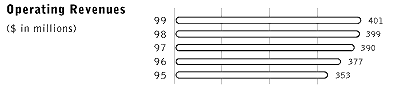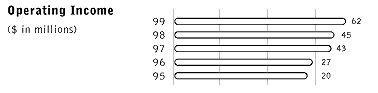



The Magazine Publishing division, which includes Newsweek, Inc., and Post-Newsweek Business Information, Inc., recorded operating income of $62.1 million in 1999, an increase of 39 percent over operating income of $44.5 million in 1998. Revenue totaled $401.1 million, slightly ahead of 1998 revenue of $399.5 million. Newsweek had a strong year in 1999, turning in record operating income for the third year in a row. The increase was driven by a solid gain in domestic advertising revenues, substantial growth in the pension credit, and careful cost controls. Overall expenses declined by 3 percent as a result of the increased pension credit and cost control measures. Newsweek continued to serve readers with forward-looking coverage of major news events, as well as in-depth coverage of family, religion, health, science, and technology. The fall saw two launches. e-Life, which is scheduled to appear twice a year, helps readers understand the increasingly complex digital environment. Teen Newsweek, which made its debut in September, is aimed at middle schools and produced in partnership with Weekly Reader. Domestic advertising revenue was fueled by strong gains in the computers, software, and telecommunications categories. In virtually all categories, the growth of the Internet contributed to increased pages of print advertising. The magazine's strong showing in recent syndicated research fueled ad sales growth. Newsweek's U.S. edition reached a total readership of more than 19 million, according to the latest MRI study. Newsweek's domestic paid circulation remained strong and profitable at nearly 3.2 million. Newsweek International's business picture remains a major challenge. Continuing economic turmoil in Asia and intense pan-regional competition for advertising dollars left the overseas editions short of their revenue goals. Bright spots included growth in the European market and a strong showing by the December special edition "Issues 2000," published both in the U.S. and overseas in cooperation with the World Economic Forum in Davos. Newsweek remains the only news magazine with weekly foreign-language editions - in Japanese, Korean, and Spanish. An Arabic-language edition will be launched in 2000. Itogi, Russia's first independent news magazine, is also published in cooperation with Newsweek. In December, Newsweek acquired Arthur Frommer's Budget Travel magazine. Launched in 1998, the bimonthly magazine became the top-selling travel title at newsstands after just one issue. Newsweek Productions expanded its health programming to include a 30-part "Health Scope" series on the Discovery Health Network and a new weekly "Health Point" series for The Health Network, in addition to continuing production of "HealthWeek" on PBS. Post-Newsweek Business Information (PNBI), publishers of controlled-circulation trade periodicals for the technology industry, had a difficult year as an industry-wide decline in advertising depressed results. However, Washington Technology, which serves the systems integration market, had a good year, and there were solid financial performances by FOSE, an annual trade show, and Newsbytes News Network, an international Internet news provider. PNBI incorporated its monthly technology magazine, TechCapital, into a new twice-monthly publication, Washington Techway, launched in January 2000 with a companion website, www.washtech.com. It focuses on the exploding non-government technology business market in the nation's capital.
|