he magic is working at Rohm and Haas. For the fourth consecutive year, the company reported double-digit growth in earnings per common share.
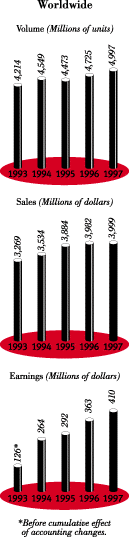
    Unit volume was up 6 percent for the second year in a row in 1997, a good indicator of ongoing demand for our products and technology.  
     The year-long strength of the U.S. dollar made it impossible to capture the impact of volume growth in the sales numbers. As a result, overall sales of $4 billion remained essentially flat with 1996 levels.


    The magic becomes apparent when one talks about net earnings and cash flow. Rohm and Haas reported earnings of $410 million, a 13 percent increase over the $363 million reported for 1996. The higher 19 percent increase in earnings per common share reflects the impact of an ongoing stock buyback program. Free cash flow for the year was $416 million, up more than 60 percent from 1996.
    No matter how easy it looks on stage, magic is hard work. Every feat is the culmination of hours of study and practice, a combination of bright ideas, chemistry and physics. It's no different at Rohm and Haas. We've been hard at work transforming this company since 1993.
    That year, the U.S. dollar strengthened against foreign currencies - much as it did in 1997. And volume growth in 1993 was exceptional &endash; up 12 percent from the previous year. Yet, although Rohm and Haas struggled mightily to overcome the effects of the stronger dollar, the company reported an earnings decline. We could not let that happen again!
    At the end of that year, every business and staff group made commitments to reduce costs and to find faster ways of inventing, making and delivering products.
    We shed lower margin products in favor of more profitable ones. We streamlined internal processes and accelerated our speed of response to changing market conditions and customer needs. We reconfigured the connections among research, manufacturing, marketing, sales and staff functions in new, innovative and more productive ways.
    The numbers for 1997 prove that we have kept our commitments and have fundamentally changed this company for the better. When the dollar again strengthened in 1997 we transformed solid volume increases into exceptional earnings growth because we've focused our product portfolio and lowered the overall cost structure for Rohm and Haas.
    We must pause here to acknowledge the stellar, ongoing achievements of the men and women who are employed by Rohm and Haas. Their work - along with our customers who challenge us to do better every day - are the originators of the "magic" behind this company.


After five years of dramatically declining injury rates, in 1997 the number of employee injuries increased to 1.8 cases for every 100 full-time employees, up from the 1.5 incident rate reported for 1996. While this injury rate is below the U.S. chemical industry average, we are not where we want to be - among the handful of the safest companies in the world. We have begun an effort to identify and change the underlying behaviors and cultural factors that may be impeding permanent progress toward our "no injuries" goal for everyone who works for Rohm and Haas.


Again in 1997, Rohm and Haas converted its unparalleled expertise in acrylic chemistry into products that quietly help improve the quality of life around the world.
    Polymers and Resins, our largest business, reported strong demand for products used in acrylic paints, adhesive tapes and labels, floor polishes and building materials, and for hollow-sphere pigments used in the production of quality papers and paints.
    Other segments of the acrylic port-folio - Monomers and Formulation Chemicals - reported double-digit volume increases. Growth was not as strong for Plastics Additives and AtoHaas, but productivity improvements in those businesses enabled them to transfer the benefits of whatever volume growth they did see directly to earnings.
    Ion Exchange Resins deserves special mention for an improving ability to deal with an extremely competitive market, and still managing to make substantial contributions to the company's cash flow. Profitability for this business improved throughout 1997.
    Because of their heavy concentration of sales in Europe and Asia, Agricultural Chemicals and Biocides were hurt most by unfavorable currency translations. In addition, sales of Ag's flagship product, Dithane fungicide, lagged in 1997, due primarily to drier weather conditions that diminished the need to control crop fungus.
    The fastest-growing business in Rohm and Haas today is Electronic Chemicals, led by Shipley Company. Since 1993, volume and sales have increased at an annual rate of about 10 percent, with earnings growth substantially higher.

The numbers for 1997 prove that

we have kept our commitments

and have fundamentally changed

this company for the better.


    Electronic Chemicals also has been the most active area for acquisitions. In 1997, Shipley acquired a 26 percent interest in Rodel, Inc., a supplier of chemical mechanical polishing slurries and pads, among other things. This technology complements Shipley's photoresist chemistry and gives semiconductor manufacturers an excellent source for the products they need to lay down complicated circuitry on silicon wafers. Shipley also expanded its printed wiring board business with the mid-year acquisition of Pratta. An alliance formed with LG Chemical early in 1998 will lead to the manufacture, sale and distribution of photoresist chemistry in Korea.
    The performance of affiliate companies was nothing short of outstanding - swinging from a net loss of $12 million in 1996 to a net gain of $11 million in 1997. AtoHaas Europe improved its performance for most of 1997, but was in a negative position at the end of the year. The newest contributor, Rodel, was mentioned earlier, but its immediate, positive contribution to Rohm and Haas earnings is noted here. RohMax, our former petroleum additives business which became part of a joint venture with Röhm in 1996, exceeded all expectations for 1997. They are applauded for their hard work and resulting success.
    In December 1997, we announced a decision to sell our interest in RohMax to Röhm, our partner in the lubricant additives joint venture. The following month, we announced our intention to sell our stake in AtoHaas, our acrylic sheet and resins joint venture, to Elf Atochem and acquire from them full control of the NorsoHaas venture for polyacrylate chemistry. While the departures of the Rohm and Haas employees associated with these ventures and the products they made are bittersweet, we believe the long-term future for these businesses will be brighter with firms that want to concentrate in these markets.
    On a regional basis, Latin America turned in an outstanding performance, with increases in sales, volume and earnings on top of a superb 1996. Demand remained strong throughout Europe, especially for Polymers and Resins products, which reported unit volume increases at double-digit rates. North America remained strong throughout the year.
    All eyes - including ours - turned to Asia-Pacific during the latter part of 1997. About one-fifth of that region's sales occur in countries that today have experienced serious economic difficulties. If these difficulties remain confined to those economies currently being affected, Rohm and Haas could see a 5 to 7 percent decrease in 1998 Asia-Pacific region sales. And while we have taken decisive financial action to protect and conserve our interests in the region, we also are on the outlook for acquisition or venture opportunities which might arise.


    There also have been changes in our Board of Directors. In 1997, Jorge Montoya of Procter & Gamble spent his first full year on the board. William Avery of Crown, Cork & Seal joined us in December 1997. In 1998, two long-time directors will reach retirement age and will not stand for re-election in May. George "Spike" Beitzel, who came to us from IBM, has given us wise counsel, both on the board and as a member of our Environmental Advisory Council for more than a decade. Paul Miller has earned the distinction of having the longest service of any outside board member - 29 years. Throughout his tenure, Paul has been an unabashed champion of the shareholder. We thank both men for sharing their wisdom and time with us.

    Fred Shaffer, Chief Financial Officer, retired in August after 37 years of service. It is said that, "If a man has any greatness in him, it comes to light - not in one flamboyant hour, but in the ledger of his daily work." Fred's contribution to Rohm and Haas was significant, and we thank him for it. We also welcome Brad Bell, our new Chief Financial Officer.


We remain committed to making the magic work at Rohm and Haas. And we are committed to making improvements at an ever faster pace.
    Rohm and Haas's strategy is to expand its ever-growing franchise in acrylic technology - a technology that, absent RohMax and AtoHaas, has generated an average of 15 percent compound earnings growth since 1993. We are intent upon expanding our role in electronic chemicals, and intend to advance our expertise in this area in the years to come. The cluster of technologies linked with biocides, ion exchange resins and agricultural chemicals will collectively continue to generate good earnings growth and cash flow.
    We will use the technologies we have invented and the efficiencies we have learned to leverage our already strong positions in world markets.
    Look for more magic from Rohm and Haas. We are still hard at work behind the scenes manipulating molecules into new products, and finding faster and more efficient ways to get these products into the hands of customers around the world.


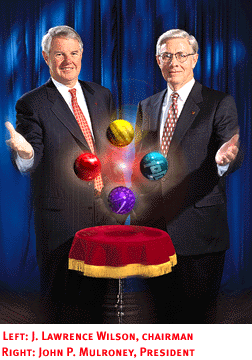
J Lawrence Wilson
Chairman


John P. Mulroney
President

March 27, 1998

We remain committed to

making the magic work at

Rohm and Haas. And we are

committed to making

improvements at an

ever faster pace.