Note 19: Stock Compensation Plans
In October 1995, the Financial Accounting Standards Board
issued Statement No. 123, "Accounting for Stock-Based
Compensation," which became effective in 1996. The statement
encourages the fair value based method which recognizes
compensation expense equal to the fair value of the
stock-based compensation at the date of the grant. As an
alternative, the statement allows companies to continue to
apply APB Opinion No. 25 and related Interpretations, which
for certain types of stock-based compensation, does not
result in a charge to earnings.
The company has elected to continue to apply the
provisions of APB Opinion No. 25. Accordingly, no
compensation expense has been recognized for the fixed stock
option plans. For restricted stock awards, compensation
expense equal to the fair value of the stock on the date of
the grant is recognized over the five-year vesting period.
Total compensation expense for restricted stock was $1
million in each of the years ended December 31, 1997, 1996
and 1995. Had compensation expense for the company's fixed
stock option plans been determined in accordance with SFAS
No. 123, the company's net earnings would have been reduced
to $407 million in 1997, $361 million in 1996 and $291
million in 1995. Basic earnings per common share would have
been reduced to $6.46, $5.41 and $4.20 in 1997, 1996 and
1995, respectively.
Non-Employee Directors'
Stock Plan of 1997
Additionally, directors receive dividend equivalents on
each share of deferred stock, payable in deferred stock,
equal to the dividend paid on a share of common stock. Fixed Stock Option
Plans The Black-Scholes option pricing model was used to
estimate the fair value for each grant made during the year.
The following are the weighted-average assumptions used for
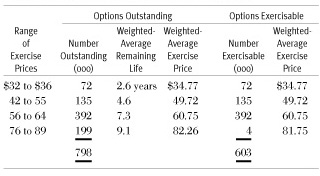
all shares granted in the years indicated: The following table summarizes information about stock
options outstanding and exercisable at December 31,
1997:
Restricted Stock Plan of
1992 for Non-Employee Directors
Non-employee directors were given an initial
grant of common stock equal to $25,000 when they were first
elected to the board and every fifth year thereafter. The
shares vest 20% for each year of service. The plan covers an
aggregate 50,000 shares of common stock. In 1996, 419 shares
with a total value of $24,983 were issued in connection with
the election of a new member to the board. Non-employee
directors could also elect to receive their board and
committee retainers in restricted stock. These shares are
immediately vested. In 1996, 1,413 shares at a
weighted-average grant-date fair value of $64.88 per share
were granted in payment of board and committee retainers. In
1997, no further shares were issued under this Plan and,
because of a change in directors' compensation, no further
awards are contemplated.
Non-employee directors compensation was changed
effective January 1, 1997. Under the 1997 Non-Employee
Directors Stock Plan, directors receive half of their annual
retainer in deferred stock. Each share of deferred stock
represents the right to receive one share of company common
stock upon leaving the board. Directors may also elect to
defer all or part of their cash compensation into deferred
stock. Annual compensation expense is recorded equal to the
number of deferred stock shares awarded multiplied by the
market value of the company's common stock on the date of
award.
The company has granted stock options to key
employees under its Stock Option Plans of 1984 and 1992.
Options granted pursuant to the plans are priced at the fair
market value of the common stock on the date of the grant.
Options vest after one year and most expire 10 years from
the date of grant. The Stock Option Plan of 1992, as amended
in 1994, limits the number of options that can be granted to
any one individual within a five-year period to 100,000
shares. Under this plan, the company may grant options for
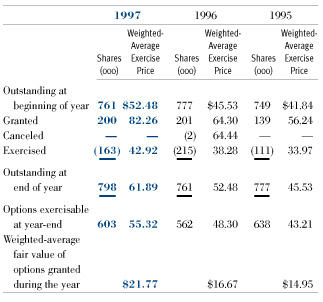
up to 2.5 million shares of common stock. The status of the
company's stock options is presented below:

Return to Financial Table of Contents