Chemical Specialties
High-Tech Crop Protection
Click to view
A farmer faces a series of trade-offs when selecting a pesticide. Harsh agricultural chemicals may control insects in his fields, but they often exact a steep price-in addition to increasing the farmer's production costs:
- Farmhands who apply the chemicals may face health risks.
- Local streams and ground water may be threatened with environmental degradation.
- Nearby crops may be damaged.
- Beneficial insects-the bees that assist in pollination and the predator insects that help control pests-may be harmed.
- Birds and other wildlife may be poisoned by chemicals designed to act on insects' nervous systems.
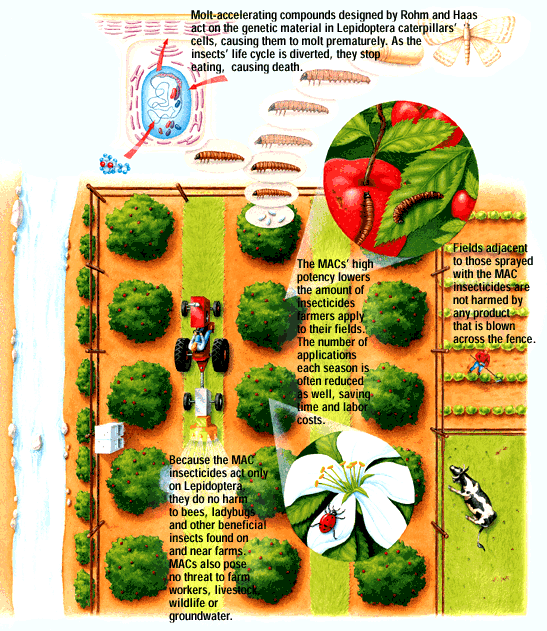
The U.S. Environmental Protection Agency has responded to these hazards by designating a new class of "reduced risk" pesticides. One of the first technologies to receive "reduced risk" status was Rohm and Haas's molt accelerating compounds (MACs), an innovative class of chemistry that allows farmers to avoid many of the problems associated with harsh chemical pesticides. In June 1998, the EPA awarded Rohm and Haas its Presidential Green Chemistry Challenge Award in recognition of the many environmental and other benefits the MACs offer farmers and their communities (see below).
Rohm and Haas's MAC insecticide products include Mimic™, Confirm®, Runner™ and Intrepid™. Each is based on a new class of chemistry the company has developed called diacylhydrazines, which target the Lepidoptera class of caterpillars-by far the most destructive pests in agriculture and forestry. When a MAC pesticide is sprayed on a farmer's field, it acts only on the caterpillars' cells. Within hours, the pesticide mimics a hormone in the insects called 20-hydrozyecdysone. This naturally occurring substance regulates the caterpillar's development-and, most importantly, triggers its molting process (see nearby illustration). The MAC pesticide prompts the caterpillars to molt prematurely and thus to stop feeding, causing death.
Following the MACs' introduction in 1994, Rohm and Haas has received approvals for its use in 44 countries, and for use on a long list of crops including citrus fruits, apples, pears, grapes strawberries and kiwifruit; beans, corn, cotton, rice, squash, onions, eggplants, tomatoes, walnuts and oil palm; as well as tea and a wide range of forestry, ornamental and turf applications. As more countries continue to approve more uses of these products-and as newer, more potent formulations reach the market-the MACs' contribution to Rohm and Haas's financial performance is expected to grow at double-digit rates.
Given the molt-accelerating compounds' many advantages over harsh agricultural chemicals, their prospects for greater use around the world are bright. Because the MACs target only the hormones of Lepidoptera, the pesticides pose no environmental risk to farmers' ground water and the rich ecosystems that it often supports. Likewise, birds and other wildlife are not harmed by contact with the MACs.
Another benefit of the MAC technology is its benign impact on those insects that assist in farmers' efforts. In apple orchards, for instance, ladybird beetles (often known as "ladybugs") and so-called predator aphids help to control another class of aphids that can do significant damage to a farmer's crop. While the MACs are highly effective in eliminating the threat of Lepidoptera, they pose no threat to the ladybugs, predator aphids and the many other beneficial insects that farmers depend upon. The MACs also do no harm to the bees that help to pollinate their crops.
As Rohm and Haas's MACs greatly lower the amount of harsh chemicals that farmers must use, they significantly reduce the health risks to the workers that apply pesticides in the fields. Also importantly, the MACs decrease the number of times workers must apply pesticides their fields each year, helping to reduce a farmer's production costs, and thus increase his profits. In all, Rohm and Haas's molt-accelerating compounds are very bad news for Lepidoptera, but great news for people and the environment.
A Recognized Leader in Environmental Stewardship
In June 1998, Rohm and Haas's molt-accelerating compound (MAC) technology received the annual Presidential Green Chemistry Award from the U.S. Environmental Protection Agency. Rohm and Haas is the only company to win this award twice since its inception in 1995. The company is also the first chemical manufacturer to receive the award for an agricultural product."Your receipt of this award identifies your company as one of the leaders of environmental innovation in this country," EPA Administrator Carol M. Browner told Rohm and Haas Chairman and CEO Larry Wilson. "You and your entire organization should take great pride in this achievement. Your commitment to developing chemical technologies that are scientifically and economically sound as well as less hazardous to human health and the environment is very deserving of this prestigious Presidential award."
The EPA initiated the Green Chemistry Award to recognize "fundamental breakthroughs in cleaner, cheaper, smarter chemistry." An independent panel of technical experts convened by the American Chemical Society judges each year's entrants according to criteria that measure their health and environmental benefits, scientific innovation and industrial applicability. In 1996, Rohm and Haas won its first Presidential Green Chemistry Award for the development of Sea-Nine®, an anti-foulant that allows formulators of marine paints to meet increasingly stringent world-wide environmental specifications.
Previous | Return to Annual Report Main page | Next