
Electronic Materials
Polishing to Perfection
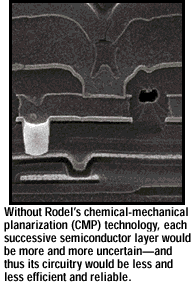
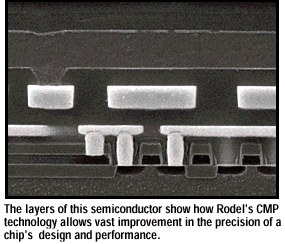
Rohm and Haas's photoresists are not the only technology required in manufacturing semiconductors. In order for the photolithographic process to create precise patterns in the photoresist, each layer must be applied to an extremely flat clean surface. Rodel, Inc., supplies the materials and expertise essential for chemical-mechanical polishing, the process that ensures each layer is built upon a firm foundation.
Before a silicon wafer receives the first layer of photoresist (see diagram below), Rodel's chemically engineered slurries and polishing pads remove imperfections at and below the silicon surface. The polishing slurry is a reactive liquid that contains ultrafine particles. The slurry and the polishing pads work together to chemically alter the silicon and mechanically remove atomic layers of the crystal structure until an extremely flat, flawless surface remains on the wafer.
After each layer of photoresist is applied, exposed and etched, insulating or conducting materials are deposited in the remaining patterns. These deposited materials must also be carefully polished to eliminate height variations across the surface so that the next layer of photoresist can be laid precisely on top. The most sophisticated chips may have many layers in the final design (see nearby photos). CMP is the only known technique for producing the high degree of flatness required for sub-0.35 micron electronic circuitry devices. The value that Rodel's products deliver is even greater in cutting-edge applications, which use circuits that have lines 0.18 micron wide.
Semiconductor manufacturers are only some of Rodel's customers. The company offers a comprehensive line of polishing pads, laps, sleeves, wheels, fixturing products and slurries for the surface finishing of metallurgical specimens, CRT screens, precision optical components, fiber-optic connectors, computer disk drives, television faceplates and liquid-crystal display panels. Its technology also enables the efficient, cost-effective production of hard, brittle materials such as ceramics, sapphire and other crystals.
In January 1999, Rohm and Haas increased its ownership in Rodel, Inc., to 48%. Rohm and Haas has long admired the technological innovations and entrepreneurial spirit of Rodel founders William D. Budinger and Donald V. Budinger, who have built Rodel into an important force in the semiconductor industry. "We've made no secret about our intention to grow our Electronic Materials business group," said Raj Gupta, vice chairman of Rohm and Haas and head of Electronic Materials. "Our increased position in Rodel is the logical next step in our plan to grow the business quickly and profitably. We want to be the technology and market leader for the electronic materials market."
Rohm and Haas first bought a 25% stake in Rodel in June 1997. Since that time, the relationship between the two companies has strengthened and deepened, allowing Rodel and Rohm and Haas's Shipley subsidiary to coordinate their efforts in a number of strategic areas, including technology research. The result is one of Rohm and Haas's most important platforms for profitable growth in Electronic Materials.
Previous | Return to Annual Report Main page | Next