Focus on Asia-Pacific Region
Opportunities in Adversity
Click to view
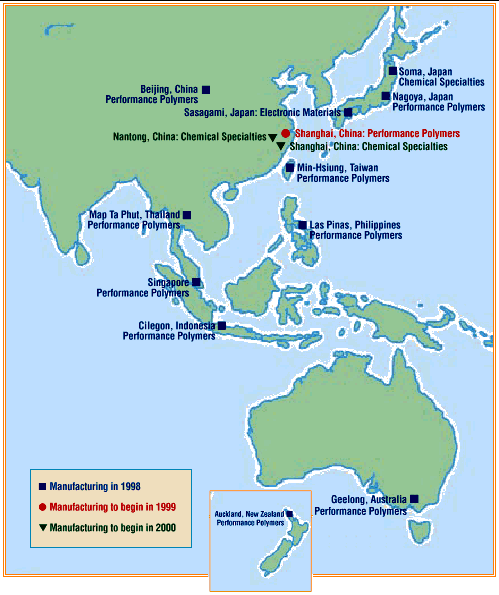
Asia's financial crisis continued during 1998, greatly restricting the region's economy. By one estimate, the chemical industry's shipments in the region have been reduced by more than 25%. However, Rohm and Haas continued to operate profitably in Asia, and its businesses took a number of steps to ensure that the region will remain a platform for significant future growth.
Macroeconomic growth in many Asian countries reversed in 1998, in some cases by considerable margins. Several countries' economies shrank by more than 4%, and Indonesia's shrank by more than 15%. In addition, many of the region's currencies continued to experience enormous volatility. The Japanese yen traded between 113.6 and 147.3 to the U.S. dollar, a range of 30%. The value of the Indonesian rupiah, meanwhile, ranged between 5,400 and 16,650 to the U.S. dollar-a range of more than 200%. Together, the economic and financial uncertainty made it extremely difficult for companies of all kinds to plan their future operations. Many businesses in the region failed.
For Rohm and Haas, the most significant impact was on the Specialty Polymers, Electronic Materials and Ion Exchange Resins businesses. Asian overcapacity among producers of paper and adhesives weakened demand for Rohm and Haas's specialty products used in these markets around the world. Electronic Materials, meanwhile, suffered the continued softness in Asia's electronics industry for much of the year. Ion Exchange Resins felt the impact most heavily in Japan, the largest Asian market for its water treatment products.
Despite the difficult economic environment, in 1998 Rohm and Haas maintained or expanded its market share in most businesses and countries throughout Asia. These successes came largely as the result of the company's region-wide effort to strengthen its long-term relationships with strategic customers. In many cases, Rohm and Haas provided important customer service and technical support to customers facing economic difficulties. The company also strengthened its supply chain management in Asia, often extending Rohm and Haas systems to include customers' inventory controls. Many Rohm and Haas production facilities in the region also implemented cycle-time improvements that will yield significant results when the region's economies recover.
Largely driven by this strong emphasis on operational excellence, Rohm and Haas expects to deliver improved results in the region during 1999. And when Asia's economies return to robust performance, Rohm and Haas expects to be in a very favorable position to deliver profitable growth across the region.
Previous | Return to Annual Report Main page | Next