
Management Discussion and Analysis
Liquidity, Capital Resources and Other Financial Data
Click here to view the charts for this pageCash Flow Cash provided by operations for 1998 was $682 million compared to $791 in 1997. The resulting free cash flow of $328 million in 1998 and $416 million in 1997 was used to reduce debt, invest in joint ventures and to fund the company's stock repurchase program. Free cash flow is cash provided by operating activities less fixed asset spending and dividends.
Financing Total borrowings at year-end 1998 were $581 million, down $25 million from the prior year. At the end of 1998, the debt-to-equity ratio, calculated without the reduction to stockholders' equity for the ESOP transaction, was 34%, compared with 31% at the end of 1997 and 38% at the end of 1996. In 1998 the company retired $130 million of high interest long-term debt through a tender offer. These debt retirements resulted in an after-tax extraordinary loss of $13 million, or $.07 per share.
Environmental There is a risk of environmental damage in chemical manufacturing operations. The company's environmental policies and practices are designed to ensure compliance with existing laws and regulations and to minimize the possibility of significant environmental damage. These laws and regulations require the company to make significant expenditures for remediation, capital improvements and the operation of environmental protection equipment. Future developments and even more stringent environmental regulations may require the company to make additional unforeseen environmental expenditures. The company's major competitors are confronted by substantially similar environmental risks and regulations.
The company is a party in various government enforcement and private actions associated with former waste disposal sites, many of which are on the U.S. Environmental Protection Agency's (EPA) Superfund priority list. The company is also involved in corrective actions at some of its manufacturing facilities. The company considers a broad range of information when determining the amount of its remediation accruals, including available facts about the waste site, existing and proposed remediation technology and the range of costs of applying those technologies, prior experience, government proposals for this or similar sites, the liability of other parties, the ability of other principally responsible parties to pay costs apportioned to them and current laws and regulations. These accruals are updated quarterly as additional technical and legal information becomes available. Major sites for which reserves have been provided are the non-company-owned Lipari, Woodland and Kramer sites in New Jersey, and Whitmoyer in Pennsylvania and company-owned sites in Bristol and Philadelphia, Pennsylvania, and in Houston, Texas. In addition, the company has provided for future costs at approximately 80 other sites where it has been identified as potentially responsible for cleanup costs and, in some cases, damages for alleged personal injury or property damage.
The amount charged to earnings before tax for environmental remediation, net of insurance recoveries, was $9 million in 1998. In 1997, remediation related settlements with insurance carriers, a $20 million charge resulting from an unfavorable arbitration decision relating to the Woodlands sites, and other waste remediation expenses resulted in a net gain of $13 million. The 1996 charge, net of insurance recoveries, was $27 million.
The reserves for remediation were $131 million and $147 million at December 31, 1998 and 1997, respectively, and are recorded as "other liabilities" (current and long-term). The company is in the midst of lawsuits over insurance coverage for environmental liabilities. It is the company's practice to reflect environmental insurance recoveries in results of operations for the quarter in which the litigation is resolved through settlement or other appropriate legal process. Resolutions typically resolve coverage for both past and future environmental spending. Insurance recoveries receivable, included in accounts receivable, net, were $2 million at December 31, 1998 and $19 million at December 31, 1997. The company settled with several of its insurance carriers in January 1999 for approximately $17 million. These settlements will be recognized in income in 1999.
In addition to accrued environmental liabilities, the company has reasonably possible loss contingencies related to environmental matters of approximately $65 million at December 31, 1998 and 1997. Further, the company has identified other sites, including its larger manufacturing facilities in the United States, where additional future environmental remediation may be required, but these loss contingencies are not reasonably estimable at this time. These matters involve significant unresolved issues, including the number of parties found liable at each site and their ability to pay, the outcome of negotiations with regulatory authorities, the alternative methods of remediation and the range of costs associated with those alternatives. The company believes that these matters, when ultimately resolved, which may be over an extended period of time, will not have a material adverse effect on the consolidated financial position or consolidated cash flows of the company, but could have a material adverse effect on consolidated results of operations in any given year because of the company's obligation to record the full projected cost of a project when such costs are probable and reasonably estimable.
Capital spending for new environmental protection equipment was $17 million in 1998. Spending for 1999 and 2000 is expected to be approximately $22 million and $15 million, respectively. Capital expenditures in this category include projects whose primary purposes are pollution control and safety, as well as environmental aspects of projects in other categories on page 33 that are intended primarily to improve operations or increase plant efficiency. The company expects future capital spending for environmental protection equipment to be consistent with prior-year spending patterns. Capital spending does not include the cost of environmental remediation of waste disposal sites.
Cash expenditures for waste disposal site remediation were $26 million in 1998, $37 million in 1997 and $58 million in 1996. The expenditures for remediation are charged against accrued remediation reserves. The cost of operating and maintaining environmental facilities was $94 million, $95 million and $104 million in 1998, 1997 and 1996, respectively, and was charged against current-year earnings.
Dividends Total common stock dividends paid in 1998 were $.70 per share, compared to $.63 per share in 1997 and $.57 per share in 1996. The company's common stock dividend payout is targeted at approximately 35% of trend-line earnings. Common stock dividends have been paid each year since 1927. The common stock dividend payout has increased annually every year since 1977. Total preferred dividends paid were $2.75 per share in 1998, 1997 and 1996.
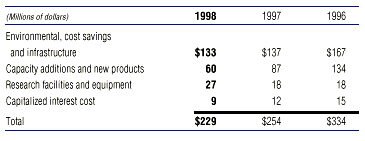
Additions to Land, Buildings and Equipment Fixed asset additions in 1998 were $229 million, down $25 million from the prior year's spending of $254 million. The decrease reflects the absence of significant projects in process during 1997, such as the completion of capacity expansion in Texas. Improved asset utilization also contributed to the lower spending. Nineteen ninety-eight spending focused on emulsions capacity in Europe, ion exchange resin and emulsions capacity in Asia-Pacific and further investment in the Electronic Materials businesses. The company has budgeted capital expenditures in 1999 of approximately $225 million. Spending for environmental protection equipment, which is included in several of the categories in the table shown below, was $17 million in 1998, $18 million in 1997 and $32 million in 1996. Expenditures for the past three years, categorized by primary purpose of project, were:
Acquisitions and Divestitures On January 31, 1999, the company and Morton approved a merger agreement under which the company will acquire Morton in a cash and stock transaction valued at $4.9 billion, including the assumption of $268 million of debt. The transaction creates a global specialty chemical company with combined annual revenues of $6.5 billion and will provide the company with international leadership positions in adhesives, specialty coatings, electronic materials and salt. On February 5, 1999 the company commenced a cash tender offer to purchase up to 80,916,766 shares of Morton common stock for $37.125 per share, representing 67% of the outstanding Morton shares on January 31, 1999. The tender offer is subject to certain conditions including, among other things, the tender of at least a majority of the outstanding shares of Morton on a fully diluted basis, the expiration or termination of the applicable waiting period under the Hart-Scott-Rodino Act, and the receipt of European Union approval. The offer is scheduled to expire on Friday, March 5, 1999, unless extended. The tender offer is not conditioned upon obtaining financing. Following the successful completion of the tender offer, the company intends to acquire the remaining Morton shares in a second-step merger. In this step, subject to shareholder approval, each share of Morton will be exchanged for between 1.0887 and 1.3306 of company shares based on the company's stock price for a period of twenty days prior to closing, or, if fewer than 80,916,766 shares are purchased in the tender, for a combination of cash and company stock.
On January 23, 1999 the company acquired all of the outstanding shares of LeaRonal for approximately $460 million. LeaRonal develops and manufactures specialty chemical processes used in the manufacture of printed circuit boards, semiconductor packaging and electronic connector plating, and also provides processes for metal-finishing applications. LeaRonal reported $242 million in sales and $21 million in net income for its fiscal year ended February 28, 1998.
The LeaRonal and Morton acquisitions will be financed through a combination of commercial paper, bank loans and long-term debt and will be accounted for using the purchase method. Their results are not included in the company's 1998 results.
The company sold its interest in the AtoHaas and RohMax businesses in June 1998 for cash proceeds of $287 million, resulting in a net after-tax gain of $76 million, or $.41 per share. Subsequent to the sale of the AtoHaas joint venture, the buyer asserted a claim against the company in late 1998 related to the value of certain joint venture assets. Because the investigation and assessment of this claim is not expected to be completed until the latter part of the first quarter of 1999, the potential amount of the claim and its impact on results of operations and financial position, if any, cannot be reasonably estimated at this time.
During 1998 and 1997, the company purchased a 33% interest in Rodel and in early 1999 purchased an additional 15% interest. The total cost for these investments was approximately $149 million. Rodel is a privately held, Delaware-based leader in precision polishing technology serving the semiconductor, memory disk and glass polishing industries. The investment is accounted for on the equity method with the company's share of earnings reported as equity in affiliates. Also in 1998, the company acquired the remaining 50% interest in NorsoHaas, which was an affiliate in 1997.
Stock Repurchases For the three years ended December 31, 1998, the company repurchased more than 38 million shares, or approximately 19% of common shares outstanding, at a cost of approximately $1 billion. During 1998, the company repurchased 17,459,435 shares of its common stock at a total cost of $567 million. Most of the shares were obtained in August 1998 through an accelerated stock repurchase program with a third party. Under the terms of this purchase, the final cost to the company will reflect the average share price paid by the third party in the market over an extended trading period. Through December 31, 1998, the company had repurchased two-thirds of the 12 million shares of common stock authorized under the current buyback program and received board approval in October 1998 for another buyback program of an additional 9 million shares. The company does not intend to buy back a significant number of shares in the near future. The company purchased 7,653,453 shares in 1997 at a cost of $216 million. There were 167,587,287 and 182,626,947 common shares outstanding at December 31, 1998 and 1997, respectively.
Stock Split and Retirements In 1998, the board of directors declared a three-for-one split of the company's common stock. The stock split was effected in the form of a 200% common stock dividend. The par value of the common stock remained unchanged at $2.50 per share. Also in 1998, the company retired 39 million treasury shares. As a result of these transactions, the company reclassified $296 million from retained earnings to common stock. This amount represents the total par value of new shares issued, net of retirements of treasury shares. Amounts per share, numbers of common shares and capital accounts have been restated to give retroactive effect to the stock split.
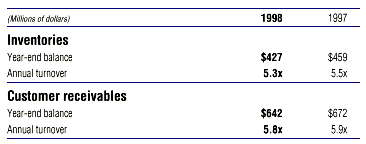
Working Capital (the excess of current assets over current liabilities) was $412 million at year-end 1998, down from $547 million in 1997. Accounts receivable from customers decreased $30 million, while inventory decreased $32 million and notes payable increased $75 million. Days sales outstanding were 63 days, up from 61 days at the end of 1997. Days cost of sales in ending inventory was 69 days, up from 66 days at the end of 1997. Details about two major components of working capital at the end of 1998 and 1997 follow:
Land, Building and Equipment, Net Investments in land, buildings and equipment, net is summarized below:

Annual turnover figures are calculated by dividing annual sales (for customer receivables and land, buildings and equipment, net) or cost of goods sold (for inventories) by the year-end balance. Days sales outstanding was calculated by dividing ending customer receivables by daily sales, and days cost of sales in ending inventory was calculated by dividing ending inventory by daily cost of sales.
Asset Turnover equals sales divided by year-end total assets. Asset turnover has shown steady improvement, increasing from a low of .87 times in 1992 to 1.0 in 1998 and 1997.
Return on Net Assets (RONA) equals net earnings plus after-tax interest expense, divided by year-end total assets. RONA was 12.7% in 1998, 11.2% in 1997 and 9.9% in 1996. The 1998 amount rounds to 11.4% when calculated without the effects of the year's non-recurring items. The 1997 amount rounds to 10.8% when calculated without fourth quarter 1997 environmental insurance recoveries.
Return on Common Stockholders' Equity (ROE) is obtained by dividing net earnings less preferred stock dividends by average year-end common stockholders' equity. Average year-end common stockholders' equity is calculated without the reduction for the ESOP transaction. ROE was 25% in 1998, 23% in 1997 and 20% in 1996.
Euro Beginning in 1999 eleven of the fifteen member countries of the European Union adopted the euro as their common currency after establishing fixed conversion rates from their existing currencies. The company formed a multifunctional steering team to evaluate the potential effect of the euro in key impact areas such as information technology, treasury, supply chain and accounting. The company's view is that the relevant systems and processes related to these functions are generally capable of accommodating a conversion to the euro; therefore, the company does not expect that the conversion will have a material effect on its financial position or results of operations.
Year 2000 During 1996 management initiated an enterprise-wide program to prepare the company's computer systems and applications for the year 2000, and, in 1997, began assessing supply chain and customer implications. All of the company's centralized computer systems have been inventoried and assessed to determine their year 2000 readiness. Remediation of all systems was originally scheduled for completion by year end 1998. Remediation of most computer applications supporting manufacturing is complete while remediation of sales and marketing, order processing and financial systems is expected to be completed by the end of April 1999. The company is closely tracking the remediation of systems that are not yet complete and will devote resources, as necessary, to bring them back on schedule. Testing of all remediated systems is expected to be completed by June 1999 as originally planned. Assessment and most remediation of key process control and other plant floor systems at each facility is complete. Some remaining remediation is scheduled for early 1999. In addition to these internal systems and processes, the company has placed a high priority on assessing the status of its critical suppliers and business partners, such as warehouses, toll manufacturers, distributors and transportation services.
The company expects all of its internal remediation and testing to be completed by June 1999; however, despite its best efforts, business may be interrupted with potentially material impact on its financial position or results of operations if any of the following occur: external supply of raw materials or utilities is delayed or unavailable for an extended period; manufacturing systems fail; or, central corporate computer systems fail. To limit the effects of these potential failures, the company has completed corporate contingency planning guidelines and will prepare contingency plans for potential disruptions of critical systems or processes. Examples of contingency plans include a "freezing" of modifications to computer systems, ensuring availability of additional information technology personnel during the critical time period, backing-up systems at off-site facilities, making alternate raw material supply arrangements, and preparing for temporary shut-downs of certain plants and facilities. In addition, the company has standard operating procedures in place for a safe and orderly shut-down of systems and facilities should this be necessary.
A significant proportion of the costs associated with the year 2000 effort represent the redeployment of existing information technology resources. In addition, consulting and other expenses related to software application and facilities enhancements necessary to prepare the systems for the year 2000 will be incurred. Approximately half of these costs, which are expected to total $17 million, have been incurred and charged to expense through December 31, 1998.
This discussion contains forward-looking statements based, in part, on assumptions such as the following: that the manufacturers of the company's computer systems and software have correctly represented the year 2000 status of their products; that the company's suppliers and customers will meet their stated year 2000 and euro compliance obligations; and that the company's own investigation, remediation, testing and systems implementations are successful. The year 2000 and euro discussions and other forward-looking statements made in this report are based on current expectations and are subject to the risks and uncertainties discussed here as well as those detailed in the "Cautionary Statements" section of the 1998 Form 10-K, Item 7 "Management's Discussion and Analysis of Financial Condition and Results of Operations." Actual results in the future may differ from those projected.
Recent Accounting Standards In 1996, the American Institute of Certified Public Accountants (AICPA) issued Statement of Position 96-1 (SOP 96-1), "Environmental Remediation Liabilities," which became effective in 1997. The statement provides authoritative guidance regarding the recognition, measurement, display and disclosure of environmental remediation liabilities. The company's adoption of this accounting guidance in 1997 did not have a material impact on the company's financial position or results of operations.
In 1997, the company adopted Statement of Financial Accounting Standards No. 128 (SFAS No. 128), "Earnings Per Share," which requires computation and presentation of basic and dilutive earnings per share. Basic earnings per share (EPS) is computed by dividing net income available for common shareholders by the weighted average number of common shares outstanding for the period. Diluted EPS reflects the potential dilution that could occur if securities or other contracts to issue common stock were exercised or converted. For the years presented, the company's basic earnings per share are equal to earnings per share reported under the previous accounting standards. Dilutive earnings per share is slightly lower than basic earnings per share, primarily due to the impact of convertible preferred stock.
In June 1997, the Financial Accounting Standards Board (FASB) issued SFAS No. 130, "Reporting Comprehensive Income," which establishes standards for reporting and display of comprehensive income and its components in a financial statement that is displayed with the same prominence as other financial statements. Comprehensive income includes all changes in equity during a period from all transactions other than those with shareholders, including net income, foreign currency related items and unrealized gain/loss on certain securities. The disclosures prescribed by this standard were adopted in 1998 and are presented in the Statement of Consolidated Stockholders' Equity.
Also in 1997, the FASB issued SFAS No. 131, "Disclosures about Segments of an Enterprise and Related Information" and, in 1998, SFAS No. 132, "Employers' Disclosures about Pensions and Other Postretirement Benefits." Both standards establish guidance for disclosure in annual financial statements. The company's business segment reporting under SFAS No. 131 are consistent with the changes in its financial reporting structure incorporated in the company's reporting since the first quarter of 1998. As required, the company adopted the disclosures prescribed by both statements in its 1998 year-end reporting.
In 1998, the FASB issued SFAS No. 133, "Accounting for Derivative Instruments and Hedging Activities," which establishes a new model for the accounting and reporting of derivative and hedging transactions. The statement amends a number of existing standards and is effective for fiscal years beginning after June 15, 1999. The company expects to adopt this standard as required in fiscal year 2000 and, because of continual business-driven changes to its derivatives and hedging programs, has not fully assessed its potential impact on its financial position or results of operations.
Also in 1998, the AICPA issued SOP 98-1, "Accounting for Internally Developed Software," with required adoption for most companies beginning in 1999. This SOP provides guidelines for the capitalization of certain internal software development costs. The company adopted this standard in 1998, which resulted in an increase in 1998 before-tax earnings of approximately $5 million.
Previous | Return to Annual Report Main page | Next