Management Discussion and Analysis
Results of Operations
Results of Operations
1998, 1997 and 1996In 1998, the board of directors declared a three-for-one split of the company's common stock. Amounts per share, numbers of common shares and capital accounts have been restated to give retroactive effect to the stock split.
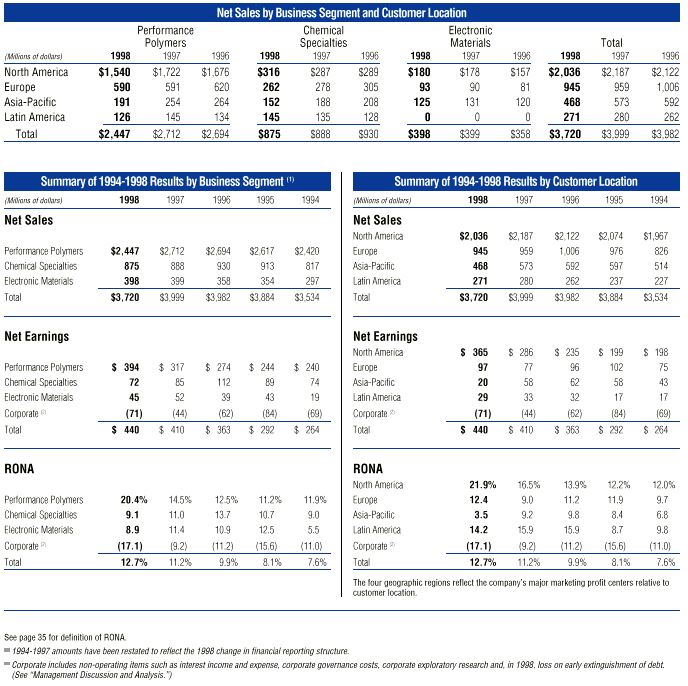
Earnings for 1998 were $440 million, an increase of 7% over last year's earnings of $410 million. Diluted earnings per common share were $2.45 compared to $2.13 in 1997. Sales decreased 7% on a 1% volume increase. The company sold its interest in the AtoHaas joint venture in 1998, affecting the sales and volume comparison. In addition to the exclusion of AtoHaas' sales from 1998, the remaining 50% of NorsoHaas was acquired and operations in China were consolidated during the year. The unconsolidated RohMax joint venture was also sold in 1998 but did not affect the sales and volume comparisons. On a comparable-business basis, sales decreased 3% while volume was flat. The sales decrease on flat volume is largely a result of weaker currencies, primarily in Asia-Pacific, and lower selling prices. Volume increased in Europe and in Latin America while economic weakness hurt volume in the Asia-Pacific region. Volume in North America was flat. On a comparable basis, Asia-Pacific region sales declined 19% and volume decreased 12%. The company's earnings for the year were flat, excluding non-recurring items. Diluted earnings per common share excluding non-recurring items were $2.20 in 1998, up 7% versus 1997. The increase in reported earnings per share reflects the impact of the company's stock repurchase program and earnings from non-recurring items discussed below.
Earnings in 1997 were $410 million, 13% higher than the $363 million reported in 1996. Diluted earnings per common share were $2.13, up 19% from $1.79 the previous year. Despite 6% volume growth, sales of $3,999 million were essentially unchanged from 1996 due to weaker currencies in Europe and Asia-Pacific and the absence of Petroleum Chemicals sales, which were part of the unconsolidated RohMax joint venture during 1997. All business segments helped the volume increase, except Chemical Specialties, in part due to lower volume in Agricultural Chemicals. All regions also contributed, with the European and Latin American regions maintaining strong volume momentum throughout the year. In addition to volume growth within consolidated operations, earnings in affiliates benefited from strong volume in RohMax and Rodel, as well as reduced losses in AtoHaas Europe.
Included in 1998 results are a one-time net after-tax gain of $45 million, or $.25 per share. This net gain affected all segments and regions except Latin America, and was the net result of the sale of the company's interest in the AtoHaas and RohMax joint ventures, an early extinguishment of debt, the write-off of certain intangible assets in Europe and business realignment costs primarily in Asia. Earnings in 1997 include a gain of $16 million after tax, or $.09 per common share, the net result of remediation settlements with insurance carriers during the fourth quarter. Included in 1996 earnings was an after-tax gain of $.02 per common share for the sale of land and retroactive tax credits, net of asset writedowns and restructuring charges. The repurchase of 17.5 million, 7.7 million and 13.2 million common shares during 1998, 1997 and 1996, respectively, contributed incrementally $.13 per share to 1998, $.12 to 1997 and $.06 to 1996.
These and other factors affecting earnings are discussed below. They are summarized on a per-share basis on page 30.
Summary by Business Segment
(Refer to table )The company's operations are organized by worldwide business groups. A description of each business segment's operations is included in Item 1 "Business" of the 1998 Form 10-K.
Change in Financial Reporting Structure In 1998, the company changed its financial reporting structure and the related management structure to better reflect its technical strengths and focus on key markets. Rohm and Haas now reports by three business segments: Performance Polymers, consisting of Polymers and Resins (which includes Coatings, Specialty Polymers and Building Products), Monomers, Formulation Chemicals and Plastics Additives businesses; Chemical Specialties, consisting of the Agricultural Chemicals, Ion Exchange, Biocides and Primenes businesses; and Electronic Materials, consisting of Shipley and Rodel, Inc. (Rodel), a privately held affiliate and leader in precision polishing technology serving the semiconductor, memory disk and glass polishing industries. The 1997 and 1996 presentation and analysis of sales and earnings has been restated to reflect these changes. In the restatement, 1997 and 1996 results of AtoHaas and RohMax are reported under Performance Polymers.
Recent Developments On January 23, 1999, the company acquired all of the outstanding shares of LeaRonal, Inc. (LeaRonal), a maker of specialty chemicals for the electronics industry. The company added this business to its Electronic Materials segment in 1999. On January 31, 1999, the company and Morton International, Inc. (Morton) approved a merger agreement under which the company will acquire Morton in a cash and stock transaction valued at $4.9 billion, including the assumption of $268 million of debt. The transaction adds international leadership positions in adhesives, specialty coatings, electronic materials and salt. LeaRonal and Morton are not included in the company's 1998 results. [See below discussion of "Acquisitions and Divestitures" for more information on these transactions.]
Performance Polymers 1998 earnings, excluding non-recurring items, were $320 million, up 1% from 1997. Sales were down 10% to $2,447 million from $2,712 million in 1997, largely as a result of the absence of 1997 AtoHaas sales of $305 million. Volume was flat and sales decreased 4% on a comparable-business basis. The decrease in sales on flat volume was primarily a result of unfavorable currencies in Europe and Asia-Pacific and lower selling prices. Performance Polymers sales in the Asia-Pacific region were down more than 26% from the prior year while volume decreased 11%. Earnings increased slightly, excluding non-recurring items, largely as a result of lower raw material prices and higher volume in North America and Europe.
Performance Polymers reported 1997 earnings of $317 million, up 16% from 1996. Excluding the effect of the former Petroleum Chemicals business, which was part of the unconsolidated RohMax joint venture in 1997, sales were up 3% on an 8% volume increase. Volume growth was evident in all regions and reflected strong performances in the paper, adhesives and coatings markets. Monomers and Formulation Chemicals also showed volume increases. Volume largely drove the segment's earnings increase. The positive effects, however, were held back by lower selling prices and weaker currencies, the dollar value of which declined an average of 9% in Europe and 10% in Japan during the year. Earnings in the Plastics business also contributed as a result of improvement in AtoHaas Europe, where modest earnings were reported compared with significant losses in 1996. Though Plastics' volume increased 4%, sales decreased 2%, reflecting decreased selling prices and weaker currencies in Europe. Continuing pricing pressure in most plastics sectors also dampened Plastics' earnings recovery. In 1997 AtoHaas Europe was hurt by a $4 million after-tax write-off of start-up expenses for a plant in Italy.
Chemical Specialties earnings in 1998 were $87 million, excluding non-recurring items, up 2% from $85 million in 1997. Sales of $875 million decreased 1% from 1997 sales of $888 million, in part due to weaker currencies in Europe and Asia-Pacific and to lower selling prices. Volume was flat for the segment despite strong mid-year demand in the Agricultural Chemicals business, which was partially offset by decreased comparative results for the Ion Exchange Resins business, particularly in Asia and Eastern Europe. The earnings increase was driven by strength in the Agricultural Chemicals and Biocides businesses particularly in North America. Asia volume-driven earnings decreases in the Ion Exchange Resins business offset most of these increases.
Chemical Specialties reported 1997 earnings of $85 million, down 24% from 1996 earnings of $112 million. Sales decreased 5% on a 2% volume decrease. The earnings decrease was primarily due to 1997 results in the Agricultural Chemicals business, where earnings were 33% lower than in 1996. Sales and volume in this business decreased 2% from 1996, primarily because of weather-related lower Dithane fungicide shipments in all regions except Latin America. Sales of other Agricultural Chemical product lines showed growth. It was this lower sales and volume and weaker currencies in Europe and Japan that largely drove the earnings decrease for the Chemical Specialties segment. Volume growth and operating improvements in the Ion Exchange Resins business helped improve earnings but the comparison to 1996 was hurt by the absence of a $6 million after-tax gain from the sale of land in Japan in that year. Another factor affecting the comparison to the prior year was the discontinuation of the Biocides joint venture with Dead Sea Bromine in 1997, which decreased both net sales and earnings.
Electronic Materials earnings of $46 million in 1998, excluding non-recurring items, decreased $6 million, or 12%, from the 1997 period. Sales and volume were essentially flat. Shipley Company volume increased in all regions, except Asia-Pacific, which offset the other regions. The effects of solid growth in North America and the 1998 contribution of Rodel, a 33%-owned affiliate acquired in 1997, were mitigated by lower sales and earnings in Asia-Pacific.
Nineteen ninety-seven earnings of $52 million in Electronic Materials increased 33% compared with $39 million in 1996. This earnings increase largely was a result of volume in Shipley Company. The company's share of earnings from Rodel, Inc., a 1997 investment, also contributed. Sales increased 11% to $399 million from $358 million reported in the 1996 period. Volume growth and earnings were strong in Asia-Pacific and North America, driven largely by positive results in the microelectronics and printed wiring board businesses. Demand was strong for both Shipley and Rodel products throughout 1997.
Corporate expenses totaled $71 million in 1998, compared with $44 million in 1997 and $62 million in 1996. After-tax charges of $13 million related to extraordinary losses on the early extinguishment of debt were included in 1998 results while 1997 reflects an after-tax gain of $16 million, the result of remediation settlements with insurance carriers during the fourth quarter. Interest expense of $34 million in 1998 was down 13% from 1997 interest expense because of 1998 debt retirements. The 1997 interest expense was flat compared to 1996.
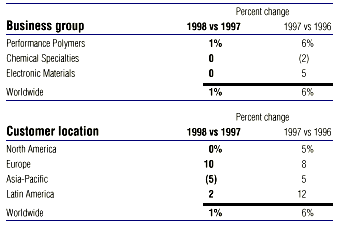
Physical Volume of shipments increased by 1% in 1998 and 6% in 1997:
Previous | Return to Annual Report Main page | Next