|
|
 |
|
|
|
|

The groundbreaking “If You Let Me Play” ads were more than a decade
away (“I will have more self-confidence…I will learn to be strong”),
but Nike’s commitment to women showed through 2 world-class runners. As a
12-year-old, Mary Decker Slaney ran a 440, 880, mile, 2-mile and a marathon in
one week. In ‘82, she set indoor world records in the 2000 and 3000 and outdoor
marks in the 5000, mile and 10,000. What Mary was to middle distance, Joan Benoit
was to distance: her ‘83 Boston Marathon record was her second; that same
year, she set U.S. records in the 10km, the half-marathon, the 10-mile and 25km.
We knew we could be a running company—and, inspired by athletes brimming
with self-confidence and strength, we knew we could be a women’s company,
too.

It started in ‘83 as something called the Cities Campaign: murals and billboards
featuring Nike-endorsed athletes sprang up throughout L.A. By ‘84, the campaign
spread to 8 other U.S. cities—and the sun was ready to shine on Nike and
the home team during the Los Angeles Games. U.S. athletes carted off more medals
than ever, led by Carl Lewis’ 4 Golds and Joan Benoit’s triumph in the
first women’s Olympic marathon. Both wore the Swoosh, as did another 56 athletes
from around the world who took home 65 medals. “We Love L.A.” emanated
from the TV, as Nike’s ad became the soundtrack for what seemed an endless
summer—and in our evolving legacy, that’s what it was destined to be.

At 7 a.m. December 30, 1986, Julie Papen buckled herself in to drive to work at
Nike. Around 7:20, she stopped at a deli, then got into her car for the minute-and-a-half
trip to work. 60 seconds later, she got broadsided, hit the windshield and ended
up in the passenger seat with a broken neck. She still can’t believe she
didn’t put her seatbelt on. For the next 6 months, Julie was either in traction,
wearing a halo or entertaining visitors from work. When she left the hospital
in April, a group of Nike employees pooled some money and bought her a speakerphone—an
expensive item in those days. When she came back to work, she still couldn’t
drive and was only able to put in 3 or 4 hours a day—not the kind of progress
she’d been hoping for. So she found a rehab center in California she thought
could give her the help she needed. A catch: she’d have to live there for
6 to 9 months, and she didn’t want to leave Nike. She wrote a letter asking
for a leave of absence to Phil Knight. Phil told Julie to go. Julie says, “I
was on my way.” Julie Papen is an incomplete quadriplegic—she has some
movement in her legs, not much in her hands. For what it’s worth, she’s
also a two-time triathlete. And that’s since 1986.

In a conversation with Nike employees, an advertising executive says: “You
Nike guys, you just do it.” That’s the whole story.

People still remember when they first saw the Air Huarache. They didn’t know
if it was sandal, shoe, or something in between. Its logo—an intersection
of lines forming a hovering H—reinforced its sense of not being of this footwear
world. Still, its roots were historical: named after, and inspired by, the braided
leather Mexican sandal, it was an evolutionary moment grounded in reality, yet
pointing toward a future of ever lighter-weight footwear—from running, to
training, to Presto.

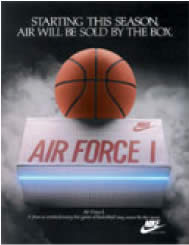
Its profile inspired by a hiking boot, its distinctive eyestay grabbed from running,
the Air Force 1 was Nike’s elite basketball shoe in 1983. It was first highlighted
in ads that claimed, “…air will be sold by the box” and the more
technical “the Proprioceptus Belt exerts slight pressure to the base of the
tibia and fibula…” A few years later, Proprioceptus Belt-conscious skateboarders
and breakdancers gave it new life off the hardwood—and it’s still seen
on NBA courts today.

In the late ‘70s, Frank Rudy has an idea for athletic footwear. It’s
air. Other companies get a taste of it, but we bite. Air-Sole units underfoot
seem crazy, but also seem to work. By ‘79, Nike-Air cushioning — urethane
bags filled with pressurized gas that compress under impact, then spring back
to cushion the next blow—debuts in the Tailwind shoe. In the ‘80s, the
idea set us apart: in ‘82, we introduced it in basketball and tennis; by
‘87, Nike-Air—now visible— has firmly established the 15-year-old
brand as the industry’s technological leader.

In 1984, a prominent Oregon sports organization could’ve invited Michael
Jordan into its fold. The Blazers declined. Fortunately, in ‘85, we saw something
they didn’t, and signed a rookie who was about to enter international iconography
in a succession of black and red shoes. Just as Jordan changed the game , Nike
designers knew that basketball shoes could reach new heights. The result: a shoe
so hot it was banned from the league (sales inevitably soared). Playing in them
in spite of the ban, Michael earned a trip to the All-Star Game, collected Rookie
of the Year honors, and…we’re gonna guess you probably know the rest.

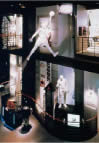
In 1990, the World Campus opens in Beaverton. It’s a futuristic blend
of college campus and European village—a place where work, play and 2,500
employees can come together in the name of sport. European Headquarters will open
9 years later, globalizing the building phenomenon. In downtown Portland, the
first Nike Town store opens, and 2 years later, Nike Town Chicago’s 60,000
square feet become the Windy City’s #1 tourist attraction. More than a place
to get your gear, Nike Town stores were—and are—places to get inspired.
Nike World Campus, European Headquarters and Nike Town stores: more than buildings—they’re
concrete examples of Nike’s blueprint
for the future. |
|
|
|
|