|
|
 |
|
|
|
|

After more than 4 years of research, testing and design, we introduce the Swift
Skin suit for athletes competing at the Salt Lake Games as the answer to the question:
“How can we help speedskaters go faster?” After testing materials for
wind resistance, elasticity, warmth and breathability, we placed selected fabrics
on certain body locations to work with the skater’s motion, maximizing performance
against air friction and other physiological and environmental factors. The Swift
Skin suit’s seams correspond with air-flow direction or are placed out of
the way to reduce drag. Low-friction panels under each arm and on the right inner
thigh reduce body friction and further improve overall movement and human efficiency.
Simply stated, the Swift Skin suit was designed to help athletes discover how
fast they could truly go—and the results were golden. And silver… And
bronze…

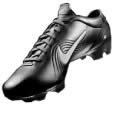
The kings reign again. Brazil wins the Cup for a record 5th time, and Ronaldo
scores 2 in the final—bringing his 2002 tournament total to 8, the most by
one player in a generation—in a pair of shiny chrome Mercurial Vapor boots
that he’d only seen days before. It is a triumph for a country—and a
company, the result of cultivating a presence in the world’s greatest footballing
nation that culminated when Phil Knight looked down on the pitch and noticed that
all those Brazilians were “wearing Nike.” The Mercurial Vapor itself:
a minimalist statement of craft and innovation. The kings of football: pure magic.

Global companies get caught up in global events. When 1999’s Kosovo refugee
crisis became the world’s dominant news story, it reached us. A handful of
Nike employees knew that we had thousands of B-grade shoes— the last thing
they wanted to see was an opportunity go to waste. So began a saga that would
include Logistics, Sales, Finance, Distribution—and in the end, 40,000 pairs
of Nike shoes and 1,000 jackets were off to a place where footwear and apparel
had life-and-death meanings that few of us can truly understand.

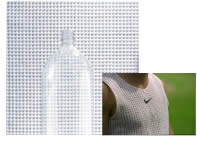
The DRI-FIT Stand-off Distance Singlet looked strange, but it was designed to
cool runners in Sydney— and it worked. Even better: it was 75% recycled.
1.5 plastic bottles per singlet; formed with water jets, ultrasonic welding, and
a lot of ingenuity; by leaving it in its natural white, we even eliminated the
dyeing process. Still, it was one of the greenest things we’d ever done.
As for performance, it was a whole new way of running the recycling down to the
curb.

On April 20, 2001, Dr. Donald Schneekloth, of Neenah, Wisconsin, wrote Nike a
letter. He had an 11-year-old patient with a condition called Bannayan’s
Syndrome that caused her to have “excessively large feet while the rest of
the body is essentially normal.” She wore a men’s 14 and her foot was
too wide to fit on a Brannock Device. “Shoes that have your label… would
boost her morale and allow her to have one less problem in dealing with this untreatable
disease,” the doctor wrote. The letter and plaster casts of the patient’s
feet found designer Mike Aveni and senior researcher Jeff Pisciotta, who threw
themselves at the job. Mike sent questionnaires asking for as much information
as he could get. And he got to work. In February 2002, a box arrived at Dr. Schneekloth’s
of€ce. In addition to the shoes Mike had designed, it contained an invoice: “We’ve
calculated the time, resources and expenses incurred and have determined a final
price…,” which Mike fixed at “one huge smile.” To us, it’s
a story of another happy athlete, and another reminder that our work matters.

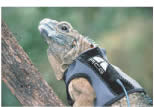
In 1999, a zoo in Kansas needed to attach a tracking beacon to some iguanas they
were breeding to release into the wild. The catch was that the apparatus couldn’t
restrict movement or alter behavior. So they called Nike. After some research
and design, the iguana vest was born. When Nike’s ACG designers were called
to design a vest that would accommodate a monitor, they had no idea the description
would apply to both the device and the wearer. True, there’s no real market
for lizard vests; but it never hurts for a designer to get a change of perspective.

They were saying that the pressure would overwhelm a man fresh off of finals at
Stanford, that the glare would be too much for a kid who had played with Bob Hope
when he was 2, that the Amateurs and the NCAAs were different… Really—they
were saying these things. But this one we just knew. And now? There’s now
a “Tiger Slam.” A Tiger Slam. We think he’s handling the pressure
just fine.

In 1996, Brandi Chastain, a lifetime forward, rejoined the national team after
a 3-year lay-off. Because of injuries, she wasn’t the player she used to
be: she wasn’t a forward anymore. So she became a defender, and played every
minute as the team won Gold in Atlanta. As ‘99 approached, Brandi was a major
part of the equation, and when it came down to a single moment in Pasadena, there
was Brandi, alone in front of the goal, one penalty kick away from the championship
of the world.

Ten years ago, Nike had no Equipment Division. In ‘95, it was composed of
2 people. Now, it’s a $781 million business. Ray Riley, who was there, recalls
the early days: “You’re taking big chances because you don’t know
not to. That’s how cool stuff happens…it’s the good part of design,
when you’re solving problems. Whether you do great design or not, that’s
up to you—you’ve still gotta make the stuff look great.” Gotta
make this stuff look great? “Hey…there’s also form follows emotion.”
And there’s also gratifying returns follow wise investment. There’s
also that. |
|
|
|
|